
Homework Answers
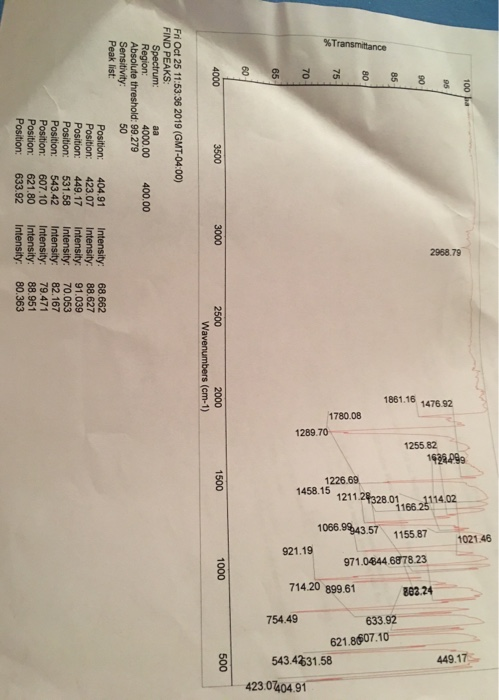
In IR spectrum the values of wave numbers are given. As each and every functional group posses unique ranges of IR range. Just proceed through different functional group and its characteristic stretching frequency values. We are able to identify the groups and compound.
Add Answer to:
for this experiemt, in the ir spectrum result how do you identify the peaks and which compunds are present here? T...
for this experiment i got a yield of 0.93g how do you and what is the...
 for this experiment i got a yield of 0.93g
how do you and what is the theoretical and percentage
yield?
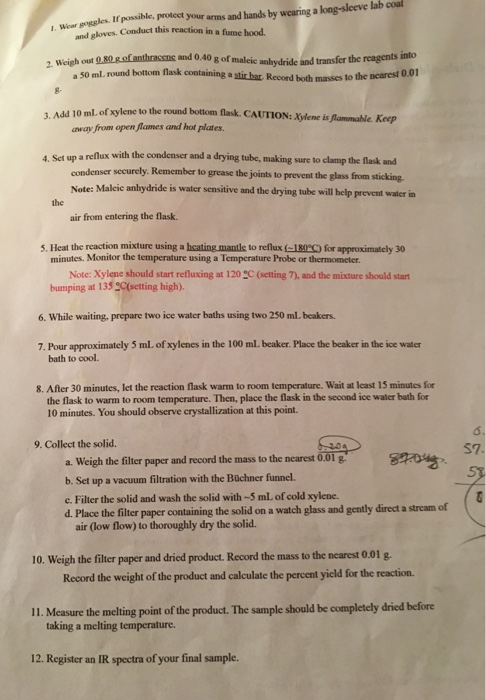
The Diels-Alder Reaction of Anthracene with Maleic Ankudride The Disco Alder reaction is a member of a class of reactions called cycladditions. The reacties wolves three x bonds, two from the diene and one from the dicnophile in a concerted reaction to Come six-memberedning Smce the reaction involves four electroes in the dienendo slectrons from the dicasphile, it is sometimes...
for this experiment i got a yield of 0.93g
how do you and what is the theoretical and percentage
yield?
The Diels-Alder Reaction of Anthracene with Maleic Ankudride The Disco Alder reaction is a member of a class of reactions called cycladditions. The reacties wolves three x bonds, two from the diene and one from the dicnophile in a concerted reaction to Come six-memberedning Smce the reaction involves four electroes in the dienendo slectrons from the dicasphile, it is sometimes...
Diels-alder reaction lab Reaction: anthracene+ maleic anhydride <---> 9,10-Dihydroanthracene-9,10-α,β-succinic acid anhydride How would raising the temperature...
Diels-alder reaction lab Reaction: anthracene+ maleic anhydride <---> 9,10-Dihydroanthracene-9,10-α,β-succinic acid anhydride How would raising the temperature of the experiment affect product isolation? Would more or less product be expected, and why?
What is the objective of this experiment? The reaction solvent for this experiment is xylene. What...
 What is the objective of this experiment?
The reaction solvent for this experiment is xylene. What
property of this solvent makes it a better choice than toluene or
benzene?
Draw the orbitals involved in the 4+2 electrocyclization for
this reaction. Draw the structures of the reactants as best you
can. It may be appropriate to abbreviate the structure of
anthracene.
IR is not provided for this reaction product. Why is IR not
useful for monitoring the reaction or characterizing the...
What is the objective of this experiment?
The reaction solvent for this experiment is xylene. What
property of this solvent makes it a better choice than toluene or
benzene?
Draw the orbitals involved in the 4+2 electrocyclization for
this reaction. Draw the structures of the reactants as best you
can. It may be appropriate to abbreviate the structure of
anthracene.
IR is not provided for this reaction product. Why is IR not
useful for monitoring the reaction or characterizing the...
EXPERIMENT 2A DIELS-ALDER REACTION OF ANTHRACENE REFERENCES Pavia et al (4/e): Tech. 6.1/6.2, 7.2-7.4 Klein (1/e)...
 EXPERIMENT 2A DIELS-ALDER REACTION OF ANTHRACENE REFERENCES Pavia et al (4/e): Tech. 6.1/6.2, 7.2-7.4 Klein (1/e) pp. 784-792 EQUATION heat Diels-Alder Adduct 9,30-dihydroanthracene-9,10- endo-o B-seccinic anhydride mp 262264 PROCEDURE Place 0.200 grams of anthracene and an equal molar amount of maleic anhydride in 5 mL of xylenes in a 10-mL round-bottom flask with a magnetic stir bar. Attach a water-cooled condenser and reflux for 60 minutes. Allow the solution to cool to room temperature and then place the flask in...
In this Diels-Alder reaction, what is the limiting reagent for this reaction? Please show work In...
 In this Diels-Alder reaction, what is the limiting reagent for
this reaction? Please show work
In this experiment, a Diels-Alder reaction will be performed to generate 4-cyclohexene- 1,2-dicarboxylic anhydride. The reaction occurs when 1,3-butadiene is combined with maleic anhydride and heated as shown below. Once the product has been isolated, the IR spectrum, melting point, and experimental yield can be determined. 5.- I111NI O Due to the inherent difficulties with the handling of gaseous 1,3-butadiene, it will be generated in...
In this Diels-Alder reaction, what is the limiting reagent for
this reaction? Please show work
In this experiment, a Diels-Alder reaction will be performed to generate 4-cyclohexene- 1,2-dicarboxylic anhydride. The reaction occurs when 1,3-butadiene is combined with maleic anhydride and heated as shown below. Once the product has been isolated, the IR spectrum, melting point, and experimental yield can be determined. 5.- I111NI O Due to the inherent difficulties with the handling of gaseous 1,3-butadiene, it will be generated in...
I need help calculating theoretical yield for my Diels-Alder lab experiment. This reaction was between 1,3-butadiene...
 I need help calculating theoretical yield for my
Diels-Alder lab experiment. This reaction was between 1,3-butadiene
and maleic anhydride, forming cis 1,2,3,6-tetrahydrophthalic
anhydride. In this experiment 1.0g of maleic anhydride was combined
with 1.8g 3-sulfolene and 2 mL dry xylene and refluxed for 30 mins.
6 mL of xylene was added to dissolve solids and then decanted, then
warm pet. ether was added to form crystalline product after
cooling. some of this info may be irrelevant in what is needed...
I need help calculating theoretical yield for my
Diels-Alder lab experiment. This reaction was between 1,3-butadiene
and maleic anhydride, forming cis 1,2,3,6-tetrahydrophthalic
anhydride. In this experiment 1.0g of maleic anhydride was combined
with 1.8g 3-sulfolene and 2 mL dry xylene and refluxed for 30 mins.
6 mL of xylene was added to dissolve solids and then decanted, then
warm pet. ether was added to form crystalline product after
cooling. some of this info may be irrelevant in what is needed...
Consider a Chemical reaction between Sulfolene and Maleic Anhydride in Xylene: (2 pts) Identify the diene...
Consider a Chemical reaction between Sulfolene and Maleic Anhydride in Xylene: (2 pts) Identify the diene and dienophile in the above reaction (1 pt) Using IR spectral studies, how do you identify if the desired Diel’s alder adduct is formed in the above reaction? (2 pts) Calculate the percentage yield, if 1g of product is formed when 2.0 g of 3-sulfolene, 1.2 g of finely powdered maleic anhydride, and 1.0 mL of xylenes are used in the above reaction. (1...
Draw product from IR on the spectrum and identify two IR absorptions that let you know...
 Draw product from IR on the spectrum and identify two IR
absorptions that let you know you have formed your product. Make
sure to indicate functional groups that is creating the
absorbtion.This IR is the result of a product from a Diels Alder
Reaction between Anthracene and Maleic Anhydride.
100 UFJEM 9A 24 92 90 1862.10cm 1. 89.59*T 88 86- 1499.03-1.85.51%T 84 82 1211.5-1.84.17 227.3cm 1. 83.31 BO 78 1761.10m, 80.27MT 76 74 72 70 4000 3500 3000 2500 2000...
Draw product from IR on the spectrum and identify two IR
absorptions that let you know you have formed your product. Make
sure to indicate functional groups that is creating the
absorbtion.This IR is the result of a product from a Diels Alder
Reaction between Anthracene and Maleic Anhydride.
100 UFJEM 9A 24 92 90 1862.10cm 1. 89.59*T 88 86- 1499.03-1.85.51%T 84 82 1211.5-1.84.17 227.3cm 1. 83.31 BO 78 1761.10m, 80.27MT 76 74 72 70 4000 3500 3000 2500 2000...
1.) What side reactions occur during the following steps. 2.) How can the IR spectrum be...
 1.)
What side reactions occur during the following steps.
2.) How can the IR spectrum be used to show that there is not
starting material left and the products are ketones?
3.) Describe the major differences and similarities between
the IR spectra of benzoin and benzil. Compare your IR spectrum with
those of benzoin and benzil.
Copper-Catalyzed Oxidation of Benzoin 1. Add a stir bar and 1.5 mL of glacial acetic acid, 0.250 g of NH4NO3 and 0.500 g of...
1.)
What side reactions occur during the following steps.
2.) How can the IR spectrum be used to show that there is not
starting material left and the products are ketones?
3.) Describe the major differences and similarities between
the IR spectra of benzoin and benzil. Compare your IR spectrum with
those of benzoin and benzil.
Copper-Catalyzed Oxidation of Benzoin 1. Add a stir bar and 1.5 mL of glacial acetic acid, 0.250 g of NH4NO3 and 0.500 g of...
i did the synthesis of aspirin experiment and got the data below. how do you do...
 i did the synthesis of aspirin experiment and got the data
below. how do you do the theoretical yield? percent yield of the
pure aspirin?
DATA: Mass of Salicylic Acid: 2.034g Volume of Acetic Anhydride used in synthesis: 4.00ml Mass of filter paper: 0.196g Mass of filter paper plus Aspirin: 1.868g Mass of Aspirin: 1.672g Percent Yield of Pure Aspirin: I Experimental Procedure HAZARD: Sulfuric acid, acetic anhydride and glacial acetic acid are corrosive to the skin. They are also...
i did the synthesis of aspirin experiment and got the data
below. how do you do the theoretical yield? percent yield of the
pure aspirin?
DATA: Mass of Salicylic Acid: 2.034g Volume of Acetic Anhydride used in synthesis: 4.00ml Mass of filter paper: 0.196g Mass of filter paper plus Aspirin: 1.868g Mass of Aspirin: 1.672g Percent Yield of Pure Aspirin: I Experimental Procedure HAZARD: Sulfuric acid, acetic anhydride and glacial acetic acid are corrosive to the skin. They are also...
 for this experiment i got a yield of 0.93g
how do you and what is the theoretical and percentage
yield?
The Diels-Alder Reaction of Anthracene with Maleic Ankudride The Disco Alder reaction is a member of a class of reactions called cycladditions. The reacties wolves three x bonds, two from the diene and one from the dicnophile in a concerted reaction to Come six-memberedning Smce the reaction involves four electroes in the dienendo slectrons from the dicasphile, it is sometimes...
for this experiment i got a yield of 0.93g
how do you and what is the theoretical and percentage
yield?
The Diels-Alder Reaction of Anthracene with Maleic Ankudride The Disco Alder reaction is a member of a class of reactions called cycladditions. The reacties wolves three x bonds, two from the diene and one from the dicnophile in a concerted reaction to Come six-memberedning Smce the reaction involves four electroes in the dienendo slectrons from the dicasphile, it is sometimes...
 What is the objective of this experiment?
The reaction solvent for this experiment is xylene. What
property of this solvent makes it a better choice than toluene or
benzene?
Draw the orbitals involved in the 4+2 electrocyclization for
this reaction. Draw the structures of the reactants as best you
can. It may be appropriate to abbreviate the structure of
anthracene.
IR is not provided for this reaction product. Why is IR not
useful for monitoring the reaction or characterizing the...
What is the objective of this experiment?
The reaction solvent for this experiment is xylene. What
property of this solvent makes it a better choice than toluene or
benzene?
Draw the orbitals involved in the 4+2 electrocyclization for
this reaction. Draw the structures of the reactants as best you
can. It may be appropriate to abbreviate the structure of
anthracene.
IR is not provided for this reaction product. Why is IR not
useful for monitoring the reaction or characterizing the...
 EXPERIMENT 2A DIELS-ALDER REACTION OF ANTHRACENE REFERENCES Pavia et al (4/e): Tech. 6.1/6.2, 7.2-7.4 Klein (1/e) pp. 784-792 EQUATION heat Diels-Alder Adduct 9,30-dihydroanthracene-9,10- endo-o B-seccinic anhydride mp 262264 PROCEDURE Place 0.200 grams of anthracene and an equal molar amount of maleic anhydride in 5 mL of xylenes in a 10-mL round-bottom flask with a magnetic stir bar. Attach a water-cooled condenser and reflux for 60 minutes. Allow the solution to cool to room temperature and then place the flask in...
 In this Diels-Alder reaction, what is the limiting reagent for
this reaction? Please show work
In this experiment, a Diels-Alder reaction will be performed to generate 4-cyclohexene- 1,2-dicarboxylic anhydride. The reaction occurs when 1,3-butadiene is combined with maleic anhydride and heated as shown below. Once the product has been isolated, the IR spectrum, melting point, and experimental yield can be determined. 5.- I111NI O Due to the inherent difficulties with the handling of gaseous 1,3-butadiene, it will be generated in...
In this Diels-Alder reaction, what is the limiting reagent for
this reaction? Please show work
In this experiment, a Diels-Alder reaction will be performed to generate 4-cyclohexene- 1,2-dicarboxylic anhydride. The reaction occurs when 1,3-butadiene is combined with maleic anhydride and heated as shown below. Once the product has been isolated, the IR spectrum, melting point, and experimental yield can be determined. 5.- I111NI O Due to the inherent difficulties with the handling of gaseous 1,3-butadiene, it will be generated in...
 I need help calculating theoretical yield for my
Diels-Alder lab experiment. This reaction was between 1,3-butadiene
and maleic anhydride, forming cis 1,2,3,6-tetrahydrophthalic
anhydride. In this experiment 1.0g of maleic anhydride was combined
with 1.8g 3-sulfolene and 2 mL dry xylene and refluxed for 30 mins.
6 mL of xylene was added to dissolve solids and then decanted, then
warm pet. ether was added to form crystalline product after
cooling. some of this info may be irrelevant in what is needed...
I need help calculating theoretical yield for my
Diels-Alder lab experiment. This reaction was between 1,3-butadiene
and maleic anhydride, forming cis 1,2,3,6-tetrahydrophthalic
anhydride. In this experiment 1.0g of maleic anhydride was combined
with 1.8g 3-sulfolene and 2 mL dry xylene and refluxed for 30 mins.
6 mL of xylene was added to dissolve solids and then decanted, then
warm pet. ether was added to form crystalline product after
cooling. some of this info may be irrelevant in what is needed...
 Draw product from IR on the spectrum and identify two IR
absorptions that let you know you have formed your product. Make
sure to indicate functional groups that is creating the
absorbtion.This IR is the result of a product from a Diels Alder
Reaction between Anthracene and Maleic Anhydride.
100 UFJEM 9A 24 92 90 1862.10cm 1. 89.59*T 88 86- 1499.03-1.85.51%T 84 82 1211.5-1.84.17 227.3cm 1. 83.31 BO 78 1761.10m, 80.27MT 76 74 72 70 4000 3500 3000 2500 2000...
Draw product from IR on the spectrum and identify two IR
absorptions that let you know you have formed your product. Make
sure to indicate functional groups that is creating the
absorbtion.This IR is the result of a product from a Diels Alder
Reaction between Anthracene and Maleic Anhydride.
100 UFJEM 9A 24 92 90 1862.10cm 1. 89.59*T 88 86- 1499.03-1.85.51%T 84 82 1211.5-1.84.17 227.3cm 1. 83.31 BO 78 1761.10m, 80.27MT 76 74 72 70 4000 3500 3000 2500 2000...
 1.)
What side reactions occur during the following steps.
2.) How can the IR spectrum be used to show that there is not
starting material left and the products are ketones?
3.) Describe the major differences and similarities between
the IR spectra of benzoin and benzil. Compare your IR spectrum with
those of benzoin and benzil.
Copper-Catalyzed Oxidation of Benzoin 1. Add a stir bar and 1.5 mL of glacial acetic acid, 0.250 g of NH4NO3 and 0.500 g of...
1.)
What side reactions occur during the following steps.
2.) How can the IR spectrum be used to show that there is not
starting material left and the products are ketones?
3.) Describe the major differences and similarities between
the IR spectra of benzoin and benzil. Compare your IR spectrum with
those of benzoin and benzil.
Copper-Catalyzed Oxidation of Benzoin 1. Add a stir bar and 1.5 mL of glacial acetic acid, 0.250 g of NH4NO3 and 0.500 g of...
 i did the synthesis of aspirin experiment and got the data
below. how do you do the theoretical yield? percent yield of the
pure aspirin?
DATA: Mass of Salicylic Acid: 2.034g Volume of Acetic Anhydride used in synthesis: 4.00ml Mass of filter paper: 0.196g Mass of filter paper plus Aspirin: 1.868g Mass of Aspirin: 1.672g Percent Yield of Pure Aspirin: I Experimental Procedure HAZARD: Sulfuric acid, acetic anhydride and glacial acetic acid are corrosive to the skin. They are also...
i did the synthesis of aspirin experiment and got the data
below. how do you do the theoretical yield? percent yield of the
pure aspirin?
DATA: Mass of Salicylic Acid: 2.034g Volume of Acetic Anhydride used in synthesis: 4.00ml Mass of filter paper: 0.196g Mass of filter paper plus Aspirin: 1.868g Mass of Aspirin: 1.672g Percent Yield of Pure Aspirin: I Experimental Procedure HAZARD: Sulfuric acid, acetic anhydride and glacial acetic acid are corrosive to the skin. They are also...
Most questions answered within 3 hours.
-
Where is the error in this code sequence?
String s1 = "Hello";
String s2 = "ello";...
asked 10 months ago -
Financial data for Joel de Paris, Inc., for last year
follow:
Joel de Paris, Inc.
Balance...
asked 10 months ago -
Consider this reaction:
Al2(SO4)3 (aq)+ BaCl3
(aq) Al2Cl6 (aq)- +
3BaSO4(s) . What is the...
asked 10 months ago -
Suppose that Savneet is considering increasing her
recent random sample from 20 car rentals to 40...
asked 10 months ago -
Trucks arrive at an unloading terminal at an average rate of 120
per hour.
Trucks arrive...
asked 10 months ago -
Why are methanol and ethanol completely soluble in water while
octanol is not very little soluble....
asked 10 months ago -
A facilities manager at a university reads in a research report
that the mean amount of...
asked 10 months ago -
When the CuSO4 is rehydrated by adding water to the anhydrous
compound, is this an endothermic...
asked 10 months ago -
A ray of sunlight is passing from diamond into crown glass; the
angle of incidence is...
asked 10 months ago -
A block of mass 0.249 kg is placed on top of a light, vertical
spring of...
asked 10 months ago -
how do the kidneys compensate in the presences of acidosis
a) trigger hyperventilate
b) reserve acid...
asked 10 months ago -
Question 501 pts
The rental rate of capital to the firm increases. Which of the
following...
asked 10 months ago