Colligative properties, determination of the freezing point of a nonelectrolyte, unknown solution. 1. What is the freezi...
Colligative properties, determination of the freezing point of a nonelectrolyte, unknown solution.
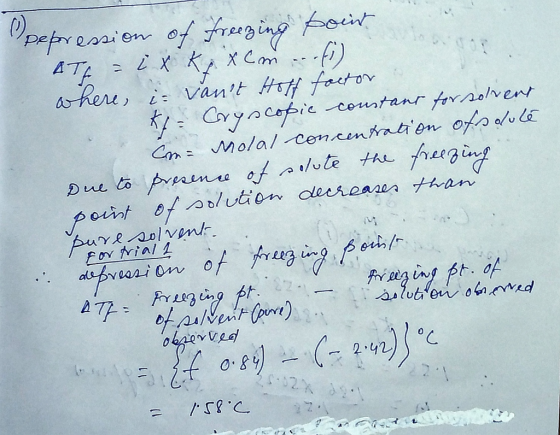
1. What is the freezing point depression for the
unknown, nonelectrolyte solution?
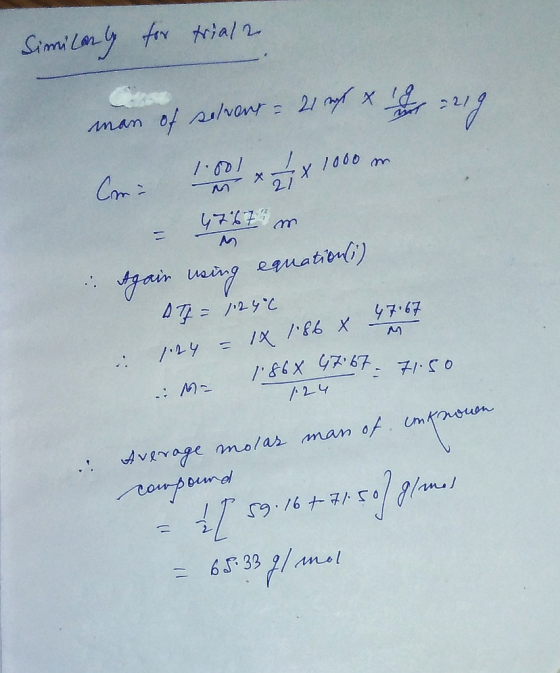
2. How do you determine the molar mass of the unknown,
nonelectrolyte compound for each trial, and what is the average
molar mass for the unknown compound?
Please help me figure this out? We performed experiment with the
solution in a tube suspended in a bath of ice water and mixed
solution/observed for freezing. Here is the data I collected,
please tell me if something is missing?
Trial 1:
20mL water, 1.005g unknown
solution initial temp: 10.18 degrees C. observed freezing point of
solution: -2.42 degrees C.
Observed freezing point of water: -0.84 degrees C.
Trial 2:
21 mL water, 1.001g unknown
solution initial temp: 17.73 degrees C. observed freezing point of
solution: -2.09 degrees C
Observed freezing point of water: -0.85 degrees C
Homework Answers

Add Answer to:
Colligative properties, determination of the freezing point of a nonelectrolyte, unknown solution. 1. What is the freezi...
1. What is the freezing point depression for the unknown solution for each trial? 2. How...
1. What is the freezing point depression for the unknown solution for each trial? 2. How do you determine the van't Hoff factor for each trial, and what is the average van't Hoff factor? Trial 1: 18mL of 0.200 m unknown, ionic compound solution initial temp: 17.90 degrees C. observed freezing point of solution: -1.55 degrees C. Observed freezing point of water: -0.84 degrees C. Trial 2: 20 mL of 0.200 m unknown, ionic compound solution initial temp: 17.66 degrees...
Colligative Properties 1a When a solution is made from 25.9 g of an unknown nonelectrolyte dissolved...
Colligative Properties 1a When a solution is made from 25.9 g of an unknown nonelectrolyte dissolved in 167.6 g of solvent, the solution boils at 63.24 °C. The boiling point of the pure solvent and its Kb are 59.02 °C and 2.09 °C/m, respectively. Calculate the molar mass of the unknown electrolyte in g/mol. Report your answer to TWO places past the decimal 1b When a solution is made from 39.5 g of an unknown nonelectrolyte dissolved in 109.1-2.47 °C....
An aqueous solution containing 16.5 g of an unknown molecular (nonelectrolyte) compound in 105.5 g of...
An aqueous solution containing 16.5 g of an unknown molecular (nonelectrolyte) compound in 105.5 g of water was found to have a freezing point of -1.5 ∘C. Calculate the molar mass of the unknown compound.
An aqueous solution containing 17.3 g of an unknown molecular (nonelectrolyte) compound in 102.0 g of...
An aqueous solution containing 17.3 g of an unknown molecular (nonelectrolyte) compound in 102.0 g of water was found to have a freezing point of -1.6 ?C. Part A Calculate the molar mass of the unknown compound.
Course Contents> ... Experiment 6 -- Colligative Properties -- Freezing Point De Due in 3 hours,...
 Course Contents> ... Experiment 6 -- Colligative Properties -- Freezing Point De Due in 3 hours, 1 minute 5 homework point(s) Molar Mass of a Solute The freezing point of cyclohexane is 6.50°C. For cyclohexane solvent K=20.0. 0.144 g of an unknown solute is dissolved in 7.88 g of cyclohexane (C6H12). The freezing point of the solution was 3.36°C. Calculate the corresponding molar mass of the solute. 117.89 g/mol 1homework pts Submit Answer Incorrect. Tries 3/5 Previous Tries To the...
An aqueous solution containing 16.2 g of an unknown molecular (nonelectrolyte) compound in 109.5 g of...
An aqueous solution containing 16.2 g of an unknown molecular (nonelectrolyte) compound in 109.5 g of water was found to have a freezing point of -1.8 ∘C. Calculate the molar mass of the unknown compound. Please show all work.
Post-Lab Material Experiment 19 Data and Calculations: Molar Mass Determination by Depression of the Freezing Point...
 Post-Lab Material Experiment 19 Data and Calculations: Molar Mass Determination by Depression of the Freezing Point 0.3 Name Section A. Measured Freezing Point of Pure Water B. Finding the Freezing Point of a Solution of Liquid Unknown Target mass of solute (Calculated based on the parameters in the instructions) Unknown # Liquid 3.5 Actual mass of solute used Trial Freezing point of solution (observed) -3.0 Mass of solution 116.6 Trial II Freezing point of solution -3.3 Mass of solution 101.3....
An aqueous solution containing 15.0 g of an unknown molecular (nonelectrolyte) compound in 100.5 g of...
An aqueous solution containing 15.0 g of an unknown molecular (nonelectrolyte) compound in 100.5 g of water has a freezing point of -1.9 ∘C. Calculate the molar mass of the unknown compound. I am stumped because I am not given Kf??
Eicosene is a molecular compound and nonelectrolyte with the empirical formula CH2. The freezing point of...
Eicosene is a molecular compound and nonelectrolyte with the empirical formula CH2. The freezing point of a solution prepared by dissolving 100mg of eicosene in 1.00g Benzene was 1.75 degrees C lower than the freezing point of pure benzene. What is the molar mass of eicosene if Kf for benzene is 4.90 Degrees C/m?
Pre-Laboratory Questions 1. The freezing point of 20.024 grams of distilled water was determined by recording...
 Pre-Laboratory Questions 1. The freezing point of 20.024 grams of distilled water was determined by recording a thermogram (see plot below). 1.006 grams of an unknown, nonelectrolyte compound was added to the water, and a second thermogram was recorded to determine the freezing point of the solution. Freezing Point Curves for Water and Unknown Nonelectrolyte Temperature, c -Water -0.270 °C Time, s a. Determine the freezing point depression, Tg, for the unknown solution. b. Determine the molality, m, of the...
 Course Contents> ... Experiment 6 -- Colligative Properties -- Freezing Point De Due in 3 hours, 1 minute 5 homework point(s) Molar Mass of a Solute The freezing point of cyclohexane is 6.50°C. For cyclohexane solvent K=20.0. 0.144 g of an unknown solute is dissolved in 7.88 g of cyclohexane (C6H12). The freezing point of the solution was 3.36°C. Calculate the corresponding molar mass of the solute. 117.89 g/mol 1homework pts Submit Answer Incorrect. Tries 3/5 Previous Tries To the...
 Post-Lab Material Experiment 19 Data and Calculations: Molar Mass Determination by Depression of the Freezing Point 0.3 Name Section A. Measured Freezing Point of Pure Water B. Finding the Freezing Point of a Solution of Liquid Unknown Target mass of solute (Calculated based on the parameters in the instructions) Unknown # Liquid 3.5 Actual mass of solute used Trial Freezing point of solution (observed) -3.0 Mass of solution 116.6 Trial II Freezing point of solution -3.3 Mass of solution 101.3....
 Pre-Laboratory Questions 1. The freezing point of 20.024 grams of distilled water was determined by recording a thermogram (see plot below). 1.006 grams of an unknown, nonelectrolyte compound was added to the water, and a second thermogram was recorded to determine the freezing point of the solution. Freezing Point Curves for Water and Unknown Nonelectrolyte Temperature, c -Water -0.270 °C Time, s a. Determine the freezing point depression, Tg, for the unknown solution. b. Determine the molality, m, of the...
Most questions answered within 3 hours.
-
Where is the error in this code sequence?
String s1 = "Hello";
String s2 = "ello";...
asked 10 months ago -
Financial data for Joel de Paris, Inc., for last year
follow:
Joel de Paris, Inc.
Balance...
asked 10 months ago -
Consider this reaction:
Al2(SO4)3 (aq)+ BaCl3
(aq) Al2Cl6 (aq)- +
3BaSO4(s) . What is the...
asked 10 months ago -
Suppose that Savneet is considering increasing her
recent random sample from 20 car rentals to 40...
asked 10 months ago -
Trucks arrive at an unloading terminal at an average rate of 120
per hour.
Trucks arrive...
asked 10 months ago -
Why are methanol and ethanol completely soluble in water while
octanol is not very little soluble....
asked 10 months ago -
A facilities manager at a university reads in a research report
that the mean amount of...
asked 10 months ago -
When the CuSO4 is rehydrated by adding water to the anhydrous
compound, is this an endothermic...
asked 10 months ago -
A ray of sunlight is passing from diamond into crown glass; the
angle of incidence is...
asked 10 months ago -
A block of mass 0.249 kg is placed on top of a light, vertical
spring of...
asked 10 months ago -
how do the kidneys compensate in the presences of acidosis
a) trigger hyperventilate
b) reserve acid...
asked 10 months ago -
Question 501 pts
The rental rate of capital to the firm increases. Which of the
following...
asked 10 months ago