
Homework Answers
The question was based over concept of limiting reagent and mole calculation.
The calculation of question is given below:
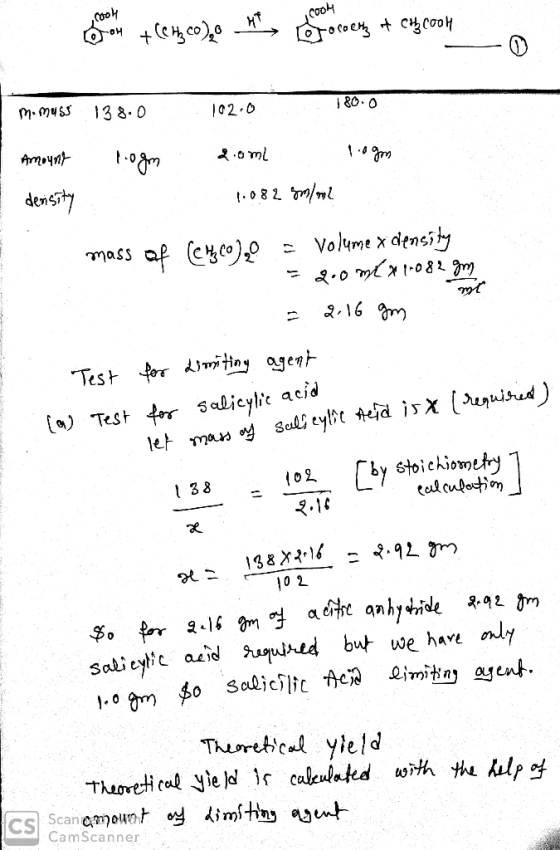
 The
best possible solution of question is given above, if you are
satisfied( or not )comment please .
The
best possible solution of question is given above, if you are
satisfied( or not )comment please .
thank you..
Add Answer to:
predict 4. (15 pts) For the synthesis of aspirin, COOH COOH OOH + (Cusco).out o ccis+ CH.COOH Use the following d...
Experiment 11: Synthesis of Aspirin pre-lab (4 pts) 1) (2 pts) Refer to the introduction on...
 Experiment 11: Synthesis of Aspirin pre-lab (4 pts) 1) (2 pts) Refer to the introduction on interpreting the ferric chloride test for phenols. Two students performed the aspirin synthesis experiment. Their melting point and ferric chloride test data are shown below. Based on the results, which student's aspirin has the higher purity? Justify your choice using the melting point data and ferric chloride test results. Melting point range for pure aspirin = 136-140 °C. Melting point range (°C) Ferric chloride...
question 4 & 5 Question 4 (2 points) if you accidently read the procedure wrong while doing the synthesis of asp...
 question 4 & 5
Question 4 (2 points) if you accidently read the procedure wrong while doing the synthesis of aspirin and mixed Sg of salicylic acid with 2 mL of acetic anhydride (instead of correctly mixing 2g of salicylic acid with 5 mL of acetic anhydride), what would be the effect7(density of acetic anhydride = 1.082 g/mL) a Nothing, it would still work just fine Ob Reaction would work fine, but less product would form since acetic anhydride is...
question 4 & 5
Question 4 (2 points) if you accidently read the procedure wrong while doing the synthesis of aspirin and mixed Sg of salicylic acid with 2 mL of acetic anhydride (instead of correctly mixing 2g of salicylic acid with 5 mL of acetic anhydride), what would be the effect7(density of acetic anhydride = 1.082 g/mL) a Nothing, it would still work just fine Ob Reaction would work fine, but less product would form since acetic anhydride is...
Aspirin can be synthesized in the lab by combining salicylic acid (C7H6O3) and acetic anhydride (C4H6O3)...
Aspirin can be synthesized in the lab by combining salicylic acid (C7H6O3) and acetic anhydride (C4H6O3) to form aspirin (C9H8O4) and acetic acid (C2H4O2).C2H4O2). The balanced equation for this reaction is C7H6O3+C4H6O3⟶C9H8O4+C2H4O2 A student started with 4.00 mL acetic anhydride (density=1.08 g/mL) and 2.07 g salicylic acid. The student synthesized 2.00 g of aspirin. Select the limiting reactant. acetic acid (C2H4O2) salicylic acid (C7H6O3) aspirin (C9H8O4) acetic anhydride (C4H6O3) Calculate the theoretical yield of aspirin (C9H8O4). theoretical yield: Calculate the...
A student measures out exactly 0.0920 g of salicylic acid and carries out an aspirin synthesis...
A student measures out exactly 0.0920 g of salicylic acid and carries out an aspirin synthesis using salicylic acid, acetic anhydride, heat, and an acid catalyst. Salicylic acid is the limiting reagent in this reaction, which yields 0.0900 g of aspirin. What is the percent yield for the reaction?
Aspirin can be made by reacting acetic anhydride (C4H6O3) with salicylic acid (C7H6O3) to form aspirin...
Aspirin can be made by reacting acetic anhydride (C4H6O3) with salicylic acid (C7H6O3) to form aspirin (C9H8O4). C4H6O3 + C7H6O3 --> C2H4O2 + C9H8O4 When synthesizing aspirin, a student began with 3.05 mL of acetic anhydride (density = 1.08 g/mL) and 1.85 g of salicylic acid. The reaction was allowed to run its course and 1.84 grams of aspirin was collected by the student. Determine the limiting reactant, theoretical yield of aspirin, and percent yield for the reaction.
95 Experiment IX Synthesis of Aspirin Prelaboratory Assignment Name: frobect Bun, Bak Baniot Date...
 95 Experiment IX Synthesis of Aspirin Prelaboratory Assignment Name: frobect Bun, Bak Baniot Date Sabaitecd Section #. . Using chemical structures, write the balanced equation for the synthesis of aspirin and label all reagents and products with their appropriate names. ooH он C14 14,03 2. What are the two functional groups on salicylic acid? 3. What are the two functional groups on aspirin? b. anhydride? b) How many moles of Apririn could be produced from 2 moles of salicylic acid?...
Instructions: Use the following reaction to answer the questions in part ad Tom aspirin acetic acid...
 Instructions: Use the following reaction to answer the questions in part ad Tom aspirin acetic acid Salicylic P.M. - 138g/mol acetic anhydride P.M. -102.1g/mol PM180.2g/mol a. Calculate the theoretical yield if 6.0g of salicylic acid are reacted with 12mL of acetic anhydride (density 1.08g/ml) b. What is the limiting REAGENT and what is the excess REAGENT? c. How many moles of excess reagent did not react with the limiting reagent? d. f 6.9 g of aspirin are produced in an...
please help me ! do you think this is good so far ? Results/Data • Aspirin...
 please help me ! do you think this is good so far ?
Results/Data • Aspirin synthesis salicylic acid: 2.0 g Acetic anhydride: 2 mL d= 1.082g/mL sodium acetate: 0.4 g • Experimental yield of aspirin: 2.4 g FORMATION OF ESTERS II. PREPARATION OF ACETYL SALICYLIC ACID (ASPIRIN): 1 Complete the table below by entering appropriate values into the empty boxes. Show calculations for all entries clearly below. Reactants Chemical MW Grams of Moles of Moles of Limiting Melting Formula...
please help me ! do you think this is good so far ?
Results/Data • Aspirin synthesis salicylic acid: 2.0 g Acetic anhydride: 2 mL d= 1.082g/mL sodium acetate: 0.4 g • Experimental yield of aspirin: 2.4 g FORMATION OF ESTERS II. PREPARATION OF ACETYL SALICYLIC ACID (ASPIRIN): 1 Complete the table below by entering appropriate values into the empty boxes. Show calculations for all entries clearly below. Reactants Chemical MW Grams of Moles of Moles of Limiting Melting Formula...
Aspirin can be made in the laboratory by reacting acetic anhydride (C,HeOs) with salicylic acid (CHeO3)...
 Aspirin can be made in the laboratory by reacting acetic anhydride (C,HeOs) with salicylic acid (CHeO3) to form aspirin (Co Hg 04) and acetic acid (C2H4O2). The balanced equation is CAHeOs+CHeOs CoHsO+CHO In a laboratory synthesis, a student begins with 2.90 mL of acetic anhydride (density salicylic acid Once the reaction is complete, the student collects 1.24 g of aspirin Detemine the limiting reactant for the reaction acetic anhydride =1.08 g/ml) and 1.23 g of salicylic acid Request Answer Submit...
A student noticed that after drying the aspirin for a week in his drawer, the aspirin...
 A student noticed that after drying the aspirin for a week in his drawer, the aspirin crystals appeared to be dry but the filter paper was still damp. He went ahead and performed the weighing as directed in the procedure. Did the damp filter paper affect any of the following? In each case, briefly explain your answer. 2. a. theoretical yield b. calculated actual yield calculated percent yield C. Name Class & Section Preparation of Aspirin - Report Form Data...
 Experiment 11: Synthesis of Aspirin pre-lab (4 pts) 1) (2 pts) Refer to the introduction on interpreting the ferric chloride test for phenols. Two students performed the aspirin synthesis experiment. Their melting point and ferric chloride test data are shown below. Based on the results, which student's aspirin has the higher purity? Justify your choice using the melting point data and ferric chloride test results. Melting point range for pure aspirin = 136-140 °C. Melting point range (°C) Ferric chloride...
 question 4 & 5
Question 4 (2 points) if you accidently read the procedure wrong while doing the synthesis of aspirin and mixed Sg of salicylic acid with 2 mL of acetic anhydride (instead of correctly mixing 2g of salicylic acid with 5 mL of acetic anhydride), what would be the effect7(density of acetic anhydride = 1.082 g/mL) a Nothing, it would still work just fine Ob Reaction would work fine, but less product would form since acetic anhydride is...
question 4 & 5
Question 4 (2 points) if you accidently read the procedure wrong while doing the synthesis of aspirin and mixed Sg of salicylic acid with 2 mL of acetic anhydride (instead of correctly mixing 2g of salicylic acid with 5 mL of acetic anhydride), what would be the effect7(density of acetic anhydride = 1.082 g/mL) a Nothing, it would still work just fine Ob Reaction would work fine, but less product would form since acetic anhydride is...
 95 Experiment IX Synthesis of Aspirin Prelaboratory Assignment Name: frobect Bun, Bak Baniot Date Sabaitecd Section #. . Using chemical structures, write the balanced equation for the synthesis of aspirin and label all reagents and products with their appropriate names. ooH он C14 14,03 2. What are the two functional groups on salicylic acid? 3. What are the two functional groups on aspirin? b. anhydride? b) How many moles of Apririn could be produced from 2 moles of salicylic acid?...
 Instructions: Use the following reaction to answer the questions in part ad Tom aspirin acetic acid Salicylic P.M. - 138g/mol acetic anhydride P.M. -102.1g/mol PM180.2g/mol a. Calculate the theoretical yield if 6.0g of salicylic acid are reacted with 12mL of acetic anhydride (density 1.08g/ml) b. What is the limiting REAGENT and what is the excess REAGENT? c. How many moles of excess reagent did not react with the limiting reagent? d. f 6.9 g of aspirin are produced in an...
 please help me ! do you think this is good so far ?
Results/Data • Aspirin synthesis salicylic acid: 2.0 g Acetic anhydride: 2 mL d= 1.082g/mL sodium acetate: 0.4 g • Experimental yield of aspirin: 2.4 g FORMATION OF ESTERS II. PREPARATION OF ACETYL SALICYLIC ACID (ASPIRIN): 1 Complete the table below by entering appropriate values into the empty boxes. Show calculations for all entries clearly below. Reactants Chemical MW Grams of Moles of Moles of Limiting Melting Formula...
please help me ! do you think this is good so far ?
Results/Data • Aspirin synthesis salicylic acid: 2.0 g Acetic anhydride: 2 mL d= 1.082g/mL sodium acetate: 0.4 g • Experimental yield of aspirin: 2.4 g FORMATION OF ESTERS II. PREPARATION OF ACETYL SALICYLIC ACID (ASPIRIN): 1 Complete the table below by entering appropriate values into the empty boxes. Show calculations for all entries clearly below. Reactants Chemical MW Grams of Moles of Moles of Limiting Melting Formula...
 Aspirin can be made in the laboratory by reacting acetic anhydride (C,HeOs) with salicylic acid (CHeO3) to form aspirin (Co Hg 04) and acetic acid (C2H4O2). The balanced equation is CAHeOs+CHeOs CoHsO+CHO In a laboratory synthesis, a student begins with 2.90 mL of acetic anhydride (density salicylic acid Once the reaction is complete, the student collects 1.24 g of aspirin Detemine the limiting reactant for the reaction acetic anhydride =1.08 g/ml) and 1.23 g of salicylic acid Request Answer Submit...
 A student noticed that after drying the aspirin for a week in his drawer, the aspirin crystals appeared to be dry but the filter paper was still damp. He went ahead and performed the weighing as directed in the procedure. Did the damp filter paper affect any of the following? In each case, briefly explain your answer. 2. a. theoretical yield b. calculated actual yield calculated percent yield C. Name Class & Section Preparation of Aspirin - Report Form Data...
Most questions answered within 3 hours.
-
Where is the error in this code sequence?
String s1 = "Hello";
String s2 = "ello";...
asked 11 months ago -
Financial data for Joel de Paris, Inc., for last year
follow:
Joel de Paris, Inc.
Balance...
asked 11 months ago -
Consider this reaction:
Al2(SO4)3 (aq)+ BaCl3
(aq) Al2Cl6 (aq)- +
3BaSO4(s) . What is the...
asked 11 months ago -
Suppose that Savneet is considering increasing her
recent random sample from 20 car rentals to 40...
asked 11 months ago -
Trucks arrive at an unloading terminal at an average rate of 120
per hour.
Trucks arrive...
asked 11 months ago -
Why are methanol and ethanol completely soluble in water while
octanol is not very little soluble....
asked 11 months ago -
A facilities manager at a university reads in a research report
that the mean amount of...
asked 11 months ago -
When the CuSO4 is rehydrated by adding water to the anhydrous
compound, is this an endothermic...
asked 11 months ago -
A ray of sunlight is passing from diamond into crown glass; the
angle of incidence is...
asked 11 months ago -
A block of mass 0.249 kg is placed on top of a light, vertical
spring of...
asked 11 months ago -
how do the kidneys compensate in the presences of acidosis
a) trigger hyperventilate
b) reserve acid...
asked 11 months ago -
Question 501 pts
The rental rate of capital to the firm increases. Which of the
following...
asked 11 months ago