
Homework Answers
We know that,
Acceleration is defined as the slope of the velocity- time graph.
So,
a=dv/dt
So, for the segment 1, we can see that the slope of the curve is zero.
So,
Acceleration in segment 1 will be zero.
Now, for segment 3,
a=(3.5-3.75)/(60-35)
a=-0.01 m/s 2
Now for a6,
a=(3.5-3.25)/(110-90)
a=0.0125 m/s 2
3. Calculate accelerations for the F= 200 N 300 N 00N Force (N) Neccleration's) Physics Education...
 3. Calculate accelerations for the F= 200 N 300 N 00N Force (N) Neccleration's) Physics Education Technology Project Workshop 6 Plot Acceleration vs. Force graph and answer the questions below. (Labels aves with correct units. Acceleration vs. Force a. Describe the shape of the graph . Calculate the slope of the graph e. If you use an object with mass soo kg how does the shape of the graph change?
91. Humans can endure accelerations over 45 times as great as g. One of the main...
 91. Humans can endure accelerations over 45 times as great as g. One of the main ways of testing human endurance of these accelerations was the "human centrifuge" the first of which was built by the U.S. Navy in 1950 and operated by them from 1950 through 1996. This device consisted of a large metal sphere in which the subject sat. This sphere connected to the end of a 15.2 m metal arm, which rotated rapidly to create accelerations as...
Steve was subjected to accelerations in a horizontal "centrifuge". It is considered that such a device...
Steve was subjected to accelerations in a horizontal "centrifuge". It is considered that such a device has a radius of 5.0 m and can generate a centripetal acceleration equivalent to 7 times the average gravitational acceleration on Earth. a) For this maximum acceleration, what is the modulus of the astronaut's speed along the circular path? b) At how many revolutions per minute should the rotation occur to achieve such acceleration? c) What is the period of this rotation?
What is the difference between accelerations “a” and “g”? Completely lost!
What is the difference between accelerations “a” and “g”? Completely lost!
During his training as a Canadian astronaut, David Saint-Jacques was submitted to accelerations in a horizontal...
During his training as a Canadian astronaut, David Saint-Jacques was submitted to accelerations in a horizontal "centrifuge". Such a device is considered to have a radius of 5.0 m and can generate a centripetal acceleration equivalent to 7 times the acceleration gravitational average on Earth. At how many turn per minute should the rotation be made to have such an acceleration?
please answer both 6. Determine the Centripetal, the Tangential accelerations and the velocity of a particle...
 please answer both
6. Determine the Centripetal, the Tangential accelerations and the velocity of a particle moving along a circular path having a radius 2.5 km; at a constant acceleration of 20 m/s at an angle of 30° with the radius? The position of a particle moving along the x axis is given by x = (21 t + 22t2-6.0t) m, where t s in s. What is the average velocity during the time intervalに1.0 s to 3.0 s?
please answer both
6. Determine the Centripetal, the Tangential accelerations and the velocity of a particle moving along a circular path having a radius 2.5 km; at a constant acceleration of 20 m/s at an angle of 30° with the radius? The position of a particle moving along the x axis is given by x = (21 t + 22t2-6.0t) m, where t s in s. What is the average velocity during the time intervalに1.0 s to 3.0 s?
(2 dimensions, 1 object, 2 accelerations) 1) A projectile is thrown with a wind. The wind...
(2 dimensions, 1 object, 2 accelerations) 1) A projectile is thrown with a wind. The wind produces a constant acceleration of 2 m/s/s in the same direction as the projectile’s horizontal direction. The projectile is launched with a velocity of 20 m/s at an angle of 30°. The projectile lands at the same height as it was launched. a. How far from the launch point does the projectile land? Do this problem again with no numbers. b. Calculate the range...
You have been contracted by a railroad company to determine safe starting and stopping accelerations for...
You have been contracted by a railroad company to determine safe starting and stopping accelerations for a fleet of railroad cars. Five of the cars (and the hitch to the engine) have new, stronger hitch systems that can safely withstand tensile and compression forces of up to 53,400 Newtons (equivalent to about 6 tons of force). Ten of the cars are older, with hitch systems that can only withstand tensile and compression forces of up to 35,600 Newtons (equivalent to...
2. Determine the tension in the strings and accelerations of two blocks of masses A =...
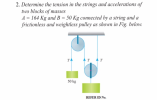 2. Determine the tension in the strings and accelerations of two blocks of masses A = 164 Kg and B = 50 Kg connected by a string and a frictionless and weightless pulley as shown in Fig. below. т. ТАТ 50 kg REFER ID No.
Part A Rank in order, from largest to smallest, the angular accelerations α a to α...
Part A Rank in order, from largest to smallest, the angular accelerations α a to α d in the figure(Figure 1) . Rank from largest to smallest. To rank items as equivalent, overlap them.
 3. Calculate accelerations for the F= 200 N 300 N 00N Force (N) Neccleration's) Physics Education Technology Project Workshop 6 Plot Acceleration vs. Force graph and answer the questions below. (Labels aves with correct units. Acceleration vs. Force a. Describe the shape of the graph . Calculate the slope of the graph e. If you use an object with mass soo kg how does the shape of the graph change?
 91. Humans can endure accelerations over 45 times as great as g. One of the main ways of testing human endurance of these accelerations was the "human centrifuge" the first of which was built by the U.S. Navy in 1950 and operated by them from 1950 through 1996. This device consisted of a large metal sphere in which the subject sat. This sphere connected to the end of a 15.2 m metal arm, which rotated rapidly to create accelerations as...
 please answer both
6. Determine the Centripetal, the Tangential accelerations and the velocity of a particle moving along a circular path having a radius 2.5 km; at a constant acceleration of 20 m/s at an angle of 30° with the radius? The position of a particle moving along the x axis is given by x = (21 t + 22t2-6.0t) m, where t s in s. What is the average velocity during the time intervalに1.0 s to 3.0 s?
please answer both
6. Determine the Centripetal, the Tangential accelerations and the velocity of a particle moving along a circular path having a radius 2.5 km; at a constant acceleration of 20 m/s at an angle of 30° with the radius? The position of a particle moving along the x axis is given by x = (21 t + 22t2-6.0t) m, where t s in s. What is the average velocity during the time intervalに1.0 s to 3.0 s?
 2. Determine the tension in the strings and accelerations of two blocks of masses A = 164 Kg and B = 50 Kg connected by a string and a frictionless and weightless pulley as shown in Fig. below. т. ТАТ 50 kg REFER ID No.
Most questions answered within 3 hours.
-
Where is the error in this code sequence?
String s1 = "Hello";
String s2 = "ello";...
asked 10 months ago -
Financial data for Joel de Paris, Inc., for last year
follow:
Joel de Paris, Inc.
Balance...
asked 10 months ago -
Consider this reaction:
Al2(SO4)3 (aq)+ BaCl3
(aq) Al2Cl6 (aq)- +
3BaSO4(s) . What is the...
asked 10 months ago -
Suppose that Savneet is considering increasing her
recent random sample from 20 car rentals to 40...
asked 10 months ago -
Trucks arrive at an unloading terminal at an average rate of 120
per hour.
Trucks arrive...
asked 10 months ago -
Why are methanol and ethanol completely soluble in water while
octanol is not very little soluble....
asked 10 months ago -
A facilities manager at a university reads in a research report
that the mean amount of...
asked 10 months ago -
When the CuSO4 is rehydrated by adding water to the anhydrous
compound, is this an endothermic...
asked 10 months ago -
A ray of sunlight is passing from diamond into crown glass; the
angle of incidence is...
asked 10 months ago -
A block of mass 0.249 kg is placed on top of a light, vertical
spring of...
asked 10 months ago -
how do the kidneys compensate in the presences of acidosis
a) trigger hyperventilate
b) reserve acid...
asked 10 months ago -
Question 501 pts
The rental rate of capital to the firm increases. Which of the
following...
asked 10 months ago