
Homework Answers
Add Answer to:
3.) Suggest two separate alcohol and alkyl halide combinations that could be used to produce the following ethers. Whic...
(5) Ethers can be synthesized using an alkoxide and alkyl halide. Provide two possible routes using an alkoxide and an...
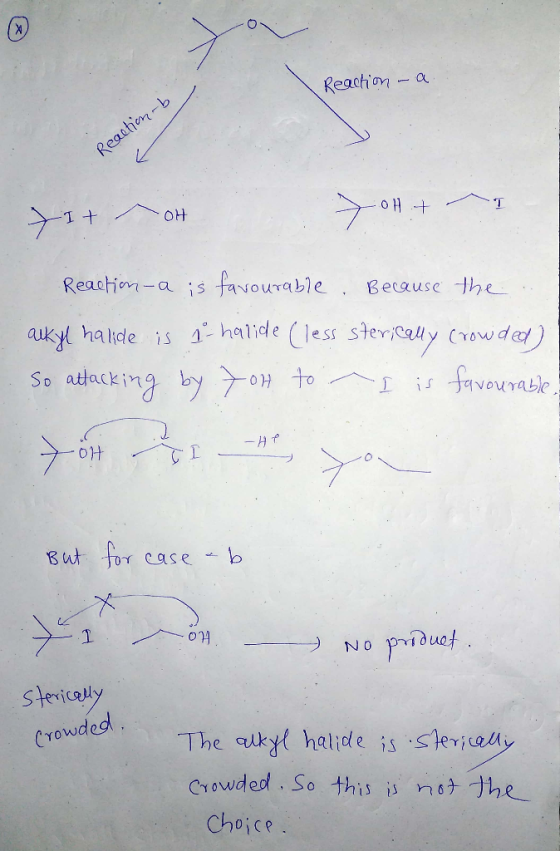
 (5) Ethers can be synthesized using an alkoxide and alkyl halide. Provide two possible routes using an alkoxide and an alkyl halide to synthesize t-butylethylether, below . Label the route that is better and briefly explain why.
3. Beginning with an alcohol and an alkyl halide, draw two different routes to each of...
 3. Beginning with an alcohol and an alkyl halide, draw two different routes to each of the following ethers using a Williamson ether synthesis (Smith 9.6). Indicate the preferred route (if there is one). Predict the products of dehydration (elimination) of the following alcohol. Read Smith 9.8A. Predict which product will be the major product. H.SO 2-pentanol Write a mechanism for the dehydration reaction (steps showing the flow of electrons with curved arrows). Read Smith 9.8B & 9.9. 2-methylcyclopentanol
2Beginning with an alcohol and an alkyl halide, draw two different routes to each of the...
 2Beginning with an alcohol and an alkyl halide, draw two different routes to each of the following ethers using Williamson ether symthesis (Smith 9.6 Indicate the preferred route (if there is one), 8.
Using retro synthesis what alkyl halide and ketone were used to produce 3-ethyl-3-hexanol. The two starting...
Using retro synthesis what alkyl halide and ketone were used to produce 3-ethyl-3-hexanol. The two starting materials cannot be 1-bromopropane and 3-pentanone. Calculate the percent yield of the final product which weighed 0.16g. The starting weight of Magnesium was 0.612g and starting weight of Ammonium Chloride was 0.6012g.
3. An alkyl halide is reacted with sodium iodide and sodium chloride in separate test tubes....
 3. An alkyl halide is reacted with sodium iodide and sodium chloride in separate test tubes. The rate was the same in both experiments. Is this an Syl or an SN2 reaction? How would you know? 4. Why is sodium iodide used as a solution in acetone in these experiments instead of a solution in water? 5. Will the reaction below be Spl or Sn2? Show the mechanism.
Draw the structure of an alkyl halide that could be used in an E2 reaction to give the following alkene as the...
 Draw the structure of an alkyl halide that could be used in an E2 reaction to give the following alkene as the only alkene product:
Draw the structure of an alkyl halide that could be used in an E2 reaction to give the following alkene as the only alk...
 Draw the structure of an alkyl halide that could be used in an
E2 reaction to give the following alkene as the only alkene
product:
Draw the structure of an alkyl halide that could be used in an
E2 reaction to give the following alkene as the only alkene
product:
Design syntheses to produce the following compounds starting withany alkyl halide with 3 or fewer carbons...
 Design syntheses to produce the following compounds starting
withany alkyl halide with 3 or fewer carbons and butadiene. You may
useany any inorganic reagents necessary. Note that once a compound
hasbeen synthesized in one process it can be used in a different
process ifyou reference where it was first made.
Design syntheses to produce the following compounds starting
withany alkyl halide with 3 or fewer carbons and butadiene. You may
useany any inorganic reagents necessary. Note that once a compound
hasbeen synthesized in one process it can be used in a different
process ifyou reference where it was first made.
2 Rob page 6 Part B: 3 1. Classify the following cation, alkyl halide, and alcohol...
 2 Rob page 6 Part B: 3 1. Classify the following cation, alkyl halide, and alcohol as either primary (1"), secondary (2) or tertiary (3) HO 2. Write the major product(s) A, B and C for the following transformations: RUBH NaOH, HO2 С Br2 NaOH ( excess) B А
Draw the structure of an alkyl halide that could be used in an E2 reaction to give the following alkene as the only alk...
 Draw the structure of an alkyl halide that could be used in an E2 reaction to give the following alkene as the only alkene product. Hint: Look closely at the wording. ONLY alkene product - means only one product is formed СHз KО-Bu Check Answer Next Previous Exit
 (5) Ethers can be synthesized using an alkoxide and alkyl halide. Provide two possible routes using an alkoxide and an alkyl halide to synthesize t-butylethylether, below . Label the route that is better and briefly explain why.
 3. Beginning with an alcohol and an alkyl halide, draw two different routes to each of the following ethers using a Williamson ether synthesis (Smith 9.6). Indicate the preferred route (if there is one). Predict the products of dehydration (elimination) of the following alcohol. Read Smith 9.8A. Predict which product will be the major product. H.SO 2-pentanol Write a mechanism for the dehydration reaction (steps showing the flow of electrons with curved arrows). Read Smith 9.8B & 9.9. 2-methylcyclopentanol
 2Beginning with an alcohol and an alkyl halide, draw two different routes to each of the following ethers using Williamson ether symthesis (Smith 9.6 Indicate the preferred route (if there is one), 8.
 3. An alkyl halide is reacted with sodium iodide and sodium chloride in separate test tubes. The rate was the same in both experiments. Is this an Syl or an SN2 reaction? How would you know? 4. Why is sodium iodide used as a solution in acetone in these experiments instead of a solution in water? 5. Will the reaction below be Spl or Sn2? Show the mechanism.
 Draw the structure of an alkyl halide that could be used in an E2 reaction to give the following alkene as the only alkene product:
 Draw the structure of an alkyl halide that could be used in an
E2 reaction to give the following alkene as the only alkene
product:
Draw the structure of an alkyl halide that could be used in an
E2 reaction to give the following alkene as the only alkene
product:
 Design syntheses to produce the following compounds starting
withany alkyl halide with 3 or fewer carbons and butadiene. You may
useany any inorganic reagents necessary. Note that once a compound
hasbeen synthesized in one process it can be used in a different
process ifyou reference where it was first made.
Design syntheses to produce the following compounds starting
withany alkyl halide with 3 or fewer carbons and butadiene. You may
useany any inorganic reagents necessary. Note that once a compound
hasbeen synthesized in one process it can be used in a different
process ifyou reference where it was first made.
 2 Rob page 6 Part B: 3 1. Classify the following cation, alkyl halide, and alcohol as either primary (1"), secondary (2) or tertiary (3) HO 2. Write the major product(s) A, B and C for the following transformations: RUBH NaOH, HO2 С Br2 NaOH ( excess) B А
 Draw the structure of an alkyl halide that could be used in an E2 reaction to give the following alkene as the only alkene product. Hint: Look closely at the wording. ONLY alkene product - means only one product is formed СHз KО-Bu Check Answer Next Previous Exit
Most questions answered within 3 hours.
-
Where is the error in this code sequence?
String s1 = "Hello";
String s2 = "ello";...
asked 10 months ago -
Financial data for Joel de Paris, Inc., for last year
follow:
Joel de Paris, Inc.
Balance...
asked 10 months ago -
Consider this reaction:
Al2(SO4)3 (aq)+ BaCl3
(aq) Al2Cl6 (aq)- +
3BaSO4(s) . What is the...
asked 10 months ago -
Suppose that Savneet is considering increasing her
recent random sample from 20 car rentals to 40...
asked 10 months ago -
Trucks arrive at an unloading terminal at an average rate of 120
per hour.
Trucks arrive...
asked 10 months ago -
Why are methanol and ethanol completely soluble in water while
octanol is not very little soluble....
asked 10 months ago -
A facilities manager at a university reads in a research report
that the mean amount of...
asked 10 months ago -
When the CuSO4 is rehydrated by adding water to the anhydrous
compound, is this an endothermic...
asked 10 months ago -
A ray of sunlight is passing from diamond into crown glass; the
angle of incidence is...
asked 10 months ago -
A block of mass 0.249 kg is placed on top of a light, vertical
spring of...
asked 10 months ago -
how do the kidneys compensate in the presences of acidosis
a) trigger hyperventilate
b) reserve acid...
asked 10 months ago -
Question 501 pts
The rental rate of capital to the firm increases. Which of the
following...
asked 10 months ago