

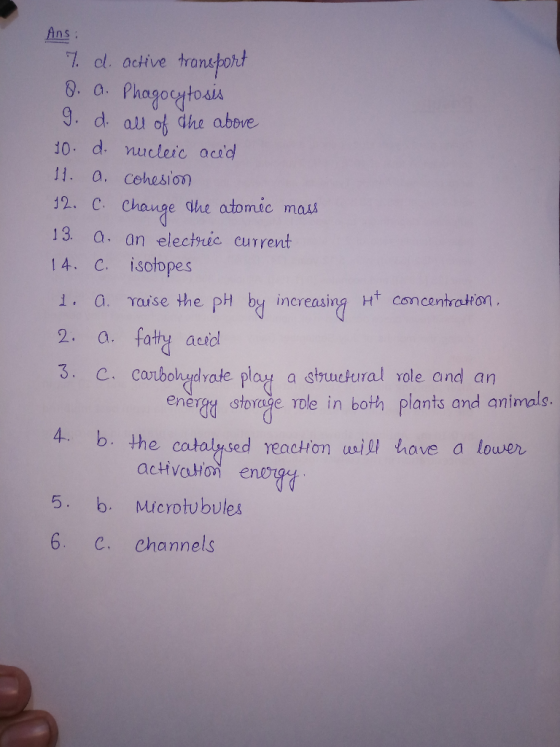
ne(L point each) 1. An acid would a. raise the pH by increasing H' concentration. b. lower the pH by increasing OH concentration. c. lower the pH by increasing H' concentration. d. raise the pH by decreasing OH concentration. 2. The monomer of lipids is the a fatty acid. b. amino acid c. nucleotide. d. nitrogenous base. e. monosaccharide. 3. How is carbohydrate use similar or different berween plants and animals? Select the true statement below. In animals, carbohydrates only have a structural role, while in plants, carbohydrates are used to store a. energy b. Carbohydrates catalyze reactions in both animals and plants. Carbohydrates play a structural role and an energy storage role in both plants and animals. d. In animals, carbohydrates only function in energy strorage, while in plants, carbohydrates have a structural role. Which of the following is true when comparing an uncatalyzed reaction to the same reaction with a catalyst? a. the catalyzed reaction will be slower. b. the catalyzed reaction will have a lower activation energy c. the catalyzed reaction will have higher activation energy d. the catalyzed reaction will consume all of the catalyst. 4. 5. The components of the cytoskeleton that provide the pathways or "railroad tracks for inter-cellular transport are the a. Microfilaments b. Microtubules c. Intermediate filaments d. Centrioles 6. lons are typically transported into a cell via a. Diffusion b. Carrier proteins c. Channels d. Osmosis
Homework Answers
Add Answer to:
The process(es) of a. osmosis b. diffusion c. facilitated diffusion d. active transport e. two of the above 7. do...
15. Diffusion of water through a differentially permeable membrane is called A. active transport. B. energy....
 15. Diffusion of water through a differentially permeable membrane is called A. active transport. B. energy. C. osmosis. D. All of these answers are true. 16. What happens when an animal cell is placed into a hypertonic solution? A. plasmolysis B. crenation occurs C. it swells D. it is unchanged 17. The point on the enzyme where the enzyme causes the substrate to change is called the A. attachment site. B. active site. C. binding site. D. enzyme-substrate complex 18....
7. Which of the following is involved in the synthesis and packaging of certain molecules produced...
 7. Which of the following is involved in the synthesis and packaging of certain molecules produced for secretion by a cell? A. cell granule B. Golgi apparatus C. flagella D. nucleolus 8. Which of the following organelles contains a green-colored pigment? Alysosome B. mitochondria C. chloroplast D. leucoplastosome 9. Eukaryotic cells are found in the group known as the A. fungi. B. plants. C. animals D. All of these answers are true. 10. An outside source of energy (ATP) is...
1) Respiratory gases cross the respiratory membrane by____ A) simple diffusion B) active transport C) osmosis...
1) Respiratory gases cross the respiratory membrane by____ A) simple diffusion B) active transport C) osmosis D) facilitated diffusion 2) Which environment separated by the respiratory membrane would display the highest oxygen partial pressure? A) alveolar air B) pulmonary capillary blood
20) - 24) Diffusion is a process by which a substance A) goes down its concentration...
 20) - 24) Diffusion is a process by which a substance A) goes down its concentration gradient. B) goes from lesser to greater concentration C) goes up its concentration gradient D) is at equilibrium 25 25) What product(s) do plants produce during photosynthesis that is/are used by humans and other animals? A) glucose B) carbon dioxide C) oxygen D) glucose and oxygen 26) The term that describes the diffusion of water is A) simple diffusion. B) equilibrium C) facilitated diffusion...
1. (1 pt) Starch, glycogen, and cellulose are all types of: a. Cholesterol b. Carbohydrates c....
 1. (1 pt) Starch, glycogen, and cellulose are all types of: a. Cholesterol b. Carbohydrates c. Lipids d. Nucleic Acids e. Protein 2. (1 pt) What are some differences between animal and vegetable fat? 3. (1 pt) What is an essential amino acid? What types of foods contain it? 4. (2 pt) Pick two organelles from the list below and describe their functions. Golgi Nucleus Rough Endoplasmic Reticulum Lysosome Mitochondria Smooth Endoplasmic Reticulum 5. (1 pt) What is the function...
12) Which statement is NOT true? A) There are many different types of lipids. B) Lipids...
 12) Which statement is NOT true? A) There are many different types of lipids. B) Lipids are found in cell membranes. C) Some hormones are lipids. D) Lipids are soluble in organic solvents. E) All lipids contain fatty acids. 13) The process of building up new molecules in the coll is called A) glycolysis. B) catabolism. C) anabolism. D) metabolism. E) transamination 14) Which of the following does not require energy from ATP hydrolysis? A) digestion B) synthesis of an...
Facilitated diffusion: A) transports solute up its concentration gradient. B) transports solute down its concentration gradient. C) does not require a transport protein. D) requires ATP hydrolysis for...
Facilitated diffusion: A) transports solute up its concentration gradient. B) transports solute down its concentration gradient. C) does not require a transport protein. D) requires ATP hydrolysis for transport to occur.
The smallest chemical units of matter are atoms b) molecules c) protons d) neutrons e) electrons...
 The smallest chemical units of matter are atoms b) molecules c) protons d) neutrons e) electrons . Which of the following would have the largest size? a) an atom b) a molecule c) a proton d) a neutron e) an electron 3. Isotopes of an element differ in the number of a) protons in the nucleus b) electrons in the nucleus © neutrons in the nucleus d) electron clouds e) energy levels they contain 4. VO The atomic number represents...
identify your answer. (2 pts ea) 12) Which statement is NOT true? A) There are many different types of lipids. B)...
 identify your answer. (2 pts ea) 12) Which statement is NOT true? A) There are many different types of lipids. B) Lipids are found in cell membranes. C) Some hormones are lipids D) Lipids are soluble in organic solvents. E) All lipids contain fatty acids. 13) The process of building up new molecules in the coll is called A) glycolysis. B) catabolism. C) anabolism. D) metabolism E) transamination. 14) Which of the following does not require energy from ATP hydrolysis?...
7. Hemoglobin, which carries oxygen to the cell, is an example b. storage of what type...
 7. Hemoglobin, which carries oxygen to the cell, is an example b. storage of what type of protein? d. transport c. hormone a. structural 8. An essential amino acid is an amino acid that a. must be provided in the diet. c. does not exist as a zwitterions. b. is missing from the diet d. is synthesized in the body. 9. This amino acid would be: a nonpolar and hydrophobic e. monpolar and hydrophilic b.polar and hydrophobie d. polar and...
 15. Diffusion of water through a differentially permeable membrane is called A. active transport. B. energy. C. osmosis. D. All of these answers are true. 16. What happens when an animal cell is placed into a hypertonic solution? A. plasmolysis B. crenation occurs C. it swells D. it is unchanged 17. The point on the enzyme where the enzyme causes the substrate to change is called the A. attachment site. B. active site. C. binding site. D. enzyme-substrate complex 18....
 7. Which of the following is involved in the synthesis and packaging of certain molecules produced for secretion by a cell? A. cell granule B. Golgi apparatus C. flagella D. nucleolus 8. Which of the following organelles contains a green-colored pigment? Alysosome B. mitochondria C. chloroplast D. leucoplastosome 9. Eukaryotic cells are found in the group known as the A. fungi. B. plants. C. animals D. All of these answers are true. 10. An outside source of energy (ATP) is...
 20) - 24) Diffusion is a process by which a substance A) goes down its concentration gradient. B) goes from lesser to greater concentration C) goes up its concentration gradient D) is at equilibrium 25 25) What product(s) do plants produce during photosynthesis that is/are used by humans and other animals? A) glucose B) carbon dioxide C) oxygen D) glucose and oxygen 26) The term that describes the diffusion of water is A) simple diffusion. B) equilibrium C) facilitated diffusion...
 1. (1 pt) Starch, glycogen, and cellulose are all types of: a. Cholesterol b. Carbohydrates c. Lipids d. Nucleic Acids e. Protein 2. (1 pt) What are some differences between animal and vegetable fat? 3. (1 pt) What is an essential amino acid? What types of foods contain it? 4. (2 pt) Pick two organelles from the list below and describe their functions. Golgi Nucleus Rough Endoplasmic Reticulum Lysosome Mitochondria Smooth Endoplasmic Reticulum 5. (1 pt) What is the function...
 12) Which statement is NOT true? A) There are many different types of lipids. B) Lipids are found in cell membranes. C) Some hormones are lipids. D) Lipids are soluble in organic solvents. E) All lipids contain fatty acids. 13) The process of building up new molecules in the coll is called A) glycolysis. B) catabolism. C) anabolism. D) metabolism. E) transamination 14) Which of the following does not require energy from ATP hydrolysis? A) digestion B) synthesis of an...
 The smallest chemical units of matter are atoms b) molecules c) protons d) neutrons e) electrons . Which of the following would have the largest size? a) an atom b) a molecule c) a proton d) a neutron e) an electron 3. Isotopes of an element differ in the number of a) protons in the nucleus b) electrons in the nucleus © neutrons in the nucleus d) electron clouds e) energy levels they contain 4. VO The atomic number represents...
 identify your answer. (2 pts ea) 12) Which statement is NOT true? A) There are many different types of lipids. B) Lipids are found in cell membranes. C) Some hormones are lipids D) Lipids are soluble in organic solvents. E) All lipids contain fatty acids. 13) The process of building up new molecules in the coll is called A) glycolysis. B) catabolism. C) anabolism. D) metabolism E) transamination. 14) Which of the following does not require energy from ATP hydrolysis?...
 7. Hemoglobin, which carries oxygen to the cell, is an example b. storage of what type of protein? d. transport c. hormone a. structural 8. An essential amino acid is an amino acid that a. must be provided in the diet. c. does not exist as a zwitterions. b. is missing from the diet d. is synthesized in the body. 9. This amino acid would be: a nonpolar and hydrophobic e. monpolar and hydrophilic b.polar and hydrophobie d. polar and...
Most questions answered within 3 hours.
-
Where is the error in this code sequence?
String s1 = "Hello";
String s2 = "ello";...
asked 10 months ago -
Financial data for Joel de Paris, Inc., for last year
follow:
Joel de Paris, Inc.
Balance...
asked 10 months ago -
Consider this reaction:
Al2(SO4)3 (aq)+ BaCl3
(aq) Al2Cl6 (aq)- +
3BaSO4(s) . What is the...
asked 10 months ago -
Suppose that Savneet is considering increasing her
recent random sample from 20 car rentals to 40...
asked 10 months ago -
Trucks arrive at an unloading terminal at an average rate of 120
per hour.
Trucks arrive...
asked 10 months ago -
Why are methanol and ethanol completely soluble in water while
octanol is not very little soluble....
asked 10 months ago -
A facilities manager at a university reads in a research report
that the mean amount of...
asked 10 months ago -
When the CuSO4 is rehydrated by adding water to the anhydrous
compound, is this an endothermic...
asked 10 months ago -
A ray of sunlight is passing from diamond into crown glass; the
angle of incidence is...
asked 10 months ago -
A block of mass 0.249 kg is placed on top of a light, vertical
spring of...
asked 10 months ago -
how do the kidneys compensate in the presences of acidosis
a) trigger hyperventilate
b) reserve acid...
asked 10 months ago -
Question 501 pts
The rental rate of capital to the firm increases. Which of the
following...
asked 10 months ago