
Homework Answers
Michaelis - Menten equation can be derived as follows.
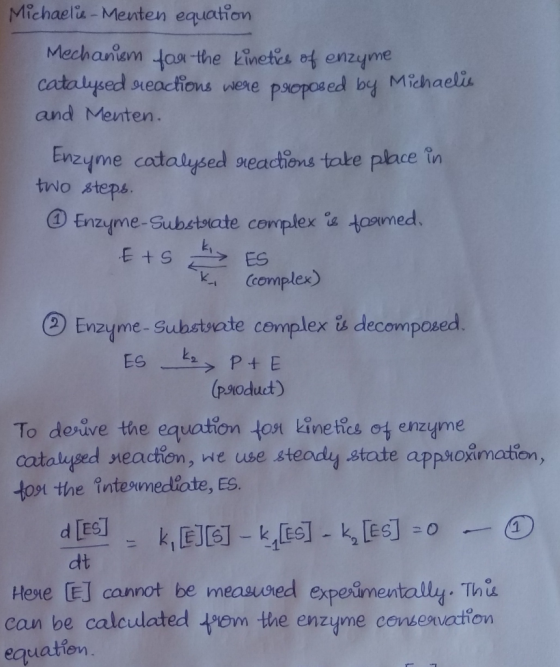
![E1. – [E] + [ES] - © >>[E] = [E]. - [ES] where [[] is the total enzyme concentration [E] the free enzyme concentration ES] is](http://img.homeworklib.com/questions/577c4f40-12ae-11ea-971a-87f54527b565.png?x-oss-process=image/resize,w_560)
![Substituting eqn. in equation , we have. d[es] . k, (E).- [ES]) 6J - K [es] -k, [ES] = 0 dt dt → d[es] . k, 11.S] - [ES][S] -](http://img.homeworklib.com/questions/58373ef0-12ae-11ea-8d06-a70a41eaedcd.png?x-oss-process=image/resize,w_560)
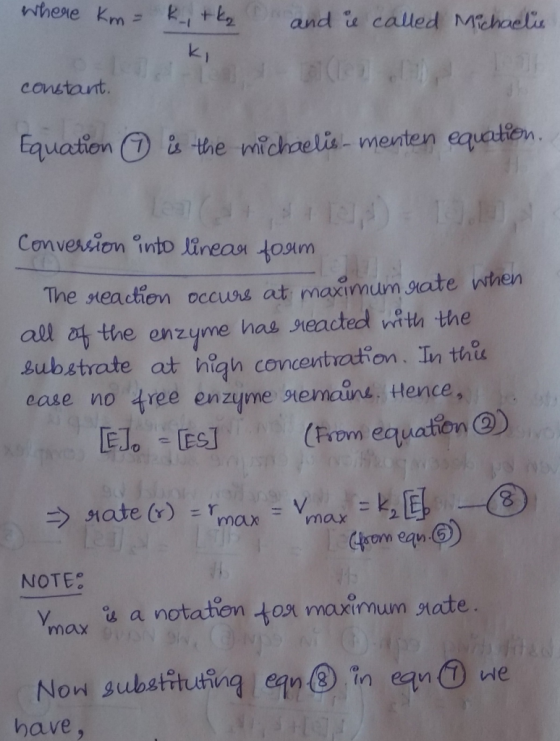
![a = Vmax [s] [s] + km Taking reciprocal on both sides, 1 = [s] + km max [s] 4 I Vmax [5]. Vmax Rearranging we have Vmax IST m](http://img.homeworklib.com/questions/59c75260-12ae-11ea-bb76-3d8db9392272.png?x-oss-process=image/resize,w_560)
Add Answer to:
Derive the Michaelis-Menten equation. Convert the derived equation to a linear form.
derive michaelis menten equation please show steps
derive michaelis menten equation please show steps
The equation that describes the above Michaelis-Menten curve: Vo TS]+K Vmax [S] Michaelis-Menten Equation Lineweaver and...
 The equation that describes the above Michaelis-Menten curve: Vo TS]+K Vmax [S] Michaelis-Menten Equation Lineweaver and Burke manipulated the Michaelis-Menten equation to yield: Ko V I S Vmax [S] Lineweaver-Burke Equation Linewenver Burke Equation If you plot 1/ V. vs. 1/[S], you get the following Lineweaver-Burke plot: 1/V. Slope = km/Vmax Intercept = -1/KM -Intercept = 1/Vmax 1/[S] Which is easier to calculate values for Km and Vmax, using the linear (y=mx+b) Lineweaver-Burke Plot or the Michaelis-Menten curve?
The kinetics of enzyme catalyzed reactions can be described the Michaelis-Menten equation and the Eadie-Hofstee equatio...
The kinetics of enzyme catalyzed reactions can be described the Michaelis-Menten equation and the Eadie-Hofstee equation as shown below: V0 = (-Km) V0 / [S] + Vmax a). Please derive the Eadie-Hofstee equation starting from the Michaelis-Menten equation. b). The Vmax and Km of the enzyme catalyzed reaction can be derived from a plot of V0 versus V0/[S]. Please draw one of these plots and explain how do you use it to derive Vmax and Km. c). Please draw a...
1. (15 points) Give the Michaelis-Menten equation and define each term in it (no need to derive the equation). Does...
 1. (15 points) Give the Michaelis-Menten equation and define each term in it (no need to derive the equation). Does this equation apply to all enzymes? If not, to which kind does it not apply?
(5) The Michaelis-Menten equation describes the following simplistic pathway Km (a) State each of the assumptions...
 (5) The Michaelis-Menten equation describes the following simplistic pathway Km (a) State each of the assumptions on which the Michaelis-Menten equation is based. (b) Derive the rate law for this process
For substrate inhibition, one can write the following equations. Derive the Michaelis-Menten equation using the simplified...
For substrate inhibition, one can write the following equations. Derive the Michaelis-Menten equation using the simplified protocol described in the lab. E + S ↔ ES-->E + P ES + S-->ES2
4. Basic concepts of Michaelis-Menten kinetics. The Michaelis-Menten equation is expression of the relationship between the...
 4. Basic concepts of Michaelis-Menten kinetics. The Michaelis-Menten equation is expression of the relationship between the initial velocity, Vo, of an enzymatic reaction and substrate concentration, [S]. There are three conditions that are useful for simplifying the Michaelis-Menten equation: [S] <<Km; [S] = Km; [S] >> Km. Match each condition with the statement(s) that describe it. TV, Vmox[S] Vo =Vmax m . V Vo - Vmax [S] Km +[S] V. (um/min) max [S] (mm) (a) Doubling [S] will almost double...
Describe the assumptions that went into the derivation of the Michaelis-Menten equation.
Describe the assumptions that went into the derivation of the Michaelis-Menten equation.
How can the Michaelis-Menten constant, be derived from this Lineweaver-Burk plot? Vmax O km = (-1)/(x-intercept)...
 How can the Michaelis-Menten constant, be derived from this Lineweaver-Burk plot? Vmax O km = (-1)/(x-intercept) O km = (-1) * (x-intercept) O km = 1/(x-intercept) 0 Km = s;lope
1)Derivation of the Michaelis -Menten equation. I want you to show every single step
 1)Derivation of the Michaelis -Menten equation. I want you to show every single step
 The equation that describes the above Michaelis-Menten curve: Vo TS]+K Vmax [S] Michaelis-Menten Equation Lineweaver and Burke manipulated the Michaelis-Menten equation to yield: Ko V I S Vmax [S] Lineweaver-Burke Equation Linewenver Burke Equation If you plot 1/ V. vs. 1/[S], you get the following Lineweaver-Burke plot: 1/V. Slope = km/Vmax Intercept = -1/KM -Intercept = 1/Vmax 1/[S] Which is easier to calculate values for Km and Vmax, using the linear (y=mx+b) Lineweaver-Burke Plot or the Michaelis-Menten curve?
 1. (15 points) Give the Michaelis-Menten equation and define each term in it (no need to derive the equation). Does this equation apply to all enzymes? If not, to which kind does it not apply?
 (5) The Michaelis-Menten equation describes the following simplistic pathway Km (a) State each of the assumptions on which the Michaelis-Menten equation is based. (b) Derive the rate law for this process
 4. Basic concepts of Michaelis-Menten kinetics. The Michaelis-Menten equation is expression of the relationship between the initial velocity, Vo, of an enzymatic reaction and substrate concentration, [S]. There are three conditions that are useful for simplifying the Michaelis-Menten equation: [S] <<Km; [S] = Km; [S] >> Km. Match each condition with the statement(s) that describe it. TV, Vmox[S] Vo =Vmax m . V Vo - Vmax [S] Km +[S] V. (um/min) max [S] (mm) (a) Doubling [S] will almost double...
 How can the Michaelis-Menten constant, be derived from this Lineweaver-Burk plot? Vmax O km = (-1)/(x-intercept) O km = (-1) * (x-intercept) O km = 1/(x-intercept) 0 Km = s;lope
 1)Derivation of the Michaelis -Menten equation. I want you to show every single step
Most questions answered within 3 hours.
-
Where is the error in this code sequence?
String s1 = "Hello";
String s2 = "ello";...
asked 11 months ago -
Financial data for Joel de Paris, Inc., for last year
follow:
Joel de Paris, Inc.
Balance...
asked 11 months ago -
Consider this reaction:
Al2(SO4)3 (aq)+ BaCl3
(aq) Al2Cl6 (aq)- +
3BaSO4(s) . What is the...
asked 11 months ago -
Suppose that Savneet is considering increasing her
recent random sample from 20 car rentals to 40...
asked 11 months ago -
Trucks arrive at an unloading terminal at an average rate of 120
per hour.
Trucks arrive...
asked 11 months ago -
Why are methanol and ethanol completely soluble in water while
octanol is not very little soluble....
asked 11 months ago -
A facilities manager at a university reads in a research report
that the mean amount of...
asked 11 months ago -
When the CuSO4 is rehydrated by adding water to the anhydrous
compound, is this an endothermic...
asked 11 months ago -
A ray of sunlight is passing from diamond into crown glass; the
angle of incidence is...
asked 11 months ago -
A block of mass 0.249 kg is placed on top of a light, vertical
spring of...
asked 11 months ago -
how do the kidneys compensate in the presences of acidosis
a) trigger hyperventilate
b) reserve acid...
asked 11 months ago -
Question 501 pts
The rental rate of capital to the firm increases. Which of the
following...
asked 11 months ago