
Homework Answers
Add Answer to:
3. A pharmaceutical company acquired a 10 year drug patent, making the company a monopolist in the corresponding market...
A pharmaceutical company acquired a 10 year drug patent, making the company a monopolist in the...
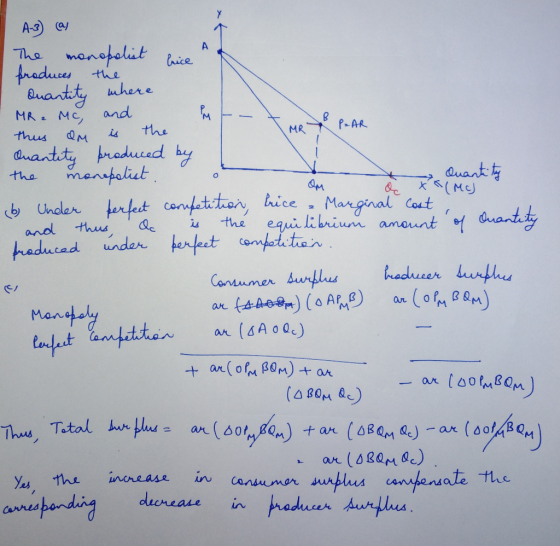
A pharmaceutical company acquired a 10 year drug patent, making the company a monopolist in the corresponding market for this period. Suppose the marginal cost of producing the drug is zero and the demand curve has a downward slope and a positive intercept. (a) Plot the demand, marginal revenue and the marginal cost curves and show the quantity produced by the monopolist. (b) Suppose after the patent runs out, new firms enter the market for this particular drug and the...
A pharmaceutical company acquired a 10 year drug patent, making the company a monopolist in the...
 A pharmaceutical company acquired a 10 year drug patent, making the company a monopolist in the corresponding market for this period. Suppose the marginal cost of producing the drug is zero and the demand curve has a downward slope and a positive intercept. (a) Plot the demand, marginal revenue and the marginal cost curves and show the quantity produced by the monopolist. (b) Suppose after the patent runs out, new firms enter the market for this particular drug and the...
In many countries such as the US, when a pharmaceutical company discovers a new drug, it...
In many countries such as the US, when a pharmaceutical company discovers a new drug, it can apply to the government for a patent on the new drug. The patent gives the company the exclusive right to sell the new drug for a long period of time, such as 20 years. In other words, the pharmaceutical company is a monopolist in the market for the new drug. Suppose the market demand for the new drug is shown as below: Price...
3. Monopoly Consider a situation where a monopolist faces the following inverse market demand curve 132...
 3. Monopoly Consider a situation where a monopolist faces the following inverse market demand curve 132 - 2a p and the following cost function TС — 12g + 2q* a) Derive the marginal revenue and marginal cost functions b) What are the equilibrium price and quantity if this market behaved as if it were competitive? c) Calculate the Consumer Surplus, Producer Surplus and Welfare levels under perfect petition d) What are the equilibrium price and quantity when the monopolist produces...
Part E-H Assume a profit-maximizing monopolist faces a market demand given by P = (12,000 –...
Part E-H Assume a profit-maximizing monopolist faces a market demand given by P = (12,000 – 90Q)/100 and long run total and marginal cost given by LRTC = 5Q + Q2 + 40 (Note: The answer to this question must be hand-written.): a) Find the equation of the marginal revenue curve corresponding to the market demand curve. b) Find the equation for the marginal cost function. c) Find the profit-maximizing quantity of output for the monopoly and the price the...
In the market for apples in Country A, cost curves are shown for both monopoly and...
In the market for apples in Country A, cost curves are shown for both monopoly and perfect competition. Under perfect competition 400 apples are produced at a price of $5 while if the market were operated by Apple Kings (A monopoly) only 150 apples would be produced at a price of $15 per apple. The y-intercept of both Marginal revenue and the demand curve is at $30. (a) Calculate the consumer surplus if the market were operated by Apple Kings...
Drugtech has produced another new drug, a vaccine for the common cold! It has received a...
Drugtech has produced another new drug, a vaccine for the common cold! It has received a patent for the drug’s formula and thus can operate as a monopolist until the patent expires. Drugtech faces demand of P=120-5Q for the vaccine and produce each shot of the vaccine at a constant marginal cost of 10 dollars. Hint: MR=120-10Q. Show ALL work. What is the optimal quantity it should produce? What is the optimal price it should charge? Graph the market for...
Suppose a pharmaceutical firm just invents a new drug to treat mad cow disease and this...
Suppose a pharmaceutical firm just invents a new drug to treat mad cow disease and this is the only effective drug available in the market. The demand and total cost functions of the firm are: Demand: P = 36 – Q Total cost: C = 24 + 2Q2 where P is the price of the drug, Q is the quantity of the drug and C is the total cost of the firm. a. Find the marginal cost and marginal revenue...
2. Assume a pharmaceutical company invented a drug that is more effective in treating (or at...
2. Assume a pharmaceutical company invented a drug that is more effective in treating (or at least life extending) blood cancers and managed to obtain a patent on the drug making the company the sole provider of this blood cancer drug in the market for the next 30 years. Assume in the long-run (i.e.,in 30 years) as the patent expires, given a perfectly elastic long-run supply in the long-run, the competitive price becomes Pc, which also represents the industry’s marginal...
Suppose a profit maximizing monopolist has total cost and marginal cost as follow:
 Suppose a profit maximizing monopolist has total cost and marginal
cost as follow:1. Suppose a profit-maximizing monopolist has total cost and marginal cost as follow: \(\mathrm{TC}=0.1 Q^{2}+Q+10\) and \(\mathrm{MC}=0.2 Q+1\). It faces the demand curve \(\mathrm{Q}=35-5^{\mathrm{P}} .(35\) points \()\)a) What are the price, output, and profit for this monopolist?b) Carefully draw the diagram that illustrates your answers.c) What are the equilibrium price, output, and total profit if this is a perfectly competitive market?d) Compare the results between monopoly and perfect...
Suppose a profit maximizing monopolist has total cost and marginal
cost as follow:1. Suppose a profit-maximizing monopolist has total cost and marginal cost as follow: \(\mathrm{TC}=0.1 Q^{2}+Q+10\) and \(\mathrm{MC}=0.2 Q+1\). It faces the demand curve \(\mathrm{Q}=35-5^{\mathrm{P}} .(35\) points \()\)a) What are the price, output, and profit for this monopolist?b) Carefully draw the diagram that illustrates your answers.c) What are the equilibrium price, output, and total profit if this is a perfectly competitive market?d) Compare the results between monopoly and perfect...
 A pharmaceutical company acquired a 10 year drug patent, making the company a monopolist in the corresponding market for this period. Suppose the marginal cost of producing the drug is zero and the demand curve has a downward slope and a positive intercept. (a) Plot the demand, marginal revenue and the marginal cost curves and show the quantity produced by the monopolist. (b) Suppose after the patent runs out, new firms enter the market for this particular drug and the...
 3. Monopoly Consider a situation where a monopolist faces the following inverse market demand curve 132 - 2a p and the following cost function TС — 12g + 2q* a) Derive the marginal revenue and marginal cost functions b) What are the equilibrium price and quantity if this market behaved as if it were competitive? c) Calculate the Consumer Surplus, Producer Surplus and Welfare levels under perfect petition d) What are the equilibrium price and quantity when the monopolist produces...
 Suppose a profit maximizing monopolist has total cost and marginal
cost as follow:1. Suppose a profit-maximizing monopolist has total cost and marginal cost as follow: \(\mathrm{TC}=0.1 Q^{2}+Q+10\) and \(\mathrm{MC}=0.2 Q+1\). It faces the demand curve \(\mathrm{Q}=35-5^{\mathrm{P}} .(35\) points \()\)a) What are the price, output, and profit for this monopolist?b) Carefully draw the diagram that illustrates your answers.c) What are the equilibrium price, output, and total profit if this is a perfectly competitive market?d) Compare the results between monopoly and perfect...
Suppose a profit maximizing monopolist has total cost and marginal
cost as follow:1. Suppose a profit-maximizing monopolist has total cost and marginal cost as follow: \(\mathrm{TC}=0.1 Q^{2}+Q+10\) and \(\mathrm{MC}=0.2 Q+1\). It faces the demand curve \(\mathrm{Q}=35-5^{\mathrm{P}} .(35\) points \()\)a) What are the price, output, and profit for this monopolist?b) Carefully draw the diagram that illustrates your answers.c) What are the equilibrium price, output, and total profit if this is a perfectly competitive market?d) Compare the results between monopoly and perfect...
Most questions answered within 3 hours.
-
Where is the error in this code sequence?
String s1 = "Hello";
String s2 = "ello";...
asked 10 months ago -
Financial data for Joel de Paris, Inc., for last year
follow:
Joel de Paris, Inc.
Balance...
asked 10 months ago -
Consider this reaction:
Al2(SO4)3 (aq)+ BaCl3
(aq) Al2Cl6 (aq)- +
3BaSO4(s) . What is the...
asked 10 months ago -
Suppose that Savneet is considering increasing her
recent random sample from 20 car rentals to 40...
asked 10 months ago -
Trucks arrive at an unloading terminal at an average rate of 120
per hour.
Trucks arrive...
asked 10 months ago -
Why are methanol and ethanol completely soluble in water while
octanol is not very little soluble....
asked 10 months ago -
A facilities manager at a university reads in a research report
that the mean amount of...
asked 10 months ago -
When the CuSO4 is rehydrated by adding water to the anhydrous
compound, is this an endothermic...
asked 10 months ago -
A ray of sunlight is passing from diamond into crown glass; the
angle of incidence is...
asked 10 months ago -
A block of mass 0.249 kg is placed on top of a light, vertical
spring of...
asked 10 months ago -
how do the kidneys compensate in the presences of acidosis
a) trigger hyperventilate
b) reserve acid...
asked 10 months ago -
Question 501 pts
The rental rate of capital to the firm increases. Which of the
following...
asked 10 months ago