
Homework Answers
In general, primary alkyl halides undergo reactions with strong nucleophiles and tertiary alkyl halides undergo reaction with weak nucleophiles.
Strong nucleophile is required for reaction and these reactions are occurred in polar aprotic solvents (i.e. DMSO, DMF etc.).
Weak nucleophile is required for reaction. If a nucleophile is strong then there is a chance for the E2 product formation.
Part a
The reaction is,

Part b
The reaction is,

Thus, the choice of reagent is .
Select the best conditions for the reactions. CH3OH NaOCH3, CH3OH H+, NaOCH3, CH3OH NaOCH3, DMSO H+, NaOCH3, DMSO...
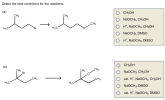 Select the best conditions for the reactions. CH3OH NaOCH3, CH3OH H+, NaOCH3, CH3OH NaOCH3, DMSO H+, NaOCH3, DMSO CH3OH NaOCH3, CH3OH cat. H+, NaOCH3, CH3OH NaOCH3, DMSO cat. H+, NaOCH3, DMSO
Place the best reagent and conditions in the bins for each of the following reactions. (Stoichiometry...
 Place the best reagent and conditions in the bins for each of the following reactions. (Stoichiometry is omitted.) Treating an acyl chloride with a Grignard reagent tends to form (via two steps) an alcohol. A different reagent is needed to stop the reaction at the ketone product.
Reactions In each reaction box, place the best reagent and conditions from the list below. 2)...
 Reactions
In each reaction box, place the best reagent and conditions from the list below. 2) Br2 HBr (CH3)3C0- 03 in CH2Cl2 NaBH4 in EtOH CH3COO- BHY/THE H2Oz/NaOH CH3CH20-
Reactions
In each reaction box, place the best reagent and conditions from the list below. 2) Br2 HBr (CH3)3C0- 03 in CH2Cl2 NaBH4 in EtOH CH3COO- BHY/THE H2Oz/NaOH CH3CH20-
Select the best reagents for each of the following five reactions. Explanation would be helpful thanks
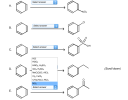 Select the best reagents for each of the following five
reactions. Explanation would be helpful thanks
Select the best reagents for each of the following five
reactions. Explanation would be helpful thanks
Which enzymes in glycolysis catalyze reactions thx are irreversible in cellular conditions? Select all that apply....
 Which enzymes in glycolysis catalyze reactions thx are irreversible in cellular conditions? Select all that apply. 0 Select all that apply Hexokinase Phosphoglucoisomerase с Phosphofructokinase Aldolase Triose Phosphate Isomerase Glyceraldehyde-3-phosphate dehydrogenase Phosphoglycerate kinase H Phosphoglycerate Mutase Enolase Submit Pyruvate kinase
For multi-step reactions, which is the best method? Select one: two steps three steps four steps...
For multi-step reactions, which is the best method? Select one: two steps three steps four steps five steps six steps
Which sequence of conditions best accomplishes the transformation below? CN steps Select one: O a. 1)...
 Which sequence of conditions best accomplishes the transformation below? CN steps Select one: O a. 1) LDA; i)CN ; ) NaOH :) H30* O C. 1) NaOH; ii) CN ; ) H30 O b. 1) NaH; b) I CN O d. 1) H+ -(H2O); 11) CN ; II) H,O* N
Which sequence of conditions best accomplishes the transformation below? Br steps Select one: O a. i)...
 Which sequence of conditions best accomplishes the transformation below? Br steps Select one: O a. i) Mg; ii) CO2; iii) ETOH, H, heat o b.i) Mg; ii) SOCI; iii) EtOH, pyridine O c. i) CO2; ii) EtOH, H+ O d. i) Na2Cr207, H2SO4; ii) SOCI; ii) EtOH, pyridine
Which sequence of conditions best accomplishes the transformation below? OH OH steps Select one: O a....
 Which sequence of conditions best accomplishes the transformation below? OH OH steps Select one: O a. i) LDA, -78 °C; ii) CH3CH2CHO; iii) Zn, HCI o b.i) NaOEt -78 °C; ii) CH3CH2CHO; iii) Zn, HCI O c. 1) LDA, -78 °C; ii) CH3CH2CHO; iii) NaBHA o d. i) NaOet 25 °C; ii) CH3CH2CHO;iii) NaBH4
Which sequence of conditions best accomplishes the transformation below? COH Select one: O a. 1) KMnO4,...
 Which sequence of conditions best accomplishes the transformation below? COH Select one: O a. 1) KMnO4, KOH; then H30*. 2) Cl2, FeCl3. 3) (CH3)3CCI, AICI: o b. 1) Cl2, FeCl3. 2) KMnO4, KOH; then H30*. 3) (CH3)3CCI, AICI: O c. 1) KMnO4, KOH; then H307. 2) (CH3)3CCI, AICI:. 3) Cl, FeCl3 od 1) (CH3)3CCI, AICI. 2) Cl2, FeClz. 3) KMnO, KOH; then H30*
 Select the best conditions for the reactions. CH3OH NaOCH3, CH3OH H+, NaOCH3, CH3OH NaOCH3, DMSO H+, NaOCH3, DMSO CH3OH NaOCH3, CH3OH cat. H+, NaOCH3, CH3OH NaOCH3, DMSO cat. H+, NaOCH3, DMSO
 Place the best reagent and conditions in the bins for each of the following reactions. (Stoichiometry is omitted.) Treating an acyl chloride with a Grignard reagent tends to form (via two steps) an alcohol. A different reagent is needed to stop the reaction at the ketone product.
 Reactions
In each reaction box, place the best reagent and conditions from the list below. 2) Br2 HBr (CH3)3C0- 03 in CH2Cl2 NaBH4 in EtOH CH3COO- BHY/THE H2Oz/NaOH CH3CH20-
Reactions
In each reaction box, place the best reagent and conditions from the list below. 2) Br2 HBr (CH3)3C0- 03 in CH2Cl2 NaBH4 in EtOH CH3COO- BHY/THE H2Oz/NaOH CH3CH20-
 Select the best reagents for each of the following five
reactions. Explanation would be helpful thanks
Select the best reagents for each of the following five
reactions. Explanation would be helpful thanks
 Which enzymes in glycolysis catalyze reactions thx are irreversible in cellular conditions? Select all that apply. 0 Select all that apply Hexokinase Phosphoglucoisomerase с Phosphofructokinase Aldolase Triose Phosphate Isomerase Glyceraldehyde-3-phosphate dehydrogenase Phosphoglycerate kinase H Phosphoglycerate Mutase Enolase Submit Pyruvate kinase
 Which sequence of conditions best accomplishes the transformation below? CN steps Select one: O a. 1) LDA; i)CN ; ) NaOH :) H30* O C. 1) NaOH; ii) CN ; ) H30 O b. 1) NaH; b) I CN O d. 1) H+ -(H2O); 11) CN ; II) H,O* N
 Which sequence of conditions best accomplishes the transformation below? Br steps Select one: O a. i) Mg; ii) CO2; iii) ETOH, H, heat o b.i) Mg; ii) SOCI; iii) EtOH, pyridine O c. i) CO2; ii) EtOH, H+ O d. i) Na2Cr207, H2SO4; ii) SOCI; ii) EtOH, pyridine
 Which sequence of conditions best accomplishes the transformation below? OH OH steps Select one: O a. i) LDA, -78 °C; ii) CH3CH2CHO; iii) Zn, HCI o b.i) NaOEt -78 °C; ii) CH3CH2CHO; iii) Zn, HCI O c. 1) LDA, -78 °C; ii) CH3CH2CHO; iii) NaBHA o d. i) NaOet 25 °C; ii) CH3CH2CHO;iii) NaBH4
 Which sequence of conditions best accomplishes the transformation below? COH Select one: O a. 1) KMnO4, KOH; then H30*. 2) Cl2, FeCl3. 3) (CH3)3CCI, AICI: o b. 1) Cl2, FeCl3. 2) KMnO4, KOH; then H30*. 3) (CH3)3CCI, AICI: O c. 1) KMnO4, KOH; then H307. 2) (CH3)3CCI, AICI:. 3) Cl, FeCl3 od 1) (CH3)3CCI, AICI. 2) Cl2, FeClz. 3) KMnO, KOH; then H30*
Most questions answered within 3 hours.
-
Where is the error in this code sequence?
String s1 = "Hello";
String s2 = "ello";...
asked 10 months ago -
Financial data for Joel de Paris, Inc., for last year
follow:
Joel de Paris, Inc.
Balance...
asked 10 months ago -
Consider this reaction:
Al2(SO4)3 (aq)+ BaCl3
(aq) Al2Cl6 (aq)- +
3BaSO4(s) . What is the...
asked 10 months ago -
Suppose that Savneet is considering increasing her
recent random sample from 20 car rentals to 40...
asked 10 months ago -
Trucks arrive at an unloading terminal at an average rate of 120
per hour.
Trucks arrive...
asked 10 months ago -
Why are methanol and ethanol completely soluble in water while
octanol is not very little soluble....
asked 10 months ago -
A facilities manager at a university reads in a research report
that the mean amount of...
asked 10 months ago -
When the CuSO4 is rehydrated by adding water to the anhydrous
compound, is this an endothermic...
asked 10 months ago -
A ray of sunlight is passing from diamond into crown glass; the
angle of incidence is...
asked 10 months ago -
A block of mass 0.249 kg is placed on top of a light, vertical
spring of...
asked 10 months ago -
how do the kidneys compensate in the presences of acidosis
a) trigger hyperventilate
b) reserve acid...
asked 10 months ago -
Question 501 pts
The rental rate of capital to the firm increases. Which of the
following...
asked 10 months ago