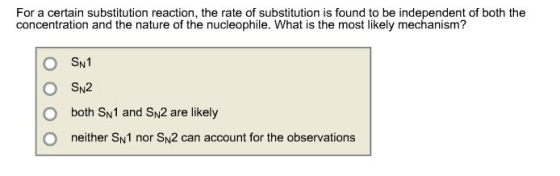
For a certain substitution reaction, the rate of substitution is found to be independent of both the concentration and the nature of the nucleophile. What is the most likely mechanism?
Homework Answers
The correct option needs to be chosen amongst the given set of mechanisms in which the concentration of nucleophile has no effect on the reaction rate.
Consider the mechanism of each reaction and determine the reaction rate from the slow step.
reaction: It stands for substitution nucleophilic unimolecular reaction. The reaction is a two-step reaction. The first step involves the removal of halide ion to form carbocation. The attack of nucleophile occurs in the second step.
reaction: It stands for substitution nucleophilic bimolecular reaction. The reaction is a single step and the removal of halide ion and the attack of the incoming nucleophile occurs in the same step.
The rate of reaction is dependent on the concentration of the haloalkane and the concentration of nucleophile has no effect on reaction rate.
The rate of reaction is dependent on the concentration of the haloalkane as well as the nucleophile.
Ans:Choose the correct options as follows:

Add Answer to:
For a certain substitution reaction, the rate of substitution is
found to be independent of both the concentration an...
What is UNTRUE about this substitution reaction? -Br- The reaction rate will double when the concentration...
 What is UNTRUE about this substitution reaction? -Br- The reaction rate will double when the concentration of the electrophile is doubled It will likely proceed via an SN1 mechanism It will take place in a single step An intermediate carbocation will be produced during the reaction Analyze this reaction mechanism and identify all species that act as nucleophiles in this process: сон ZI U OB and D O A and D OB, C and E O A, D, and F...
Which of the following would increase the proportion of a substitution reaction that proceeds via a...
 Which of the following would increase the proportion of a substitution reaction that proceeds via a $ 2 mechanism, rather than S, 1? (choose all correct answers) Use a less reactive nucleophile. Use a more highly substituted alkyl halide. Increase the concentration of the alkyl halide. Increase the concentration of the nucleophile Which of the following reactions would most likely proceed via a SN 1 mechanism? (choose all correct answers) + CH3OH Br + HO- Br + CN + HBr...
What substitution mechanism (Sn1, SN2, both, or neither) is expected for the following compound? Br What substitution m...
 What substitution mechanism (Sn1, SN2, both, or neither) is expected for the following compound? Br What substitution mechanism (Sn1, SN2, both, or neither) is expected for the following reaction? -nucleophile attacks 12 - inversion of conf SCH
Select the mechanism(s) where the concentration of the nucleophile has no effect on the reaction rate....
 Select the mechanism(s) where the concentration of the
nucleophile has no effect on the reaction rate.
Select the mechanism(s) where the concentration of the nucleophile has no effect on the reaction rate. SN1 SN2 E1 E2
Select the mechanism(s) where the concentration of the
nucleophile has no effect on the reaction rate.
Select the mechanism(s) where the concentration of the nucleophile has no effect on the reaction rate. SN1 SN2 E1 E2
Substitution v Elimination Exercise Work in pairs. Take one card of each color. For each: 1....
 Substitution v Elimination Exercise Work in pairs. Take one card of each color. For each: 1. Draw the most likely product. 2. State the most likely mechanism. 3. What is the base/nucleophile (which is it in each) 4. Write a rate equation. 5. Draw the intermediate or transition state, as appropriate to your mechanism 6. Draw a reaction energy diagram to go with your mechanism. Hint: a different mechanism is favored for each color of cards
For the following reaction, the cyanide nucleophile could reasonably substitute at either of two positions. One...
 For the following reaction, the cyanide nucleophile could
reasonably substitute at either of two positions. One mechanism
produces 4-cyanoheptane and dimethylsulfide. The competing
mechanism produces 4-methylthioheptane and acetonitrile (CH3CN). In
practice, only one substitution is observed. Choose the most likely
mechanistic pathway for this reaction and draw both of the
products. Select whether it proceeds via an SN1 or SN2
mechanism.
This is a Mixed question/ It is worth 4 points / You have unlimited attempts / There is a...
For the following reaction, the cyanide nucleophile could
reasonably substitute at either of two positions. One mechanism
produces 4-cyanoheptane and dimethylsulfide. The competing
mechanism produces 4-methylthioheptane and acetonitrile (CH3CN). In
practice, only one substitution is observed. Choose the most likely
mechanistic pathway for this reaction and draw both of the
products. Select whether it proceeds via an SN1 or SN2
mechanism.
This is a Mixed question/ It is worth 4 points / You have unlimited attempts / There is a...
Which of the following would increase the proportion of a substitution reaction that proceeds via a...
Which of the following would increase the proportion of a substitution reaction that proceeds via a SN2 mechanism, rather than SN1? (choose all correct answers) Group of answer choices Use a less reactive nucleophile. Use a more highly substituted alkyl halide. Increase the concentration of the alkyl halide. Increase the concentration of the nucleophile
Question 21 Which of the following would increase the proportion of a substitution reaction that proceeds...
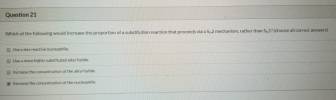 Question 21 Which of the following would increase the proportion of a substitution reaction that proceeds via a S2 mechanism, rather than Sw1? (choose all correct answers) Use a less reactive nucleophile. Use a more highly substituted alkyl halide. Increase the concentration of the alkyl halide. Increase the concentration of the nucleophile
5. (a) The following is a substitution reaction using a sulfonium ion, which has a sulfur-based...
 5. (a) The following is a substitution reaction using a sulfonium ion, which has a sulfur-based leaving group, rather than an alkyl halide. Four different nucleophiles were used in the substitution reaction and their rates were measured Rationalize the trend in reaction rates and indicate the dominant mechanism in each case Nu SPh2 Ph OH SH Rate 3.9 3.8 74 257 (b) (R)-2-Bromooctane was stirred with excess sodium iodide in acetone at room temperature for 2 days. Write an equation...
Sul B Sx2 Either Syl or S2 None of these D) 103) What substitution reaction mechanism...
 Sul B Sx2 Either Syl or S2 None of these D) 103) What substitution reaction mechanism is most likely for the following conversion? A) SI SN2 Either Snl or S2 None of these 105) Which of the following is a strong nucleophile? OH H0 A) B) C) D) E) CH OH ΝΗ, All of these 108) Which of the following is a weakest nucleophile in a polar protic solvent? A) F B) CH Br D) E) All of these 111)...
 What is UNTRUE about this substitution reaction? -Br- The reaction rate will double when the concentration of the electrophile is doubled It will likely proceed via an SN1 mechanism It will take place in a single step An intermediate carbocation will be produced during the reaction Analyze this reaction mechanism and identify all species that act as nucleophiles in this process: сон ZI U OB and D O A and D OB, C and E O A, D, and F...
 Which of the following would increase the proportion of a substitution reaction that proceeds via a $ 2 mechanism, rather than S, 1? (choose all correct answers) Use a less reactive nucleophile. Use a more highly substituted alkyl halide. Increase the concentration of the alkyl halide. Increase the concentration of the nucleophile Which of the following reactions would most likely proceed via a SN 1 mechanism? (choose all correct answers) + CH3OH Br + HO- Br + CN + HBr...
 What substitution mechanism (Sn1, SN2, both, or neither) is expected for the following compound? Br What substitution mechanism (Sn1, SN2, both, or neither) is expected for the following reaction? -nucleophile attacks 12 - inversion of conf SCH
 Select the mechanism(s) where the concentration of the
nucleophile has no effect on the reaction rate.
Select the mechanism(s) where the concentration of the nucleophile has no effect on the reaction rate. SN1 SN2 E1 E2
Select the mechanism(s) where the concentration of the
nucleophile has no effect on the reaction rate.
Select the mechanism(s) where the concentration of the nucleophile has no effect on the reaction rate. SN1 SN2 E1 E2
 Substitution v Elimination Exercise Work in pairs. Take one card of each color. For each: 1. Draw the most likely product. 2. State the most likely mechanism. 3. What is the base/nucleophile (which is it in each) 4. Write a rate equation. 5. Draw the intermediate or transition state, as appropriate to your mechanism 6. Draw a reaction energy diagram to go with your mechanism. Hint: a different mechanism is favored for each color of cards
 For the following reaction, the cyanide nucleophile could
reasonably substitute at either of two positions. One mechanism
produces 4-cyanoheptane and dimethylsulfide. The competing
mechanism produces 4-methylthioheptane and acetonitrile (CH3CN). In
practice, only one substitution is observed. Choose the most likely
mechanistic pathway for this reaction and draw both of the
products. Select whether it proceeds via an SN1 or SN2
mechanism.
This is a Mixed question/ It is worth 4 points / You have unlimited attempts / There is a...
For the following reaction, the cyanide nucleophile could
reasonably substitute at either of two positions. One mechanism
produces 4-cyanoheptane and dimethylsulfide. The competing
mechanism produces 4-methylthioheptane and acetonitrile (CH3CN). In
practice, only one substitution is observed. Choose the most likely
mechanistic pathway for this reaction and draw both of the
products. Select whether it proceeds via an SN1 or SN2
mechanism.
This is a Mixed question/ It is worth 4 points / You have unlimited attempts / There is a...
 Question 21 Which of the following would increase the proportion of a substitution reaction that proceeds via a S2 mechanism, rather than Sw1? (choose all correct answers) Use a less reactive nucleophile. Use a more highly substituted alkyl halide. Increase the concentration of the alkyl halide. Increase the concentration of the nucleophile
 5. (a) The following is a substitution reaction using a sulfonium ion, which has a sulfur-based leaving group, rather than an alkyl halide. Four different nucleophiles were used in the substitution reaction and their rates were measured Rationalize the trend in reaction rates and indicate the dominant mechanism in each case Nu SPh2 Ph OH SH Rate 3.9 3.8 74 257 (b) (R)-2-Bromooctane was stirred with excess sodium iodide in acetone at room temperature for 2 days. Write an equation...
 Sul B Sx2 Either Syl or S2 None of these D) 103) What substitution reaction mechanism is most likely for the following conversion? A) SI SN2 Either Snl or S2 None of these 105) Which of the following is a strong nucleophile? OH H0 A) B) C) D) E) CH OH ΝΗ, All of these 108) Which of the following is a weakest nucleophile in a polar protic solvent? A) F B) CH Br D) E) All of these 111)...
Most questions answered within 3 hours.
-
Where is the error in this code sequence?
String s1 = "Hello";
String s2 = "ello";...
asked 10 months ago -
Financial data for Joel de Paris, Inc., for last year
follow:
Joel de Paris, Inc.
Balance...
asked 10 months ago -
Consider this reaction:
Al2(SO4)3 (aq)+ BaCl3
(aq) Al2Cl6 (aq)- +
3BaSO4(s) . What is the...
asked 10 months ago -
Suppose that Savneet is considering increasing her
recent random sample from 20 car rentals to 40...
asked 10 months ago -
Trucks arrive at an unloading terminal at an average rate of 120
per hour.
Trucks arrive...
asked 10 months ago -
Why are methanol and ethanol completely soluble in water while
octanol is not very little soluble....
asked 10 months ago -
A facilities manager at a university reads in a research report
that the mean amount of...
asked 10 months ago -
When the CuSO4 is rehydrated by adding water to the anhydrous
compound, is this an endothermic...
asked 10 months ago -
A ray of sunlight is passing from diamond into crown glass; the
angle of incidence is...
asked 10 months ago -
A block of mass 0.249 kg is placed on top of a light, vertical
spring of...
asked 10 months ago -
how do the kidneys compensate in the presences of acidosis
a) trigger hyperventilate
b) reserve acid...
asked 10 months ago -
Question 501 pts
The rental rate of capital to the firm increases. Which of the
following...
asked 10 months ago