
Homework Answers
A reaction is given which needs to be completed with the correct substitution mechanism and the correct organic product needs to be given. Observe the given haloalkane whether it is primary, secondary or tertiary and then identify the type of mechanism that it would undergo and then write the product.
Substitution reaction can be categorized as,  and
and  depending on the type of mechanism followed.
reaction is unimolecular nucleophilic substitution reaction which takes place between a haloalkane and a nucleophile. The reaction takes place in two step through a carbocation intermediate and the reaction product are formed with both retention as well as inversion of configuration. Consider the following scheme of a reaction:

The nucleophile can attack from front side as well as from the back side to form the products with both retention of configuration and inversion of configuration.
In haloalkane, the order of reactivity for the substitution reaction is,  like the stability of carbocation.
reaction is bimolecular nucleophilic substitution reaction which takes place between a haloalkane and a nucleophile. The reaction takes place in one step through a transition state. Consider the following scheme of a reaction:

As the attack from the front is hindered by the leaving group, therefore, nucleophile can only attack from the back to form the product with inversion of configuration.
In haloalkane, the order of reactivity for the  substitution reaction is,
  .
.
Consider the given reactant and classify it as primary, secondary, and tertiary then write the type of substitution mechanism that the given reactant will undergo. Also, consider the strength of the given nucleophile as shown below:

As secondary haloalkane is given and the nucleophile employed is weak hence, the reaction will undergo  reaction mechanism.
Write the product of the given reaction following the  substitution mechanism as shown below:

Hence, the correct product of the given reaction is:

Add Answer to:
Which of the following would be the substitution product or products if ( R)-3-chloro-3-methylhexane were allowed to r...
1 The reaction between (R)-3-chloro-3 methylhexane and methanol, which also serves as solvent for the reaction,...
 1 The reaction between (R)-3-chloro-3 methylhexane and methanol, which also serves as solvent for the reaction, gives a mixture of substitution and elimination products. нснен, CH,OH products + CH Draw the stereochemically correct structure(s) for the substitution product(s). (4 pt.) A B Draw all potential regio-isomeric elimination products. (4 pt) C Use curved arrows to show in a stepwise manner the electron flow for the substitution reaction. Stereochemistry counts! (4 pt.) D Use curved arrows to show in a stepwise...
(R)–3-chloro-2-methylhexane may undergo a nucleophilic substitution reaction in the presence of sodium ethoxide and ethanol. Complete...
 (R)–3-chloro-2-methylhexane may undergo a nucleophilic
substitution reaction in the presence of sodium ethoxide and
ethanol. Complete the mechanism and draw the products of the
reaction.
<Chapter 7 SN2 and E2 Reactions of Alkyl Halides DOCH: FU MacBook Air
(R)–3-chloro-2-methylhexane may undergo a nucleophilic
substitution reaction in the presence of sodium ethoxide and
ethanol. Complete the mechanism and draw the products of the
reaction.
<Chapter 7 SN2 and E2 Reactions of Alkyl Halides DOCH: FU MacBook Air
(S)-3-chloro-3-methylhexane is reacted with sodium iodide in water Select all products that are formed.
(S)-3-chloro-3-methylhexane is reacted with sodium iodide in water Select all products that are formed.(R)-2-iodo-3-methylhexane(S)-3-iodo-3-methylhexane(R)-3-iodo-3-methylhexane(E)-3-methylhext-3-ene(Z)-3-methylhext-3-ene(S)-2-iodo-3-methylhexane
Consider the substitution reaction that takes place when (R)-3-bromo-3-methylhexane is treated with methanol. What of the...
Consider the substitution reaction that takes place when (R)-3-bromo-3-methylhexane is treated with methanol. What of the following would be true? A.) The reaction would take place only with inversion of configuration at the stereogenic center. B.) The reaction would take place only with retention of configuration at the stereogenic center. C.) The reaction would take place with racemization D.) No reaction would take place.
Which of the following would be the products of an SN2 substitution of trans-1- chloro-4-methyl-cyclohexane reacting...
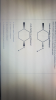 Which of the following would be the products of an SN2 substitution of trans-1- chloro-4-methyl-cyclohexane reacting with hydroxide? trans-4-methyl-1-cyclohexanol cis-4-methyl-1-cyclohexanol A. trans-4-methyl-1-cyclohexanol D. 1-methyl-1-cyclohexanol B.cis-4-methyl-1-cyclohexanol C. a 50:50 mixture of the cis and trans products
S-3-chloro-3-methylhexane reacts with an iodide anion, I-. a) Will this reaction proceed via an SN1, SN2,...
S-3-chloro-3-methylhexane reacts with an iodide anion, I-. a) Will this reaction proceed via an SN1, SN2, E1, or E2 reaction mechanism? b) What is the IUPAC name of the product(s) of this reaction? Include R and S designations if relevant. c) After the reaction has occurred, will the product solution be optically active?
The question states... "Draw structures for the following names. Show stereochemistry explicitly." a.) R-3-ethyl-4-methylhexane b.) 2R,4S-4-chloro-2-fluoroheptane
The question states... "Draw structures for the following names. Show stereochemistry explicitly." a.) R-3-ethyl-4-methylhexane b.) 2R,4S-4-chloro-2-fluoroheptane
Predict the substitution product(s) for each of the following reactions and mechanisms by which they are...
 Predict the substitution product(s) for each of the following reactions and mechanisms by which they are formed. If no reaction is expected, write no (a) (R)-2-bromobutane with sodium iodide in acetone (b) (R)-3-bromo-3-methylhexane with H20 (c) trans-1-bromo-2-ethylcyclopentane with potassium ethoxide in ethanol (d) trans-1-bromo-3-methylcyclopentane with Nal in acetone 5. For the following set of compounds, predict the order of reactivity with sodium iodide in acetone solution (list them in increasing order of reactivity). C. D. 2-bromobutane 1-chlorobutane 2-chloro-3-methylbutane 2-bromo-2-methylpropane 1-bromobutane...
3. Which of the reactions proceeded predominantly by the Si substitution mechanism? Passage 10 (Questions 1-6)...
 3. Which of the reactions proceeded predominantly by the Si substitution mechanism? Passage 10 (Questions 1-6) A student ran a series of experiments to study the S1 and S2 reaction mechanisms. The results are shown below: A. Reactions 1 and B. Reactions 2 and 4 C. Reactions 3 and 4 D. Reactions 3 and 5 Nal 1. Br acetone Br OE NaOE: HOE: 4. Which one of the following statements concerning the $ 2 reaction mechanism is true? A. It...
In the presence of sodium ethoxide and ethanol, (R)–3-chloro-2-methylhexane can undergo an elimination reaction as well...
 In the presence of sodium ethoxide and ethanol,
(R)–3-chloro-2-methylhexane can undergo an elimination
reaction as well as the SN2 reaction. Complete the reaction
mechanism for the major product of the reaction and draw that
product of the elimination reaction.
Draw all missing reactants and/or products in the appropriate
boxes by placing atoms on the grid and connecting them with bonds
and including charges where needed. Indicate the mechanism by
drawing the electron-flow arrows on the molecules. Arrows should
start on...
In the presence of sodium ethoxide and ethanol,
(R)–3-chloro-2-methylhexane can undergo an elimination
reaction as well as the SN2 reaction. Complete the reaction
mechanism for the major product of the reaction and draw that
product of the elimination reaction.
Draw all missing reactants and/or products in the appropriate
boxes by placing atoms on the grid and connecting them with bonds
and including charges where needed. Indicate the mechanism by
drawing the electron-flow arrows on the molecules. Arrows should
start on...
 1 The reaction between (R)-3-chloro-3 methylhexane and methanol, which also serves as solvent for the reaction, gives a mixture of substitution and elimination products. нснен, CH,OH products + CH Draw the stereochemically correct structure(s) for the substitution product(s). (4 pt.) A B Draw all potential regio-isomeric elimination products. (4 pt) C Use curved arrows to show in a stepwise manner the electron flow for the substitution reaction. Stereochemistry counts! (4 pt.) D Use curved arrows to show in a stepwise...
 (R)–3-chloro-2-methylhexane may undergo a nucleophilic
substitution reaction in the presence of sodium ethoxide and
ethanol. Complete the mechanism and draw the products of the
reaction.
<Chapter 7 SN2 and E2 Reactions of Alkyl Halides DOCH: FU MacBook Air
(R)–3-chloro-2-methylhexane may undergo a nucleophilic
substitution reaction in the presence of sodium ethoxide and
ethanol. Complete the mechanism and draw the products of the
reaction.
<Chapter 7 SN2 and E2 Reactions of Alkyl Halides DOCH: FU MacBook Air
 Which of the following would be the products of an SN2 substitution of trans-1- chloro-4-methyl-cyclohexane reacting with hydroxide? trans-4-methyl-1-cyclohexanol cis-4-methyl-1-cyclohexanol A. trans-4-methyl-1-cyclohexanol D. 1-methyl-1-cyclohexanol B.cis-4-methyl-1-cyclohexanol C. a 50:50 mixture of the cis and trans products
 Predict the substitution product(s) for each of the following reactions and mechanisms by which they are formed. If no reaction is expected, write no (a) (R)-2-bromobutane with sodium iodide in acetone (b) (R)-3-bromo-3-methylhexane with H20 (c) trans-1-bromo-2-ethylcyclopentane with potassium ethoxide in ethanol (d) trans-1-bromo-3-methylcyclopentane with Nal in acetone 5. For the following set of compounds, predict the order of reactivity with sodium iodide in acetone solution (list them in increasing order of reactivity). C. D. 2-bromobutane 1-chlorobutane 2-chloro-3-methylbutane 2-bromo-2-methylpropane 1-bromobutane...
 3. Which of the reactions proceeded predominantly by the Si substitution mechanism? Passage 10 (Questions 1-6) A student ran a series of experiments to study the S1 and S2 reaction mechanisms. The results are shown below: A. Reactions 1 and B. Reactions 2 and 4 C. Reactions 3 and 4 D. Reactions 3 and 5 Nal 1. Br acetone Br OE NaOE: HOE: 4. Which one of the following statements concerning the $ 2 reaction mechanism is true? A. It...
 In the presence of sodium ethoxide and ethanol,
(R)–3-chloro-2-methylhexane can undergo an elimination
reaction as well as the SN2 reaction. Complete the reaction
mechanism for the major product of the reaction and draw that
product of the elimination reaction.
Draw all missing reactants and/or products in the appropriate
boxes by placing atoms on the grid and connecting them with bonds
and including charges where needed. Indicate the mechanism by
drawing the electron-flow arrows on the molecules. Arrows should
start on...
In the presence of sodium ethoxide and ethanol,
(R)–3-chloro-2-methylhexane can undergo an elimination
reaction as well as the SN2 reaction. Complete the reaction
mechanism for the major product of the reaction and draw that
product of the elimination reaction.
Draw all missing reactants and/or products in the appropriate
boxes by placing atoms on the grid and connecting them with bonds
and including charges where needed. Indicate the mechanism by
drawing the electron-flow arrows on the molecules. Arrows should
start on...
Most questions answered within 3 hours.
-
Where is the error in this code sequence?
String s1 = "Hello";
String s2 = "ello";...
asked 11 months ago -
Financial data for Joel de Paris, Inc., for last year
follow:
Joel de Paris, Inc.
Balance...
asked 11 months ago -
Consider this reaction:
Al2(SO4)3 (aq)+ BaCl3
(aq) Al2Cl6 (aq)- +
3BaSO4(s) . What is the...
asked 11 months ago -
Suppose that Savneet is considering increasing her
recent random sample from 20 car rentals to 40...
asked 11 months ago -
Trucks arrive at an unloading terminal at an average rate of 120
per hour.
Trucks arrive...
asked 11 months ago -
Why are methanol and ethanol completely soluble in water while
octanol is not very little soluble....
asked 11 months ago -
A facilities manager at a university reads in a research report
that the mean amount of...
asked 11 months ago -
When the CuSO4 is rehydrated by adding water to the anhydrous
compound, is this an endothermic...
asked 11 months ago -
A ray of sunlight is passing from diamond into crown glass; the
angle of incidence is...
asked 11 months ago -
A block of mass 0.249 kg is placed on top of a light, vertical
spring of...
asked 11 months ago -
how do the kidneys compensate in the presences of acidosis
a) trigger hyperventilate
b) reserve acid...
asked 11 months ago -
Question 501 pts
The rental rate of capital to the firm increases. Which of the
following...
asked 11 months ago