
Homework Answers
Add Answer to:
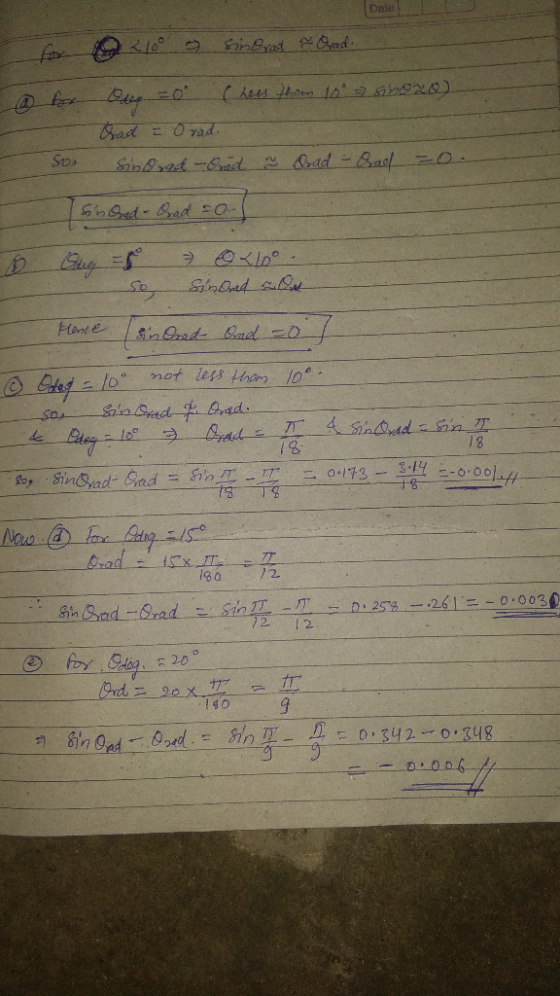
When angles are small |0| < 10° we often make the small angle approximation that sin Orad ñ Orad, where Orad is the...
en angles are small, we often use the "small-angle approximation": we use simply e tin In...
 en angles are small, we often use the "small-angle approximation": we use simply e tin In the table below, calculate the values and percentage error we would get by using θ in radians in place for smaller angles. As an example, one line of the table is completed for 3. (3 pts. total) Wh radians in place of (sin θ) or (tan θ), since the three are very nearly equal of sin θ or tan θ. (You do NOT need...
The small angle approximation is often made to simplify derivations and calculations. For the following angles...
The small angle approximation is often made to simplify derivations and calculations. For the following angles θ, compare the true value of the sine of the angle to the to the small angle approximation (using only the first term in the series expansion of the sine) by determining the fractional error (let the fractional error be positive). NOTE: If you explicitly use π to convert from degrees to radians, use an accurate value for it. DIGRESSION: The fractional error is...
(1 point) Suppose a pendulum with length L (meters) has angle 0 (radians) from the vertical. It can be shown that 0 as...
 (1 point) Suppose a pendulum with length L (meters) has angle 0 (radians) from the vertical. It can be shown that 0 as a function of time satisfies the differential equation: d20 + -sin 0 = 0 dt2 L where g = 9.8 m/sec/sec is the acceleration due to gravity. For small values of 0 we can use the approximation sin(0) ~ 0, and with that substitution, the differential equation becomes linear A. Determine the equation of motion of a...
(10 points) Suppose a pendulum with length L (meters) has angle (radians) from the vertical. It...
 (10 points) Suppose a pendulum with length L (meters) has angle (radians) from the vertical. It can be shown that e as a function of time satisfies the differential equation: de 8 + -sin 0 = 0 dt2 L where g = 9.8 m/sec/sec is the acceleration due to gravity. For small values of we can use the approximation sin(0) - 0, and with that substitution, the differential equation becomes linear. A. Determine the equation of motion of a pendulum...
show all steps please (1 point) Suppose a pendulum with length L (meters) has angle 0...
 show all steps please
(1 point) Suppose a pendulum with length L (meters) has angle 0 (radians) from the vertical. It can be shown that 0 as a function of time satisfies the differential equation: d20 +sin0 0 dt2 where g 9.8 m/sec/sec is the acceleration due to gravity. For small values of 0 we can use the approximation sin(0)~0, and with that substitution, the differential equation becomes linear. A. Determine the equation of motion of a pendulum with length...
show all steps please
(1 point) Suppose a pendulum with length L (meters) has angle 0 (radians) from the vertical. It can be shown that 0 as a function of time satisfies the differential equation: d20 +sin0 0 dt2 where g 9.8 m/sec/sec is the acceleration due to gravity. For small values of 0 we can use the approximation sin(0)~0, and with that substitution, the differential equation becomes linear. A. Determine the equation of motion of a pendulum with length...
The simple pendulum is often given as an example of simple harmonic motion. In this problem...
The simple pendulum is often given as an example of simple harmonic motion. In this problem will will see how accurate this is. (a) Imagine a vertical pendulum of length l and mass m. Using the forces on the pendulum and applying Newton’s second law, obtain a differential equation in terms of θ (the angle with respect to the vertical axis) and its time derivatives. Please work in polar coordinates. (b) Show that in the limit where θ is small...
Consider the following C++ program. It prints a small table containing sin and cos values from...
Consider the following C++ program. It prints a small table containing sin and cos values from 0 to 360 degrees. #include <iostream> #include <iomanip> #include <cmath> using namespace std; int main() { int step = 20; cout << setw(10) << "degrees" << setw(10) << "cos" << setw(10) << "sin" << endl; for (int degrees = 0; degrees <= 360; degrees += step) { cout << setw(10) << degrees << setw(10) << setprecision(5) << fixed << cos(degrees) << setw(10) << setprecision(5)...
Side length: O 0.245 0.49 0.735 0.98 Ramp angle (deg.) 0° 1.00° 2.00° 3.00° 4.00° Sin...
 Side length: O 0.245 0.49 0.735 0.98 Ramp angle (deg.) 0° 1.00° 2.00° 3.00° 4.00° Sin (0) 0 10.0174 0.0349 0.05234 0.0676 Cart acceleration (m/s) 0 0,1440 10.3204 0.4763 10.6222 f. Make (and print) a Logger Pro plot of acceleration (Y-axis) versus sin(O), by clicking on Page and then Add Page, showing the slope and its standard deviation. Record this data here: Slope=9.1.36_units M/S/DSlope Standard Deviation=2/M půnits mys? g. The quantity (g) in equation (2) is equal to the slope...
Newtonian Cosmology 1. In class, we solved the Friedmann equation for the critical case, where the...
 Newtonian Cosmology 1. In class, we solved the Friedmann equation for the critical case, where the constant of integration was set to k 0; this resulted in the Einstein-de Sitter model, where a ox t2/3 Now, let us consider the closed case (k 1), where the universe starts with a Big Bang, reaches a maximum expansion, turns around, and eventually ends in a Big Crunch. For the closed model, it is convenient to write the Friedmann equation as follows: 8T...
please answer all prelab questions, 1-4. This is the prelab manual, just in case you need...
 please answer all prelab questions, 1-4.
This is the prelab manual, just in case you need background
information to answer the questions. The prelab questions are in
the 3rd photo.
this where we put in the answers, just to give you an
idea.
Lab Manual Lab 9: Simple Harmonic Oscillation Before the lab, read the theory in Sections 1-3 and answer questions on Pre-lab Submit your Pre-lab at the beginning of the lab. During the lab, read Section 4 and...
please answer all prelab questions, 1-4.
This is the prelab manual, just in case you need background
information to answer the questions. The prelab questions are in
the 3rd photo.
this where we put in the answers, just to give you an
idea.
Lab Manual Lab 9: Simple Harmonic Oscillation Before the lab, read the theory in Sections 1-3 and answer questions on Pre-lab Submit your Pre-lab at the beginning of the lab. During the lab, read Section 4 and...
 en angles are small, we often use the "small-angle approximation": we use simply e tin In the table below, calculate the values and percentage error we would get by using θ in radians in place for smaller angles. As an example, one line of the table is completed for 3. (3 pts. total) Wh radians in place of (sin θ) or (tan θ), since the three are very nearly equal of sin θ or tan θ. (You do NOT need...
 (1 point) Suppose a pendulum with length L (meters) has angle 0 (radians) from the vertical. It can be shown that 0 as a function of time satisfies the differential equation: d20 + -sin 0 = 0 dt2 L where g = 9.8 m/sec/sec is the acceleration due to gravity. For small values of 0 we can use the approximation sin(0) ~ 0, and with that substitution, the differential equation becomes linear A. Determine the equation of motion of a...
 (10 points) Suppose a pendulum with length L (meters) has angle (radians) from the vertical. It can be shown that e as a function of time satisfies the differential equation: de 8 + -sin 0 = 0 dt2 L where g = 9.8 m/sec/sec is the acceleration due to gravity. For small values of we can use the approximation sin(0) - 0, and with that substitution, the differential equation becomes linear. A. Determine the equation of motion of a pendulum...
 show all steps please
(1 point) Suppose a pendulum with length L (meters) has angle 0 (radians) from the vertical. It can be shown that 0 as a function of time satisfies the differential equation: d20 +sin0 0 dt2 where g 9.8 m/sec/sec is the acceleration due to gravity. For small values of 0 we can use the approximation sin(0)~0, and with that substitution, the differential equation becomes linear. A. Determine the equation of motion of a pendulum with length...
show all steps please
(1 point) Suppose a pendulum with length L (meters) has angle 0 (radians) from the vertical. It can be shown that 0 as a function of time satisfies the differential equation: d20 +sin0 0 dt2 where g 9.8 m/sec/sec is the acceleration due to gravity. For small values of 0 we can use the approximation sin(0)~0, and with that substitution, the differential equation becomes linear. A. Determine the equation of motion of a pendulum with length...
 Side length: O 0.245 0.49 0.735 0.98 Ramp angle (deg.) 0° 1.00° 2.00° 3.00° 4.00° Sin (0) 0 10.0174 0.0349 0.05234 0.0676 Cart acceleration (m/s) 0 0,1440 10.3204 0.4763 10.6222 f. Make (and print) a Logger Pro plot of acceleration (Y-axis) versus sin(O), by clicking on Page and then Add Page, showing the slope and its standard deviation. Record this data here: Slope=9.1.36_units M/S/DSlope Standard Deviation=2/M půnits mys? g. The quantity (g) in equation (2) is equal to the slope...
 Newtonian Cosmology 1. In class, we solved the Friedmann equation for the critical case, where the constant of integration was set to k 0; this resulted in the Einstein-de Sitter model, where a ox t2/3 Now, let us consider the closed case (k 1), where the universe starts with a Big Bang, reaches a maximum expansion, turns around, and eventually ends in a Big Crunch. For the closed model, it is convenient to write the Friedmann equation as follows: 8T...
 please answer all prelab questions, 1-4.
This is the prelab manual, just in case you need background
information to answer the questions. The prelab questions are in
the 3rd photo.
this where we put in the answers, just to give you an
idea.
Lab Manual Lab 9: Simple Harmonic Oscillation Before the lab, read the theory in Sections 1-3 and answer questions on Pre-lab Submit your Pre-lab at the beginning of the lab. During the lab, read Section 4 and...
please answer all prelab questions, 1-4.
This is the prelab manual, just in case you need background
information to answer the questions. The prelab questions are in
the 3rd photo.
this where we put in the answers, just to give you an
idea.
Lab Manual Lab 9: Simple Harmonic Oscillation Before the lab, read the theory in Sections 1-3 and answer questions on Pre-lab Submit your Pre-lab at the beginning of the lab. During the lab, read Section 4 and...
Most questions answered within 3 hours.
-
Where is the error in this code sequence?
String s1 = "Hello";
String s2 = "ello";...
asked 10 months ago -
Financial data for Joel de Paris, Inc., for last year
follow:
Joel de Paris, Inc.
Balance...
asked 10 months ago -
Consider this reaction:
Al2(SO4)3 (aq)+ BaCl3
(aq) Al2Cl6 (aq)- +
3BaSO4(s) . What is the...
asked 10 months ago -
Suppose that Savneet is considering increasing her
recent random sample from 20 car rentals to 40...
asked 10 months ago -
Trucks arrive at an unloading terminal at an average rate of 120
per hour.
Trucks arrive...
asked 10 months ago -
Why are methanol and ethanol completely soluble in water while
octanol is not very little soluble....
asked 10 months ago -
A facilities manager at a university reads in a research report
that the mean amount of...
asked 10 months ago -
When the CuSO4 is rehydrated by adding water to the anhydrous
compound, is this an endothermic...
asked 10 months ago -
A ray of sunlight is passing from diamond into crown glass; the
angle of incidence is...
asked 10 months ago -
A block of mass 0.249 kg is placed on top of a light, vertical
spring of...
asked 10 months ago -
how do the kidneys compensate in the presences of acidosis
a) trigger hyperventilate
b) reserve acid...
asked 10 months ago -
Question 501 pts
The rental rate of capital to the firm increases. Which of the
following...
asked 10 months ago