
Homework Answers
Add Answer to:
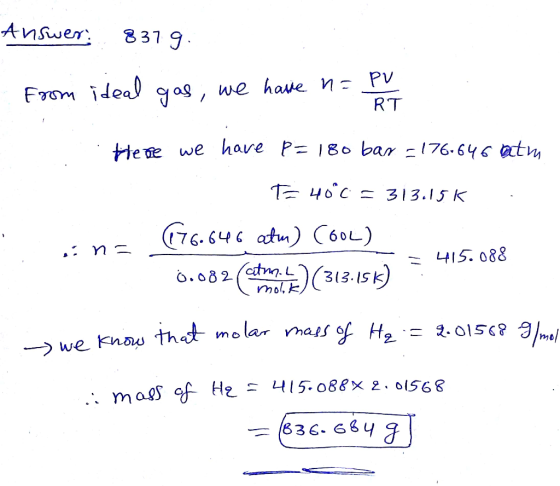
Calculate the mass of 60 liters of hydrogen at a pressure of 180 Bar and 40°C Assume ideal gas behavior 896 grams 83...
19. At atmospheric pressure, a sample of oxygen gas has a volume of 1.5 liters at...
 19. At atmospheric pressure, a sample of oxygen gas has a volume of 1.5 liters at 20°C. What volume, in liters will this gas occupy if the temperature is raised to 80 C? Assume ideal gas behavior a. 1.8 t b. 2.7L c. 3.9 L d. 6.0L e. 9.0L 20. How many grams of hydrogen, H2, are present in a 10.0 L gas cylinder at 25 C when the H2 pressure is 4.0 atm? Assume ideal gas behavior. a. 1.7...
calculate the mean speed of molecules in (a) hydrogen gas at 25°C and 10 bar pressure,...
calculate the mean speed of molecules in (a) hydrogen gas at 25°C and 10 bar pressure, (b) hydrogen gas at 1000°C and one bar pressure, and (c) nitrogen gas at 250°C and one bar pressure.
Question 2 One mole of an ideal gas, initially at 30 C and 1 bar is...
 Question 2 One mole of an ideal gas, initially at 30 C and 1 bar is changed to 130 °C and 10 bar by using two different mechanically reversible processes: 2.1 The gas is first heated at constant pressure until its temperature is 130 °C and then compressed isothermally to 10 bar. 2.2 The gas is first compressed isothermally to 10 bar and then heated at constant pressure to 13°C Calculate Q, W, AU, and AH for each case. Take...
QUESTION 1 What will be the pressure of 52.5 grams of oxygen gas in a glass...
 QUESTION 1 What will be the pressure of 52.5 grams of oxygen gas in a glass container with a volume of 6 L at 15.4 °C? QUESTION 2 At what temperature in °C does 37.34 g of oxygen gas occupy 18.17 L at 622 mm Hg? QUESTION 3 Consider the reaction between hydrogen gas and oxygen gas to form water: 2 H2(g)O2(g)-»2 H20(g) How many grams of water could be produced by the reaction of 5.1 liters of hydrogen with...
i) An ideal steam power plant operates between a high pressure of 40 bar and a...
 i) An ideal steam power plant operates between a high pressure of 40 bar and a low pressure of 0.2 bar. The cooling water in the condenser has a constant pressure of 1 bar. The pump requires a work input of 1.0 kJ/kg. Assume that the heat transfer to the surroundings for all the cycle components are negligible. For the properties in the table below, determine the (a) thermal efficiency, in %, (b) the mass flow rate of the cooling...
3. Using the ideal gas law determine the pressure, in atmosphere that a 40 gram sample...
 3. Using the ideal gas law determine the pressure, in atmosphere that a 40 gram sample of Os exerts at 127' and in a volume of 2.47L 6. Pressure is a. defined as the mass that an object exerts when at rest b. measured in Newtons c. defined as the force per unit area d. defined as the number of moles of substance divided by the mass of the substance e. measured in grams the number of moles in a...
2)Calculate the molar mass of an unknown gas with a mass of 0.462 grams that occupies...
2)Calculate the molar mass of an unknown gas with a mass of 0.462 grams that occupies a volume of 0.798 dm at temperature of 173.85 C and a pressure of 0.7 bar.
W 2. One mole of an ideal gas initially at 37°C and 2 bar pressure is...
 W 2. One mole of an ideal gas initially at 37°C and 2 bar pressure is heated and allowed to expand reversibly at constant pressure until the final temperature is 287°C. For this gas, Cum = 2.5R, constant over the temperature range. a. Derive related thermodynamic equations (q, w, U, and H) for an ideal gas, when the temperature is changed (5 points). b. Calculate w (work done on the ideal gas), 9 (the amount of heat absorbed by the...
Hydrogen gas (H2) is initially at a pressure of 20 bar and temperature of 300'C (state...
Hydrogen gas (H2) is initially at a pressure of 20 bar and temperature of 300'C (state 1), while occupying a volume of 0.5 m3 in a frictionless piston-cylinder arrangement. The gas then undergoes a reversible cycle in which it expands isothermally to a pressure of 8 bar (state 2). This is then followed by adiabatic compression to restore the pressure back to 20 bar. The cycle is then completed by a constant pressure process. Sketch the process of p-v and...
Using the ideal gas law equation, calculate the grams of NH3 that can be produced when 4.50...
Using the ideal gas law equation, calculate the grams of NH3 that can be produced when 4.50 L of NO2 react at a temperature of 435 ∘C and a pressure of 735 mmHg . How many liters of H2 gas at STP can be produced from the reaction of 1.60 g of Al with excess HCl? 2Al(s)+6HCl(aq)→2AlCl3(aq)+3H2(g) How many liters of oxygen gas at STP are needed to react completely with 9.8 g of magnesium?
 19. At atmospheric pressure, a sample of oxygen gas has a volume of 1.5 liters at 20°C. What volume, in liters will this gas occupy if the temperature is raised to 80 C? Assume ideal gas behavior a. 1.8 t b. 2.7L c. 3.9 L d. 6.0L e. 9.0L 20. How many grams of hydrogen, H2, are present in a 10.0 L gas cylinder at 25 C when the H2 pressure is 4.0 atm? Assume ideal gas behavior. a. 1.7...
 Question 2 One mole of an ideal gas, initially at 30 C and 1 bar is changed to 130 °C and 10 bar by using two different mechanically reversible processes: 2.1 The gas is first heated at constant pressure until its temperature is 130 °C and then compressed isothermally to 10 bar. 2.2 The gas is first compressed isothermally to 10 bar and then heated at constant pressure to 13°C Calculate Q, W, AU, and AH for each case. Take...
 QUESTION 1 What will be the pressure of 52.5 grams of oxygen gas in a glass container with a volume of 6 L at 15.4 °C? QUESTION 2 At what temperature in °C does 37.34 g of oxygen gas occupy 18.17 L at 622 mm Hg? QUESTION 3 Consider the reaction between hydrogen gas and oxygen gas to form water: 2 H2(g)O2(g)-»2 H20(g) How many grams of water could be produced by the reaction of 5.1 liters of hydrogen with...
 i) An ideal steam power plant operates between a high pressure of 40 bar and a low pressure of 0.2 bar. The cooling water in the condenser has a constant pressure of 1 bar. The pump requires a work input of 1.0 kJ/kg. Assume that the heat transfer to the surroundings for all the cycle components are negligible. For the properties in the table below, determine the (a) thermal efficiency, in %, (b) the mass flow rate of the cooling...
 3. Using the ideal gas law determine the pressure, in atmosphere that a 40 gram sample of Os exerts at 127' and in a volume of 2.47L 6. Pressure is a. defined as the mass that an object exerts when at rest b. measured in Newtons c. defined as the force per unit area d. defined as the number of moles of substance divided by the mass of the substance e. measured in grams the number of moles in a...
 W 2. One mole of an ideal gas initially at 37°C and 2 bar pressure is heated and allowed to expand reversibly at constant pressure until the final temperature is 287°C. For this gas, Cum = 2.5R, constant over the temperature range. a. Derive related thermodynamic equations (q, w, U, and H) for an ideal gas, when the temperature is changed (5 points). b. Calculate w (work done on the ideal gas), 9 (the amount of heat absorbed by the...
Most questions answered within 3 hours.
-
Where is the error in this code sequence?
String s1 = "Hello";
String s2 = "ello";...
asked 11 months ago -
Financial data for Joel de Paris, Inc., for last year
follow:
Joel de Paris, Inc.
Balance...
asked 11 months ago -
Consider this reaction:
Al2(SO4)3 (aq)+ BaCl3
(aq) Al2Cl6 (aq)- +
3BaSO4(s) . What is the...
asked 11 months ago -
Suppose that Savneet is considering increasing her
recent random sample from 20 car rentals to 40...
asked 11 months ago -
Trucks arrive at an unloading terminal at an average rate of 120
per hour.
Trucks arrive...
asked 11 months ago -
Why are methanol and ethanol completely soluble in water while
octanol is not very little soluble....
asked 11 months ago -
A facilities manager at a university reads in a research report
that the mean amount of...
asked 11 months ago -
When the CuSO4 is rehydrated by adding water to the anhydrous
compound, is this an endothermic...
asked 11 months ago -
A ray of sunlight is passing from diamond into crown glass; the
angle of incidence is...
asked 11 months ago -
A block of mass 0.249 kg is placed on top of a light, vertical
spring of...
asked 11 months ago -
how do the kidneys compensate in the presences of acidosis
a) trigger hyperventilate
b) reserve acid...
asked 11 months ago -
Question 501 pts
The rental rate of capital to the firm increases. Which of the
following...
asked 11 months ago