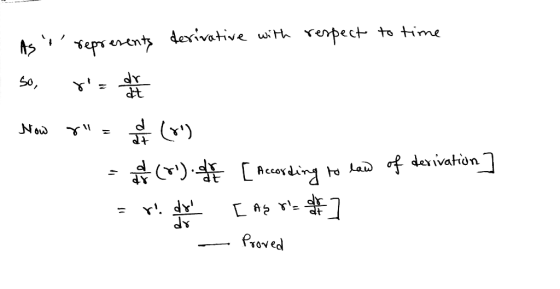
Prove that r'' = r' dr'/dr ? where ' represents derivative wrt time.
Prove that r'' = r' dr'/dr ? where ' represents derivative wrt time.
Homework Answers
Add Answer to:
Prove that r'' = r' dr'/dr ? where ' represents derivative wrt time.
Prove ▽f(r) = (f,(r)/r)r, where r = Vx2 + y2 + ~2 and f'(r)-df/dr is assum...
 Prove ▽f(r) = (f,(r)/r)r, where r = Vx2 + y2 + ~2 and f'(r)-df/dr is assum ed to exist.
Find the G.S. of the DE: xy' + y = 3x2 Prime denotes derivative WRT X....
 Find the G.S. of the DE: xy' + y = 3x2 Prime denotes derivative WRT X. (Hint: guess a P.S. yı = Axa)
Find the particular antiderivative of the following derivative that satisfies the given condition. dR/dt=111/ t4, R(1)=25
Find the particular antiderivative of the following derivative that satisfies the given condition. dR/dt=111/ t4, R(1)=25
d 4. Use the definition of the derivative to show that dr (3x2 - 4) =...
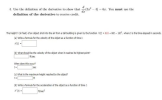 d 4. Use the definition of the derivative to show that dr (3x2 - 4) = 62. You must use the definition of the derivative to receive credit. The height A (in feet) of an object shot into the air from a tall building is given by the function 10) = 510 + 801 – 1662, where t is the time elapsed in seconds. (a) Write a formula for the velocity of the object as a function of time t....
1. The position of a particle is described as r=xi+yj, where i and j are the...
1. The position of a particle is described as r=xi+yj, where i and j are the coordinate unit vectors in 2D Cartesian coordinates a?d x and y are the coordinates of a particle. The velocity can be calculated as v=dr/dt. Find an expression for v, by taking the derivative of r with respect to time. 2. a=2.00 t, where t is the time, in seconds, and a is the acceleration in meters per second squared. s=0 and v=0 at t=0....
Prove that the total gravitational potential energy can be written as ρ(z)φ(z)dr, where ρ(z) and φ(z)...
 Prove that the total gravitational potential energy can be written as ρ(z)φ(z)dr, where ρ(z) and φ(z) are the density and gravitational poi.(.mi.ial ai. locai;ion x in space, Π iptXtively Use the above formula for W to obtain the total gravitational energy of the Plummer sphere with the graviational potential: φ(r) = (r2+p)
A particle moves along a space curve,r=r(t) is the time measured from some initial time. if...
A particle moves along a space curve,r=r(t) is the time measured from some initial time. if v=/dr/dt/=ds/dt is the magnitude of the velocity of the particle (s is the arc length along space curve measured from the initial position),prove that the acceleration a of particle is given by a=dv/dtT+v^2/pN where T and N are unit tangent and normal vectors to the space curve and p=|d^2r/ds^2|^-1={(d^2/ds^2)^2+. (d^2y/ds^2)^2 + (d^2z/ds^2)^2}^-1/2
1. Let ơ E Aut(R), where R denotes the field of real numbers. a) Prove that if a > b then σ(a) > ...
 1. Let ơ E Aut(R), where R denotes the field of real numbers. a) Prove that if a > b then σ(a) > σ(b) ( . (b) Prove that o is a continuous function. (c) Prove that ơ must be the identity function. Therefore Aut(R)-(1). (see problem 7 on pg. 567 for more details for each step).
1. Let ơ E Aut(R), where R denotes the field of real numbers. a) Prove that if a > b then σ(a) >...
1. Let ơ E Aut(R), where R denotes the field of real numbers. a) Prove that if a > b then σ(a) > σ(b) ( . (b) Prove that o is a continuous function. (c) Prove that ơ must be the identity function. Therefore Aut(R)-(1). (see problem 7 on pg. 567 for more details for each step).
1. Let ơ E Aut(R), where R denotes the field of real numbers. a) Prove that if a > b then σ(a) >...
*3. Suppose that f:R2 >R is such that .) dy dr-1 and R LR l i...
 *3. Suppose that f:R2 >R is such that .) dy dr-1 and R LR l i f (x,y) dx dy--1. What range of values can I Lndrn2 possibly have? (Here R LR m2 refers to the Lebesgue measure in R2) Prove your assertion.
Show that −1 ≤ r ≤ 1, where r represents Pearson's correlation coefficient. Note : Show...
Show that −1 ≤ r ≤ 1, where r represents Pearson's correlation coefficient. Note : Show the formulas and calculations used.
 Prove ▽f(r) = (f,(r)/r)r, where r = Vx2 + y2 + ~2 and f'(r)-df/dr is assum ed to exist.
 Find the G.S. of the DE: xy' + y = 3x2 Prime denotes derivative WRT X. (Hint: guess a P.S. yı = Axa)
 d 4. Use the definition of the derivative to show that dr (3x2 - 4) = 62. You must use the definition of the derivative to receive credit. The height A (in feet) of an object shot into the air from a tall building is given by the function 10) = 510 + 801 – 1662, where t is the time elapsed in seconds. (a) Write a formula for the velocity of the object as a function of time t....
 Prove that the total gravitational potential energy can be written as ρ(z)φ(z)dr, where ρ(z) and φ(z) are the density and gravitational poi.(.mi.ial ai. locai;ion x in space, Π iptXtively Use the above formula for W to obtain the total gravitational energy of the Plummer sphere with the graviational potential: φ(r) = (r2+p)
 1. Let ơ E Aut(R), where R denotes the field of real numbers. a) Prove that if a > b then σ(a) > σ(b) ( . (b) Prove that o is a continuous function. (c) Prove that ơ must be the identity function. Therefore Aut(R)-(1). (see problem 7 on pg. 567 for more details for each step).
1. Let ơ E Aut(R), where R denotes the field of real numbers. a) Prove that if a > b then σ(a) >...
1. Let ơ E Aut(R), where R denotes the field of real numbers. a) Prove that if a > b then σ(a) > σ(b) ( . (b) Prove that o is a continuous function. (c) Prove that ơ must be the identity function. Therefore Aut(R)-(1). (see problem 7 on pg. 567 for more details for each step).
1. Let ơ E Aut(R), where R denotes the field of real numbers. a) Prove that if a > b then σ(a) >...
 *3. Suppose that f:R2 >R is such that .) dy dr-1 and R LR l i f (x,y) dx dy--1. What range of values can I Lndrn2 possibly have? (Here R LR m2 refers to the Lebesgue measure in R2) Prove your assertion.
Most questions answered within 3 hours.
-
Where is the error in this code sequence?
String s1 = "Hello";
String s2 = "ello";...
asked 10 months ago -
Financial data for Joel de Paris, Inc., for last year
follow:
Joel de Paris, Inc.
Balance...
asked 10 months ago -
Consider this reaction:
Al2(SO4)3 (aq)+ BaCl3
(aq) Al2Cl6 (aq)- +
3BaSO4(s) . What is the...
asked 10 months ago -
Suppose that Savneet is considering increasing her
recent random sample from 20 car rentals to 40...
asked 10 months ago -
Trucks arrive at an unloading terminal at an average rate of 120
per hour.
Trucks arrive...
asked 10 months ago -
Why are methanol and ethanol completely soluble in water while
octanol is not very little soluble....
asked 10 months ago -
A facilities manager at a university reads in a research report
that the mean amount of...
asked 10 months ago -
When the CuSO4 is rehydrated by adding water to the anhydrous
compound, is this an endothermic...
asked 10 months ago -
A ray of sunlight is passing from diamond into crown glass; the
angle of incidence is...
asked 10 months ago -
A block of mass 0.249 kg is placed on top of a light, vertical
spring of...
asked 10 months ago -
how do the kidneys compensate in the presences of acidosis
a) trigger hyperventilate
b) reserve acid...
asked 10 months ago -
Question 501 pts
The rental rate of capital to the firm increases. Which of the
following...
asked 10 months ago