
Homework Answers
Dear student,
Find this solution, and RATE IT ,If you find it is helpful .your rating is very important to me.If any incorrectness ,kindly let me know I will rectify them soon.
Thanks for asking ..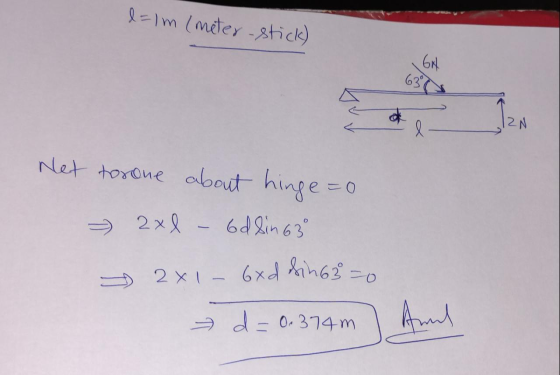
Add Answer to:
PLEASE MAKE QUESTION CLEAR AND INCLUDE UNITS Chapter 09, Problem 08 GO One end of a meter stick is pinned to a tab...
One end of a meter stick is pinned to a table, so the stick can rotate...
 One end of a meter stick is pinned to a table, so the stick can rotate freely in a plane parallel to the tabletop. Two forces, both parallel to the tabletop, are applied to the stick in such a way that the net torque is zero. The first force has a magnitude of 2.00 N and is applied perpendicular to the length of the stick at the free end. The second force has a magnitude of 6.00 N and acts...
One end of a meter stick is pinned to a table, so the stick can rotate...
 One end of a meter stick is pinned to a table, so the stick can rotate freely in a plane parallel to the tabletop. Two forces, both parallel to the tabletop, are applied to the stick in such a way that the net torque is zero. The first force has a magnitude of 2.00 N and is applied perpendicular to the length of the stick at the free end. The second force has a magnitude of 6.00 N and acts...
A rod is lying on the top of a table. One end of the rod is...
A rod is lying on the top of a table. One end of the rod is hinged to the table so that the rod can rotate freely on the tabletop. Two forces, both parallel to the tabletop, act on the rod at the same place. One force is directed perpendicular to the rod and has a magnitude of 44.7 N. The second force has a magnitude of 58.5 N and is directed at an angle θ with respect to the...
Chapter 18, Problem 09 Two spherical objects are separated by a distance of 1.55 x 10³...
 Chapter 18, Problem 09 Two spherical objects are separated by a distance of 1.55 x 10³ m. The objects are initially electrically neutral and are very small compared to the distance between them. Each object acquires the same negative charge due to the addition of electrons. As a result, each object experiences an electrostatic force that has a magnitude of 4.69 10-21 N. How many electrons did it take to produce the charge on one of the objects? Number Units...
Please make sure the answer is clear and stated with units. thanks! Chapter 09, Problem 49...
 Please make sure the answer is clear and stated with
units. thanks!
Chapter 09, Problem 49 Three objects lie in the x, y plane. Each rotates about the z axis with an angular speed of 1.39 rad/s. The mass m of each object and its perpendicular distance r from the Z axis are as follows: (1) m = 7.30 kg and r - 2.80 m, (2) m2 = 9.60 kg and 2 = 3.50 m, (3) m3 = 5.20 kg...
Please make sure the answer is clear and stated with
units. thanks!
Chapter 09, Problem 49 Three objects lie in the x, y plane. Each rotates about the z axis with an angular speed of 1.39 rad/s. The mass m of each object and its perpendicular distance r from the Z axis are as follows: (1) m = 7.30 kg and r - 2.80 m, (2) m2 = 9.60 kg and 2 = 3.50 m, (3) m3 = 5.20 kg...
Chapter 21, Problem 07 Your answer is partially correct. Try again. A magnetic field has a...
 Chapter 21, Problem 07 Your answer is partially correct. Try again. A magnetic field has a magnitude of 0.0013 T, and an electric field has a magnitude of 3.6 × 10³ N/C. Both fields point in the same direction. A positive 2.6-4C charge moves at a speed of 4.2 x 10⁶ m/s in a direction that is perpendicular to both fields. Determine the magnitude of the net force that acts on the charge. B Ē 9 ✓ 90° X Number...
PRINTER VERSION BACK ESOURCES Chapter 21, Problem 07 Your answer is partially correct. Try again. Problem OR Problem...
 PRINTER VERSION BACK ESOURCES Chapter 21, Problem 07 Your answer is partially correct. Try again. Problem OR Problem 02 Problem 03 Problem 04 Problem 05 Problem 06 A magnetic field has a magnitude of 0.0010 T, and an electric field has a magnitude of 5.2 x 10' N/C. Both fields point in the same direction. A positive 2.5-C charge moves at a speed of 2.6 X 10 m/s in a direction that is perpendicular to both fields. Determine the magnitude...
PRINTER VERSION BACK ESOURCES Chapter 21, Problem 07 Your answer is partially correct. Try again. Problem...
 PRINTER VERSION BACK ESOURCES Chapter 21, Problem 07 Your answer is partially correct. Try again. Problem OR Problem 02 Problem 03 Problem 04 Problem 05 Problem 06 A magnetic field has a magnitude of 0.0010 T, and an electric field has a magnitude of 5.2 x 10' N/C. Both fields point in the same direction. A positive 2.5-C charge moves at a speed of 2.6 X 10 m/s in a direction that is perpendicular to both fields. Determine the magnitude...
Please do both problems and explain steps Chapter 18, Problem 08 Your answer is partially correct....
 Please do both problems and explain steps
Chapter 18, Problem 08 Your answer is partially correct. Try again. In a vacuum, two particles have charges of q1 and q2, where q1- +4.4HC. They are separated by a distance of 0.30 m, and particle 1 experiences an attractive force of 4.3 N. What is the value of q2, with its sign? Numbe Chapter 18, Problem 13 Two point charges are fixed on the y axis: a negative point charge qī--32 μc...
Please do both problems and explain steps
Chapter 18, Problem 08 Your answer is partially correct. Try again. In a vacuum, two particles have charges of q1 and q2, where q1- +4.4HC. They are separated by a distance of 0.30 m, and particle 1 experiences an attractive force of 4.3 N. What is the value of q2, with its sign? Numbe Chapter 18, Problem 13 Two point charges are fixed on the y axis: a negative point charge qī--32 μc...
To understand the two most common procedures for finding torques when the forces and displacements are all in one plan...
 To understand the two most
common procedures for finding torques when the forces and
displacements are all in one plane: the moment arm method and the
tangential force method. The purpose of this problem is to give you
further practice finding torques in two-dimensional situations. In
this case it is overkill to use the full cross product definition
of the torque because the only nonzero component of the torque is
the component perpendicular to the plane containing the problem.
There...
To understand the two most
common procedures for finding torques when the forces and
displacements are all in one plane: the moment arm method and the
tangential force method. The purpose of this problem is to give you
further practice finding torques in two-dimensional situations. In
this case it is overkill to use the full cross product definition
of the torque because the only nonzero component of the torque is
the component perpendicular to the plane containing the problem.
There...
 One end of a meter stick is pinned to a table, so the stick can rotate freely in a plane parallel to the tabletop. Two forces, both parallel to the tabletop, are applied to the stick in such a way that the net torque is zero. The first force has a magnitude of 2.00 N and is applied perpendicular to the length of the stick at the free end. The second force has a magnitude of 6.00 N and acts...
 One end of a meter stick is pinned to a table, so the stick can rotate freely in a plane parallel to the tabletop. Two forces, both parallel to the tabletop, are applied to the stick in such a way that the net torque is zero. The first force has a magnitude of 2.00 N and is applied perpendicular to the length of the stick at the free end. The second force has a magnitude of 6.00 N and acts...
 Chapter 18, Problem 09 Two spherical objects are separated by a distance of 1.55 x 10³ m. The objects are initially electrically neutral and are very small compared to the distance between them. Each object acquires the same negative charge due to the addition of electrons. As a result, each object experiences an electrostatic force that has a magnitude of 4.69 10-21 N. How many electrons did it take to produce the charge on one of the objects? Number Units...
 Please make sure the answer is clear and stated with
units. thanks!
Chapter 09, Problem 49 Three objects lie in the x, y plane. Each rotates about the z axis with an angular speed of 1.39 rad/s. The mass m of each object and its perpendicular distance r from the Z axis are as follows: (1) m = 7.30 kg and r - 2.80 m, (2) m2 = 9.60 kg and 2 = 3.50 m, (3) m3 = 5.20 kg...
Please make sure the answer is clear and stated with
units. thanks!
Chapter 09, Problem 49 Three objects lie in the x, y plane. Each rotates about the z axis with an angular speed of 1.39 rad/s. The mass m of each object and its perpendicular distance r from the Z axis are as follows: (1) m = 7.30 kg and r - 2.80 m, (2) m2 = 9.60 kg and 2 = 3.50 m, (3) m3 = 5.20 kg...
 Chapter 21, Problem 07 Your answer is partially correct. Try again. A magnetic field has a magnitude of 0.0013 T, and an electric field has a magnitude of 3.6 × 10³ N/C. Both fields point in the same direction. A positive 2.6-4C charge moves at a speed of 4.2 x 10⁶ m/s in a direction that is perpendicular to both fields. Determine the magnitude of the net force that acts on the charge. B Ē 9 ✓ 90° X Number...
 PRINTER VERSION BACK ESOURCES Chapter 21, Problem 07 Your answer is partially correct. Try again. Problem OR Problem 02 Problem 03 Problem 04 Problem 05 Problem 06 A magnetic field has a magnitude of 0.0010 T, and an electric field has a magnitude of 5.2 x 10' N/C. Both fields point in the same direction. A positive 2.5-C charge moves at a speed of 2.6 X 10 m/s in a direction that is perpendicular to both fields. Determine the magnitude...
 PRINTER VERSION BACK ESOURCES Chapter 21, Problem 07 Your answer is partially correct. Try again. Problem OR Problem 02 Problem 03 Problem 04 Problem 05 Problem 06 A magnetic field has a magnitude of 0.0010 T, and an electric field has a magnitude of 5.2 x 10' N/C. Both fields point in the same direction. A positive 2.5-C charge moves at a speed of 2.6 X 10 m/s in a direction that is perpendicular to both fields. Determine the magnitude...
 Please do both problems and explain steps
Chapter 18, Problem 08 Your answer is partially correct. Try again. In a vacuum, two particles have charges of q1 and q2, where q1- +4.4HC. They are separated by a distance of 0.30 m, and particle 1 experiences an attractive force of 4.3 N. What is the value of q2, with its sign? Numbe Chapter 18, Problem 13 Two point charges are fixed on the y axis: a negative point charge qī--32 μc...
Please do both problems and explain steps
Chapter 18, Problem 08 Your answer is partially correct. Try again. In a vacuum, two particles have charges of q1 and q2, where q1- +4.4HC. They are separated by a distance of 0.30 m, and particle 1 experiences an attractive force of 4.3 N. What is the value of q2, with its sign? Numbe Chapter 18, Problem 13 Two point charges are fixed on the y axis: a negative point charge qī--32 μc...
 To understand the two most
common procedures for finding torques when the forces and
displacements are all in one plane: the moment arm method and the
tangential force method. The purpose of this problem is to give you
further practice finding torques in two-dimensional situations. In
this case it is overkill to use the full cross product definition
of the torque because the only nonzero component of the torque is
the component perpendicular to the plane containing the problem.
There...
To understand the two most
common procedures for finding torques when the forces and
displacements are all in one plane: the moment arm method and the
tangential force method. The purpose of this problem is to give you
further practice finding torques in two-dimensional situations. In
this case it is overkill to use the full cross product definition
of the torque because the only nonzero component of the torque is
the component perpendicular to the plane containing the problem.
There...
Most questions answered within 3 hours.
-
Where is the error in this code sequence?
String s1 = "Hello";
String s2 = "ello";...
asked 10 months ago -
Financial data for Joel de Paris, Inc., for last year
follow:
Joel de Paris, Inc.
Balance...
asked 10 months ago -
Consider this reaction:
Al2(SO4)3 (aq)+ BaCl3
(aq) Al2Cl6 (aq)- +
3BaSO4(s) . What is the...
asked 10 months ago -
Suppose that Savneet is considering increasing her
recent random sample from 20 car rentals to 40...
asked 10 months ago -
Trucks arrive at an unloading terminal at an average rate of 120
per hour.
Trucks arrive...
asked 10 months ago -
Why are methanol and ethanol completely soluble in water while
octanol is not very little soluble....
asked 10 months ago -
A facilities manager at a university reads in a research report
that the mean amount of...
asked 10 months ago -
When the CuSO4 is rehydrated by adding water to the anhydrous
compound, is this an endothermic...
asked 10 months ago -
A ray of sunlight is passing from diamond into crown glass; the
angle of incidence is...
asked 10 months ago -
A block of mass 0.249 kg is placed on top of a light, vertical
spring of...
asked 10 months ago -
how do the kidneys compensate in the presences of acidosis
a) trigger hyperventilate
b) reserve acid...
asked 10 months ago -
Question 501 pts
The rental rate of capital to the firm increases. Which of the
following...
asked 10 months ago