
Homework Answers
Add Answer to:
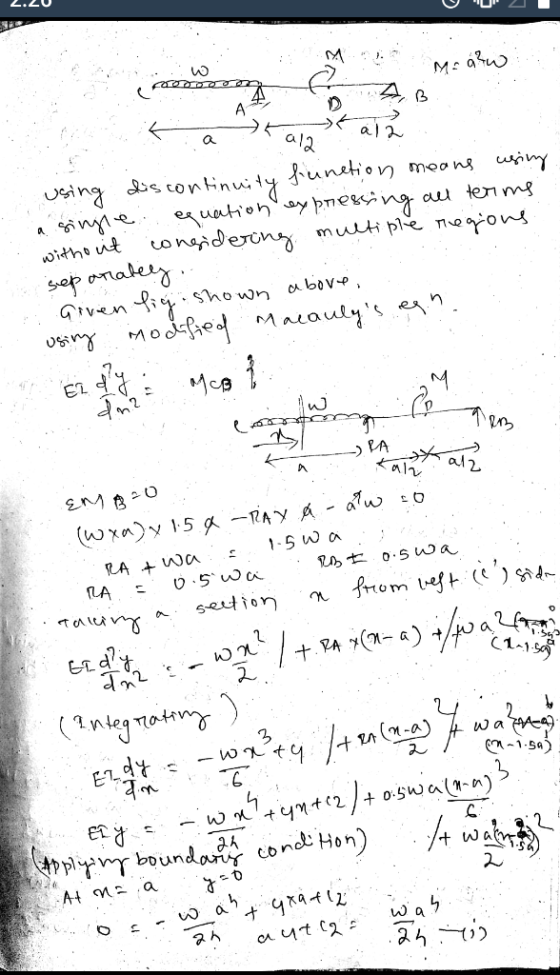
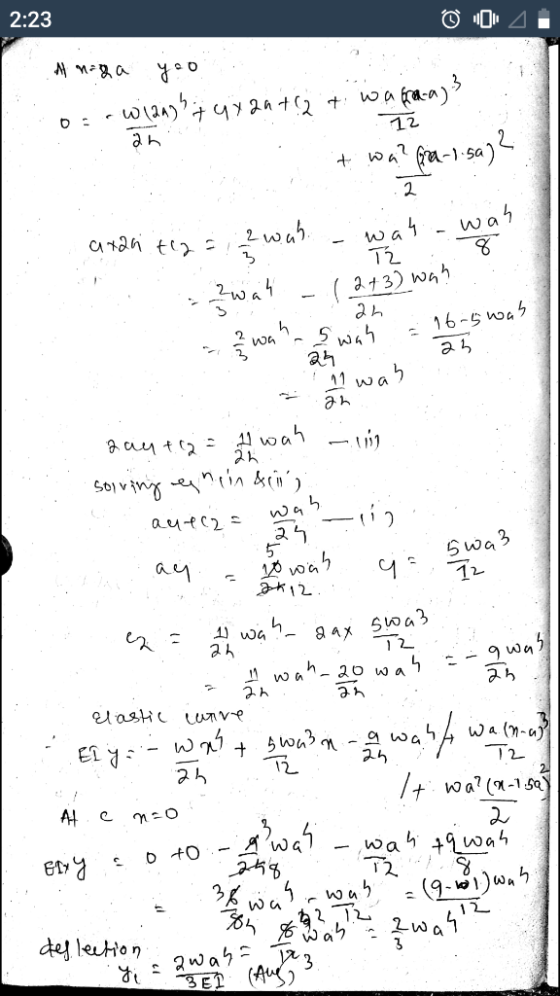
7-8. An overhanging beam is supported shown functions equation of the elastic curve and deflection Using determine...
Problem 2 For the beam and loading shown, using singularity functions, determine (a) the equation...
 Problem 2 For the beam and loading shown, using singularity functions, determine (a) the equation of the elastic curve, (b) the deflection at point B, (c) the deflection at point D L/2 L/2 L/2
Problem 2 For the beam and loading shown, using singularity functions, determine (a) the equation of the elastic curve, (b) the deflection at point B, (c) the deflection at point D L/2 L/2 L/2
Problem 2 For the beam and loading shown, using singularity functions, determine (a) the equation of the elastic curve, (b) the deflection at point B, (c) the deflection at point D L/2 L/2 L/2
For the beam and loading shown, determine (a) the equation of the elastic curve, (b) the...
 For the beam and loading shown, determine (a) the equation of
the elastic curve, (b) the slope at the free end, (c) the
deflection at the free end.
9.17 For the beam and loading shown, determine (a) the equation of the elastic curve, (b) the slope at the free end, (c) the deflection at the free end. - w=wocos Fig. P9.17
For the beam and loading shown, determine (a) the equation of
the elastic curve, (b) the slope at the free end, (c) the
deflection at the free end.
9.17 For the beam and loading shown, determine (a) the equation of the elastic curve, (b) the slope at the free end, (c) the deflection at the free end. - w=wocos Fig. P9.17
The equation of the elastic curve (deflection) for a simply supported beam under uniform load is...
The equation of the elastic curve (deflection) for a simply supported beam under uniform load is given by y= 1.7 * 10^-5 x^2 (160 - x^2 + x^3), in which, x is the distance from the left support of the beam to any point on the beam, and y is the deflection, both in meters. Find the rate of change of the deflection of the elastic curve at x m = 2
8.30. A simply supported beam with overhanging ends is loaded by the uniformly distributed loads shown in Fig. 8-25. De...
 8.30. A simply supported beam with overhanging ends is loaded by
the uniformly distributed loads shown in Fig. 8-25. Determine the
deflection of the midpoint of the beam with respect to origin at
the level of the supports.
8.31. For the beam described in Problem 8.30, determine the
deflection of one end of the beam with respect to origin at the
level of the supports. Use singularity functions.
espect to origin at the level of the supporlS to 2a Fig....
8.30. A simply supported beam with overhanging ends is loaded by
the uniformly distributed loads shown in Fig. 8-25. Determine the
deflection of the midpoint of the beam with respect to origin at
the level of the supports.
8.31. For the beam described in Problem 8.30, determine the
deflection of one end of the beam with respect to origin at the
level of the supports. Use singularity functions.
espect to origin at the level of the supporlS to 2a Fig....
Question 2 For the beam and loading shown, use Macaulay notation to determine t0) (a) the equation of the elastic curve, (b) the deflection at point B, (c) the deflection at point C. BI IIC Use,...
 Question 2 For the beam and loading shown, use Macaulay notation to determine t0) (a) the equation of the elastic curve, (b) the deflection at point B, (c) the deflection at point C. BI IIC Use, L=2.5 m E = 200 GPa l 3.6 x 10⁻⁵ m
Question 2 For the beam and loading shown, use Macaulay notation to determine t0) (a) the equation of the elastic curve, (b) the deflection at point B, (c) the deflection at point C....
Question 2 For the beam and loading shown, use Macaulay notation to determine t0) (a) the equation of the elastic curve, (b) the deflection at point B, (c) the deflection at point C. BI IIC Use, L=2.5 m E = 200 GPa l 3.6 x 10⁻⁵ m
Question 2 For the beam and loading shown, use Macaulay notation to determine t0) (a) the equation of the elastic curve, (b) the deflection at point B, (c) the deflection at point C....
For the cantilever beam and loading shown, determine (a) the equation of the elastic curve for...
 For the cantilever beam and loading shown, determine (a) the equation of the elastic curve for portion AB of the beam, (b) the deflection at B, (c) the slope at B. W2 a2 Fig. 29.5
9. For the beam loaded and supported as shown in Figure (see Week 4), use the integration method ...
 9. For the beam loaded and supported as shown in Figure (see Week 4), use the integration method to determine (a) The equation of the elastic curve using the xi and x2 coordinates (b) The slope at A. (c) The deflection at C Take E 200 GPa and1- 4 x 108 mm4 30 kN 20 kNm 4 m 2 m
9. For the beam loaded and supported as shown in Figure (see Week 4), use the integration method to determine...
9. For the beam loaded and supported as shown in Figure (see Week 4), use the integration method to determine (a) The equation of the elastic curve using the xi and x2 coordinates (b) The slope at A. (c) The deflection at C Take E 200 GPa and1- 4 x 108 mm4 30 kN 20 kNm 4 m 2 m
9. For the beam loaded and supported as shown in Figure (see Week 4), use the integration method to determine...
Question (50 pts Determine the elastic curve equation of the elastic curve for the beam using...
 Question (50 pts Determine the elastic curve equation of the elastic curve for the beam using the x1 and x2 coordinates specify the slope at A and the maximum deflection. Use TWO METHODS. EI is constant. R12-4
stress analysis ASAP please Question 5 1201 (Energy Method): 5) Determine the equation of the deflection curve of the cantilever beam loaded as shown in Figure. 3. Use as the deflection shape of t...
 stress analysis
ASAP please
Question 5 1201 (Energy Method): 5) Determine the equation of the deflection curve of the cantilever beam loaded as shown in Figure. 3. Use as the deflection shape of the loaded beam Figure 3
Question 5 1201 (Energy Method): 5) Determine the equation of the deflection curve of the cantilever beam loaded as shown in Figure. 3. Use as the deflection shape of the loaded beam Figure 3
stress analysis
ASAP please
Question 5 1201 (Energy Method): 5) Determine the equation of the deflection curve of the cantilever beam loaded as shown in Figure. 3. Use as the deflection shape of the loaded beam Figure 3
Question 5 1201 (Energy Method): 5) Determine the equation of the deflection curve of the cantilever beam loaded as shown in Figure. 3. Use as the deflection shape of the loaded beam Figure 3
Find the equation of the elastic curve, y(x) (deflection) by integration of the Moment equation
 Find the equation of the elastic curve, y(x) (deflection) by integration of the Moment equation, M(x)/EL. Find the location of maximum deflection. In a small dam, a typical vertical beam is subjected to the hydrostatic loading shown in the figure. Determine the stress at point D of section a-a due to the bending moment. Ans: 7.29MPa.
 Problem 2 For the beam and loading shown, using singularity functions, determine (a) the equation of the elastic curve, (b) the deflection at point B, (c) the deflection at point D L/2 L/2 L/2
Problem 2 For the beam and loading shown, using singularity functions, determine (a) the equation of the elastic curve, (b) the deflection at point B, (c) the deflection at point D L/2 L/2 L/2
Problem 2 For the beam and loading shown, using singularity functions, determine (a) the equation of the elastic curve, (b) the deflection at point B, (c) the deflection at point D L/2 L/2 L/2
 For the beam and loading shown, determine (a) the equation of
the elastic curve, (b) the slope at the free end, (c) the
deflection at the free end.
9.17 For the beam and loading shown, determine (a) the equation of the elastic curve, (b) the slope at the free end, (c) the deflection at the free end. - w=wocos Fig. P9.17
For the beam and loading shown, determine (a) the equation of
the elastic curve, (b) the slope at the free end, (c) the
deflection at the free end.
9.17 For the beam and loading shown, determine (a) the equation of the elastic curve, (b) the slope at the free end, (c) the deflection at the free end. - w=wocos Fig. P9.17
 8.30. A simply supported beam with overhanging ends is loaded by
the uniformly distributed loads shown in Fig. 8-25. Determine the
deflection of the midpoint of the beam with respect to origin at
the level of the supports.
8.31. For the beam described in Problem 8.30, determine the
deflection of one end of the beam with respect to origin at the
level of the supports. Use singularity functions.
espect to origin at the level of the supporlS to 2a Fig....
8.30. A simply supported beam with overhanging ends is loaded by
the uniformly distributed loads shown in Fig. 8-25. Determine the
deflection of the midpoint of the beam with respect to origin at
the level of the supports.
8.31. For the beam described in Problem 8.30, determine the
deflection of one end of the beam with respect to origin at the
level of the supports. Use singularity functions.
espect to origin at the level of the supporlS to 2a Fig....
 Question 2 For the beam and loading shown, use Macaulay notation to determine t0) (a) the equation of the elastic curve, (b) the deflection at point B, (c) the deflection at point C. BI IIC Use, L=2.5 m E = 200 GPa l 3.6 x 10⁻⁵ m
Question 2 For the beam and loading shown, use Macaulay notation to determine t0) (a) the equation of the elastic curve, (b) the deflection at point B, (c) the deflection at point C....
Question 2 For the beam and loading shown, use Macaulay notation to determine t0) (a) the equation of the elastic curve, (b) the deflection at point B, (c) the deflection at point C. BI IIC Use, L=2.5 m E = 200 GPa l 3.6 x 10⁻⁵ m
Question 2 For the beam and loading shown, use Macaulay notation to determine t0) (a) the equation of the elastic curve, (b) the deflection at point B, (c) the deflection at point C....
 For the cantilever beam and loading shown, determine (a) the equation of the elastic curve for portion AB of the beam, (b) the deflection at B, (c) the slope at B. W2 a2 Fig. 29.5
 9. For the beam loaded and supported as shown in Figure (see Week 4), use the integration method to determine (a) The equation of the elastic curve using the xi and x2 coordinates (b) The slope at A. (c) The deflection at C Take E 200 GPa and1- 4 x 108 mm4 30 kN 20 kNm 4 m 2 m
9. For the beam loaded and supported as shown in Figure (see Week 4), use the integration method to determine...
9. For the beam loaded and supported as shown in Figure (see Week 4), use the integration method to determine (a) The equation of the elastic curve using the xi and x2 coordinates (b) The slope at A. (c) The deflection at C Take E 200 GPa and1- 4 x 108 mm4 30 kN 20 kNm 4 m 2 m
9. For the beam loaded and supported as shown in Figure (see Week 4), use the integration method to determine...
 Question (50 pts Determine the elastic curve equation of the elastic curve for the beam using the x1 and x2 coordinates specify the slope at A and the maximum deflection. Use TWO METHODS. EI is constant. R12-4
 stress analysis
ASAP please
Question 5 1201 (Energy Method): 5) Determine the equation of the deflection curve of the cantilever beam loaded as shown in Figure. 3. Use as the deflection shape of the loaded beam Figure 3
Question 5 1201 (Energy Method): 5) Determine the equation of the deflection curve of the cantilever beam loaded as shown in Figure. 3. Use as the deflection shape of the loaded beam Figure 3
stress analysis
ASAP please
Question 5 1201 (Energy Method): 5) Determine the equation of the deflection curve of the cantilever beam loaded as shown in Figure. 3. Use as the deflection shape of the loaded beam Figure 3
Question 5 1201 (Energy Method): 5) Determine the equation of the deflection curve of the cantilever beam loaded as shown in Figure. 3. Use as the deflection shape of the loaded beam Figure 3
Most questions answered within 3 hours.
-
Where is the error in this code sequence?
String s1 = "Hello";
String s2 = "ello";...
asked 11 months ago -
Financial data for Joel de Paris, Inc., for last year
follow:
Joel de Paris, Inc.
Balance...
asked 11 months ago -
Consider this reaction:
Al2(SO4)3 (aq)+ BaCl3
(aq) Al2Cl6 (aq)- +
3BaSO4(s) . What is the...
asked 11 months ago -
Suppose that Savneet is considering increasing her
recent random sample from 20 car rentals to 40...
asked 11 months ago -
Trucks arrive at an unloading terminal at an average rate of 120
per hour.
Trucks arrive...
asked 11 months ago -
Why are methanol and ethanol completely soluble in water while
octanol is not very little soluble....
asked 11 months ago -
A facilities manager at a university reads in a research report
that the mean amount of...
asked 11 months ago -
When the CuSO4 is rehydrated by adding water to the anhydrous
compound, is this an endothermic...
asked 11 months ago -
A ray of sunlight is passing from diamond into crown glass; the
angle of incidence is...
asked 11 months ago -
A block of mass 0.249 kg is placed on top of a light, vertical
spring of...
asked 11 months ago -
how do the kidneys compensate in the presences of acidosis
a) trigger hyperventilate
b) reserve acid...
asked 11 months ago -
Question 501 pts
The rental rate of capital to the firm increases. Which of the
following...
asked 11 months ago