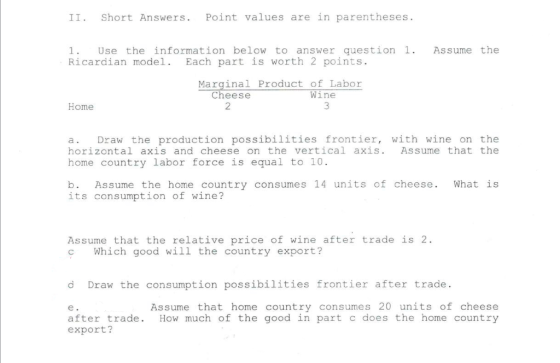
International Economics: Short Answer. Please be kind enough to answer all parts of the question. Partial answers will be downvoted.
Homework Answers
Ans 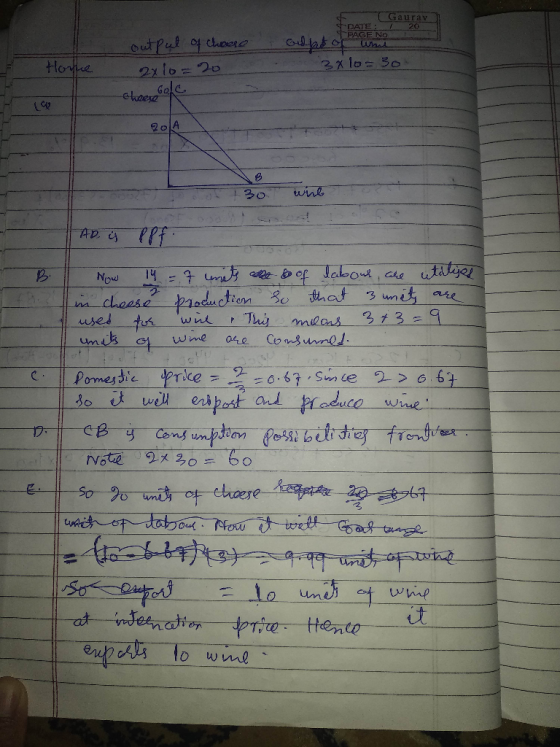
Add Answer to:
International Economics: Short Answer. Please be kind enough to answer all parts of the question. Partial answers will b...
Home &n
Home Foreign Marginal Products Cheese 6 2 Wine 4 3 Labor Force 100 200 a. Suppose the price of wine in the home country before trade is equal to 2. What is the price of cheese? What is the wage? b. Suppose that the relative price of wine after trade is equal to one. Draw the consumption possibilities frontier for both the home country and the foreign country. Again show numerical values for the vertical and horizontal intercepts....
Home Foreigrn MarginalProducts Cheese Wine Labor Force 100 200 g Suppose that the home country consumes...
 Home Foreigrn MarginalProducts Cheese Wine Labor Force 100 200 g Suppose that the home country consumes 240 units of cheese before trade and 240 units of cheese after trade Calculate the amount of wine the home country will consume both before and after trade h. Calculate home country's exports and imports (list the good it is exporting and the amount, and the good that it is importing and the amount) . i. Draw the world supply curve for wine. Label...
Home Fareign Cheese Wine Labor Force 100 200 Several questions require drawing graphs. In these cases...
 Home Fareign Cheese Wine Labor Force 100 200 Several questions require drawing graphs. In these cases you should graph carefully, either using graph paper à computer, or if you graph by hand, a ruler to show exact amaunts an the vertical and horizantal axes à. Whith country has an absolute advantage in producing cheese? Which country has an absolute advantage in producing wine? b. Whith country has a comparative advantage in producing cheese? Which country has a comparative advantage in...
I don't understand the answer in part b. For Moonited Republic, 10w=4c To find the cost...
 I don't understand the answer in part b. For Moonited Republic,
10w=4c To find the cost of 1w, divide both sides by 10 and we get
1w=.4c, but the answer says 1c=.4w. I don't understand why they
flipped the numbers.
Step 2 of 6 A b. Moonited Republic has a comparative advantage in cheese. The opportunity cost of producing a kilogram of cheese is 0.4 (= 4/10) bottles of wine in Moonited Republic, while the opportunity of a kilo of...
I don't understand the answer in part b. For Moonited Republic,
10w=4c To find the cost of 1w, divide both sides by 10 and we get
1w=.4c, but the answer says 1c=.4w. I don't understand why they
flipped the numbers.
Step 2 of 6 A b. Moonited Republic has a comparative advantage in cheese. The opportunity cost of producing a kilogram of cheese is 0.4 (= 4/10) bottles of wine in Moonited Republic, while the opportunity of a kilo of...
Consider a two countries, Portugal and England, that produce two goods, wine and cheese, with only...
Consider a two countries, Portugal and England, that produce two goods, wine and cheese, with only one factor of production, Labor. In England, one unit of labor can produce 2 units of wine or 1 unit of cheese. In Portugal, one unit of labor can produce 3 units of wine or 1/2 of cheese. There are 100 units of labor in Portugal, and 100 in England. Countries share the same tastes, and there is perfect competition. 1) Fill in the...
Answer question 4 based on previous information. 1. Suppose that each worker in the home country...
 Answer question 4 based on previous information.
1. Suppose that each worker in the home country can produce three loaves of bread or two shirts. Assume that Home has four workers a. Graph the production possiblities frontier for the Home country. b. What is the no-trade relative price for bread at Home? 2. Suppose that each worker in the Foreign country can produce two loaves of bread or three shirts. Assume that Foreign also has four workers. a. Graph the...
Answer question 4 based on previous information.
1. Suppose that each worker in the home country can produce three loaves of bread or two shirts. Assume that Home has four workers a. Graph the production possiblities frontier for the Home country. b. What is the no-trade relative price for bread at Home? 2. Suppose that each worker in the Foreign country can produce two loaves of bread or three shirts. Assume that Foreign also has four workers. a. Graph the...
Determine whether each of the following statements is TRUE or FALSE. Justify all the answers in f...
 Determine whether each of the following statements is TRUE or FALSE. Justify all the answers in few sentences 1. (6 points) In the general neoclassical model with perfect competition, constant returns to scale, homothetic preferences. (a) The consumption bundle under autarky may not be affordable under free trade (b)Let p be the price vector under autarky, p be the price vector under trade, and m be the vector of net imports under trade. Thern , (p* -pP)o (c) With 2...
10 ( 1JW al questions) 01. (20 marks) Assume a Ricardian model. Home needs 3 units...
 10 ( 1JW al questions) 01. (20 marks) Assume a Ricardian model. Home needs 3 units of labour to pro food and 2 units of labour to produce a unit of cloth home needs 3 units of labour to produce a unit of units of labour to produce a unit of clothes. The foreign country needs 3 unit of labour to produce a unit of food and 1 unit of labou oduce a unit of food and 1 unit of...
Question 01. Suppose that both the U.S. and Japan can produce computers and bushels of wheat...
Question 01. Suppose that both the U.S. and Japan can produce computers and bushels of wheat using only labor (i.e., two countries, two goods, one factor Ricardian model). One U.S. worker can produce 3 computers or 10 bushels of wheat. One Japanese worker can produce 2 computers or 5 bushels of wheat. Given that the U.S. has 100 workers and Japan has 180 workers, answer each of the following parts. Show your work for credit. A. Which country has the...
Assume a standard trade model. Which of the following statements is NOT true? a) At the...
Assume a standard trade model. Which of the following statements is NOT true? a) At the optimal output mix, the slope of the production possibility frontier equals the negative relative price. b) If the economy produces more of one good, it has to produce less of the other good. c) The production possibility frontier is convex. d) The optimal output mix is realized where the isovalue line is tangent to the production possibility frontier. Assume a firm faces the following...
 Home Foreigrn MarginalProducts Cheese Wine Labor Force 100 200 g Suppose that the home country consumes 240 units of cheese before trade and 240 units of cheese after trade Calculate the amount of wine the home country will consume both before and after trade h. Calculate home country's exports and imports (list the good it is exporting and the amount, and the good that it is importing and the amount) . i. Draw the world supply curve for wine. Label...
 Home Fareign Cheese Wine Labor Force 100 200 Several questions require drawing graphs. In these cases you should graph carefully, either using graph paper à computer, or if you graph by hand, a ruler to show exact amaunts an the vertical and horizantal axes à. Whith country has an absolute advantage in producing cheese? Which country has an absolute advantage in producing wine? b. Whith country has a comparative advantage in producing cheese? Which country has a comparative advantage in...
 I don't understand the answer in part b. For Moonited Republic,
10w=4c To find the cost of 1w, divide both sides by 10 and we get
1w=.4c, but the answer says 1c=.4w. I don't understand why they
flipped the numbers.
Step 2 of 6 A b. Moonited Republic has a comparative advantage in cheese. The opportunity cost of producing a kilogram of cheese is 0.4 (= 4/10) bottles of wine in Moonited Republic, while the opportunity of a kilo of...
I don't understand the answer in part b. For Moonited Republic,
10w=4c To find the cost of 1w, divide both sides by 10 and we get
1w=.4c, but the answer says 1c=.4w. I don't understand why they
flipped the numbers.
Step 2 of 6 A b. Moonited Republic has a comparative advantage in cheese. The opportunity cost of producing a kilogram of cheese is 0.4 (= 4/10) bottles of wine in Moonited Republic, while the opportunity of a kilo of...
 Answer question 4 based on previous information.
1. Suppose that each worker in the home country can produce three loaves of bread or two shirts. Assume that Home has four workers a. Graph the production possiblities frontier for the Home country. b. What is the no-trade relative price for bread at Home? 2. Suppose that each worker in the Foreign country can produce two loaves of bread or three shirts. Assume that Foreign also has four workers. a. Graph the...
Answer question 4 based on previous information.
1. Suppose that each worker in the home country can produce three loaves of bread or two shirts. Assume that Home has four workers a. Graph the production possiblities frontier for the Home country. b. What is the no-trade relative price for bread at Home? 2. Suppose that each worker in the Foreign country can produce two loaves of bread or three shirts. Assume that Foreign also has four workers. a. Graph the...
 Determine whether each of the following statements is TRUE or FALSE. Justify all the answers in few sentences 1. (6 points) In the general neoclassical model with perfect competition, constant returns to scale, homothetic preferences. (a) The consumption bundle under autarky may not be affordable under free trade (b)Let p be the price vector under autarky, p be the price vector under trade, and m be the vector of net imports under trade. Thern , (p* -pP)o (c) With 2...
 10 ( 1JW al questions) 01. (20 marks) Assume a Ricardian model. Home needs 3 units of labour to pro food and 2 units of labour to produce a unit of cloth home needs 3 units of labour to produce a unit of units of labour to produce a unit of clothes. The foreign country needs 3 unit of labour to produce a unit of food and 1 unit of labou oduce a unit of food and 1 unit of...
Most questions answered within 3 hours.
-
Where is the error in this code sequence?
String s1 = "Hello";
String s2 = "ello";...
asked 10 months ago -
Financial data for Joel de Paris, Inc., for last year
follow:
Joel de Paris, Inc.
Balance...
asked 10 months ago -
Consider this reaction:
Al2(SO4)3 (aq)+ BaCl3
(aq) Al2Cl6 (aq)- +
3BaSO4(s) . What is the...
asked 10 months ago -
Suppose that Savneet is considering increasing her
recent random sample from 20 car rentals to 40...
asked 10 months ago -
Trucks arrive at an unloading terminal at an average rate of 120
per hour.
Trucks arrive...
asked 10 months ago -
Why are methanol and ethanol completely soluble in water while
octanol is not very little soluble....
asked 10 months ago -
A facilities manager at a university reads in a research report
that the mean amount of...
asked 10 months ago -
When the CuSO4 is rehydrated by adding water to the anhydrous
compound, is this an endothermic...
asked 10 months ago -
A ray of sunlight is passing from diamond into crown glass; the
angle of incidence is...
asked 10 months ago -
A block of mass 0.249 kg is placed on top of a light, vertical
spring of...
asked 10 months ago -
how do the kidneys compensate in the presences of acidosis
a) trigger hyperventilate
b) reserve acid...
asked 10 months ago -
Question 501 pts
The rental rate of capital to the firm increases. Which of the
following...
asked 10 months ago