
Homework Answers
Add Answer to:
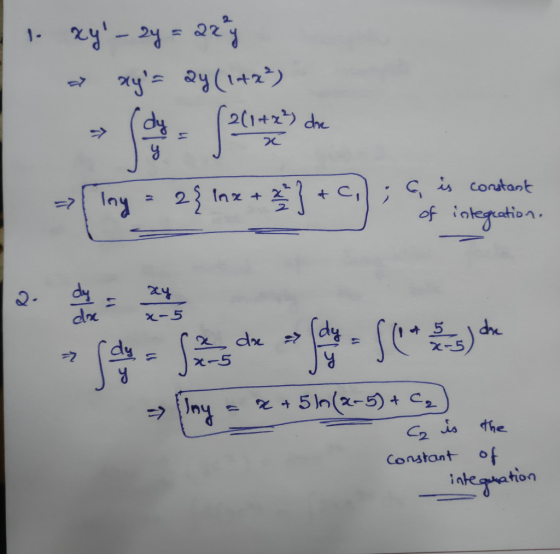
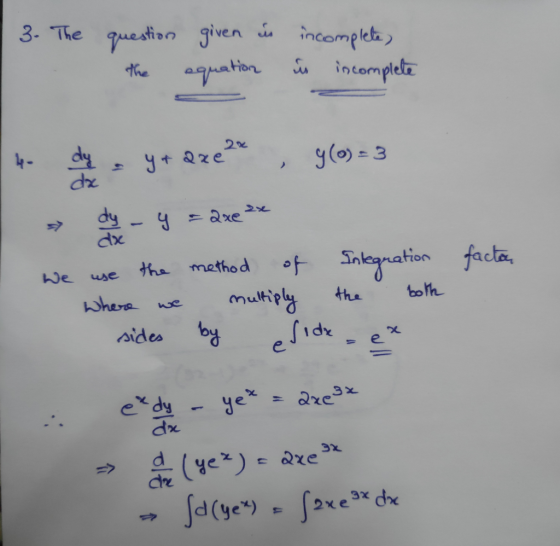
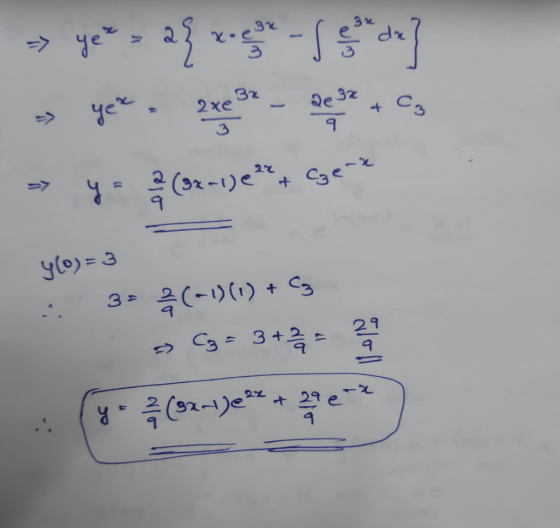
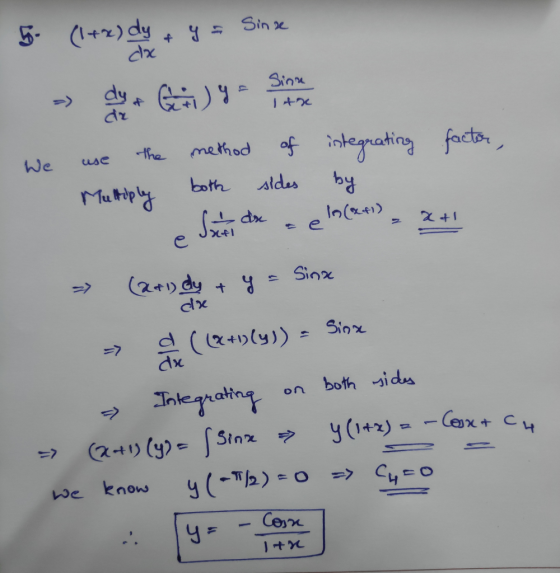
Solve the following: 1. x*y'-2*y-2*x^2*y 2. y xty/(x-5) 3. y'y/x, y(1)-2 4. yy+2*exp(2*x), y(0)=3 5. (1+x)*y+ysi...
C. Execute the following statements in MATLAB: 1. A=3*5 2. A=2^10 3. A-abs(3 + i*4) 4.x=pi/2;...
 C. Execute the following statements in MATLAB: 1. A=3*5 2. A=2^10 3. A-abs(3 + i*4) 4.x=pi/2; A = 10*sin(x) 5.x=pi/4; A = 5*cos(x) 6. A=2*exp(4) 7. A=2*exp(i 2) 8. A-20*sin(pi/4)*exp(-2) C. Execute the following statements in MATLAB: 1. A=3*5 2. A=2^10 3. A-abs(3 + i*4) 4.x=pi/2; A = 10*sin(x) 5.x=pi/4; A = 5*cos(x) 6. A=2*exp(4) 7. A=2*exp(i 2) 8. A-20*sin(pi/4)*exp(-2)
For the equation y = -2 exp(3 - x) - 4 write a program to solve...
 For the equation y = -2 exp(3 - x) - 4 write a program to solve for the first positive root. Describe the error in your solution.
please do only 5 and 7 PART II. Manually solve each of these diagonal systems. 5. Y'(x)=10-5 6, Y'(x)=| 0-5 0 |Yu), Y(0)=| 0-2 3 1 -1 0 Y(0)=| 0-4 3 0 0-2 7. Y'(x)=10-7 |Y(x), 0 0 0 3...
 please do only 5 and 7
PART II. Manually solve each of these diagonal systems. 5. Y'(x)=10-5 6, Y'(x)=| 0-5 0 |Yu), Y(0)=| 0-2 3 1 -1 0 Y(0)=| 0-4 3 0 0-2 7. Y'(x)=10-7 |Y(x), 0 0 0 3
PART II. Manually solve each of these diagonal systems. 5. Y'(x)=10-5 6, Y'(x)=| 0-5 0 |Yu), Y(0)=| 0-2 3 1 -1 0 Y(0)=| 0-4 3 0 0-2 7. Y'(x)=10-7 |Y(x), 0 0 0 3
please do only 5 and 7
PART II. Manually solve each of these diagonal systems. 5. Y'(x)=10-5 6, Y'(x)=| 0-5 0 |Yu), Y(0)=| 0-2 3 1 -1 0 Y(0)=| 0-4 3 0 0-2 7. Y'(x)=10-7 |Y(x), 0 0 0 3
PART II. Manually solve each of these diagonal systems. 5. Y'(x)=10-5 6, Y'(x)=| 0-5 0 |Yu), Y(0)=| 0-2 3 1 -1 0 Y(0)=| 0-4 3 0 0-2 7. Y'(x)=10-7 |Y(x), 0 0 0 3
9. Use the Laplace transform to solve the system dx -xty dt dy dt x(0) =...
 9. Use the Laplace transform to solve the system dx -xty dt dy dt x(0) = 0, y(0) = 1 = 2x
part c Solve the initial value problem yy' + + y with y(4) - 33 a....
 part c
Solve the initial value problem yy' + + y with y(4) - 33 a. To solve this, we should use the substitution u=x^2+y^2 help (formulas '= 2x+2yi help (formulas) Enter derivatives using prime notation (e.g.. you would enter y' for ). N b . After the substitution from the previous part, we obtain the following linear differential equation in ruu 1/2 sqrt() help. (equations e. The solution to the original initial value problem is described by the following...
part c
Solve the initial value problem yy' + + y with y(4) - 33 a. To solve this, we should use the substitution u=x^2+y^2 help (formulas '= 2x+2yi help (formulas) Enter derivatives using prime notation (e.g.. you would enter y' for ). N b . After the substitution from the previous part, we obtain the following linear differential equation in ruu 1/2 sqrt() help. (equations e. The solution to the original initial value problem is described by the following...
solve the exact differential equation (-2sin(x)-ysin(x)+2cos(x))dx+(cos(x))dy=0 where y(0)=5
solve the exact differential equation (-2sin(x)-ysin(x)+2cos(x))dx+(cos(x))dy=0 where y(0)=5
1. Find the solution to the IVP : yy - x = 1, y (0) =...
 1. Find the solution to the IVP : yy - x = 1, y (0) = 2 2. Find the general solution to the exact DE: e* dx – ydy = 0 3. Use ji = cos y to find an EXPLICIT solution to: (tan y)dx + xdy = 0
Use Gramar's Role Find D and save for X X-Y+Z=4 x+2y - Z=-| xty-3 .3Z=-2
 Use Gramar's Role Find D and save for X X-Y+Z=4 x+2y - Z=-| xty-3 .3Z=-2
Solve the following differential equation y(z) – 2 (dy (z)) – 15 y (z) = 0,...
 Solve the following differential equation y(z) – 2 (dy (z)) – 15 y (z) = 0, with y(0) = 1, y'(0) = -27 d22 Enter your answer in Maple syntax in the format "y(x)= ...." For example, if your answer is y(t) = 3e-+421, enter y(x)=3*exp(-x)+4*exp(2*x) in the box.
1. Suppose that the joint density of X and Y is given by exp(-y) (1- exp(-x)), if 0 S y,0 syS oo ...
 1. Suppose that the joint density of X and Y is given by exp(-y) (1- exp(-x)), if 0 S y,0 syS oo exp(-x) (1- exp(-y)), if 0SyS ,0 oo (e,y)exp(-y) Then . The marginal density of X (and also that of Y), ·The conditional density of Y given X = x and vice versa, Cov(X, Y) . Are X and Y independent? Explain with proper justification.
1. Suppose that the joint density of X and Y is given by exp(-y)...
1. Suppose that the joint density of X and Y is given by exp(-y) (1- exp(-x)), if 0 S y,0 syS oo exp(-x) (1- exp(-y)), if 0SyS ,0 oo (e,y)exp(-y) Then . The marginal density of X (and also that of Y), ·The conditional density of Y given X = x and vice versa, Cov(X, Y) . Are X and Y independent? Explain with proper justification.
1. Suppose that the joint density of X and Y is given by exp(-y)...
 C. Execute the following statements in MATLAB: 1. A=3*5 2. A=2^10 3. A-abs(3 + i*4) 4.x=pi/2; A = 10*sin(x) 5.x=pi/4; A = 5*cos(x) 6. A=2*exp(4) 7. A=2*exp(i 2) 8. A-20*sin(pi/4)*exp(-2) C. Execute the following statements in MATLAB: 1. A=3*5 2. A=2^10 3. A-abs(3 + i*4) 4.x=pi/2; A = 10*sin(x) 5.x=pi/4; A = 5*cos(x) 6. A=2*exp(4) 7. A=2*exp(i 2) 8. A-20*sin(pi/4)*exp(-2)
 For the equation y = -2 exp(3 - x) - 4 write a program to solve for the first positive root. Describe the error in your solution.
 please do only 5 and 7
PART II. Manually solve each of these diagonal systems. 5. Y'(x)=10-5 6, Y'(x)=| 0-5 0 |Yu), Y(0)=| 0-2 3 1 -1 0 Y(0)=| 0-4 3 0 0-2 7. Y'(x)=10-7 |Y(x), 0 0 0 3
PART II. Manually solve each of these diagonal systems. 5. Y'(x)=10-5 6, Y'(x)=| 0-5 0 |Yu), Y(0)=| 0-2 3 1 -1 0 Y(0)=| 0-4 3 0 0-2 7. Y'(x)=10-7 |Y(x), 0 0 0 3
please do only 5 and 7
PART II. Manually solve each of these diagonal systems. 5. Y'(x)=10-5 6, Y'(x)=| 0-5 0 |Yu), Y(0)=| 0-2 3 1 -1 0 Y(0)=| 0-4 3 0 0-2 7. Y'(x)=10-7 |Y(x), 0 0 0 3
PART II. Manually solve each of these diagonal systems. 5. Y'(x)=10-5 6, Y'(x)=| 0-5 0 |Yu), Y(0)=| 0-2 3 1 -1 0 Y(0)=| 0-4 3 0 0-2 7. Y'(x)=10-7 |Y(x), 0 0 0 3
 9. Use the Laplace transform to solve the system dx -xty dt dy dt x(0) = 0, y(0) = 1 = 2x
 part c
Solve the initial value problem yy' + + y with y(4) - 33 a. To solve this, we should use the substitution u=x^2+y^2 help (formulas '= 2x+2yi help (formulas) Enter derivatives using prime notation (e.g.. you would enter y' for ). N b . After the substitution from the previous part, we obtain the following linear differential equation in ruu 1/2 sqrt() help. (equations e. The solution to the original initial value problem is described by the following...
part c
Solve the initial value problem yy' + + y with y(4) - 33 a. To solve this, we should use the substitution u=x^2+y^2 help (formulas '= 2x+2yi help (formulas) Enter derivatives using prime notation (e.g.. you would enter y' for ). N b . After the substitution from the previous part, we obtain the following linear differential equation in ruu 1/2 sqrt() help. (equations e. The solution to the original initial value problem is described by the following...
 1. Find the solution to the IVP : yy - x = 1, y (0) = 2 2. Find the general solution to the exact DE: e* dx – ydy = 0 3. Use ji = cos y to find an EXPLICIT solution to: (tan y)dx + xdy = 0
 Use Gramar's Role Find D and save for X X-Y+Z=4 x+2y - Z=-| xty-3 .3Z=-2
 Solve the following differential equation y(z) – 2 (dy (z)) – 15 y (z) = 0, with y(0) = 1, y'(0) = -27 d22 Enter your answer in Maple syntax in the format "y(x)= ...." For example, if your answer is y(t) = 3e-+421, enter y(x)=3*exp(-x)+4*exp(2*x) in the box.
 1. Suppose that the joint density of X and Y is given by exp(-y) (1- exp(-x)), if 0 S y,0 syS oo exp(-x) (1- exp(-y)), if 0SyS ,0 oo (e,y)exp(-y) Then . The marginal density of X (and also that of Y), ·The conditional density of Y given X = x and vice versa, Cov(X, Y) . Are X and Y independent? Explain with proper justification.
1. Suppose that the joint density of X and Y is given by exp(-y)...
1. Suppose that the joint density of X and Y is given by exp(-y) (1- exp(-x)), if 0 S y,0 syS oo exp(-x) (1- exp(-y)), if 0SyS ,0 oo (e,y)exp(-y) Then . The marginal density of X (and also that of Y), ·The conditional density of Y given X = x and vice versa, Cov(X, Y) . Are X and Y independent? Explain with proper justification.
1. Suppose that the joint density of X and Y is given by exp(-y)...
Most questions answered within 3 hours.
-
Where is the error in this code sequence?
String s1 = "Hello";
String s2 = "ello";...
asked 11 months ago -
Financial data for Joel de Paris, Inc., for last year
follow:
Joel de Paris, Inc.
Balance...
asked 11 months ago -
Consider this reaction:
Al2(SO4)3 (aq)+ BaCl3
(aq) Al2Cl6 (aq)- +
3BaSO4(s) . What is the...
asked 11 months ago -
Suppose that Savneet is considering increasing her
recent random sample from 20 car rentals to 40...
asked 11 months ago -
Trucks arrive at an unloading terminal at an average rate of 120
per hour.
Trucks arrive...
asked 11 months ago -
Why are methanol and ethanol completely soluble in water while
octanol is not very little soluble....
asked 11 months ago -
A facilities manager at a university reads in a research report
that the mean amount of...
asked 11 months ago -
When the CuSO4 is rehydrated by adding water to the anhydrous
compound, is this an endothermic...
asked 11 months ago -
A ray of sunlight is passing from diamond into crown glass; the
angle of incidence is...
asked 11 months ago -
A block of mass 0.249 kg is placed on top of a light, vertical
spring of...
asked 11 months ago -
how do the kidneys compensate in the presences of acidosis
a) trigger hyperventilate
b) reserve acid...
asked 11 months ago -
Question 501 pts
The rental rate of capital to the firm increases. Which of the
following...
asked 11 months ago