OH + H2 → H2O + H.
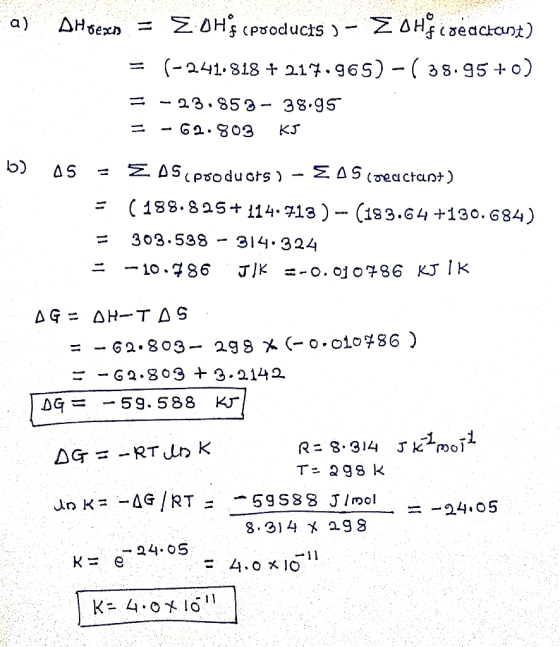
a. Using all columns of data provided, find ∆rxnHo at 298 K
b. Find Keq at 298 K
c. Using all columns of data provided, find ∆H‡ at 298 K
Homework Answers
Add Answer to:
OH + H2 → H2O + H. a. Using all columns of data provided, find ∆rxnHo at 298 K b. Find Keq at 298 K c. Using all column...
OH + H2 → H2O + H. a. Using all columns of data provided, find ∆rxnHo...
 OH + H2 → H2O + H.
a. Using all columns of data provided, find
∆rxnHo at 298 K
b. Find Keq at 298 K
c. Using all columns of data provided, find ∆H‡ at
298 K
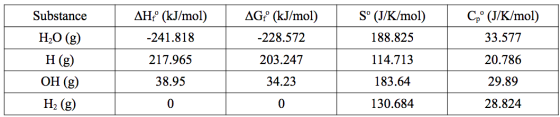
Substance AH" (kJ/mol) AGE (kJ/mol) -228.572 Sº (J/K/mol) 188.825 -241.818 217.965 203.247 114.713 H2O (g) H(g) OH (g) H2 (g) Cpº (J/K/mol) 33.577 20.786 29.89 28.824 38.95 34.23 183.64 130.684
OH + H2 → H2O + H.
a. Using all columns of data provided, find
∆rxnHo at 298 K
b. Find Keq at 298 K
c. Using all columns of data provided, find ∆H‡ at
298 K
Substance AH" (kJ/mol) AGE (kJ/mol) -228.572 Sº (J/K/mol) 188.825 -241.818 217.965 203.247 114.713 H2O (g) H(g) OH (g) H2 (g) Cpº (J/K/mol) 33.577 20.786 29.89 28.824 38.95 34.23 183.64 130.684
Consider the reaction 2 CO2(g) +5 H2(e) C H2(e) + 4H2O(g) Using the standard thermodynamic data...
 Consider the reaction 2 CO2(g) +5 H2(e) C H2(e) + 4H2O(g) Using the standard thermodynamic data in the tables linked above, calculate the equilibrium constant for this reaction at 298.15K ANSWER: Submit Answer Retry Entire Group more group attempts remaining AH,(kJ/mol) AG® (kJ/mol) Sº (J/mol K) -238.7 -116.0 126.8 219.0 -363.0 249.0 135.1 -166.3 -110.0 -351.0 125.0 209.2 68.2 - 129.0 202.0 226.7 200.9 52.3 - 166.0 -53.0 -277.7 219.6 250.0 242.0 160.7 -13.0 -235.1 282.7 Carbon CH3OH (1) H2CO...
At 298 K, evaluate deltaG(kJ) and deltaE (V) for 2CH3OH(l) + 3O2(g) -> 4H2O(g) + 2CO2(g)...
 At 298 K, evaluate deltaG(kJ) and deltaE (V) for
2CH3OH(l) + 3O2(g) -> 4H2O(g) + 2CO2(g)
S (J/mol-K) AH°y (kJ/mol) So (J/mol-K) AH(kJ/mol) Substance Substance N2(g) CH-ОН() 126.8 0 191.5 -238.6 CO(g) NH3(g) 197.9 192.5 -110.5 -46.2 CO2(g) NO(g) 213.6 +90.4 210.6 -393.5 NO2(g) +33.8 240.5 H2(g) HNO3(aq) 130.6 146.0 -206.6 H2O( 69.9 -285.8 O2(g) 188.8 H2O(g) 0 205.0 -241.8
At 298 K, evaluate deltaG(kJ) and deltaE (V) for
2CH3OH(l) + 3O2(g) -> 4H2O(g) + 2CO2(g)
S (J/mol-K) AH°y (kJ/mol) So (J/mol-K) AH(kJ/mol) Substance Substance N2(g) CH-ОН() 126.8 0 191.5 -238.6 CO(g) NH3(g) 197.9 192.5 -110.5 -46.2 CO2(g) NO(g) 213.6 +90.4 210.6 -393.5 NO2(g) +33.8 240.5 H2(g) HNO3(aq) 130.6 146.0 -206.6 H2O( 69.9 -285.8 O2(g) 188.8 H2O(g) 0 205.0 -241.8
QUESTION Use the given data at 298 K to calculate AGº for the reaction 2012(g) +...
 QUESTION Use the given data at 298 K to calculate AGº for the reaction 2012(g) + SO2(g) → SOC12(g) + Cl20(g) Substance: Cl2 (8) SO2(8) SOCI2(g) Cl20(g) AHºf (kJ/mol): 0 -296.8 -212.5 80.3 Sº (J/mol-K): 223.0 248.1 309.77 266.1 O 129.3 kJ 133.6 k) 196.0 k) 199.8 k) 229.6 kJ
Using the following data determine the temperature (in K) at which the reaction H2O(g)+ C(s,graphite) ↔...
Using the following data determine the temperature (in K) at which the reaction H2O(g)+ C(s,graphite) ↔ H2(g) + CO(g) this becomes spontaneous. ΔfH° (H2O(g)) = -251.2 kJ mol-1 ΔfH° (C(s,graphite)) = 0.0 kJ mol-1 ΔfH° (H2(g)) = 0.0 kJ mol-1 ΔfH° (CO(g)) = -110.1 kJ mol-1 S° (H2O(g)) = 192.6 J K-1 mol-1 S° (C(s,graphite)) = 6.4 J K-1 mol-1 S° (H2(g)) = 136.9 J K-1 mol-1 S° (CO(g)) = 192.4 J K-1 mol-1
12. Using the data: CH«(9), AH; = +51.9 kJ mor', sº = 219.8 J mor' k'...
 12. Using the data: CH«(9), AH; = +51.9 kJ mor', sº = 219.8 J mor' k' CO2(g), AH = -394.0 kJ mor', sº = 213.6 J mor' k' H2O(), AH = -286.0 kJ mor', sº = 69.96 J mor'' O2(g), AH = 0.00 kJ mor', sº = 205 J mor'' calculate the maximum amount of useful work that can be obtained, at 25.0 °C, from the process: C2H4(9) + 3 O2(g) → 2 CO2(g) + 2 H2O(1) a. 1332 kJ...
1 attempts left Check my work Enter your answer in the provided box. Find AGⓇ for...
 1 attempts left Check my work Enter your answer in the provided box. Find AGⓇ for the following reaction, at 25°C, using AHand S values. NH,Cs) – NHỊg) + Hg) -55 kJ Substance or Ion HCl(g) HCl(aq) NH3) NH3(aq) NH,Cl(s) Standard Thermodynamic Values at 298 K AH KkJ/mol) -92.3 -167.46 -45.9 -S0.83 -314.4 sº (J/mol K) 186.79 55.06 193 110 94.6
You are provided the following data: H2(g) → 2 H(g) Br(g) → 2 Br(g) H2(g) +...
 You are provided the following data: H2(g) → 2 H(g) Br(g) → 2 Br(g) H2(g) + Brz(g) → 2 HBr(g) AH = 436.4 kJ/mol AH = 192.5 kJ/mol AH = - 72.4 kJ/mol Calculate AH for the reaction H(g) + Br(g) → HBr(g) Show your work | What is ΔΗ?
problem #9 Calculate the equilibrium constant for the following reaction at 25°C. 2H2(g) + O2(g) 2H20cv)...
 problem #9 Calculate the equilibrium constant for the following reaction at 25°C. 2H2(g) + O2(g) 2H20cv) Given the following standard free-energy: H2O , -237.2 KJ/mol at 25°C. Problem #10. Given the following data at 25°C: substance sº (J/mol.K) AH', (KJ/mol) 240.45, 33.8 304.33 9.66 NO 249) N2O160) (a) Calculate the value of A Gº for the following reaction at 25°C: 2 NO2(9) N20 (9) (b) Is the formation of NO a spontaneous process at 25°C and standard-state conditions? (a) What...
help with this please Ca(OH)2(aq) + 2 HCl(aq) +CaCl2(8) + 2 H2O(1) Using the standard thermodynamic...
 help with this please
Ca(OH)2(aq) + 2 HCl(aq) +CaCl2(8) + 2 H2O(1) Using the standard thermodynamic data in the tables linked above, calculate the equilibrium constant for this reaction at 298.15K ANSWER: N2(g) + O2(g) +2NO(g) Using the standard thermodynamic data in the tables linked above, calculate the equilibrium constant for this reaction at 298.15K ANSWER: 2CO(g) + O2(g) +2002(9) - der e en manos de 20, ali ne more than one so mi dicogna undan Using standard thermodynamic data...
help with this please
Ca(OH)2(aq) + 2 HCl(aq) +CaCl2(8) + 2 H2O(1) Using the standard thermodynamic data in the tables linked above, calculate the equilibrium constant for this reaction at 298.15K ANSWER: N2(g) + O2(g) +2NO(g) Using the standard thermodynamic data in the tables linked above, calculate the equilibrium constant for this reaction at 298.15K ANSWER: 2CO(g) + O2(g) +2002(9) - der e en manos de 20, ali ne more than one so mi dicogna undan Using standard thermodynamic data...
 OH + H2 → H2O + H.
a. Using all columns of data provided, find
∆rxnHo at 298 K
b. Find Keq at 298 K
c. Using all columns of data provided, find ∆H‡ at
298 K
Substance AH" (kJ/mol) AGE (kJ/mol) -228.572 Sº (J/K/mol) 188.825 -241.818 217.965 203.247 114.713 H2O (g) H(g) OH (g) H2 (g) Cpº (J/K/mol) 33.577 20.786 29.89 28.824 38.95 34.23 183.64 130.684
OH + H2 → H2O + H.
a. Using all columns of data provided, find
∆rxnHo at 298 K
b. Find Keq at 298 K
c. Using all columns of data provided, find ∆H‡ at
298 K
Substance AH" (kJ/mol) AGE (kJ/mol) -228.572 Sº (J/K/mol) 188.825 -241.818 217.965 203.247 114.713 H2O (g) H(g) OH (g) H2 (g) Cpº (J/K/mol) 33.577 20.786 29.89 28.824 38.95 34.23 183.64 130.684
 Consider the reaction 2 CO2(g) +5 H2(e) C H2(e) + 4H2O(g) Using the standard thermodynamic data in the tables linked above, calculate the equilibrium constant for this reaction at 298.15K ANSWER: Submit Answer Retry Entire Group more group attempts remaining AH,(kJ/mol) AG® (kJ/mol) Sº (J/mol K) -238.7 -116.0 126.8 219.0 -363.0 249.0 135.1 -166.3 -110.0 -351.0 125.0 209.2 68.2 - 129.0 202.0 226.7 200.9 52.3 - 166.0 -53.0 -277.7 219.6 250.0 242.0 160.7 -13.0 -235.1 282.7 Carbon CH3OH (1) H2CO...
 At 298 K, evaluate deltaG(kJ) and deltaE (V) for
2CH3OH(l) + 3O2(g) -> 4H2O(g) + 2CO2(g)
S (J/mol-K) AH°y (kJ/mol) So (J/mol-K) AH(kJ/mol) Substance Substance N2(g) CH-ОН() 126.8 0 191.5 -238.6 CO(g) NH3(g) 197.9 192.5 -110.5 -46.2 CO2(g) NO(g) 213.6 +90.4 210.6 -393.5 NO2(g) +33.8 240.5 H2(g) HNO3(aq) 130.6 146.0 -206.6 H2O( 69.9 -285.8 O2(g) 188.8 H2O(g) 0 205.0 -241.8
At 298 K, evaluate deltaG(kJ) and deltaE (V) for
2CH3OH(l) + 3O2(g) -> 4H2O(g) + 2CO2(g)
S (J/mol-K) AH°y (kJ/mol) So (J/mol-K) AH(kJ/mol) Substance Substance N2(g) CH-ОН() 126.8 0 191.5 -238.6 CO(g) NH3(g) 197.9 192.5 -110.5 -46.2 CO2(g) NO(g) 213.6 +90.4 210.6 -393.5 NO2(g) +33.8 240.5 H2(g) HNO3(aq) 130.6 146.0 -206.6 H2O( 69.9 -285.8 O2(g) 188.8 H2O(g) 0 205.0 -241.8
 QUESTION Use the given data at 298 K to calculate AGº for the reaction 2012(g) + SO2(g) → SOC12(g) + Cl20(g) Substance: Cl2 (8) SO2(8) SOCI2(g) Cl20(g) AHºf (kJ/mol): 0 -296.8 -212.5 80.3 Sº (J/mol-K): 223.0 248.1 309.77 266.1 O 129.3 kJ 133.6 k) 196.0 k) 199.8 k) 229.6 kJ
 12. Using the data: CH«(9), AH; = +51.9 kJ mor', sº = 219.8 J mor' k' CO2(g), AH = -394.0 kJ mor', sº = 213.6 J mor' k' H2O(), AH = -286.0 kJ mor', sº = 69.96 J mor'' O2(g), AH = 0.00 kJ mor', sº = 205 J mor'' calculate the maximum amount of useful work that can be obtained, at 25.0 °C, from the process: C2H4(9) + 3 O2(g) → 2 CO2(g) + 2 H2O(1) a. 1332 kJ...
 1 attempts left Check my work Enter your answer in the provided box. Find AGⓇ for the following reaction, at 25°C, using AHand S values. NH,Cs) – NHỊg) + Hg) -55 kJ Substance or Ion HCl(g) HCl(aq) NH3) NH3(aq) NH,Cl(s) Standard Thermodynamic Values at 298 K AH KkJ/mol) -92.3 -167.46 -45.9 -S0.83 -314.4 sº (J/mol K) 186.79 55.06 193 110 94.6
 You are provided the following data: H2(g) → 2 H(g) Br(g) → 2 Br(g) H2(g) + Brz(g) → 2 HBr(g) AH = 436.4 kJ/mol AH = 192.5 kJ/mol AH = - 72.4 kJ/mol Calculate AH for the reaction H(g) + Br(g) → HBr(g) Show your work | What is ΔΗ?
 problem #9 Calculate the equilibrium constant for the following reaction at 25°C. 2H2(g) + O2(g) 2H20cv) Given the following standard free-energy: H2O , -237.2 KJ/mol at 25°C. Problem #10. Given the following data at 25°C: substance sº (J/mol.K) AH', (KJ/mol) 240.45, 33.8 304.33 9.66 NO 249) N2O160) (a) Calculate the value of A Gº for the following reaction at 25°C: 2 NO2(9) N20 (9) (b) Is the formation of NO a spontaneous process at 25°C and standard-state conditions? (a) What...
 help with this please
Ca(OH)2(aq) + 2 HCl(aq) +CaCl2(8) + 2 H2O(1) Using the standard thermodynamic data in the tables linked above, calculate the equilibrium constant for this reaction at 298.15K ANSWER: N2(g) + O2(g) +2NO(g) Using the standard thermodynamic data in the tables linked above, calculate the equilibrium constant for this reaction at 298.15K ANSWER: 2CO(g) + O2(g) +2002(9) - der e en manos de 20, ali ne more than one so mi dicogna undan Using standard thermodynamic data...
help with this please
Ca(OH)2(aq) + 2 HCl(aq) +CaCl2(8) + 2 H2O(1) Using the standard thermodynamic data in the tables linked above, calculate the equilibrium constant for this reaction at 298.15K ANSWER: N2(g) + O2(g) +2NO(g) Using the standard thermodynamic data in the tables linked above, calculate the equilibrium constant for this reaction at 298.15K ANSWER: 2CO(g) + O2(g) +2002(9) - der e en manos de 20, ali ne more than one so mi dicogna undan Using standard thermodynamic data...
Most questions answered within 3 hours.
-
Where is the error in this code sequence?
String s1 = "Hello";
String s2 = "ello";...
asked 10 months ago -
Financial data for Joel de Paris, Inc., for last year
follow:
Joel de Paris, Inc.
Balance...
asked 10 months ago -
Consider this reaction:
Al2(SO4)3 (aq)+ BaCl3
(aq) Al2Cl6 (aq)- +
3BaSO4(s) . What is the...
asked 10 months ago -
Suppose that Savneet is considering increasing her
recent random sample from 20 car rentals to 40...
asked 10 months ago -
Trucks arrive at an unloading terminal at an average rate of 120
per hour.
Trucks arrive...
asked 10 months ago -
Why are methanol and ethanol completely soluble in water while
octanol is not very little soluble....
asked 10 months ago -
A facilities manager at a university reads in a research report
that the mean amount of...
asked 10 months ago -
When the CuSO4 is rehydrated by adding water to the anhydrous
compound, is this an endothermic...
asked 10 months ago -
A ray of sunlight is passing from diamond into crown glass; the
angle of incidence is...
asked 10 months ago -
A block of mass 0.249 kg is placed on top of a light, vertical
spring of...
asked 10 months ago -
how do the kidneys compensate in the presences of acidosis
a) trigger hyperventilate
b) reserve acid...
asked 10 months ago -
Question 501 pts
The rental rate of capital to the firm increases. Which of the
following...
asked 10 months ago