4. In this procedure, the ether layer is extracted with a total of 30.0 mL of 10% (by mass) NaHCO3 (aq). Calculate: (a)...
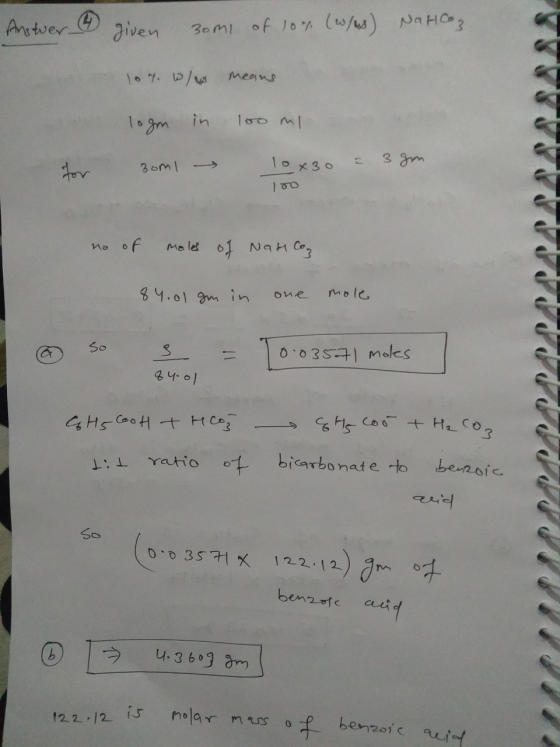
4. In this procedure, the ether layer is extracted with a total of 30.0 mL of 10% (by mass) NaHCO3 (aq). Calculate:
(a) the number of moles of NaHCO3 in this amount of solution.
(b) the mass of benzoic acid that could theoretically be extracted by this solution.
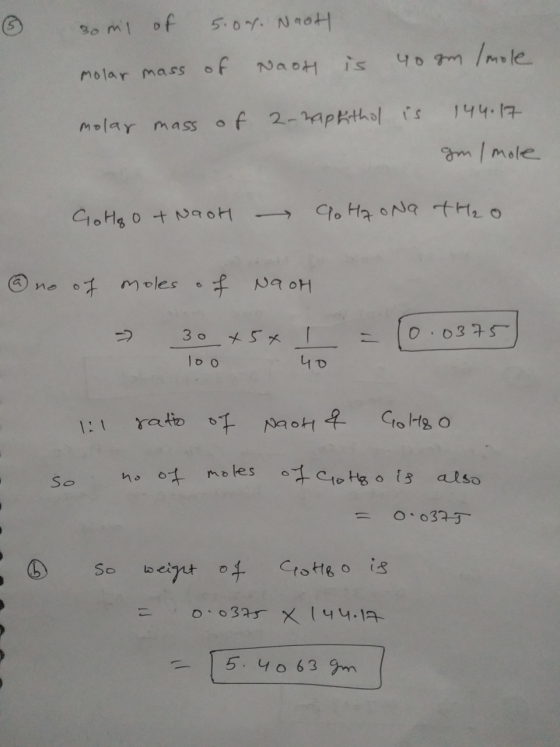
5. In this procedure, the ether layer is extracted with a total of 30.0 mL of 5.00 % (by mass) NaOH (aq). Calculate:
(a) the number of moles of NaOH in this amount of solution.
(b) the mass of 2-naphthol that could theoretically be extracted by this solution.
Homework Answers
Add Answer to:
4. In this procedure, the ether layer is extracted with a total of 30.0 mL of 10% (by mass) NaHCO3 (aq). Calculate: (a)...
5. The same procedure used in this lab can also be used to separate a 3-component mixture of benz...
 Referring to liquid-liquid separation
5. The same procedure used in this lab can also be used to separate a 3-component mixture of benzoic acid, 2-naphthol and naphthalene. Predict the contents of the flasks 1-3 in the following situations (for flasks 1 and 2 after acidification with HCI). [3 points per part 9 points] a) The procedure was performed correctly. b) A student accidentally used 5% NaOH (aq) for the first set of extractions (flask 1) instead of 10% NaHCO3(aq). He...
Referring to liquid-liquid separation
5. The same procedure used in this lab can also be used to separate a 3-component mixture of benzoic acid, 2-naphthol and naphthalene. Predict the contents of the flasks 1-3 in the following situations (for flasks 1 and 2 after acidification with HCI). [3 points per part 9 points] a) The procedure was performed correctly. b) A student accidentally used 5% NaOH (aq) for the first set of extractions (flask 1) instead of 10% NaHCO3(aq). He...
Calculate the pH of the resulting solution if 30.0 mL of 0.300 M HCl(aq) is added...
 Calculate the pH of the resulting solution if 30.0 mL of 0.300 M HCl(aq) is added to (a) 40.0 mL of 0.300 M NaOH(aq). Number pH= 12.63 (b) 20.0 mL of 0.400 M NaOH(aq). Number pH = Tools x 102
Calculate the pH of the resulting solution if 30.0 mL of 0.300 M HCl(aq) is added to (a) 40.0 mL of 0.300 M NaOH(aq). N...
 Calculate the pH of the resulting solution if 30.0 mL of 0.300 M HCl(aq) is added to (a) 40.0 mL of 0.300 M NaOH(aq). Number pH= 12.63 (b) 20.0 mL of 0.400 M NaOH(aq). Number pH= 1.22
3. Using the mass of NaHCO3, calculate the number of moles of NaHCO3. PART A: REACTION...
 3. Using the mass of NaHCO3, calculate the number of moles of NaHCO3. PART A: REACTION STOICHIOMETRY Thala Tablet 1 Tablet 2 Average Data 20.2g 1,99 a 194.919 187.31 g Mass of NaHCO, Mass of Beaker + Acetic Acid + NaHCO, +Watch Glass before Reaction Mass of Beaker + Reaction Mixture + Watch Glass after Reaction Calculated Results (see below for guidance) Mass of CO2 Gas Released 1:02 g Moles of CO2 Gas Released 0.6231 Ymol 0.02227 mol Moles of...
What is the purpose of extracting the aqueous layer two more times with ether in step...
 What is the purpose of extracting the aqueous layer two more
times with ether in step 5?
What is the purpose of washing the combined organic layers with
NaOH in step 6?
Thank you
Reaction 1: Nitration HNO3 NO2 + H2SO4, H20 NO2 toluene NO2 ortho meta para Procedure for Reaction 1: 1) To a stirred solution of 3 ml (44.7 mmoles) 67 % HNO3 in 3.75 mL of water, H2SO4 (9 mL) was slowly added at 10-15 °C. 2)...
What is the purpose of extracting the aqueous layer two more
times with ether in step 5?
What is the purpose of washing the combined organic layers with
NaOH in step 6?
Thank you
Reaction 1: Nitration HNO3 NO2 + H2SO4, H20 NO2 toluene NO2 ortho meta para Procedure for Reaction 1: 1) To a stirred solution of 3 ml (44.7 mmoles) 67 % HNO3 in 3.75 mL of water, H2SO4 (9 mL) was slowly added at 10-15 °C. 2)...
NaHCO3(s) + CH3COOH(aq) -----------> NaCH3COO(aq) + CO2(g) + H2O(l) You will be calculating the minimum mass...
NaHCO3(s) + CH3COOH(aq) -----------> NaCH3COO(aq) + CO2(g) + H2O(l) You will be calculating the minimum mass of sodium hydrogen carbonate and the minimum volume of 3.0 M acetic acid required to completely fill a 1.0-L plastic bag at room conditions. Assume the following: 100% reactant purity, complete reaction, and the barometric pressure and temperature are 772 mmHg and 20.5oC. (a) Calculate the number of moles of carbon dioxide gas that would fill the bag completely, using the ideal gas law....
Question 4 2.5 pts 1.00 mL of a 3.05 x 10 M solution of oleic acid is diluted with 9.00 mL of petroleum ether, form...
 Question 4 2.5 pts 1.00 mL of a 3.05 x 10 M solution of oleic acid is diluted with 9.00 mL of petroleum ether, forming solution A. Then 2.00 mL of solution A is diluted with 8.00 mL of petroleum ether, forming solution B. How many grams of oleic acid are 5.00 mL of solution B? (Molar mass for oleic acid = 282 g/mol) 1.19 x 10⁻⁵ g 1.72 x 10 g 4.30 x 10 g 4.30 104 g 8.60...
1. Calculate the molar mass of NaHCO3: of NaHCO: 0 84.01, 2. Write the balance chemical...
 1. Calculate the molar mass of NaHCO3: of NaHCO: 0 84.01, 2. Write the balance chemical equation for the reaction of sodium bicarbonate with hydrochloric acid: NaHCO3 (s) +_ HCI (aq) → 3. Calculate the volume of CO2 (in mL) of 0.005 moles of CO2 (Remember the gas equation, PV = nRT, where R -0.082 L-atm-mol''.K. Room temperature, T = 20.0°C and Pco2 = 738.5 mm Hg; 1 atm = 760 mm Hg). 4. Calculate the volume of CO2 that...
PART A. Standardization of NaOH(aq) Calculate the molar mass of KHP from the molecular formula: __204.22...
PART A. Standardization of NaOH(aq) Calculate the molar mass of KHP from the molecular formula: __204.22 g/mol______________ Trial Run 1 Run 2 Mass of KHP 0.326g 0.307g 0.314g Calculate Moles of KHP Calculate Moles of NaOH needed for the reaction Initial volume of NaOH(aq) in mL 11.30ml 22.20ml 25.20ml Final volume of NaOH(aq) in mL 21.60ml 31.60ml 35.00ml Calculate the total volume of NaOH titrated in mL Convert the total volume of NaOH titrated into L xxxx Calculate the concentration...
Would the methylene chloride layer be above or below the experiment? Justify your answer. 1. aqueous layer in today...
 Would the methylene chloride layer be above or below the experiment? Justify your answer. 1. aqueous layer in today's ium carbonate used in the isolation of caffeine? Be specific as to the 2. Why is potass chemical species the carbonate may act on. Why was sodium sulfate used? 3. 4. After introducing 1.0 g of potassium carbonate into the centri hot water extract, it was capped, shaken, and then cooled to room temperature. Following this, roug minute. Why wasn't the...
 Referring to liquid-liquid separation
5. The same procedure used in this lab can also be used to separate a 3-component mixture of benzoic acid, 2-naphthol and naphthalene. Predict the contents of the flasks 1-3 in the following situations (for flasks 1 and 2 after acidification with HCI). [3 points per part 9 points] a) The procedure was performed correctly. b) A student accidentally used 5% NaOH (aq) for the first set of extractions (flask 1) instead of 10% NaHCO3(aq). He...
Referring to liquid-liquid separation
5. The same procedure used in this lab can also be used to separate a 3-component mixture of benzoic acid, 2-naphthol and naphthalene. Predict the contents of the flasks 1-3 in the following situations (for flasks 1 and 2 after acidification with HCI). [3 points per part 9 points] a) The procedure was performed correctly. b) A student accidentally used 5% NaOH (aq) for the first set of extractions (flask 1) instead of 10% NaHCO3(aq). He...
 Calculate the pH of the resulting solution if 30.0 mL of 0.300 M HCl(aq) is added to (a) 40.0 mL of 0.300 M NaOH(aq). Number pH= 12.63 (b) 20.0 mL of 0.400 M NaOH(aq). Number pH = Tools x 102
 Calculate the pH of the resulting solution if 30.0 mL of 0.300 M HCl(aq) is added to (a) 40.0 mL of 0.300 M NaOH(aq). Number pH= 12.63 (b) 20.0 mL of 0.400 M NaOH(aq). Number pH= 1.22
 3. Using the mass of NaHCO3, calculate the number of moles of NaHCO3. PART A: REACTION STOICHIOMETRY Thala Tablet 1 Tablet 2 Average Data 20.2g 1,99 a 194.919 187.31 g Mass of NaHCO, Mass of Beaker + Acetic Acid + NaHCO, +Watch Glass before Reaction Mass of Beaker + Reaction Mixture + Watch Glass after Reaction Calculated Results (see below for guidance) Mass of CO2 Gas Released 1:02 g Moles of CO2 Gas Released 0.6231 Ymol 0.02227 mol Moles of...
 What is the purpose of extracting the aqueous layer two more
times with ether in step 5?
What is the purpose of washing the combined organic layers with
NaOH in step 6?
Thank you
Reaction 1: Nitration HNO3 NO2 + H2SO4, H20 NO2 toluene NO2 ortho meta para Procedure for Reaction 1: 1) To a stirred solution of 3 ml (44.7 mmoles) 67 % HNO3 in 3.75 mL of water, H2SO4 (9 mL) was slowly added at 10-15 °C. 2)...
What is the purpose of extracting the aqueous layer two more
times with ether in step 5?
What is the purpose of washing the combined organic layers with
NaOH in step 6?
Thank you
Reaction 1: Nitration HNO3 NO2 + H2SO4, H20 NO2 toluene NO2 ortho meta para Procedure for Reaction 1: 1) To a stirred solution of 3 ml (44.7 mmoles) 67 % HNO3 in 3.75 mL of water, H2SO4 (9 mL) was slowly added at 10-15 °C. 2)...
 Question 4 2.5 pts 1.00 mL of a 3.05 x 10 M solution of oleic acid is diluted with 9.00 mL of petroleum ether, forming solution A. Then 2.00 mL of solution A is diluted with 8.00 mL of petroleum ether, forming solution B. How many grams of oleic acid are 5.00 mL of solution B? (Molar mass for oleic acid = 282 g/mol) 1.19 x 10⁻⁵ g 1.72 x 10 g 4.30 x 10 g 4.30 104 g 8.60...
 1. Calculate the molar mass of NaHCO3: of NaHCO: 0 84.01, 2. Write the balance chemical equation for the reaction of sodium bicarbonate with hydrochloric acid: NaHCO3 (s) +_ HCI (aq) → 3. Calculate the volume of CO2 (in mL) of 0.005 moles of CO2 (Remember the gas equation, PV = nRT, where R -0.082 L-atm-mol''.K. Room temperature, T = 20.0°C and Pco2 = 738.5 mm Hg; 1 atm = 760 mm Hg). 4. Calculate the volume of CO2 that...
 Would the methylene chloride layer be above or below the experiment? Justify your answer. 1. aqueous layer in today's ium carbonate used in the isolation of caffeine? Be specific as to the 2. Why is potass chemical species the carbonate may act on. Why was sodium sulfate used? 3. 4. After introducing 1.0 g of potassium carbonate into the centri hot water extract, it was capped, shaken, and then cooled to room temperature. Following this, roug minute. Why wasn't the...
Most questions answered within 3 hours.
-
Where is the error in this code sequence?
String s1 = "Hello";
String s2 = "ello";...
asked 10 months ago -
Financial data for Joel de Paris, Inc., for last year
follow:
Joel de Paris, Inc.
Balance...
asked 10 months ago -
Consider this reaction:
Al2(SO4)3 (aq)+ BaCl3
(aq) Al2Cl6 (aq)- +
3BaSO4(s) . What is the...
asked 10 months ago -
Suppose that Savneet is considering increasing her
recent random sample from 20 car rentals to 40...
asked 10 months ago -
Trucks arrive at an unloading terminal at an average rate of 120
per hour.
Trucks arrive...
asked 10 months ago -
Why are methanol and ethanol completely soluble in water while
octanol is not very little soluble....
asked 10 months ago -
A facilities manager at a university reads in a research report
that the mean amount of...
asked 10 months ago -
When the CuSO4 is rehydrated by adding water to the anhydrous
compound, is this an endothermic...
asked 10 months ago -
A ray of sunlight is passing from diamond into crown glass; the
angle of incidence is...
asked 10 months ago -
A block of mass 0.249 kg is placed on top of a light, vertical
spring of...
asked 10 months ago -
how do the kidneys compensate in the presences of acidosis
a) trigger hyperventilate
b) reserve acid...
asked 10 months ago -
Question 501 pts
The rental rate of capital to the firm increases. Which of the
following...
asked 10 months ago