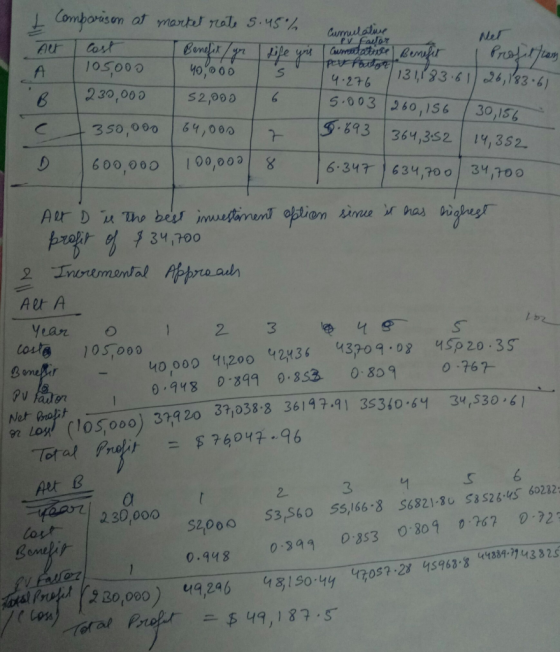
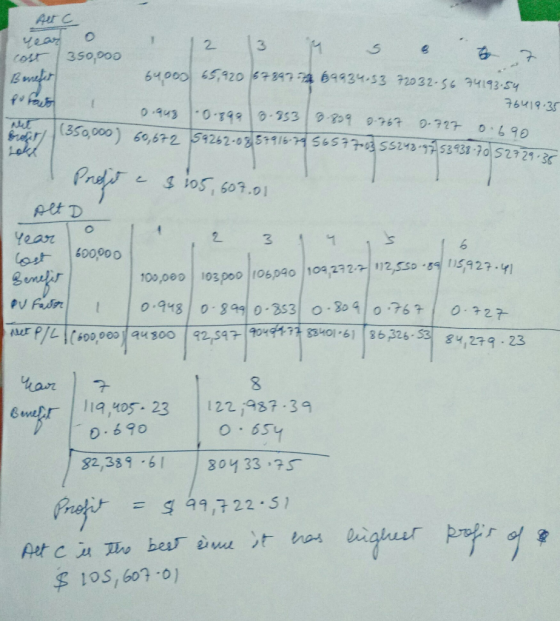
Compare the following alterntives given a market rate of 5.45% per year and an inflation rate of 3% per year. Use firs...
- Compare the following alterntives given a market rate of 5.45% per year and an inflation rate of 3% per year. Use first the B/C method to determine feasibility and then the incremental B/C method to determine the oprimum level of investment.
|
Alt |
Construction Cost $ |
Annual Benefits $/yr |
Life yrs |
|
A |
105,000 |
40,000 |
5 |
|
B |
230,000 |
52,000 |
6 |
|
C |
350,000 |
64,000 |
7 |
|
D |
600,000 |
100,000 |
8 |
Homework Answers
Add Answer to:
Compare the following alterntives given a market rate of 5.45% per year and an inflation rate of 3% per year. Use firs...
Compare the following alterntives given a market rate of 5.45% per year and an inflation rate...
Compare the following alterntives given a market rate of 5.45% per year and an inflation rate of 3% per year. Use first the B/C method to determine feasibility and then the incremental B/C method to determine the oprimum level of investment. Alt Construction Cost $ Annual Benefits $/yr Life yrs A 105,000 40,000 5 B 230,000 52,000 6 C 350,000 64,000 7 D 600,000 100,000 8
4. Compare the following altemtives given a market rate of 3.45% per year and an inflation...
 4. Compare the following altemtives given a market rate of 3.45% per year and an inflation rate of 3% per year. Use first the B/C method to determine feasibility and then the incremental B/C method to determine the oprimum level of investment. Life yrs Alt A Construction Costs Annual Benefits S/yr 105,000 40,000 230,000 52.000 350.000 64,000 600,000 100,000 6
Compare the following 2 alternatives using the Net Present Worth (NPW) method – rate is 4.5%...
Compare the following 2 alternatives using the Net Present Worth (NPW) method – rate is 4.5% per year. Repeat the solution using the Net Equivalent Uniform Annual (NEUA) method. Which one is simpler? Draw all cash flow diagrams. Alt. Construction Cost Benefit Maintenance Service Life A $380,000 $240,000/yr. $10,000/yr. 9 yrs B $750,000 $270,000/yr. $20,000/yr. 18 yrs
Compare the following 2 alternatives using the Net Present Worth (NPS) method – rate is 3%...
Compare the following 2 alternatives using the Net Present Worth (NPS) method – rate is 3% per year. Draw all cash flow diagrams. Please show work using a formula. Alt. Construction Cost ($) Benefit ($/yr.) Service Life (yrs.) A 380,000 200,000 7 B 450,000 220,000 7
Compare the following 2 alternatives using the Net Equivalent Uniform Annual (NEUA) method and the given...
Compare the following 2 alternatives using the Net Equivalent Uniform Annual (NEUA) method and the given interest rate of 4.5% Draw the Cash Flow Diagram Alt. Construction cost $ Benefit ($/yr) Salvage $ Service Life (yrs) A 1,800,000 400,000 40,000 7 B 2,900,000 550,000 80,000 14
5. Compare the following two alternatives by the IRR method, given MARR of 8%/year. Is the...
 5. Compare the following two alternatives by the IRR method, given MARR of 8%/year. Is the incement in cost form A to B justified? Alt. Construction cost | Benefits Styr | Salvage Service Life (yrs 510,000 145,000 10,000 775,000 155,000 20,000
4. Apply incremental conventional B/C analysis at an interest rate of 8% per year to determine...
 4. Apply incremental conventional B/C analysis at an interest rate of 8% per year to determine which alternative should be selected. Use a 20-year study period, and assume the damage costs might occur in year 6 of the study period. Alternative A 600,000 50,000 Alternative B Initial cost, S Annual M&O 800,000 70,000 costs, S/year Potential damage 950,000 250,000 costs, $ [Ans. Inc. B/C 1.11]
The real risk-free rate, r*, is expected to remain constant at 3% per year. Inflation is expected...
The real risk-free rate, r*, is expected to remain constant at 3% per year. Inflation is expected to be 2% per year forever. Assume that the expectations theory holds; that is, there is no maturity risk premium. Treasury securities do not require any default risk or liquidity premiums. Which of the following is most correct? The Treasury yield curve is flat and all Treasury securities yield 5%. The Treasury yield curve is upward sloping for the first 10 years, and then downward sloping....
I DO RATE. PLEASE ANWSER EVERYTHING CORRECT AND ORGANIZED SOLE RVEYTHING BY HAND NO SOFTWARE THANK...
 I DO RATE. PLEASE ANWSER EVERYTHING CORRECT AND ORGANIZED SOLE
RVEYTHING BY HAND NO SOFTWARE THANK YOU
BONUS QUESTIONS 5a) A manufacturer of braided steel tire rubber molding equipment for automotive tire rubber fabrication in considering purchase either a semi-automatic or fully automatic system. The estima for each are as follows: Semi-Automatic Fully Automatic First Cost Annual Disbursement Annual Benefits Salvage Value Life $160,000 $ 3.000 $ 70,000 S 11,000 8 yrs $200,000 $ 6,000 $100,000 S 20,000 4 yrs...
I DO RATE. PLEASE ANWSER EVERYTHING CORRECT AND ORGANIZED SOLE
RVEYTHING BY HAND NO SOFTWARE THANK YOU
BONUS QUESTIONS 5a) A manufacturer of braided steel tire rubber molding equipment for automotive tire rubber fabrication in considering purchase either a semi-automatic or fully automatic system. The estima for each are as follows: Semi-Automatic Fully Automatic First Cost Annual Disbursement Annual Benefits Salvage Value Life $160,000 $ 3.000 $ 70,000 S 11,000 8 yrs $200,000 $ 6,000 $100,000 S 20,000 4 yrs...
1. 2. 3. 4. 5. Use this information for Kellman Company to answer the question that...
 1.
2.
3.
4.
5.
Use this information for Kellman Company to answer the question that follow. The balance sheets at the end of each of the first two years of operations indicate the following: Kellman Company Total current assets Total investments Total property, plant, and equipment Total current liabilities Total long-term liabilities Preferred 9% stock, $100 par Common stock, $10 par Paid in capital in excess of par-Common stock Retained earnings Year 2 $600,000 60,000 900,000 125,000 350,000 100,000...
1.
2.
3.
4.
5.
Use this information for Kellman Company to answer the question that follow. The balance sheets at the end of each of the first two years of operations indicate the following: Kellman Company Total current assets Total investments Total property, plant, and equipment Total current liabilities Total long-term liabilities Preferred 9% stock, $100 par Common stock, $10 par Paid in capital in excess of par-Common stock Retained earnings Year 2 $600,000 60,000 900,000 125,000 350,000 100,000...
 4. Compare the following altemtives given a market rate of 3.45% per year and an inflation rate of 3% per year. Use first the B/C method to determine feasibility and then the incremental B/C method to determine the oprimum level of investment. Life yrs Alt A Construction Costs Annual Benefits S/yr 105,000 40,000 230,000 52.000 350.000 64,000 600,000 100,000 6
 5. Compare the following two alternatives by the IRR method, given MARR of 8%/year. Is the incement in cost form A to B justified? Alt. Construction cost | Benefits Styr | Salvage Service Life (yrs 510,000 145,000 10,000 775,000 155,000 20,000
 4. Apply incremental conventional B/C analysis at an interest rate of 8% per year to determine which alternative should be selected. Use a 20-year study period, and assume the damage costs might occur in year 6 of the study period. Alternative A 600,000 50,000 Alternative B Initial cost, S Annual M&O 800,000 70,000 costs, S/year Potential damage 950,000 250,000 costs, $ [Ans. Inc. B/C 1.11]
 I DO RATE. PLEASE ANWSER EVERYTHING CORRECT AND ORGANIZED SOLE
RVEYTHING BY HAND NO SOFTWARE THANK YOU
BONUS QUESTIONS 5a) A manufacturer of braided steel tire rubber molding equipment for automotive tire rubber fabrication in considering purchase either a semi-automatic or fully automatic system. The estima for each are as follows: Semi-Automatic Fully Automatic First Cost Annual Disbursement Annual Benefits Salvage Value Life $160,000 $ 3.000 $ 70,000 S 11,000 8 yrs $200,000 $ 6,000 $100,000 S 20,000 4 yrs...
I DO RATE. PLEASE ANWSER EVERYTHING CORRECT AND ORGANIZED SOLE
RVEYTHING BY HAND NO SOFTWARE THANK YOU
BONUS QUESTIONS 5a) A manufacturer of braided steel tire rubber molding equipment for automotive tire rubber fabrication in considering purchase either a semi-automatic or fully automatic system. The estima for each are as follows: Semi-Automatic Fully Automatic First Cost Annual Disbursement Annual Benefits Salvage Value Life $160,000 $ 3.000 $ 70,000 S 11,000 8 yrs $200,000 $ 6,000 $100,000 S 20,000 4 yrs...
 1.
2.
3.
4.
5.
Use this information for Kellman Company to answer the question that follow. The balance sheets at the end of each of the first two years of operations indicate the following: Kellman Company Total current assets Total investments Total property, plant, and equipment Total current liabilities Total long-term liabilities Preferred 9% stock, $100 par Common stock, $10 par Paid in capital in excess of par-Common stock Retained earnings Year 2 $600,000 60,000 900,000 125,000 350,000 100,000...
1.
2.
3.
4.
5.
Use this information for Kellman Company to answer the question that follow. The balance sheets at the end of each of the first two years of operations indicate the following: Kellman Company Total current assets Total investments Total property, plant, and equipment Total current liabilities Total long-term liabilities Preferred 9% stock, $100 par Common stock, $10 par Paid in capital in excess of par-Common stock Retained earnings Year 2 $600,000 60,000 900,000 125,000 350,000 100,000...
Most questions answered within 3 hours.
-
Where is the error in this code sequence?
String s1 = "Hello";
String s2 = "ello";...
asked 10 months ago -
Financial data for Joel de Paris, Inc., for last year
follow:
Joel de Paris, Inc.
Balance...
asked 10 months ago -
Consider this reaction:
Al2(SO4)3 (aq)+ BaCl3
(aq) Al2Cl6 (aq)- +
3BaSO4(s) . What is the...
asked 10 months ago -
Suppose that Savneet is considering increasing her
recent random sample from 20 car rentals to 40...
asked 10 months ago -
Trucks arrive at an unloading terminal at an average rate of 120
per hour.
Trucks arrive...
asked 10 months ago -
Why are methanol and ethanol completely soluble in water while
octanol is not very little soluble....
asked 10 months ago -
A facilities manager at a university reads in a research report
that the mean amount of...
asked 10 months ago -
When the CuSO4 is rehydrated by adding water to the anhydrous
compound, is this an endothermic...
asked 10 months ago -
A ray of sunlight is passing from diamond into crown glass; the
angle of incidence is...
asked 10 months ago -
A block of mass 0.249 kg is placed on top of a light, vertical
spring of...
asked 10 months ago -
how do the kidneys compensate in the presences of acidosis
a) trigger hyperventilate
b) reserve acid...
asked 10 months ago -
Question 501 pts
The rental rate of capital to the firm increases. Which of the
following...
asked 10 months ago