
Homework Answers
lineweaver-burk equation is
=
+
now lineweaver-burk plot at no inhibitor
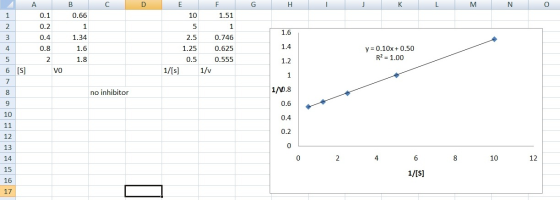
bestline equation is
y = 0.10 x + 0.50
so,
= 0.50
or, Vmax = (1/.0.50) = 2.00 nmol/min.
= 0.10
or, Km = Vmax
* 0.10 = (2 *0.10) = 0.20 M
now the plot in presence of inhibitor
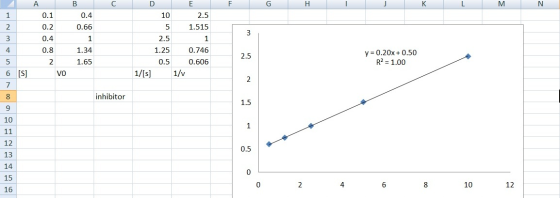
best line equation is
y = 0.20 x + 0.5
or, Vmax = (1/.0.50 ) = 2.00 nmol/min.
= 0.20
or, Km = Vmax * 0.20 = (2 *0.20) =
0.40 M
Therefore, in presence of inhibitor Vmax is unchanged and Km has increased, so type of inhibition is competitive .
Competitive inhibitor : The structure of inhibitor is similar to substrate so it competes with the substrate so such kind of inhibition is overcome by increasing the substrate concentration.
Add Answer to:
and Vmax 2 points for interpreting the gapl Name (can be on graph paper or Excel. It is easier on Excel). This is w...
Name (Can be on graph paper or Excel. It is easier on Excel This is worth 10 points. 3 points for determining the c...
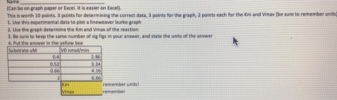 Name (Can be on graph paper or Excel. It is easier on Excel This is worth 10 points. 3 points for determining the correct data, 3 points for the graph, 2 points each for the Km and Vmax (be sure to remember units 1. Use this experimental data to plot a lineweaver burke graph 2. Use the graph determine them and Vmax of the reaction 3. Be sure to keep the same number of sig figs in your answer, and...
please graph all 3 lines and explain the vmax&km How to: Lineweaver Burke 1. The following...
 please graph all 3 lines and explain the
vmax&km
How to: Lineweaver Burke 1. The following data was determined for an enzyme in the absence of an inhibitor and in the presence of two different inhibitors (V2 and V3). Determine the V. and K for the enzyme (1) Plot the data and determine the type of inhibition for each inhibitor (S) mm 1 V2 4.3 5.5 V1 12 20 29 2 relliate 150b
please graph all 3 lines and explain the
vmax&km
How to: Lineweaver Burke 1. The following data was determined for an enzyme in the absence of an inhibitor and in the presence of two different inhibitors (V2 and V3). Determine the V. and K for the enzyme (1) Plot the data and determine the type of inhibition for each inhibitor (S) mm 1 V2 4.3 5.5 V1 12 20 29 2 relliate 150b
4) (5 points) What fraction of Vmax is observed at [S] = 5 KM? 5) (20...
 4) (5 points) What fraction of Vmax is
observed at [S] = 5 KM?
5) (20 points) For the following data:
[S] (μM)
V0 (no inhibitor)
V0 (2.45 μM inhibitor present)
2.1
0.031
0.020
4.2
0.06
0.045
13
0.138
0.09
20
0.153
0.13
52
0.170
0.135
a) Construct a 1/v (y-axis) versus 1/[S]
(x-axis) plot in the space below.
b) Is the inhibition competitive, noncompetitive, or
uncompetitive?
c) Calculate KM, KMapp,
Vmax, and Vmaxapp....
4) (5 points) What fraction of Vmax is
observed at [S] = 5 KM?
5) (20 points) For the following data:
[S] (μM)
V0 (no inhibitor)
V0 (2.45 μM inhibitor present)
2.1
0.031
0.020
4.2
0.06
0.045
13
0.138
0.09
20
0.153
0.13
52
0.170
0.135
a) Construct a 1/v (y-axis) versus 1/[S]
(x-axis) plot in the space below.
b) Is the inhibition competitive, noncompetitive, or
uncompetitive?
c) Calculate KM, KMapp,
Vmax, and Vmaxapp....
CHEM3250 Assignment-Enzyme Inhibition Consider the data below for an enzyme catalyzed reaction. T...
 CHEM3250 Assignment-Enzyme Inhibition Consider the data below for an enzyme catalyzed reaction. The rate of the reaction has been determined with and without an inhibitor. A total concentration of enzyme of 20 uM was used in the experiment. SHOW WORK AND UNITS!!! Without Inhibitor With Inhibitor [substrate] (mM)Rate of formation of te of formation of product product (mM/min) mM/min) 6.67 5.25 0.49 7.04 38.91 1.0 2.2 6.9 41.8 44.0 1.5 3.5 1 a) On the same graph, plot the data...
The effect of an inhibitor on an enzyme was tested and the experiment gave the results...
The effect of an inhibitor on an enzyme was tested and the experiment gave the results below. Plot on Excel the data using a double-reciprocal plot (Lineweaver-Burke), determine Km and Vmax of the no inhibitor and each type of inhibitor and the type of inhibition that is occurring. [S] µM V (µmol/min) V (µmol/min) V (µmol/min) with 0.0 nM with 25 nM with 50 nM Inhibitor Inhibitor Inhibitor ______ ___________ ___________ ___________ 0.4 0.22 0.21 0.20...
9. The following data were obtained from an enzyme kinetics experiment. Graph the data using a...
 9. The following data were obtained from an enzyme kinetics experiment. Graph the data using a Lineweaver-Burk plot and determine the values for Km and Vmax. [S] (UM) V(nmol/min) 0.20 0.26 1.43 1.67 2.08 3.33 0.33 1.00
11. In Excel, prepare Lineweaver-Burk plots for the behavior of an enzyme for which the following...
 11. In Excel, prepare Lineweaver-Burk plots for the behavior of an enzyme for which the following experimental data are available: V, umol/min umol/min (No Inhibitor) S], mM (Inhibitor Present) 3.66 5.12 6.18 6.98 7.60 4.58 6.40 7.72 8.72 9.50 3.0 5.0 7.0 9.0 11.0 a. What are the KM and Vmax values for the inhibited and uninhibited reaction 5 pts. each reaction) b. Is the inhibitor competitive or noncompetitive? (5 pts.) Micheli-Menten) EQUATIONS: VV
Problem Set #3 Due in class 10/10/18 se in a classic 1. Sucrose (common table sugar)...
 Problem Set #3 Due in class 10/10/18 se in a classic 1. Sucrose (common table sugar) is hydrolyzed to glucose and fructo experiment in kinetics. The reaction is catalyzed by the enzyme invertase. Using the following data, determine by the Lineweaver-Burke method A) the Vmax and Km of the enzyme and B) whether the inhibition of this reaction by 2 M urea is competitive or noncompetitive. V, no inhibitor (arbitrary units) V, inhibitor present (same arbitrary units) Sucrose concentration 0.0292...
Prostaglandins are a class of eicosanoids (fatty acid derivatives) with a variety of extremely potent actions...
 Prostaglandins are a class of eicosanoids (fatty acid derivatives) with a variety of extremely potent actions on vertebrate tissues. They are responsible for producing fever and inflammation and its associated pain. Prostaglandins are derived from the 20-carbon fatty acid, arachidonic acid, in a reaction catalyzed by the enzyme, prostaglandin endoperoxide synthase. This uses oxygen to convert arachidonic acid to PGG2 (a prostaglandin). Ibuprofen inhibits this enzyme and is a fever reducer and anti-inflammatory agent. The kinetic data is given below...
What is the Km of this graph if 1/2 the Vmax with inhibitor- yellow dot- is...
 What is the Km of this graph if 1/2 the Vmax with inhibitor-
yellow dot- is 1.96. And Kmax 1/2 with out inhibitor(grey dot) is
2.34.
V/Inhibitor V/Reaction Rate (mol/min) V/No Inhinitor km(no inhibitor) Km/w/inhinitor) 0.00033 0.000033 0.000133 0.000133 0.00133 0.002 0.000667 [S] (mol/liters)
What is the Km of this graph if 1/2 the Vmax with inhibitor-
yellow dot- is 1.96. And Kmax 1/2 with out inhibitor(grey dot) is
2.34.
V/Inhibitor V/Reaction Rate (mol/min) V/No Inhinitor km(no inhibitor) Km/w/inhinitor) 0.00033 0.000033 0.000133 0.000133 0.00133 0.002 0.000667 [S] (mol/liters)
 Name (Can be on graph paper or Excel. It is easier on Excel This is worth 10 points. 3 points for determining the correct data, 3 points for the graph, 2 points each for the Km and Vmax (be sure to remember units 1. Use this experimental data to plot a lineweaver burke graph 2. Use the graph determine them and Vmax of the reaction 3. Be sure to keep the same number of sig figs in your answer, and...
 please graph all 3 lines and explain the
vmax&km
How to: Lineweaver Burke 1. The following data was determined for an enzyme in the absence of an inhibitor and in the presence of two different inhibitors (V2 and V3). Determine the V. and K for the enzyme (1) Plot the data and determine the type of inhibition for each inhibitor (S) mm 1 V2 4.3 5.5 V1 12 20 29 2 relliate 150b
please graph all 3 lines and explain the
vmax&km
How to: Lineweaver Burke 1. The following data was determined for an enzyme in the absence of an inhibitor and in the presence of two different inhibitors (V2 and V3). Determine the V. and K for the enzyme (1) Plot the data and determine the type of inhibition for each inhibitor (S) mm 1 V2 4.3 5.5 V1 12 20 29 2 relliate 150b
 4) (5 points) What fraction of Vmax is
observed at [S] = 5 KM?
5) (20 points) For the following data:
[S] (μM)
V0 (no inhibitor)
V0 (2.45 μM inhibitor present)
2.1
0.031
0.020
4.2
0.06
0.045
13
0.138
0.09
20
0.153
0.13
52
0.170
0.135
a) Construct a 1/v (y-axis) versus 1/[S]
(x-axis) plot in the space below.
b) Is the inhibition competitive, noncompetitive, or
uncompetitive?
c) Calculate KM, KMapp,
Vmax, and Vmaxapp....
4) (5 points) What fraction of Vmax is
observed at [S] = 5 KM?
5) (20 points) For the following data:
[S] (μM)
V0 (no inhibitor)
V0 (2.45 μM inhibitor present)
2.1
0.031
0.020
4.2
0.06
0.045
13
0.138
0.09
20
0.153
0.13
52
0.170
0.135
a) Construct a 1/v (y-axis) versus 1/[S]
(x-axis) plot in the space below.
b) Is the inhibition competitive, noncompetitive, or
uncompetitive?
c) Calculate KM, KMapp,
Vmax, and Vmaxapp....
 CHEM3250 Assignment-Enzyme Inhibition Consider the data below for an enzyme catalyzed reaction. The rate of the reaction has been determined with and without an inhibitor. A total concentration of enzyme of 20 uM was used in the experiment. SHOW WORK AND UNITS!!! Without Inhibitor With Inhibitor [substrate] (mM)Rate of formation of te of formation of product product (mM/min) mM/min) 6.67 5.25 0.49 7.04 38.91 1.0 2.2 6.9 41.8 44.0 1.5 3.5 1 a) On the same graph, plot the data...
 9. The following data were obtained from an enzyme kinetics experiment. Graph the data using a Lineweaver-Burk plot and determine the values for Km and Vmax. [S] (UM) V(nmol/min) 0.20 0.26 1.43 1.67 2.08 3.33 0.33 1.00
 11. In Excel, prepare Lineweaver-Burk plots for the behavior of an enzyme for which the following experimental data are available: V, umol/min umol/min (No Inhibitor) S], mM (Inhibitor Present) 3.66 5.12 6.18 6.98 7.60 4.58 6.40 7.72 8.72 9.50 3.0 5.0 7.0 9.0 11.0 a. What are the KM and Vmax values for the inhibited and uninhibited reaction 5 pts. each reaction) b. Is the inhibitor competitive or noncompetitive? (5 pts.) Micheli-Menten) EQUATIONS: VV
 Problem Set #3 Due in class 10/10/18 se in a classic 1. Sucrose (common table sugar) is hydrolyzed to glucose and fructo experiment in kinetics. The reaction is catalyzed by the enzyme invertase. Using the following data, determine by the Lineweaver-Burke method A) the Vmax and Km of the enzyme and B) whether the inhibition of this reaction by 2 M urea is competitive or noncompetitive. V, no inhibitor (arbitrary units) V, inhibitor present (same arbitrary units) Sucrose concentration 0.0292...
 Prostaglandins are a class of eicosanoids (fatty acid derivatives) with a variety of extremely potent actions on vertebrate tissues. They are responsible for producing fever and inflammation and its associated pain. Prostaglandins are derived from the 20-carbon fatty acid, arachidonic acid, in a reaction catalyzed by the enzyme, prostaglandin endoperoxide synthase. This uses oxygen to convert arachidonic acid to PGG2 (a prostaglandin). Ibuprofen inhibits this enzyme and is a fever reducer and anti-inflammatory agent. The kinetic data is given below...
 What is the Km of this graph if 1/2 the Vmax with inhibitor-
yellow dot- is 1.96. And Kmax 1/2 with out inhibitor(grey dot) is
2.34.
V/Inhibitor V/Reaction Rate (mol/min) V/No Inhinitor km(no inhibitor) Km/w/inhinitor) 0.00033 0.000033 0.000133 0.000133 0.00133 0.002 0.000667 [S] (mol/liters)
What is the Km of this graph if 1/2 the Vmax with inhibitor-
yellow dot- is 1.96. And Kmax 1/2 with out inhibitor(grey dot) is
2.34.
V/Inhibitor V/Reaction Rate (mol/min) V/No Inhinitor km(no inhibitor) Km/w/inhinitor) 0.00033 0.000033 0.000133 0.000133 0.00133 0.002 0.000667 [S] (mol/liters)
Most questions answered within 3 hours.
-
Where is the error in this code sequence?
String s1 = "Hello";
String s2 = "ello";...
asked 10 months ago -
Financial data for Joel de Paris, Inc., for last year
follow:
Joel de Paris, Inc.
Balance...
asked 10 months ago -
Consider this reaction:
Al2(SO4)3 (aq)+ BaCl3
(aq) Al2Cl6 (aq)- +
3BaSO4(s) . What is the...
asked 10 months ago -
Suppose that Savneet is considering increasing her
recent random sample from 20 car rentals to 40...
asked 10 months ago -
Trucks arrive at an unloading terminal at an average rate of 120
per hour.
Trucks arrive...
asked 10 months ago -
Why are methanol and ethanol completely soluble in water while
octanol is not very little soluble....
asked 10 months ago -
A facilities manager at a university reads in a research report
that the mean amount of...
asked 10 months ago -
When the CuSO4 is rehydrated by adding water to the anhydrous
compound, is this an endothermic...
asked 10 months ago -
A ray of sunlight is passing from diamond into crown glass; the
angle of incidence is...
asked 10 months ago -
A block of mass 0.249 kg is placed on top of a light, vertical
spring of...
asked 10 months ago -
how do the kidneys compensate in the presences of acidosis
a) trigger hyperventilate
b) reserve acid...
asked 10 months ago -
Question 501 pts
The rental rate of capital to the firm increases. Which of the
following...
asked 10 months ago