(a) An elevator of mass m moving upward has two forces acting on it: the upward force of tension in the cable and the d...
T w Both forces are equal.
(b) When the elevator is moving at a constant velocity upward, which is greater, T or w?
T w Both forces are equal.
(c) When the elevator is moving upward, but the acceleration is downward, which is greater, T or w?
T w Both forces are equal.
(d) Let the elevator have a mass of 1,600 kg and an upward acceleration of 2.5 m/s2. Find T.
N
Is your answer consistent with the answer to part (a)?
Yes No
(e) The elevator of part (d) now moves with constant upward velocity of 10 m/s. Find T.
N
Is your answer consistent with your answer to part (b)?
Yes No
(f) Having initially moved upward with a constant velocity, the elevator begins to accelerate downward at 1.30 m/s2. Find T.
N
Is your answer consistent with your answer to part (c)?
Yes No
Homework Answers
The concepts used to solve this question is free body diagram and Newton’s laws of motion.
Initially, draw the free body diagram and then use Newton’s laws of motion to determine the tension in the cable.
”The motion is defined as the change in position of the object from one point to another. The object changes its position because there is a net force acting on the object”
The magnitude of the net force is proportional to the mass of the object and acceleration of the object.
The magnitude of the net force acting on the object is,
Here, is the mass of the object and is the acceleration of the object.
(a)
The free body diagram for the elevator is drawn below.
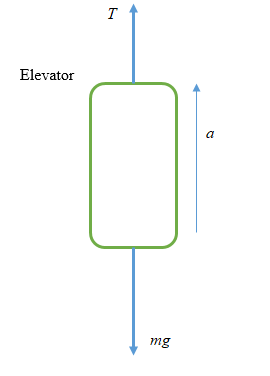
From, the above diagram, the net force acting on the elevator is,
…… (1)
Here, is the mass of the elevator, is the acceleration due to gravity and is the acceleration of the elevator.
The weight of the elevator is,
Substitute for in the equation (1).
Thus, from the above result, the tension in the cable is greater
(b)
At constant velocity, the acceleration of the elevator is zero.
Therefore,
The tension in the cable when the elevator is moving with constant velocity is,
…… (2)
Substitute for in the equation (2).
(c)
The free body diagram of the elevator is drawn below.

The net force acting on the elevators is,
Hence, from the above result, the tension in the cable is less than the weight of the elevator.
(d.1)
The free body diagram of the elevator is drawn below.

The net force acting on the elevators is,
Substitute for , for and for in the above equation.
(d.2)
The weight of the elevator is,
…… (3)
Substitute for and for in the equation (3).
Hence, from the above two result
Hence, the answer is consistent with part (a).
(e.1)
At constant velocity, the acceleration of the elevator is zero.
Therefore,
The tension in the cable when the elevator is moving with constant velocity is,
…… (4)
Substitute for in the equation (2).
The above equation is modified as,
…… (5)
Substitute for and for in the equation (5).
(e.2)
The weight of the elevator is,
Substitute for and for in the above equation.
Hence, from the above two result
Hence, the answer is consistent with part (b).
(f.1)
The free body diagram of elevator is drawn below.
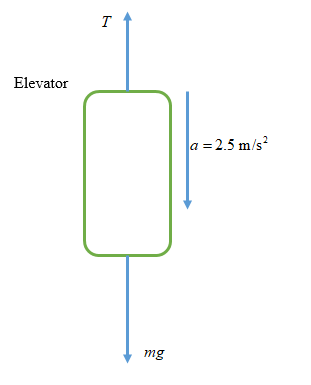
The net force acting on the elevators is,
…… (6)
Substitute for , for and for in the above equation.
(f.2)
The weight of the elevator is,
…… (7)
Substitute for and for in the equation (7).
Hence, from the above two result
Hence, the answer is consistent with part (c).
Ans: Part aThe tension in the cable is greater than the weight of the elevator.
Add Answer to:
(a) An elevator of mass m moving upward has two forces acting on
it: the upward force of tension in the cable and the d...
(a) An elevator of mass m moving upward has two forces acting on it: the upward...
(a) An elevator of mass m moving upward has two forces acting on it: the upward force of tension in the cable and the downward force due to gravity. When the elevator is accelerating upward, which is greater, T or w? Tw Both forces are equal. (b) When the elevator is moving at a constant velocity upward, which is greater, T or w? Tw Both forces are equal. (c) When the elevator is moving upward, but the acceleration is downward, which is...
An elevator is initially moving upward at a speed of 13.08 m/s. The elevator experiences a...
An elevator is initially moving upward at a speed of 13.08 m/s. The elevator experiences a constant downward acceleration of magnitude 4.16 m/s2 for 2.79 s. (a) Find the magnitude and direction of the elevator's final velocity. magnitude direction ---Select--- upward downward none (b) How far did it move during the 2.79 s interval?
_________An elevator suspended by a vertical cable is moving downward but slowing down. The tension in...
 _________An elevator suspended by a vertical cable is moving downward but slowing down. The tension in the cable must be A) greater than the weight of the elevator. B) less than the weight of the elevator. C) equal to the weight of the elevator. ______ A bucket is being lowered by a very light rope with a constant downward velocity. The tension in the rope must be A) equal to the weight of the bucket. B) greater than the weight...
An elevator is initially moving upward at a speed of 12.60 m/s. The elevator experiences a...
 An elevator is initially moving upward at a speed of 12.60 m/s. The elevator experiences a constant downward acceleration of magnitude 3.92 m/s2 for 2.97 s (a) Find the magnitude and direction of the elevator's final velocity. magnitude direction !--Select--# (b) How far did it move during the 2.97 s interval?
An elevator is pulled upward so it moves with increasing upward speed?the force exerted by the...
 An elevator is pulled upward so it moves with increasing upward
speed?the force exerted by the cable on the elevator is constant
and greater than the downward gravitational force exerted by Earth.
When the elevator is moving up medium-fast, the force exerted by
the cable on the elevator changes abruptly to just balance the
downward gravitational force of Earth?the sum of the forces that
the cable and Earth exert on the elevator is now zero.
An elevator is pulled upward so it moves with increasing upward
speed?the force exerted by the cable on the elevator is constant
and greater than the downward gravitational force exerted by Earth.
When the elevator is moving up medium-fast, the force exerted by
the cable on the elevator changes abruptly to just balance the
downward gravitational force of Earth?the sum of the forces that
the cable and Earth exert on the elevator is now zero.
An elevator is moving upward with a speed of 11 m/s. Three seconds later, the elevator...
 An elevator is moving upward with a speed of 11 m/s. Three seconds later, the elevator is still moving upward, but its speed has been reduced to 5.0 m/s. What is the average acceleration of the elevator during the 3.0 s interval? 2.0 m/s2, downward 2.0 m/s2, upward 5.3 m/s2, downward 5.3 m/s?, upward
4. (1 supporting cable when the cable is (a) moving with an upward acceleration of 2...
 4. (1 supporting cable when the cable is (a) moving with an upward acceleration of 2 m/s2 Opts) An elevator cab and its load have a combined mass of 1500 kg. Find the tension in the (b)not moving at all (c)moving with an upward constant velocity 2m/s (d) falling freely
A single cable supports an 703-kg elevator car. What is the tension in the cable when...
A single cable supports an 703-kg elevator car. What is the tension in the cable when the car is moving with constant speed? What is the tension in the cable when the car is moving with an upward acceleration of 3.50 m/s2? What is the tension in the cable when the car is moving with a downward acceleration of 3.50 m/s2?
A single mass (m1 = 4.4 kg) hangs from a spring in a motionless elevator.
 A single mass (m1 = 4.4 kg) hangs from a spring in a motionless elevator. The spring constant is k = 270 N/m. 1) What is the distance the spring is stretched from its unstretched length? 2) Now, three masses (m1 = 4.4 kg, m2 = 13.2 kg and m3 = 8.8) hang from three identical springs in a motionless elevator. The springs all have the same spring constant given above. What is the magnitude of the force the bottom spring exerts on the...
a 3000 N upward tension force is exerted on a 320-kg downward-moving freight elevator. Determine the...
a 3000 N upward tension force is exerted on a 320-kg downward-moving freight elevator. Determine the acceleration of the elevator.
 _________An elevator suspended by a vertical cable is moving downward but slowing down. The tension in the cable must be A) greater than the weight of the elevator. B) less than the weight of the elevator. C) equal to the weight of the elevator. ______ A bucket is being lowered by a very light rope with a constant downward velocity. The tension in the rope must be A) equal to the weight of the bucket. B) greater than the weight...
 An elevator is initially moving upward at a speed of 12.60 m/s. The elevator experiences a constant downward acceleration of magnitude 3.92 m/s2 for 2.97 s (a) Find the magnitude and direction of the elevator's final velocity. magnitude direction !--Select--# (b) How far did it move during the 2.97 s interval?
 An elevator is pulled upward so it moves with increasing upward
speed?the force exerted by the cable on the elevator is constant
and greater than the downward gravitational force exerted by Earth.
When the elevator is moving up medium-fast, the force exerted by
the cable on the elevator changes abruptly to just balance the
downward gravitational force of Earth?the sum of the forces that
the cable and Earth exert on the elevator is now zero.
An elevator is pulled upward so it moves with increasing upward
speed?the force exerted by the cable on the elevator is constant
and greater than the downward gravitational force exerted by Earth.
When the elevator is moving up medium-fast, the force exerted by
the cable on the elevator changes abruptly to just balance the
downward gravitational force of Earth?the sum of the forces that
the cable and Earth exert on the elevator is now zero.
 An elevator is moving upward with a speed of 11 m/s. Three seconds later, the elevator is still moving upward, but its speed has been reduced to 5.0 m/s. What is the average acceleration of the elevator during the 3.0 s interval? 2.0 m/s2, downward 2.0 m/s2, upward 5.3 m/s2, downward 5.3 m/s?, upward
 4. (1 supporting cable when the cable is (a) moving with an upward acceleration of 2 m/s2 Opts) An elevator cab and its load have a combined mass of 1500 kg. Find the tension in the (b)not moving at all (c)moving with an upward constant velocity 2m/s (d) falling freely
Most questions answered within 3 hours.
-
Where is the error in this code sequence?
String s1 = "Hello";
String s2 = "ello";...
asked 10 months ago -
Financial data for Joel de Paris, Inc., for last year
follow:
Joel de Paris, Inc.
Balance...
asked 10 months ago -
Consider this reaction:
Al2(SO4)3 (aq)+ BaCl3
(aq) Al2Cl6 (aq)- +
3BaSO4(s) . What is the...
asked 10 months ago -
Suppose that Savneet is considering increasing her
recent random sample from 20 car rentals to 40...
asked 10 months ago -
Trucks arrive at an unloading terminal at an average rate of 120
per hour.
Trucks arrive...
asked 10 months ago -
Why are methanol and ethanol completely soluble in water while
octanol is not very little soluble....
asked 10 months ago -
A facilities manager at a university reads in a research report
that the mean amount of...
asked 10 months ago -
When the CuSO4 is rehydrated by adding water to the anhydrous
compound, is this an endothermic...
asked 10 months ago -
A ray of sunlight is passing from diamond into crown glass; the
angle of incidence is...
asked 10 months ago -
A block of mass 0.249 kg is placed on top of a light, vertical
spring of...
asked 10 months ago -
how do the kidneys compensate in the presences of acidosis
a) trigger hyperventilate
b) reserve acid...
asked 10 months ago -
Question 501 pts
The rental rate of capital to the firm increases. Which of the
following...
asked 10 months ago