Homework Answers
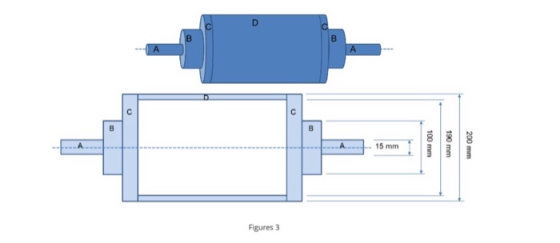
Each part A,B,C,D is a cylinder.
The part A has a diameter of 15 mm.
Now, the radius of gyration is assumed to be the imaginary point
, distant k from the axis of rotation, that has a
mass equal to the object. It has the property that 
The 

On equating these, we get:

This is the radius of gyration of the parts labelled A.
--------------------------------------------------------------------------------------------------------------------
The math part of the question is highly difficult to read. I will thus assume this for the second part:

From this, we can easily see that

--------------------------------------------------------------------------------------------------------------------
The part C is also a cylinder of diameter 200 mm = 0.2 m => Radius =0.1 m
Its mass is

The moment of inertia is:

Add Answer to:
The roller assembly, shown in figures 3, is used as part of a machine in a manufacturing line. - Determine the radius...
Question 1 3 points Sav The 50 kg wheel has a radius of gyration kA determine...
 Question 1 3 points Sav The 50 kg wheel has a radius of gyration kA determine 200 mm. If the wheel is subjected to a moment M (80 N.m, where t is in seconds. If the disC starting from rest, at t 2 s its angular velocity, c rad/s (A 4 B 16 C. 2 D. 8) the horizontal reaction at the fixed pin, Ay N (A 50 B. 0 C. 490.5 D. 245.3) the vertical reaction at the foxed...
Determine the speed of the 50-kg cylinder after it has descended a distance of 2 m, starting from...
 Determine the speed of the 50-kg cylinder after it has descended a distance of 2 m, starting from rest. Gear A has a mass of 10 kg and a radius of gyration of 125 mm about its center of mass. Gear B and drum C have a combined mass of 30 kg and a radius of gyration about their center of mass of 150 100 mm 150mm 200 mm
Determine the speed of the 50-kg cylinder after it has descended...
Determine the speed of the 50-kg cylinder after it has descended a distance of 2 m, starting from rest. Gear A has a mass of 10 kg and a radius of gyration of 125 mm about its center of mass. Gear B and drum C have a combined mass of 30 kg and a radius of gyration about their center of mass of 150 100 mm 150mm 200 mm
Determine the speed of the 50-kg cylinder after it has descended...
The weight is used to turn the gear system shown below. Gear A has a mass...
 The weight is used to turn the gear system shown below. Gear A has a mass of 15 kg and a radius of gyration of 100 mm about its center of mass. Gear B and Drum C have a combined mass of 25 kg and a radius of gyration about their mass center of 165 mm. If the system starts from rest, determine the speed of the 55-kg weight after it has been lowered 3 m, the angular velocity of...
The weight is used to turn the gear system shown below. Gear A has a mass...
 The weight is used to turn the gear system shown below. Gear A has a mass of 15 kg and a radius of gyration of 100 mm about its center of mass. Gear B and Drum C have a combined mass of 25 kg and a radius of gyration about their mass center of 165 mm. If the system starts from rest, determine the speed of the 55-kg weight after it has been lowered 3 m, the angular velocity of...
The weight is used to turn the gear system shown below. Gear A has a mass...
 The weight is used to turn the gear system shown below. Gear A has a mass of 15 kg and a radius of gyration of 100 mm about its center of mass. Gear B and Drum C have a combined mass of 25 kg and a radius of gyration about their mass center of 165 mm. If the system starts from rest, determine the speed of the 55-kg weight after it has been lowered 3 m, the angular velocity of...
The weight is used to turn the gear system shown below. Gear A has a mass...
 The weight is used to turn the gear system shown below. Gear A has a mass of 15 kg and a radius of gyration of 100 mm about its center of mass. Gear B and Drum C have a combined mass of 25 kg and a radius of gyration about their mass center of 165 mm. If the system starts from rest, determine the speed of the 55-kg weight after it has been lowered 3 m, the angular velocity of...
The weight is used to turn the gear system shown below. Gear A has a mass...
 The weight is used to turn the gear system shown below. Gear A has a mass of 15 kg and a radius of gyration of 100 mm about its center of mass. Gear B and Drum C have a combined mass of 25 kg and a radius of gyration about their mass center of 165 mm. If the system starts from rest, determine the speed of the 55-kg weight after it has been lowered 3 m, the angular velocity of...
The airplane is traveling in a straight line with a speed of 300 km/h, when the...
 The airplane is traveling in a straight line with a speed of 300 km/h, when the engines A and B produce a thrust of TA 40 kN and TB = 20 kN, respectively. (Figure 1) Figure 1 of 1 > TA = 40 kn 8 m А Go B TB = 20 KN 8 m Part A Determine the angular velocity of the airplane in t = 4.8s. The plane has a mass of 200 Mg its center of mass...
Gear Chas a mass of 13 kg and a centroidal radius of gyration of 75 mm. The uniform bar AB has a ...
 Gear Chas a mass of 13 kg and a centroidal radius of gyration of 75 mm. The uniform bar AB has a mass of 3 kg and gear D is stationary. The system is released from rest in the position shown 200 mm 100 mm eBook & Resources olue: 0.00 points Determine the angular acceleration of gear C. Round the final answer to one decimal place.) (You must provide an answer before moving to the next part) The angular acceleration...
Problem 18.15 4 of 13 Part A If the system is released from rest, determine the...
 Problem 18.15 4 of 13 Part A If the system is released from rest, determine the speed of the 23 kg cylinder A after A has moved downward a distance of 3 m. The differential pulley has a mass of 15 kg with a radius ol gyration bot ils center of mass ol 100 mm Figure 1) Express your answer with the appropriate units. Value Cnits Flgure 1 of 1 Submit Request Answer 150 mm Part B 75 mm Determine...
 Question 1 3 points Sav The 50 kg wheel has a radius of gyration kA determine 200 mm. If the wheel is subjected to a moment M (80 N.m, where t is in seconds. If the disC starting from rest, at t 2 s its angular velocity, c rad/s (A 4 B 16 C. 2 D. 8) the horizontal reaction at the fixed pin, Ay N (A 50 B. 0 C. 490.5 D. 245.3) the vertical reaction at the foxed...
 Determine the speed of the 50-kg cylinder after it has descended a distance of 2 m, starting from rest. Gear A has a mass of 10 kg and a radius of gyration of 125 mm about its center of mass. Gear B and drum C have a combined mass of 30 kg and a radius of gyration about their center of mass of 150 100 mm 150mm 200 mm
Determine the speed of the 50-kg cylinder after it has descended...
Determine the speed of the 50-kg cylinder after it has descended a distance of 2 m, starting from rest. Gear A has a mass of 10 kg and a radius of gyration of 125 mm about its center of mass. Gear B and drum C have a combined mass of 30 kg and a radius of gyration about their center of mass of 150 100 mm 150mm 200 mm
Determine the speed of the 50-kg cylinder after it has descended...
 The weight is used to turn the gear system shown below. Gear A has a mass of 15 kg and a radius of gyration of 100 mm about its center of mass. Gear B and Drum C have a combined mass of 25 kg and a radius of gyration about their mass center of 165 mm. If the system starts from rest, determine the speed of the 55-kg weight after it has been lowered 3 m, the angular velocity of...
 The weight is used to turn the gear system shown below. Gear A has a mass of 15 kg and a radius of gyration of 100 mm about its center of mass. Gear B and Drum C have a combined mass of 25 kg and a radius of gyration about their mass center of 165 mm. If the system starts from rest, determine the speed of the 55-kg weight after it has been lowered 3 m, the angular velocity of...
 The weight is used to turn the gear system shown below. Gear A has a mass of 15 kg and a radius of gyration of 100 mm about its center of mass. Gear B and Drum C have a combined mass of 25 kg and a radius of gyration about their mass center of 165 mm. If the system starts from rest, determine the speed of the 55-kg weight after it has been lowered 3 m, the angular velocity of...
 The weight is used to turn the gear system shown below. Gear A has a mass of 15 kg and a radius of gyration of 100 mm about its center of mass. Gear B and Drum C have a combined mass of 25 kg and a radius of gyration about their mass center of 165 mm. If the system starts from rest, determine the speed of the 55-kg weight after it has been lowered 3 m, the angular velocity of...
 The weight is used to turn the gear system shown below. Gear A has a mass of 15 kg and a radius of gyration of 100 mm about its center of mass. Gear B and Drum C have a combined mass of 25 kg and a radius of gyration about their mass center of 165 mm. If the system starts from rest, determine the speed of the 55-kg weight after it has been lowered 3 m, the angular velocity of...
 The airplane is traveling in a straight line with a speed of 300 km/h, when the engines A and B produce a thrust of TA 40 kN and TB = 20 kN, respectively. (Figure 1) Figure 1 of 1 > TA = 40 kn 8 m А Go B TB = 20 KN 8 m Part A Determine the angular velocity of the airplane in t = 4.8s. The plane has a mass of 200 Mg its center of mass...
 Gear Chas a mass of 13 kg and a centroidal radius of gyration of 75 mm. The uniform bar AB has a mass of 3 kg and gear D is stationary. The system is released from rest in the position shown 200 mm 100 mm eBook & Resources olue: 0.00 points Determine the angular acceleration of gear C. Round the final answer to one decimal place.) (You must provide an answer before moving to the next part) The angular acceleration...
 Problem 18.15 4 of 13 Part A If the system is released from rest, determine the speed of the 23 kg cylinder A after A has moved downward a distance of 3 m. The differential pulley has a mass of 15 kg with a radius ol gyration bot ils center of mass ol 100 mm Figure 1) Express your answer with the appropriate units. Value Cnits Flgure 1 of 1 Submit Request Answer 150 mm Part B 75 mm Determine...
Most questions answered within 3 hours.
-
Where is the error in this code sequence?
String s1 = "Hello";
String s2 = "ello";...
asked 10 months ago -
Financial data for Joel de Paris, Inc., for last year
follow:
Joel de Paris, Inc.
Balance...
asked 10 months ago -
Consider this reaction:
Al2(SO4)3 (aq)+ BaCl3
(aq) Al2Cl6 (aq)- +
3BaSO4(s) . What is the...
asked 10 months ago -
Suppose that Savneet is considering increasing her
recent random sample from 20 car rentals to 40...
asked 10 months ago -
Trucks arrive at an unloading terminal at an average rate of 120
per hour.
Trucks arrive...
asked 10 months ago -
Why are methanol and ethanol completely soluble in water while
octanol is not very little soluble....
asked 10 months ago -
A facilities manager at a university reads in a research report
that the mean amount of...
asked 10 months ago -
When the CuSO4 is rehydrated by adding water to the anhydrous
compound, is this an endothermic...
asked 10 months ago -
A ray of sunlight is passing from diamond into crown glass; the
angle of incidence is...
asked 10 months ago -
A block of mass 0.249 kg is placed on top of a light, vertical
spring of...
asked 10 months ago -
how do the kidneys compensate in the presences of acidosis
a) trigger hyperventilate
b) reserve acid...
asked 10 months ago -
Question 501 pts
The rental rate of capital to the firm increases. Which of the
following...
asked 10 months ago