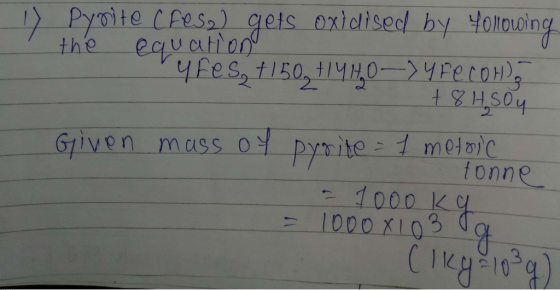
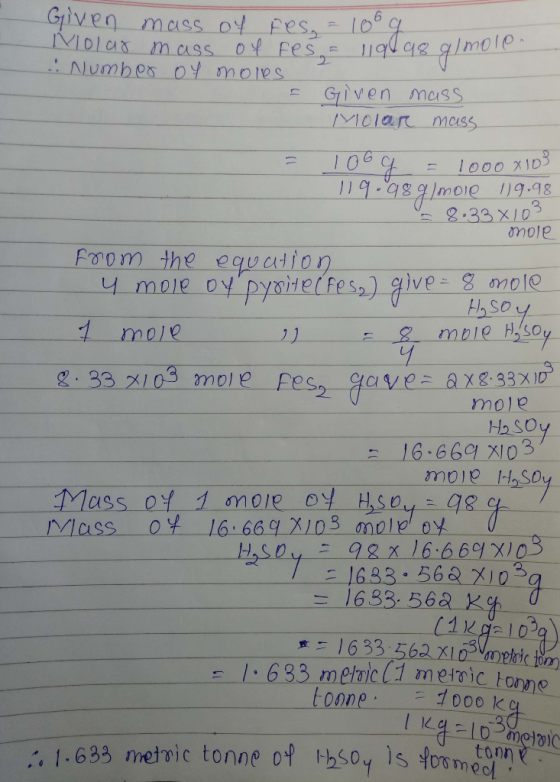
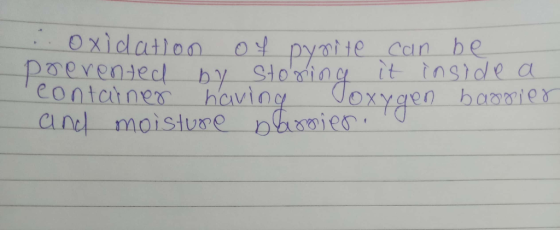
What quantity of sulfuric acid can be produced when 1 metric tonne of pyrite is oxidized by wet air? Suggest some soluti...
What quantity of sulfuric acid can be produced when 1 metric tonne of pyrite is oxidized by wet air? Suggest some solutions to control this oxidation.
Homework Answers
The answer is
Add Answer to:
What quantity of sulfuric acid can be produced when 1 metric tonne of pyrite is oxidized by wet air? Suggest some soluti...
9. Sulfuric acid (H2SO4), the industrial chemical produced in greatest quantity (almost 45 million tons per year in the...
9. Sulfuric acid (H2SO4), the industrial chemical produced in greatest quantity (almost 45 million tons per year in the United States alone), is prepared by the following chemical reaction in the presence of a catalyst 2S (s) + 302 (g) + 2H2O (1) - 2H2SO4 (aq) What volume of Oz (in liters) at 22 ° C and 0. 95 atm is required to produce 454 g of H2SO4?
One type of breathalyzer employs a fuel cell to measure the quantity of alcohol in the breath. When a suspect blows into the breathalyzer, ethyl alcohol is oxidized to acetic acid at the anode: CH3CH2...
One type of breathalyzer employs a fuel cell to measure the quantity of alcohol in the breath. When a suspect blows into the breathalyzer, ethyl alcohol is oxidized to acetic acid at the anode: CH3CH2OH(g)+4OH−(aq)→HC2H3O2(g)+3H2O(l)+4e− At the cathode, oxygen is reduced: O2(g)+2H2O(l)+4e−→4OH−(aq) The overall reaction is the oxidation of ethyl alcohol to acetic acid and water. When a suspected drunk driver blows 185 mL of his breath through this breathalyzer, the breathalyzer produces an average of 325 mA of current...
write the reaction between methanoic acid and methanol Reactions 1. What is the ketone produced when...
 write the reaction between methanoic acid and methanol
Reactions 1. What is the ketone produced when 3,3-dimethyl-2-butanol undergoes gentle oxidation? Draw the reaction and name the product. Is it possible for the product to undergo further oxidation? Explain in few words.
write the reaction between methanoic acid and methanol
Reactions 1. What is the ketone produced when 3,3-dimethyl-2-butanol undergoes gentle oxidation? Draw the reaction and name the product. Is it possible for the product to undergo further oxidation? Explain in few words.
H1- COOLING TOWER [10 p] 1. What is the wet bulb temperature? How can you measure...
 H1- COOLING TOWER [10 p] 1. What is the wet bulb temperature? How can you measure it? Is the wet-bulb temperature greater than dry-bulb temperature? Why? [10 p] 2. A cooling tower is to be designed to cool 8 kg/s of water from 37°C to 29 °C. Entering air is 25 °C and at 30 % relative humidity. Leaving air is 22 °C and at 90% relative humidity. a) Calculate the air flow rate, G. b) Determine the possible lowest...
2. Synthesis of 1-hexanol. a) Suggest one base that can deprotonate 1-butyne. b) When the deprotonated...
2. Synthesis of 1-hexanol. a) Suggest one base that can deprotonate 1-butyne. b) When the deprotonated 1-butyne reacts with epoxyethane, CH3CH2CCCH2CH2O- forms. Draw this step's curly arrow mechanism. c) Suggest an acid that will covert CH3CH2CCCH2CH2O- to CH3CH2CCCH2CH2OH. d) What reagents are needed to convert CH3CH2CCCH2CH2OH to 1-hexanol?
. Some Conceptual Questions (1) When two capacitors are wired in parallel what quantity must be...
. Some Conceptual Questions (1) When two capacitors are wired in parallel what quantity must be the same for them? When two capacitors are wired in series what quantity must be the same for them? Why? (2) How do we make sense of a single isolated conductor as having capacitance? (3) A capacitor can be used to store energy. How is it different from a battery?
1.) What would the product be if you oxidized a tertiary alcohol? A.) Ketone B.) Aldehyde...
 1.) What would the product be if you oxidized a tertiary
alcohol?
A.) Ketone
B.) Aldehyde
C.)Carboxylic Acid
D.) No reaction
2.) What would the FULLY oxidized product of a primary alcohol
be?
A.) No reaction
B.) Carboxylic Acid
C.) Aldehyde
D.) Ketone
3.) Which types of alcohol can be oxidized? Choose all that
apply.
A.) Quaternary
B.) Primary
C.) Secondary
D.) Tertiary
4.) the Ethanol standard in test tube 3 will have a final
concentration of _____%(v/v) ethanol.
5.)...
1.) What would the product be if you oxidized a tertiary
alcohol?
A.) Ketone
B.) Aldehyde
C.)Carboxylic Acid
D.) No reaction
2.) What would the FULLY oxidized product of a primary alcohol
be?
A.) No reaction
B.) Carboxylic Acid
C.) Aldehyde
D.) Ketone
3.) Which types of alcohol can be oxidized? Choose all that
apply.
A.) Quaternary
B.) Primary
C.) Secondary
D.) Tertiary
4.) the Ethanol standard in test tube 3 will have a final
concentration of _____%(v/v) ethanol.
5.)...
1) Acetic acid is produced using bacteria in batch culture. It was shown that for each mole of gl...
 1) Acetic acid is produced using bacteria in batch culture. It was shown that for each mole of glucose utilized by the bacteria, 3.60 moles of cells, 1.10 moles of acetic acid, 1.30 moles of gaseous CO2, and some H20 are formed. Oxygen and ammonia were consumed. Other components of the system such as phosphate can be neglected. Cellular composition of bacteria might be taken as CH1.770049No.24 Medium containing glucose and ammonia dissolved in 15,000 litres of water is pumped...
1) In a batch culture, formic acid (HCOOH) is produced using bacteria. For each mole of...
 1) In a batch culture, formic acid (HCOOH) is produced using bacteria. For each mole of glucose (C H206) utilized by the bacteria, 2.40 moles of cells (CH1.8000 1No.26), 1.70 moles of formic acid, 1.90 moles of gaseous CO2, and some H20 are formed. Oxygen (O2) and ammonia (NH3) were consumed. Glucose, ammonia and 18,350 kg of water were fed to the reactor and inoculated with the bacteria. Air is pumped into the reactor and during the entire process 6000...
Fisher Esterification lab. 1. What can happen if the water produced in the reaction is not...
 Fisher Esterification lab.
1. What can happen if the water produced in the reaction is not
removed, and the same conditions of reflux and temperature
continue?
2. Complete the following table by writing the missing
names:
3. Consider the start of the reaction (time 0) when all the
reagents necessary to carry out the esterification have been
mixed.
a. What signals of the corresponding IR spectrum of that
initial reagent mixture should be observed to change significantly
when the reaction...
Fisher Esterification lab.
1. What can happen if the water produced in the reaction is not
removed, and the same conditions of reflux and temperature
continue?
2. Complete the following table by writing the missing
names:
3. Consider the start of the reaction (time 0) when all the
reagents necessary to carry out the esterification have been
mixed.
a. What signals of the corresponding IR spectrum of that
initial reagent mixture should be observed to change significantly
when the reaction...
 write the reaction between methanoic acid and methanol
Reactions 1. What is the ketone produced when 3,3-dimethyl-2-butanol undergoes gentle oxidation? Draw the reaction and name the product. Is it possible for the product to undergo further oxidation? Explain in few words.
write the reaction between methanoic acid and methanol
Reactions 1. What is the ketone produced when 3,3-dimethyl-2-butanol undergoes gentle oxidation? Draw the reaction and name the product. Is it possible for the product to undergo further oxidation? Explain in few words.
 H1- COOLING TOWER [10 p] 1. What is the wet bulb temperature? How can you measure it? Is the wet-bulb temperature greater than dry-bulb temperature? Why? [10 p] 2. A cooling tower is to be designed to cool 8 kg/s of water from 37°C to 29 °C. Entering air is 25 °C and at 30 % relative humidity. Leaving air is 22 °C and at 90% relative humidity. a) Calculate the air flow rate, G. b) Determine the possible lowest...
 1.) What would the product be if you oxidized a tertiary
alcohol?
A.) Ketone
B.) Aldehyde
C.)Carboxylic Acid
D.) No reaction
2.) What would the FULLY oxidized product of a primary alcohol
be?
A.) No reaction
B.) Carboxylic Acid
C.) Aldehyde
D.) Ketone
3.) Which types of alcohol can be oxidized? Choose all that
apply.
A.) Quaternary
B.) Primary
C.) Secondary
D.) Tertiary
4.) the Ethanol standard in test tube 3 will have a final
concentration of _____%(v/v) ethanol.
5.)...
1.) What would the product be if you oxidized a tertiary
alcohol?
A.) Ketone
B.) Aldehyde
C.)Carboxylic Acid
D.) No reaction
2.) What would the FULLY oxidized product of a primary alcohol
be?
A.) No reaction
B.) Carboxylic Acid
C.) Aldehyde
D.) Ketone
3.) Which types of alcohol can be oxidized? Choose all that
apply.
A.) Quaternary
B.) Primary
C.) Secondary
D.) Tertiary
4.) the Ethanol standard in test tube 3 will have a final
concentration of _____%(v/v) ethanol.
5.)...
 1) Acetic acid is produced using bacteria in batch culture. It was shown that for each mole of glucose utilized by the bacteria, 3.60 moles of cells, 1.10 moles of acetic acid, 1.30 moles of gaseous CO2, and some H20 are formed. Oxygen and ammonia were consumed. Other components of the system such as phosphate can be neglected. Cellular composition of bacteria might be taken as CH1.770049No.24 Medium containing glucose and ammonia dissolved in 15,000 litres of water is pumped...
 1) In a batch culture, formic acid (HCOOH) is produced using bacteria. For each mole of glucose (C H206) utilized by the bacteria, 2.40 moles of cells (CH1.8000 1No.26), 1.70 moles of formic acid, 1.90 moles of gaseous CO2, and some H20 are formed. Oxygen (O2) and ammonia (NH3) were consumed. Glucose, ammonia and 18,350 kg of water were fed to the reactor and inoculated with the bacteria. Air is pumped into the reactor and during the entire process 6000...
 Fisher Esterification lab.
1. What can happen if the water produced in the reaction is not
removed, and the same conditions of reflux and temperature
continue?
2. Complete the following table by writing the missing
names:
3. Consider the start of the reaction (time 0) when all the
reagents necessary to carry out the esterification have been
mixed.
a. What signals of the corresponding IR spectrum of that
initial reagent mixture should be observed to change significantly
when the reaction...
Fisher Esterification lab.
1. What can happen if the water produced in the reaction is not
removed, and the same conditions of reflux and temperature
continue?
2. Complete the following table by writing the missing
names:
3. Consider the start of the reaction (time 0) when all the
reagents necessary to carry out the esterification have been
mixed.
a. What signals of the corresponding IR spectrum of that
initial reagent mixture should be observed to change significantly
when the reaction...
Most questions answered within 3 hours.
-
Where is the error in this code sequence?
String s1 = "Hello";
String s2 = "ello";...
asked 10 months ago -
Financial data for Joel de Paris, Inc., for last year
follow:
Joel de Paris, Inc.
Balance...
asked 10 months ago -
Consider this reaction:
Al2(SO4)3 (aq)+ BaCl3
(aq) Al2Cl6 (aq)- +
3BaSO4(s) . What is the...
asked 10 months ago -
Suppose that Savneet is considering increasing her
recent random sample from 20 car rentals to 40...
asked 10 months ago -
Trucks arrive at an unloading terminal at an average rate of 120
per hour.
Trucks arrive...
asked 10 months ago -
Why are methanol and ethanol completely soluble in water while
octanol is not very little soluble....
asked 10 months ago -
A facilities manager at a university reads in a research report
that the mean amount of...
asked 10 months ago -
When the CuSO4 is rehydrated by adding water to the anhydrous
compound, is this an endothermic...
asked 10 months ago -
A ray of sunlight is passing from diamond into crown glass; the
angle of incidence is...
asked 10 months ago -
A block of mass 0.249 kg is placed on top of a light, vertical
spring of...
asked 10 months ago -
how do the kidneys compensate in the presences of acidosis
a) trigger hyperventilate
b) reserve acid...
asked 10 months ago -
Question 501 pts
The rental rate of capital to the firm increases. Which of the
following...
asked 10 months ago