
Homework Answers
Please refer to below spreadsheet for calculation and answer. Cell reference also provided.
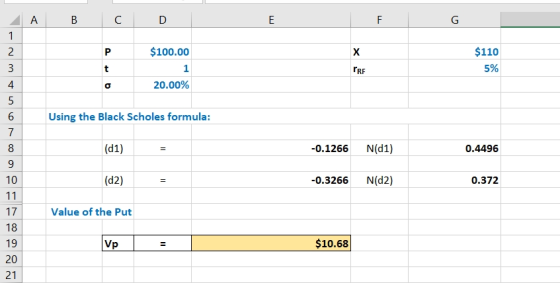
Cell reference -
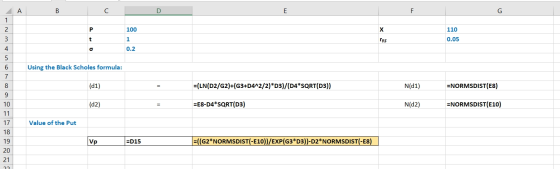
Hope this will help, please do comment if you need any further explanation. Your feedback would be highly appreciated.
Add Answer to:
We are in a Black and Scholes world. A stock today has a price of 100 with a return volatility of 0.2. The discrete...
We are in a Black and Scholes world. A stock today has a price of 100....
 We are in a Black and Scholes world. A stock today has a price of 100. The discretely compounded one-year risk-free interest rate is 0.05. A European put on this stock with a strike price of 100 that expires in one year has a price of 8.893. What is the price of a European call on this stock with a strike price of 110, which expires in one year? Report in two digits behind the comma, i.e. 0.345 +0.35.
Problem 1: - Using the Black/Scholes formula and put/call parity, value a European put option on...
 Problem 1: - Using the Black/Scholes formula and put/call parity, value a European put option on the equity in Amgen, which has the following characteristics. Expiration: Current stock price of Amgen: Strike Price: Volatility of Amgen Stock price: Risk-free rate (continuously compounded): Dividends: 3 months (i.e., 60 trade days) $53.00 $50.00 26% per year 2% None If the market price of the Amgen put is actually $2.00 per share, is the above estimate of volatility higher or lower than the...
Assume the Black-Scholes framework for options pricing. You are a portfolio manager and already have a...
 Assume the Black-Scholes framework for options pricing. You are a portfolio manager and already have a long position in Apple (ticker: AAPL). You want to protect your long position against losses and decide to buy a European put option on AAPL with a strike price of $180.15 and an expiration date of 1-year from today. The continuously compounded risk free interest rate is 8% and the stock pays no dividends. The current stock price for AAPL is $200 and its...
Consider an asset that trades at $100 today. Suppose that the European call and put options...
Consider an asset that trades at $100 today. Suppose that the European call and put options on this asset are available both with a strike price of $100. The options expire in 275 days, and the volatility is 45%. The continuously compounded risk-free rate is 3%. Determine the value of the European call and put options using the Black-Scholes-Merton model. Assume that the continuously compounded yield on the asset is 1,5% and there are 365 days in the year.
Assume the Black-Scholes framework. The 1-year futures price for stock LMN is $270. The volatility is...
Assume the Black-Scholes framework. The 1-year futures price for stock LMN is $270. The volatility is 30%, and the interest rate is 4%. What is the price of a 280-strike call option price on the LMN futures contract, expiring 9 months from today?
For a 3-month European put option on a stock: (1) The stock's price is 41. (ii)...
 For a 3-month European put option on a stock: (1) The stock's price is 41. (ii) The strike price is 45. (iii) The annual volatility of a prepaid forward on the stock is 0.25. (iv) The stock pays a dividend of 2 at the end of one month. (v) The continuously compounded risk-free interest rate is 0.05. Determine the Black-Scholes premium for the option.
In this question we assume the Black-Scholes model. We denote interest rate by r, drift rate...
 In this question we assume the Black-Scholes model. We denote interest rate by r, drift rate pi and volatility by o. A European power put option is an option with the payoff function below, Ka – rº, ha if x <K, 0, if x > K, for some a > 0. In particular, it will be a standard European put option when a = 1. (a) Derive the pricing formula for the time t, 0 <t< T, price of a...
Use the Black-Scholes formula to price a call option for a stock whose share price today...
Use the Black-Scholes formula to price a call option for a stock whose share price today is $16 when the interest rate is 4%, the maturity date is 6 month, the strike price is $17.5 and the volatility is 20%. Find the price of the same option half way to maturity if the share price at that time is $17.
14. Note that the Black-Scholes formula gives the price of European call c given the time...
14. Note that the Black-Scholes formula gives the price of European call c given the time to expiration T, the strike price K, the stock’s spot price S0, the stock’s volatility σ, and the risk-free rate of return r : c = c(T, K, S0, σ, r). All the variables but one are “observable,” because an investor can quickly observe T, K, S0, r. The stock volatility, however, is not observable. Rather it relies on the choice of models the...
A market-maker sells a straddle on a stock. You are given: (i) The stock's price follows...
 A market-maker sells a straddle on a stock. You are given: (i) The stock's price follows the Black-Scholes framework. (ii) S(O)= 45. (iii) The continuously compounded risk-free rate is 0.10. (iv) The stock pays no dividends. (v) The annual volatility of the stock is 0.2. (vi) The straddle consists of European options and expires in one year. The market-maker delta-hedges the sale by buying shares of the underlying stock. Calculate the amount of money the market-maker spends on the stock.
 We are in a Black and Scholes world. A stock today has a price of 100. The discretely compounded one-year risk-free interest rate is 0.05. A European put on this stock with a strike price of 100 that expires in one year has a price of 8.893. What is the price of a European call on this stock with a strike price of 110, which expires in one year? Report in two digits behind the comma, i.e. 0.345 +0.35.
 Problem 1: - Using the Black/Scholes formula and put/call parity, value a European put option on the equity in Amgen, which has the following characteristics. Expiration: Current stock price of Amgen: Strike Price: Volatility of Amgen Stock price: Risk-free rate (continuously compounded): Dividends: 3 months (i.e., 60 trade days) $53.00 $50.00 26% per year 2% None If the market price of the Amgen put is actually $2.00 per share, is the above estimate of volatility higher or lower than the...
 Assume the Black-Scholes framework for options pricing. You are a portfolio manager and already have a long position in Apple (ticker: AAPL). You want to protect your long position against losses and decide to buy a European put option on AAPL with a strike price of $180.15 and an expiration date of 1-year from today. The continuously compounded risk free interest rate is 8% and the stock pays no dividends. The current stock price for AAPL is $200 and its...
 For a 3-month European put option on a stock: (1) The stock's price is 41. (ii) The strike price is 45. (iii) The annual volatility of a prepaid forward on the stock is 0.25. (iv) The stock pays a dividend of 2 at the end of one month. (v) The continuously compounded risk-free interest rate is 0.05. Determine the Black-Scholes premium for the option.
 In this question we assume the Black-Scholes model. We denote interest rate by r, drift rate pi and volatility by o. A European power put option is an option with the payoff function below, Ka – rº, ha if x <K, 0, if x > K, for some a > 0. In particular, it will be a standard European put option when a = 1. (a) Derive the pricing formula for the time t, 0 <t< T, price of a...
 A market-maker sells a straddle on a stock. You are given: (i) The stock's price follows the Black-Scholes framework. (ii) S(O)= 45. (iii) The continuously compounded risk-free rate is 0.10. (iv) The stock pays no dividends. (v) The annual volatility of the stock is 0.2. (vi) The straddle consists of European options and expires in one year. The market-maker delta-hedges the sale by buying shares of the underlying stock. Calculate the amount of money the market-maker spends on the stock.
Most questions answered within 3 hours.
-
Where is the error in this code sequence?
String s1 = "Hello";
String s2 = "ello";...
asked 11 months ago -
Financial data for Joel de Paris, Inc., for last year
follow:
Joel de Paris, Inc.
Balance...
asked 11 months ago -
Consider this reaction:
Al2(SO4)3 (aq)+ BaCl3
(aq) Al2Cl6 (aq)- +
3BaSO4(s) . What is the...
asked 11 months ago -
Suppose that Savneet is considering increasing her
recent random sample from 20 car rentals to 40...
asked 11 months ago -
Trucks arrive at an unloading terminal at an average rate of 120
per hour.
Trucks arrive...
asked 11 months ago -
Why are methanol and ethanol completely soluble in water while
octanol is not very little soluble....
asked 11 months ago -
A facilities manager at a university reads in a research report
that the mean amount of...
asked 11 months ago -
When the CuSO4 is rehydrated by adding water to the anhydrous
compound, is this an endothermic...
asked 11 months ago -
A ray of sunlight is passing from diamond into crown glass; the
angle of incidence is...
asked 11 months ago -
A block of mass 0.249 kg is placed on top of a light, vertical
spring of...
asked 11 months ago -
how do the kidneys compensate in the presences of acidosis
a) trigger hyperventilate
b) reserve acid...
asked 11 months ago -
Question 501 pts
The rental rate of capital to the firm increases. Which of the
following...
asked 11 months ago