
Homework Answers
Add Answer to:
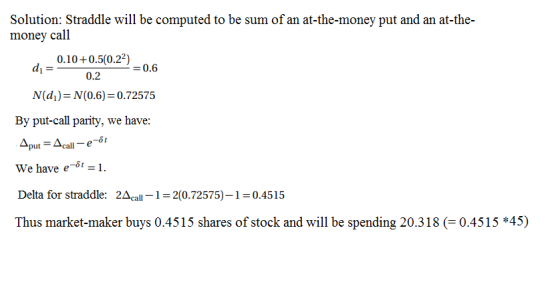
A market-maker sells a straddle on a stock. You are given: (i) The stock's price follows...
For a 3-month European put option on a stock: (1) The stock's price is 41. (ii)...
 For a 3-month European put option on a stock: (1) The stock's price is 41. (ii) The strike price is 45. (iii) The annual volatility of a prepaid forward on the stock is 0.25. (iv) The stock pays a dividend of 2 at the end of one month. (v) The continuously compounded risk-free interest rate is 0.05. Determine the Black-Scholes premium for the option.
We are in a Black and Scholes world. A stock today has a price of 100 with a return volatility of 0.2. The discrete...
 We are in a Black and Scholes world. A stock today has a price of 100 with a return volatility of 0.2. The discretely compounded one-year risk-free interest rate is 0.05. What is the price of a European put with a strike price of 110, which expires in one year? Report in two digits behind the comma, i.e. 0.345 = 0.35.
Assume the Black-Scholes framework for options pricing. You are a portfolio manager and already have a...
 Assume the Black-Scholes framework for options pricing. You are a portfolio manager and already have a long position in Apple (ticker: AAPL). You want to protect your long position against losses and decide to buy a European put option on AAPL with a strike price of $180.15 and an expiration date of 1-year from today. The continuously compounded risk free interest rate is 8% and the stock pays no dividends. The current stock price for AAPL is $200 and its...
You observe that the stock XYZ is currently trading at $8.50. The continuously compounded volatility is...
You observe that the stock XYZ is currently trading at $8.50. The continuously compounded volatility is 20% p.a. The stock is due to pay a $0.25 dividend going ex-dividend in 1 month’s time. 3-month European call and put options written on XYZ trading at $0.65 and $0.45 respectively. The strike price on both options is $8.00. The continuously compounded risk free rate is 6%pa. a) Which theoretical Black-Scholes condition is violated? b) Clearly describe the arbitrage process you would perform...
The following information is given about options on the stock of a certain company: ...
The following information is given about options on the stock of a certain company: S0 = $80, X =$70, r =10% per year (continuously compounded), T = 9 months, s= 0.30 No dividends are expected. One option contract is for 100 shares of the stock. All notations are used in the same way as in the Black-Scholes-Merton Model. What is the European call option price and European put option price, according to the Black-Scholes model? What is the cost of...
Derivatives Markets 3. You own a 6-month European put option on a XYZ Company's stock with...
 Derivatives Markets
3. You own a 6-month European put option on a XYZ Company's stock with a strike price of $100. The spot price of the stock is $102, it has a return volatility of 30% and currently pays no dividends. The continuously compounded risk free rate of interest is 3%. Using Black-Scholes you calculate the value of your put option to be $6.84. Now you have just learned the company is considering paying a one-time dividend in 3 months...
Derivatives Markets
3. You own a 6-month European put option on a XYZ Company's stock with a strike price of $100. The spot price of the stock is $102, it has a return volatility of 30% and currently pays no dividends. The continuously compounded risk free rate of interest is 3%. Using Black-Scholes you calculate the value of your put option to be $6.84. Now you have just learned the company is considering paying a one-time dividend in 3 months...
Consider the following European plain vanilla options: (1) a call with strike price K = 160,...
Consider the following European plain vanilla options: (1) a call with strike price K = 160, (2) a put with strike price K = 160, (3) a call with strike price Kc = 165, and (4) a put with strike price Kp = 155. All options have the same non-dividend-paying underlying stock and mature after one year. a) Assuming current stock price 160, stock price volatility 22%, and continuously compounded risk-free interest rate 0.49%, compute the prices of options (1)–(4)...
Question 1 a. A stock price is currently $30. It is known that at the end...
 Question 1 a. A stock price is currently $30. It is known that at the end of two months it will be either $33 or $27. The risk-free interest rate is 10% per annum with continuous compounding. What is the value of a two-month European put option with a strike price of $31? b. What is meant by the delta of a stock option? A stock price is currently $100. Over each of the next two three-month periods it is...
4.You are given the following information: stock price is $33, strike price is $30, volatility is...
4.You are given the following information: stock price is $33, strike price is $30, volatility is 25% (annual), risk free interest rate is 8% (annual), dividend yield is 0%, T is 180 days. Calculate specifically the following: European Call Option Price Market maker’s 1-day gain/loss on 10 shares if the stock price went up to $34. Assume market maker is short call options. Assume C1 = 5.67
Q8-Part I (6 marks) The current price of a non-dividend-paying stock is $42. Over the next...
 Q8-Part I (6 marks) The current price of a non-dividend-paying stock is $42. Over the next year it is expected to rise to-$44. or fall to $39. An investor buys put options with a strike price of $43. To hedge the position, should (and by how many) the investor buy or sell the underlying share (s) for each put option purchased? (6 marks) 08-Part II (9 marks) The current price of a non-dividend paying stock is $49. Use a two-step...
 For a 3-month European put option on a stock: (1) The stock's price is 41. (ii) The strike price is 45. (iii) The annual volatility of a prepaid forward on the stock is 0.25. (iv) The stock pays a dividend of 2 at the end of one month. (v) The continuously compounded risk-free interest rate is 0.05. Determine the Black-Scholes premium for the option.
 We are in a Black and Scholes world. A stock today has a price of 100 with a return volatility of 0.2. The discretely compounded one-year risk-free interest rate is 0.05. What is the price of a European put with a strike price of 110, which expires in one year? Report in two digits behind the comma, i.e. 0.345 = 0.35.
 Assume the Black-Scholes framework for options pricing. You are a portfolio manager and already have a long position in Apple (ticker: AAPL). You want to protect your long position against losses and decide to buy a European put option on AAPL with a strike price of $180.15 and an expiration date of 1-year from today. The continuously compounded risk free interest rate is 8% and the stock pays no dividends. The current stock price for AAPL is $200 and its...
 Derivatives Markets
3. You own a 6-month European put option on a XYZ Company's stock with a strike price of $100. The spot price of the stock is $102, it has a return volatility of 30% and currently pays no dividends. The continuously compounded risk free rate of interest is 3%. Using Black-Scholes you calculate the value of your put option to be $6.84. Now you have just learned the company is considering paying a one-time dividend in 3 months...
Derivatives Markets
3. You own a 6-month European put option on a XYZ Company's stock with a strike price of $100. The spot price of the stock is $102, it has a return volatility of 30% and currently pays no dividends. The continuously compounded risk free rate of interest is 3%. Using Black-Scholes you calculate the value of your put option to be $6.84. Now you have just learned the company is considering paying a one-time dividend in 3 months...
 Question 1 a. A stock price is currently $30. It is known that at the end of two months it will be either $33 or $27. The risk-free interest rate is 10% per annum with continuous compounding. What is the value of a two-month European put option with a strike price of $31? b. What is meant by the delta of a stock option? A stock price is currently $100. Over each of the next two three-month periods it is...
 Q8-Part I (6 marks) The current price of a non-dividend-paying stock is $42. Over the next year it is expected to rise to-$44. or fall to $39. An investor buys put options with a strike price of $43. To hedge the position, should (and by how many) the investor buy or sell the underlying share (s) for each put option purchased? (6 marks) 08-Part II (9 marks) The current price of a non-dividend paying stock is $49. Use a two-step...
Most questions answered within 3 hours.
-
Where is the error in this code sequence?
String s1 = "Hello";
String s2 = "ello";...
asked 10 months ago -
Financial data for Joel de Paris, Inc., for last year
follow:
Joel de Paris, Inc.
Balance...
asked 10 months ago -
Consider this reaction:
Al2(SO4)3 (aq)+ BaCl3
(aq) Al2Cl6 (aq)- +
3BaSO4(s) . What is the...
asked 10 months ago -
Suppose that Savneet is considering increasing her
recent random sample from 20 car rentals to 40...
asked 10 months ago -
Trucks arrive at an unloading terminal at an average rate of 120
per hour.
Trucks arrive...
asked 10 months ago -
Why are methanol and ethanol completely soluble in water while
octanol is not very little soluble....
asked 10 months ago -
A facilities manager at a university reads in a research report
that the mean amount of...
asked 10 months ago -
When the CuSO4 is rehydrated by adding water to the anhydrous
compound, is this an endothermic...
asked 10 months ago -
A ray of sunlight is passing from diamond into crown glass; the
angle of incidence is...
asked 10 months ago -
A block of mass 0.249 kg is placed on top of a light, vertical
spring of...
asked 10 months ago -
how do the kidneys compensate in the presences of acidosis
a) trigger hyperventilate
b) reserve acid...
asked 10 months ago -
Question 501 pts
The rental rate of capital to the firm increases. Which of the
following...
asked 10 months ago