
Homework Answers
![3. by By using using Ecell = nernst equation, we Ecole - RT In [cu] [zn2t] nf [znj. [cu2] at equilibrium → C Ecell 0) fell](http://img.homeworklib.com/questions/56bf3220-2078-11ea-b2c5-1b4ab219cd3d.png?x-oss-process=image/resize,w_560)
Add Answer to:
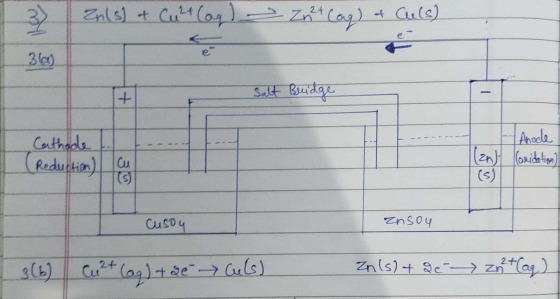
3. Consider the following redox reaction: Zn Zn (s) +Cu2 (aq) (aq)+ Cu (s) 3.a. (10 p) Indicate the line diagram of...
A galvanic cell consists of a Cu(s)|Cu2+(aq) half cell and a Zn(s)|Zn2+(aq) half-cell connected by a...
A galvanic cell consists of a Cu(s)|Cu2+(aq) half cell and a Zn(s)|Zn2+(aq) half-cell connected by a salt bridge. Oxidation occurs in the zinc half-cell. The cell can be represented in standard notation as Cu(s)|Cu2+(aq)|Zn(s)|Zn2+(aq) Zn(s)|Zn2+(aq)||Cu(s)|Cu2+(aq) Cu2+(aq)|Cu(s)||Zn(s)|Zn2+(aq) Zn(s)|Zn2+(aq)||Cu2+(aq)|Cu(s) Zn2+(aq)|Zn(s)||Cu(s)|Cu2+(aq) A,B,C,D?
A galvanic cell at a temperature of 25.0°C is powered by the following redox reaction: Cu2+(aq)...
A galvanic cell at a temperature of 25.0°C is powered by the following redox reaction: Cu2+(aq) + Zn(s) --> +Cu(s) + Zn2+(aq) Suppose the cell is prepared with 5.20 M Cu2+ in one half-cell and 3.49 M Zn2+ in the other. Calculate the cell voltage under these conditions. Round your answer to 3 significant digits.
In a galvanic cell, a spontaneous redox reaction occurs. However the reactants are separated such that...
 In a galvanic cell, a spontaneous redox reaction occurs. However the reactants are separated such that the transfer of electrons is forced to occur across a wire. The resulting electricity is measured in volts (V) and is the sum of the potentials of the oxidation and reduction half-reactions: E^o cell = E^o red + E^o ox By reversing the reduction half-reactions, you get the corresponding oxidation half-reaction, for which E^o ox has the opposite sign of E^o red You can...
Consider the balanced redox reaction below. 2Hg(I) + 2 Cu2 + (aq) +2CI-(aq)? Hg2CI2(aq) +2 Cu...
 Consider the balanced redox reaction below. 2Hg(I) + 2 Cu2 + (aq) +2CI-(aq)? Hg2CI2(aq) +2 Cu (s) Standard reduction Potentials are given below. Standard Reduction Potentials Reduction Half Reaction Cu2+ (aq) +2e-? Cu (s) 0.34 27 What is the cell potential, Ecell for the following concentrations at 298 K? Cu2+)-0.02M (CI1-0.3M [Hg2Cl21-0.005M Express your answer in units of Volts. 321
S-10 3.a) Balance the following redox equations: Ag(s) + 12(aq) Zn(s) + Cd2+ (aq) → Pb2+(aq)...
 S-10 3.a) Balance the following redox equations: Ag(s) + 12(aq) Zn(s) + Cd2+ (aq) → Pb2+(aq) + I-(aq) Cd(s) + Cu2+(aq) → b) Using your calculated half-cell potentials from Question #1, calculate the standard potential for each reaction in 3.a) and identify which of these reactions are spontaneous?
A Cu-Zn voltaic cell based on the reaction in the equation given below. Zn(s)+Cu2+(aq)àZn2+(aq)+Cu(s) Which metal...
A Cu-Zn voltaic cell based on the reaction in the equation given below. Zn(s)+Cu2+(aq)àZn2+(aq)+Cu(s) Which metal is oxidized in this voltaic cell? A. Copper B. Zinc
Given the following reaction, Cu2+(aq) + Zn(s) → Cu(s) + Zn2+(aq) E° = 1.10 V Use...
Given the following reaction, Cu2+(aq) + Zn(s) → Cu(s) + Zn2+(aq) E° = 1.10 V Use the Nernst equation to calculate the cell potential for the cell described with standard line notation below. Zn|Zn2+(0.5038 M)||Cu2+(0.3981 M)|Cu Units are not required. Report answer to three decimal places.
- Zn2+ Choose... Choose... (1pts) Identify the complete redox reaction for a ZnZn2+1|Cu2+1Cu cell. A. Zn(s)...
 - Zn2+ Choose... Choose... (1pts) Identify the complete redox reaction for a ZnZn2+1|Cu2+1Cu cell. A. Zn(s) + Cu?+ (aq) (aq) + Cu(s) B. Zn(s) + Cu(s) → Zn2+ (aq) + Cu2+ (aq) C. Zn2+ (aq) + Cu(s) Zn(s) + Cu2+ (aq) D. Zn (s) + 2 Cu(s) — Zn2+ (aq) + 2 Cu2+ (aq) (1pts) Identify the complete redox reaction for a Zn/Zn2+||Pb2+1Pb cell. A. Zn (s) + Pb(s) Zn2+ (aq) + Pb2+ (aq) B. Zn2+ (aq) + Pb(s) Zn(s)...
Calculate for the reaction: Zn! Zn2+ (0.60M)| |Cu2+ (0.20M)|Cu Given the following: Cu2+(aq) + Zn(s) Cu(s)...
 Calculate for the reaction: Zn! Zn2+ (0.60M)| |Cu2+ (0.20M)|Cu Given the following: Cu2+(aq) + Zn(s) Cu(s) + Zn2+(aq) Eo-1.10V
1- Consider the following redox reaction: Fe(s) + Cu2+(aq) --> Fe2+(aq) + Cu(s) EoCell =...
1- Consider the following redox reaction: Fe(s) + Cu2+(aq) --> Fe2+(aq) + Cu(s) EoCell = 0.78 V If [Cu2+] = 0.3 M, what [Fe2+] is needed so that Ecell = 0.76 V 2- Calculate the Eocell for the following redox reaction: Cu(s) + 2Ag+(aq) --> Cu2+(aq) + 2Ag(s)
 In a galvanic cell, a spontaneous redox reaction occurs. However the reactants are separated such that the transfer of electrons is forced to occur across a wire. The resulting electricity is measured in volts (V) and is the sum of the potentials of the oxidation and reduction half-reactions: E^o cell = E^o red + E^o ox By reversing the reduction half-reactions, you get the corresponding oxidation half-reaction, for which E^o ox has the opposite sign of E^o red You can...
 Consider the balanced redox reaction below. 2Hg(I) + 2 Cu2 + (aq) +2CI-(aq)? Hg2CI2(aq) +2 Cu (s) Standard reduction Potentials are given below. Standard Reduction Potentials Reduction Half Reaction Cu2+ (aq) +2e-? Cu (s) 0.34 27 What is the cell potential, Ecell for the following concentrations at 298 K? Cu2+)-0.02M (CI1-0.3M [Hg2Cl21-0.005M Express your answer in units of Volts. 321
 S-10 3.a) Balance the following redox equations: Ag(s) + 12(aq) Zn(s) + Cd2+ (aq) → Pb2+(aq) + I-(aq) Cd(s) + Cu2+(aq) → b) Using your calculated half-cell potentials from Question #1, calculate the standard potential for each reaction in 3.a) and identify which of these reactions are spontaneous?
 - Zn2+ Choose... Choose... (1pts) Identify the complete redox reaction for a ZnZn2+1|Cu2+1Cu cell. A. Zn(s) + Cu?+ (aq) (aq) + Cu(s) B. Zn(s) + Cu(s) → Zn2+ (aq) + Cu2+ (aq) C. Zn2+ (aq) + Cu(s) Zn(s) + Cu2+ (aq) D. Zn (s) + 2 Cu(s) — Zn2+ (aq) + 2 Cu2+ (aq) (1pts) Identify the complete redox reaction for a Zn/Zn2+||Pb2+1Pb cell. A. Zn (s) + Pb(s) Zn2+ (aq) + Pb2+ (aq) B. Zn2+ (aq) + Pb(s) Zn(s)...
 Calculate for the reaction: Zn! Zn2+ (0.60M)| |Cu2+ (0.20M)|Cu Given the following: Cu2+(aq) + Zn(s) Cu(s) + Zn2+(aq) Eo-1.10V
Most questions answered within 3 hours.
-
Where is the error in this code sequence?
String s1 = "Hello";
String s2 = "ello";...
asked 11 months ago -
Financial data for Joel de Paris, Inc., for last year
follow:
Joel de Paris, Inc.
Balance...
asked 11 months ago -
Consider this reaction:
Al2(SO4)3 (aq)+ BaCl3
(aq) Al2Cl6 (aq)- +
3BaSO4(s) . What is the...
asked 11 months ago -
Suppose that Savneet is considering increasing her
recent random sample from 20 car rentals to 40...
asked 11 months ago -
Trucks arrive at an unloading terminal at an average rate of 120
per hour.
Trucks arrive...
asked 11 months ago -
Why are methanol and ethanol completely soluble in water while
octanol is not very little soluble....
asked 11 months ago -
A facilities manager at a university reads in a research report
that the mean amount of...
asked 11 months ago -
When the CuSO4 is rehydrated by adding water to the anhydrous
compound, is this an endothermic...
asked 11 months ago -
A ray of sunlight is passing from diamond into crown glass; the
angle of incidence is...
asked 11 months ago -
A block of mass 0.249 kg is placed on top of a light, vertical
spring of...
asked 11 months ago -
how do the kidneys compensate in the presences of acidosis
a) trigger hyperventilate
b) reserve acid...
asked 11 months ago -
Question 501 pts
The rental rate of capital to the firm increases. Which of the
following...
asked 11 months ago