Simplify equation into a 2nd order DE and convert it into system of 1st order DE's

Homework Answers

Add Answer to:
Simplify equation into a 2nd order DE and convert it into system of 1st order DE's -r/R 8 e 1 d rk dr for RsrsR+ w,...
Match the following with the correct answer. 1 1st order reaction of all reactant = A...
 Match the following with the correct answer.
1 1st order reaction of all reactant = A 1/k 2 1st order reaction of one reactant = B ln(2)/ 3 2nd order reaction of one reactant = c kin R-K[A] - d[Al/dt 4 rate constant = D A +B- C 5 rate = E Rin R-k[A] - d[A]/dt 6 half time of 1st order reaction = FAAC 7 lifetime of 1st order reaction = GAB
Match the following with the correct answer.
1 1st order reaction of all reactant = A 1/k 2 1st order reaction of one reactant = B ln(2)/ 3 2nd order reaction of one reactant = c kin R-K[A] - d[Al/dt 4 rate constant = D A +B- C 5 rate = E Rin R-k[A] - d[A]/dt 6 half time of 1st order reaction = FAAC 7 lifetime of 1st order reaction = GAB
5. (15 points) Consider 3 dz r dr d, 20. a. Convert the integral to rectangular coordinates with the order d: dr dy (but don't evaluate.) b. Convert the integral to spherical coordinates (but...
 5. (15 points) Consider 3 dz r dr d, 20. a. Convert the integral to rectangular coordinates with the order d: dr dy (but don't evaluate.) b. Convert the integral to spherical coordinates (but don't evaluate.)
5. (15 points) Consider 3 dz r dr d, 20. a. Convert the integral to rectangular coordinates with the order d: dr dy (but don't evaluate.) b. Convert the integral to spherical coordinates (but don't evaluate.)
5. (15 points) Consider 3 dz r dr d, 20. a. Convert the integral to rectangular coordinates with the order d: dr dy (but don't evaluate.) b. Convert the integral to spherical coordinates (but don't evaluate.)
1. Classify each ordinary differential equation as to order (1st, 2nd, etc) and type (linear/nonlinear). a)...
 1. Classify each ordinary differential equation as to order (1st, 2nd, etc) and type (linear/nonlinear). a) y' + 2y + 3y = 0 b) y" + 2yy + 3y = 0 c) y" + 2y' + 3xy - 4e" y sin 3
cos(()dr - (r sin(O) - e)de = 0, r(0) = 1 (make r the subject of...
 cos(()dr - (r sin(O) - e)de = 0, r(0) = 1 (make r the subject of the formula)
2. (8 points) Solve the linear, 1st order ODE with initial value: dy dr 3. (7...
 2. (8 points) Solve the linear, 1st order ODE with initial value: dy dr 3. (7 points) Find all critical points and the phase portrait of the autonomous Ist order ODE dy dr -5y+4 Classify each critical point as asymptotically stable, unstable or semi-stable. Sketch typical solution curves in the regions in the ry plane separated by equilibrium solutions. dy dx (S points) Solve the Bernoulli equation:-(- 31-1 7. (8 points) Solve the ODE by variation of parameters: -4y+4y (+...
(4) Consider the 2nd order equation for a mass-spring-damper system, mx'' + bx' + kx =...
(4) Consider the 2nd order equation for a mass-spring-damper system, mx'' + bx' + kx = f(t) a) Assuming f(t) is a step function, find the Laplacian transform, X(s) (include terms for the initial conditions xo, vo). b) Assume m = 1, b = 5, and k = 6, and x(0) = 3, x’(0) = 0. Find the time-domain solution (take the inverse transform). (5)Find the Laplace transform of y(t) from the differential equation, assuming u(t) is a step function....
Ch 15 Extra credit opportunity. 10 pts max. Due By Exam 2 (11/14). 1)If you are...
 Ch 15 Extra credit opportunity. 10 pts max. Due By Exam 2 (11/14). 1)If you are enrolled in or have previously taken calculus, derive the integrated rate equations for oth, 1st and 2nd order reactions. (2 pt ea, 6 pts) Hint, start with the instantaneous rate law, expressed as differential rates, Such as d[A]/dt = k. Separate your variables, d[A] to one side, dt to the other. Integrate from time 0 to time t and simplify. Show every step. 2)...
Solve the given 2nd Order DE (t-1)y'' - ty' + y = (t-1)e^2t, y1 = t
Solve the given 2nd Order DE (t-1)y'' - ty' + y = (t-1)e^2t, y1 = t
2. Given the nonhomogeneous 2nd order differential equation y" +2y = xe*: (8 pts) a. Identify...
 2. Given the nonhomogeneous 2nd order differential equation y" +2y = xe*: (8 pts) a. Identify the forcing function (ie. the nonhomogeneous term we call f(x)). b. Write the homogeneous equation associated with this DE. c. Find the particular solution to the homogeneous DE from part b which satisfies the initial conditions y(0) = 2, y'(O)=-1. (note: you will NOT be using technique of undetermined coefficients)
Given the equation, d-3.(C ( +8-e)-F c) . Simplify and implement the equation in ladder diagram. Give appropriate details of NO and NC contact. Given the equation, d-3.(C ( +8-e)-F c) . Simp...
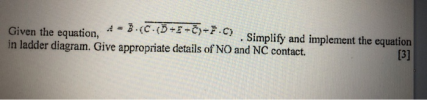 Given the equation, d-3.(C ( +8-e)-F c) . Simplify and implement the equation in ladder diagram. Give appropriate details of NO and NC contact.
Given the equation, d-3.(C ( +8-e)-F c) . Simplify and implement the equation in ladder diagram. Give appropriate details of NO and NC contact.
Given the equation, d-3.(C ( +8-e)-F c) . Simplify and implement the equation in ladder diagram. Give appropriate details of NO and NC contact.
 Match the following with the correct answer.
1 1st order reaction of all reactant = A 1/k 2 1st order reaction of one reactant = B ln(2)/ 3 2nd order reaction of one reactant = c kin R-K[A] - d[Al/dt 4 rate constant = D A +B- C 5 rate = E Rin R-k[A] - d[A]/dt 6 half time of 1st order reaction = FAAC 7 lifetime of 1st order reaction = GAB
Match the following with the correct answer.
1 1st order reaction of all reactant = A 1/k 2 1st order reaction of one reactant = B ln(2)/ 3 2nd order reaction of one reactant = c kin R-K[A] - d[Al/dt 4 rate constant = D A +B- C 5 rate = E Rin R-k[A] - d[A]/dt 6 half time of 1st order reaction = FAAC 7 lifetime of 1st order reaction = GAB
 5. (15 points) Consider 3 dz r dr d, 20. a. Convert the integral to rectangular coordinates with the order d: dr dy (but don't evaluate.) b. Convert the integral to spherical coordinates (but don't evaluate.)
5. (15 points) Consider 3 dz r dr d, 20. a. Convert the integral to rectangular coordinates with the order d: dr dy (but don't evaluate.) b. Convert the integral to spherical coordinates (but don't evaluate.)
5. (15 points) Consider 3 dz r dr d, 20. a. Convert the integral to rectangular coordinates with the order d: dr dy (but don't evaluate.) b. Convert the integral to spherical coordinates (but don't evaluate.)
 1. Classify each ordinary differential equation as to order (1st, 2nd, etc) and type (linear/nonlinear). a) y' + 2y + 3y = 0 b) y" + 2yy + 3y = 0 c) y" + 2y' + 3xy - 4e" y sin 3
 cos(()dr - (r sin(O) - e)de = 0, r(0) = 1 (make r the subject of the formula)
 2. (8 points) Solve the linear, 1st order ODE with initial value: dy dr 3. (7 points) Find all critical points and the phase portrait of the autonomous Ist order ODE dy dr -5y+4 Classify each critical point as asymptotically stable, unstable or semi-stable. Sketch typical solution curves in the regions in the ry plane separated by equilibrium solutions. dy dx (S points) Solve the Bernoulli equation:-(- 31-1 7. (8 points) Solve the ODE by variation of parameters: -4y+4y (+...
 Ch 15 Extra credit opportunity. 10 pts max. Due By Exam 2 (11/14). 1)If you are enrolled in or have previously taken calculus, derive the integrated rate equations for oth, 1st and 2nd order reactions. (2 pt ea, 6 pts) Hint, start with the instantaneous rate law, expressed as differential rates, Such as d[A]/dt = k. Separate your variables, d[A] to one side, dt to the other. Integrate from time 0 to time t and simplify. Show every step. 2)...
 2. Given the nonhomogeneous 2nd order differential equation y" +2y = xe*: (8 pts) a. Identify the forcing function (ie. the nonhomogeneous term we call f(x)). b. Write the homogeneous equation associated with this DE. c. Find the particular solution to the homogeneous DE from part b which satisfies the initial conditions y(0) = 2, y'(O)=-1. (note: you will NOT be using technique of undetermined coefficients)
 Given the equation, d-3.(C ( +8-e)-F c) . Simplify and implement the equation in ladder diagram. Give appropriate details of NO and NC contact.
Given the equation, d-3.(C ( +8-e)-F c) . Simplify and implement the equation in ladder diagram. Give appropriate details of NO and NC contact.
Given the equation, d-3.(C ( +8-e)-F c) . Simplify and implement the equation in ladder diagram. Give appropriate details of NO and NC contact.
Most questions answered within 3 hours.
-
Where is the error in this code sequence?
String s1 = "Hello";
String s2 = "ello";...
asked 11 months ago -
Financial data for Joel de Paris, Inc., for last year
follow:
Joel de Paris, Inc.
Balance...
asked 11 months ago -
Consider this reaction:
Al2(SO4)3 (aq)+ BaCl3
(aq) Al2Cl6 (aq)- +
3BaSO4(s) . What is the...
asked 11 months ago -
Suppose that Savneet is considering increasing her
recent random sample from 20 car rentals to 40...
asked 11 months ago -
Trucks arrive at an unloading terminal at an average rate of 120
per hour.
Trucks arrive...
asked 11 months ago -
Why are methanol and ethanol completely soluble in water while
octanol is not very little soluble....
asked 11 months ago -
A facilities manager at a university reads in a research report
that the mean amount of...
asked 11 months ago -
When the CuSO4 is rehydrated by adding water to the anhydrous
compound, is this an endothermic...
asked 11 months ago -
A ray of sunlight is passing from diamond into crown glass; the
angle of incidence is...
asked 11 months ago -
A block of mass 0.249 kg is placed on top of a light, vertical
spring of...
asked 11 months ago -
how do the kidneys compensate in the presences of acidosis
a) trigger hyperventilate
b) reserve acid...
asked 11 months ago -
Question 501 pts
The rental rate of capital to the firm increases. Which of the
following...
asked 11 months ago