What are the required relationships between activation energies and product energies of two competing reactions (A + B g...
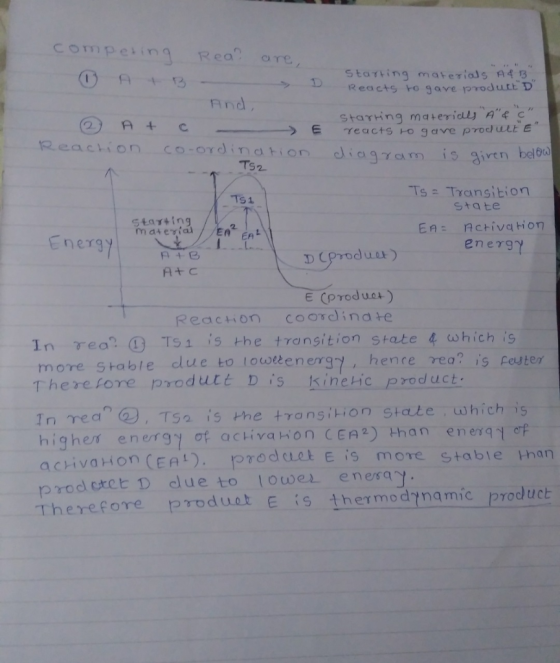
What are the required relationships between activation energies and product energies of two competing reactions (A + B gives D and A + C gives E) that would allow for different products to be formed under kinetic control and under thermodynamic control? Use a reaction co-ordinate diagram. It will help.
Homework Answers
Add Answer to:
What are the required relationships between activation energies and product energies of two competing reactions (A + B g...
Many times in Organic chemistry, two competing products are observed in a chemical reaction. The favored...
 Many times in Organic chemistry, two competing products are observed in a chemical reaction. The favored product is a result of the reaction being under Thermodynamic or under Kinetic control. Which of the following are characteristic properties of a reaction under Thermodynamic control? a. An endergonic reaction in which the products are less stable than the reactants. b. A reaction where the two products can be easily interconverted in a reversible process. c. A reaction where the product that is...
3. When 2-ethylcyclohexanone is treated with LDA (in the solvent THF), followed by ethyl bromide, two...
 3. When 2-ethylcyclohexanone is treated with LDA (in the solvent THF), followed by ethyl bromide, two different alkylated products are formed. Answer the following questions about this reaction. 1) LDA THE two products 2) CH CH Br 3. a. What is LDA and what is its purpose? 3. b. Draw mechanisms for the reactions and show how the two different products are formed. Product A Mechanism Product B Mechanism 3. c. Draw an energy diagram for the formation of both...
I need help with problems c-f 2320 PDQ 1-Chapter 16 c. Explain generally what it means...
 I need help with problems c-f
2320 PDQ 1-Chapter 16 c. Explain generally what it means to be the kinetic product. Do not focus on this specific reaction, but instead come up with a generic definition. If given an energy diagram for a reaction, which specifie piece of information would you focus on (starting material energies, activation energies, relative product energies)? Which conditions favor the kinctic product (high/low temps, long/short reaction times)? d. Explain generally what it means to be...
I need help with problems c-f
2320 PDQ 1-Chapter 16 c. Explain generally what it means to be the kinetic product. Do not focus on this specific reaction, but instead come up with a generic definition. If given an energy diagram for a reaction, which specifie piece of information would you focus on (starting material energies, activation energies, relative product energies)? Which conditions favor the kinctic product (high/low temps, long/short reaction times)? d. Explain generally what it means to be...
3) Which semicarbazone is colourless and which is yellow. Why do they differ in this property?...
 3) Which semicarbazone is colourless and which is yellow. Why do
they differ in this property? In general, what gives a compound
colour? (Isn’t chemistry cool?)
Introduction Many reactions can take more than one course but the preferential formation of only one of the possible products may be attained by a judicial choice of the reaction conditions. In general, the 1 of 5 CHEM-2300 F19 Experiment 6 formation of a product is controlled by thermodynamic (differences in relative potential energies...
3) Which semicarbazone is colourless and which is yellow. Why do
they differ in this property? In general, what gives a compound
colour? (Isn’t chemistry cool?)
Introduction Many reactions can take more than one course but the preferential formation of only one of the possible products may be attained by a judicial choice of the reaction conditions. In general, the 1 of 5 CHEM-2300 F19 Experiment 6 formation of a product is controlled by thermodynamic (differences in relative potential energies...
2. Consider the reaction energy diagram below, assuming that both the reactions are reversible. List ALL...
 2. Consider the reaction energy diagram below, assuming that both the reactions are reversible. List ALL the statements that are TRUE. Use the process of elimination to help you here. TS2 TS1 EA2 EA1 Energy a) Product Pl is formed faster b) Product P2 is formed faster c) Product thermodynamically stable d) Product thermodynamically stable e) Performing the reaction at low carefully controlled temperature will favor the formation of product P. SM P1 P1 is more is P2 P2 more...
4) There are 3 different N atoms in the semicarbazide, and yet only one of them...
 4) There are 3 different N atoms in the semicarbazide, and yet
only one of them is the site that does the nucleophilic attack. Why
is that N atom most reactive? Describe using structures.
Introduction Many reactions can take more than one course but the preferential formation of only one of the possible products may be attained by a judicial choice of the reaction conditions. In general, the 1 of 5 CHEM-2300 F19 Experiment 6 formation of a product is...
4) There are 3 different N atoms in the semicarbazide, and yet
only one of them is the site that does the nucleophilic attack. Why
is that N atom most reactive? Describe using structures.
Introduction Many reactions can take more than one course but the preferential formation of only one of the possible products may be attained by a judicial choice of the reaction conditions. In general, the 1 of 5 CHEM-2300 F19 Experiment 6 formation of a product is...
TS2 TS1 EA2 EA1 Energy a) Product P1 is formed faster. b) Product P2 is formed...
 TS2 TS1 EA2 EA1 Energy a) Product P1 is formed faster. b) Product P2 is formed faster. c) Product SM P1 is more P1 thermodynamically stable d) Product thermodynamically stable. e) Performing the reaction at low carefully controlled temperature will favor the formation of product P1. P2 is more P2 Reaction coordinate f) Performing the reaction at low, carefully controlled temperature will favor the formation of product P2. g) Running the reaction at sufficiently high temperature for a very short...
9. Identify each of the following molecules as aromatic, antiaromatic or nonaromatic. (For this problem, you...
 9. Identify each of the following molecules as aromatic, antiaromatic or nonaromatic. (For this problem, you may assume that each molecule can and will be planar, if that influences the analysis.) NUMBERS 10 and 11 are BIZZZZ-ONUSI (.e., bonus) 10. In learning about 1,2-vs. 1,4-addition to dienes, we discussed kinetic vs. thermodynamic control Apply what we learned in that discussion to the following reaction, with its reaction coordinate diagram shown to the bottom left. O K THF K B: +...
9. What is the final product of the following sequence of reactions? 13. Arrange the following...
 9. What is the final product of the following sequence of reactions? 13. Arrange the following compounds in order of decreasing adidity CH PB Mg Eto 011 CHCI 10. Methanolysis of 4-bromo-2-methyl-2-pentene gives two isomeric substitution products, one of which is shown. What is the other substitution product? B с CH,OH Isomer 14. Benzalacetone is the crossed aldol condensation product formed between betaaldehyde and acetone. Draw the structure of benzalacetone. OCH, 11. Which of the following has the largest for...
Table 1: AM1 Energies of the carbocations formed from nitration of the named compound (kcal/mol) ...
Table 1: AM1 Energies of the carbocations formed from nitration of the named compound (kcal/mol) ortho meta para Toluene (S = CH3) 221.74 224.49 219.04 Phenol (S = OH) 179.10 193.32 177.44 Trifluorotoluene (S = CF3) 95.17 90.06 93.56 Methyl benzoate (S = CO2CH3) 160.00 159.34 159.34 Using the table answer the following questions. 1 a. The carbocation intermediates are good models of the transition states for the corresponding aromatic reactions. When looking at the transition state energy of two...
 Many times in Organic chemistry, two competing products are observed in a chemical reaction. The favored product is a result of the reaction being under Thermodynamic or under Kinetic control. Which of the following are characteristic properties of a reaction under Thermodynamic control? a. An endergonic reaction in which the products are less stable than the reactants. b. A reaction where the two products can be easily interconverted in a reversible process. c. A reaction where the product that is...
 3. When 2-ethylcyclohexanone is treated with LDA (in the solvent THF), followed by ethyl bromide, two different alkylated products are formed. Answer the following questions about this reaction. 1) LDA THE two products 2) CH CH Br 3. a. What is LDA and what is its purpose? 3. b. Draw mechanisms for the reactions and show how the two different products are formed. Product A Mechanism Product B Mechanism 3. c. Draw an energy diagram for the formation of both...
 I need help with problems c-f
2320 PDQ 1-Chapter 16 c. Explain generally what it means to be the kinetic product. Do not focus on this specific reaction, but instead come up with a generic definition. If given an energy diagram for a reaction, which specifie piece of information would you focus on (starting material energies, activation energies, relative product energies)? Which conditions favor the kinctic product (high/low temps, long/short reaction times)? d. Explain generally what it means to be...
I need help with problems c-f
2320 PDQ 1-Chapter 16 c. Explain generally what it means to be the kinetic product. Do not focus on this specific reaction, but instead come up with a generic definition. If given an energy diagram for a reaction, which specifie piece of information would you focus on (starting material energies, activation energies, relative product energies)? Which conditions favor the kinctic product (high/low temps, long/short reaction times)? d. Explain generally what it means to be...
 3) Which semicarbazone is colourless and which is yellow. Why do
they differ in this property? In general, what gives a compound
colour? (Isn’t chemistry cool?)
Introduction Many reactions can take more than one course but the preferential formation of only one of the possible products may be attained by a judicial choice of the reaction conditions. In general, the 1 of 5 CHEM-2300 F19 Experiment 6 formation of a product is controlled by thermodynamic (differences in relative potential energies...
3) Which semicarbazone is colourless and which is yellow. Why do
they differ in this property? In general, what gives a compound
colour? (Isn’t chemistry cool?)
Introduction Many reactions can take more than one course but the preferential formation of only one of the possible products may be attained by a judicial choice of the reaction conditions. In general, the 1 of 5 CHEM-2300 F19 Experiment 6 formation of a product is controlled by thermodynamic (differences in relative potential energies...
 2. Consider the reaction energy diagram below, assuming that both the reactions are reversible. List ALL the statements that are TRUE. Use the process of elimination to help you here. TS2 TS1 EA2 EA1 Energy a) Product Pl is formed faster b) Product P2 is formed faster c) Product thermodynamically stable d) Product thermodynamically stable e) Performing the reaction at low carefully controlled temperature will favor the formation of product P. SM P1 P1 is more is P2 P2 more...
 4) There are 3 different N atoms in the semicarbazide, and yet
only one of them is the site that does the nucleophilic attack. Why
is that N atom most reactive? Describe using structures.
Introduction Many reactions can take more than one course but the preferential formation of only one of the possible products may be attained by a judicial choice of the reaction conditions. In general, the 1 of 5 CHEM-2300 F19 Experiment 6 formation of a product is...
4) There are 3 different N atoms in the semicarbazide, and yet
only one of them is the site that does the nucleophilic attack. Why
is that N atom most reactive? Describe using structures.
Introduction Many reactions can take more than one course but the preferential formation of only one of the possible products may be attained by a judicial choice of the reaction conditions. In general, the 1 of 5 CHEM-2300 F19 Experiment 6 formation of a product is...
 TS2 TS1 EA2 EA1 Energy a) Product P1 is formed faster. b) Product P2 is formed faster. c) Product SM P1 is more P1 thermodynamically stable d) Product thermodynamically stable. e) Performing the reaction at low carefully controlled temperature will favor the formation of product P1. P2 is more P2 Reaction coordinate f) Performing the reaction at low, carefully controlled temperature will favor the formation of product P2. g) Running the reaction at sufficiently high temperature for a very short...
 9. Identify each of the following molecules as aromatic, antiaromatic or nonaromatic. (For this problem, you may assume that each molecule can and will be planar, if that influences the analysis.) NUMBERS 10 and 11 are BIZZZZ-ONUSI (.e., bonus) 10. In learning about 1,2-vs. 1,4-addition to dienes, we discussed kinetic vs. thermodynamic control Apply what we learned in that discussion to the following reaction, with its reaction coordinate diagram shown to the bottom left. O K THF K B: +...
 9. What is the final product of the following sequence of reactions? 13. Arrange the following compounds in order of decreasing adidity CH PB Mg Eto 011 CHCI 10. Methanolysis of 4-bromo-2-methyl-2-pentene gives two isomeric substitution products, one of which is shown. What is the other substitution product? B с CH,OH Isomer 14. Benzalacetone is the crossed aldol condensation product formed between betaaldehyde and acetone. Draw the structure of benzalacetone. OCH, 11. Which of the following has the largest for...
Most questions answered within 3 hours.
-
Where is the error in this code sequence?
String s1 = "Hello";
String s2 = "ello";...
asked 11 months ago -
Financial data for Joel de Paris, Inc., for last year
follow:
Joel de Paris, Inc.
Balance...
asked 11 months ago -
Consider this reaction:
Al2(SO4)3 (aq)+ BaCl3
(aq) Al2Cl6 (aq)- +
3BaSO4(s) . What is the...
asked 11 months ago -
Suppose that Savneet is considering increasing her
recent random sample from 20 car rentals to 40...
asked 11 months ago -
Trucks arrive at an unloading terminal at an average rate of 120
per hour.
Trucks arrive...
asked 11 months ago -
Why are methanol and ethanol completely soluble in water while
octanol is not very little soluble....
asked 11 months ago -
A facilities manager at a university reads in a research report
that the mean amount of...
asked 11 months ago -
When the CuSO4 is rehydrated by adding water to the anhydrous
compound, is this an endothermic...
asked 11 months ago -
A ray of sunlight is passing from diamond into crown glass; the
angle of incidence is...
asked 11 months ago -
A block of mass 0.249 kg is placed on top of a light, vertical
spring of...
asked 11 months ago -
how do the kidneys compensate in the presences of acidosis
a) trigger hyperventilate
b) reserve acid...
asked 11 months ago -
Question 501 pts
The rental rate of capital to the firm increases. Which of the
following...
asked 11 months ago