
Homework Answers


The growth rate of exponential increasing function is faster than polynomial functions

The highest order function polynomial is n^3 in this case

Now, the order will be

Note - Post any doubts/queries in comments section.
Add Answer to:
16. Order the following functions from lowest to highest 0-class. fs= 4n /n+2n2 - fonlg (n')-lg (n'3) f2- 3n -l...
List the following functions from highest to lowest order. If any are of the same order,...
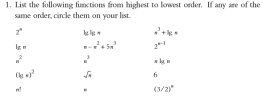 List the following functions from highest to lowest order. If any are of the same order, circle them on your list. 2^n lg n n^2 (lg n)^2 n! lg lg n n - n^2 + 5n^3 n squareroot n n n^3 + lg n 2^n - 1 n lg n 6 (3/2)^n
Question 6 !! Thanks Order the following functions according to their order of growth (from the...
 Question 6 !! Thanks
Order the following functions according to their order of growth (from the lowest to n!, n lg n, 8 lg (n + 10)^10, 2^3n, 3^2n, n^5 + 10 lg n Prove that a + lg(n^k + c) = Theta (lg n), for every fixed k > 0, a > 0 and c > 0. Determine the complexities of the following recursive functions, where c > 0 is the operations in the functions. (You may assume that...
Question 6 !! Thanks
Order the following functions according to their order of growth (from the lowest to n!, n lg n, 8 lg (n + 10)^10, 2^3n, 3^2n, n^5 + 10 lg n Prove that a + lg(n^k + c) = Theta (lg n), for every fixed k > 0, a > 0 and c > 0. Determine the complexities of the following recursive functions, where c > 0 is the operations in the functions. (You may assume that...
Order the following functions by asymptotic growth rate: 4n, 2^log(n), 4nlog(n)+2n, 2^10, 3n+100log(n), 2^n, n^2+10n, n^3,...
 Order the following functions by asymptotic growth rate: 4n, 2^log(n), 4nlog(n)+2n, 2^10, 3n+100log(n), 2^n, n^2+10n, n^3, nlog(n) You should state the asymptotic growth rate for each function in terms of Big-Oh and also explicitly order those functions that have the same asymptotic growth rate among themselves.
1. a) Let f(n) = 6n2 - 100n + 44 and g(n) = 0.5n3 . Prove...
 1. a) Let f(n) = 6n2 - 100n + 44 and g(n) =
0.5n3 . Prove that f(n) = O(g(n)) using the definition
of Big-O notation. (You need to find constants c and n0).
b) Let f(n) = 3n2 + n and g(n) = 2n2 . Use
the definition of big-O notation to prove that
f(n) = O(g(n)) (you need to find constants c and n0) and
g(n) = O(f(n)) (you need to find constants c and n0).
Conclude that...
1. a) Let f(n) = 6n2 - 100n + 44 and g(n) =
0.5n3 . Prove that f(n) = O(g(n)) using the definition
of Big-O notation. (You need to find constants c and n0).
b) Let f(n) = 3n2 + n and g(n) = 2n2 . Use
the definition of big-O notation to prove that
f(n) = O(g(n)) (you need to find constants c and n0) and
g(n) = O(f(n)) (you need to find constants c and n0).
Conclude that...
Order of Growth Rate Order the following functions by asymptotic growth: (i) fi(n) 3" (ii) f2(n)...
 Order of Growth Rate Order the following functions by asymptotic growth: (i) fi(n) 3" (ii) f2(n) ni (iii) fa(n) 12 (iv) fa(n) 2log2 n (v) fs(n) Vn (vi) f6(n) 2" (vii) fr(n) log2 n (viii) fs(n) 2V (ix) fo(n) n3
Use the definition of 0 to show that 5n^5 +4n^4 + 3n^3 + 2n^2 + n...
 Use the definition of 0 to show that 5n^5 +4n^4 + 3n^3 + 2n^2 + n 0(n^5).Use the definition of 0 to show that 2n^2 - n+ 3 0(n^2).Let f,g,h : N 1R*. Use the definition of big-Oh to prove that if/(n) 6 0(g{n)) and g(n) 0(h{n)) then/(n) 0(/i(n)). You should use different letters for the constants (i.e. don't use c to denote the constant for each big-Oh).
3. (10 pts) For each of the following functions f(n), prove the stated claim by providing...
 3. (10 pts) For each of the following functions f(n), prove the stated claim by providing constants no C1, and c2 such that for all n2 no, cig(n) S f(n) or f(n) c2g(n), and provide a calculation that shows that this inequality does indeed hold (a) f(n) 2n2 3n3-50nlgn10 0(n3) O(g(n)) (b) f(n)-2n log n + 3n2-10n-10-Ω ( 2)-0(g(n))
Arrange the following functions in ascending order of growth rate. That is, if function g(n) immediately...
 Arrange the following functions in ascending order of growth rate. That is, if function g(n) immediately follows function f(n) in your list, then it should be the case that f(n) -O(gln) fl (n) = n/i f2 (n)- 3" fs (n)-nIg(n') JA (n)- ()+54 More specifically, match the functions f? through fe to the corresponding positions a through f to illustrate the correct asymptotic order: I Choose ] I Choose ] Choose ] Choose ] I Choose ] I Choose ]
1. (15 pts List the following functions according to their order of growth from the lowest to the...
 1. (15 pts List the following functions according to their order of growth from the lowest to the highest. Show your work using limits for comparing orders of growth 2. Find a closed-form formula (a) (5 pts.) Σ-1(2i2) (b) (10 pts.) Σ_kar) for
1. (15 pts List the following functions according to their order of growth from the lowest to the highest. Show your work using limits for comparing orders of growth 2. Find a closed-form formula (a) (5 pts.)...
1. (15 pts List the following functions according to their order of growth from the lowest to the highest. Show your work using limits for comparing orders of growth 2. Find a closed-form formula (a) (5 pts.) Σ-1(2i2) (b) (10 pts.) Σ_kar) for
1. (15 pts List the following functions according to their order of growth from the lowest to the highest. Show your work using limits for comparing orders of growth 2. Find a closed-form formula (a) (5 pts.)...
3-3 Ordering by asymptotic growth rates a. Rank the following functions by order of growth; that...
 3-3 Ordering by asymptotic growth rates a. Rank the following functions by order of growth; that is, find an arrangement 81,82, 830 of the functions satisfying gi = Ω(82), g2 Ω(83), , g29 = Ω(g30). Partition your list into equivalence classes such that functions f(n) and g(n) are in the same class if and only if f(n) = Θ(g(n)) Chaptr3 Growth of Functions 1n In Inn lg* g nn-2" n'ln Ig nIn n 2" nlgn 22+1 b. Give an example...
 List the following functions from highest to lowest order. If any are of the same order, circle them on your list. 2^n lg n n^2 (lg n)^2 n! lg lg n n - n^2 + 5n^3 n squareroot n n n^3 + lg n 2^n - 1 n lg n 6 (3/2)^n
 Question 6 !! Thanks
Order the following functions according to their order of growth (from the lowest to n!, n lg n, 8 lg (n + 10)^10, 2^3n, 3^2n, n^5 + 10 lg n Prove that a + lg(n^k + c) = Theta (lg n), for every fixed k > 0, a > 0 and c > 0. Determine the complexities of the following recursive functions, where c > 0 is the operations in the functions. (You may assume that...
Question 6 !! Thanks
Order the following functions according to their order of growth (from the lowest to n!, n lg n, 8 lg (n + 10)^10, 2^3n, 3^2n, n^5 + 10 lg n Prove that a + lg(n^k + c) = Theta (lg n), for every fixed k > 0, a > 0 and c > 0. Determine the complexities of the following recursive functions, where c > 0 is the operations in the functions. (You may assume that...
 Order the following functions by asymptotic growth rate: 4n, 2^log(n), 4nlog(n)+2n, 2^10, 3n+100log(n), 2^n, n^2+10n, n^3, nlog(n) You should state the asymptotic growth rate for each function in terms of Big-Oh and also explicitly order those functions that have the same asymptotic growth rate among themselves.
 1. a) Let f(n) = 6n2 - 100n + 44 and g(n) =
0.5n3 . Prove that f(n) = O(g(n)) using the definition
of Big-O notation. (You need to find constants c and n0).
b) Let f(n) = 3n2 + n and g(n) = 2n2 . Use
the definition of big-O notation to prove that
f(n) = O(g(n)) (you need to find constants c and n0) and
g(n) = O(f(n)) (you need to find constants c and n0).
Conclude that...
1. a) Let f(n) = 6n2 - 100n + 44 and g(n) =
0.5n3 . Prove that f(n) = O(g(n)) using the definition
of Big-O notation. (You need to find constants c and n0).
b) Let f(n) = 3n2 + n and g(n) = 2n2 . Use
the definition of big-O notation to prove that
f(n) = O(g(n)) (you need to find constants c and n0) and
g(n) = O(f(n)) (you need to find constants c and n0).
Conclude that...
 Order of Growth Rate Order the following functions by asymptotic growth: (i) fi(n) 3" (ii) f2(n) ni (iii) fa(n) 12 (iv) fa(n) 2log2 n (v) fs(n) Vn (vi) f6(n) 2" (vii) fr(n) log2 n (viii) fs(n) 2V (ix) fo(n) n3
 Use the definition of 0 to show that 5n^5 +4n^4 + 3n^3 + 2n^2 + n 0(n^5).Use the definition of 0 to show that 2n^2 - n+ 3 0(n^2).Let f,g,h : N 1R*. Use the definition of big-Oh to prove that if/(n) 6 0(g{n)) and g(n) 0(h{n)) then/(n) 0(/i(n)). You should use different letters for the constants (i.e. don't use c to denote the constant for each big-Oh).
 3. (10 pts) For each of the following functions f(n), prove the stated claim by providing constants no C1, and c2 such that for all n2 no, cig(n) S f(n) or f(n) c2g(n), and provide a calculation that shows that this inequality does indeed hold (a) f(n) 2n2 3n3-50nlgn10 0(n3) O(g(n)) (b) f(n)-2n log n + 3n2-10n-10-Ω ( 2)-0(g(n))
 Arrange the following functions in ascending order of growth rate. That is, if function g(n) immediately follows function f(n) in your list, then it should be the case that f(n) -O(gln) fl (n) = n/i f2 (n)- 3" fs (n)-nIg(n') JA (n)- ()+54 More specifically, match the functions f? through fe to the corresponding positions a through f to illustrate the correct asymptotic order: I Choose ] I Choose ] Choose ] Choose ] I Choose ] I Choose ]
 1. (15 pts List the following functions according to their order of growth from the lowest to the highest. Show your work using limits for comparing orders of growth 2. Find a closed-form formula (a) (5 pts.) Σ-1(2i2) (b) (10 pts.) Σ_kar) for
1. (15 pts List the following functions according to their order of growth from the lowest to the highest. Show your work using limits for comparing orders of growth 2. Find a closed-form formula (a) (5 pts.)...
1. (15 pts List the following functions according to their order of growth from the lowest to the highest. Show your work using limits for comparing orders of growth 2. Find a closed-form formula (a) (5 pts.) Σ-1(2i2) (b) (10 pts.) Σ_kar) for
1. (15 pts List the following functions according to their order of growth from the lowest to the highest. Show your work using limits for comparing orders of growth 2. Find a closed-form formula (a) (5 pts.)...
 3-3 Ordering by asymptotic growth rates a. Rank the following functions by order of growth; that is, find an arrangement 81,82, 830 of the functions satisfying gi = Ω(82), g2 Ω(83), , g29 = Ω(g30). Partition your list into equivalence classes such that functions f(n) and g(n) are in the same class if and only if f(n) = Θ(g(n)) Chaptr3 Growth of Functions 1n In Inn lg* g nn-2" n'ln Ig nIn n 2" nlgn 22+1 b. Give an example...
Most questions answered within 3 hours.
-
Where is the error in this code sequence?
String s1 = "Hello";
String s2 = "ello";...
asked 11 months ago -
Financial data for Joel de Paris, Inc., for last year
follow:
Joel de Paris, Inc.
Balance...
asked 11 months ago -
Consider this reaction:
Al2(SO4)3 (aq)+ BaCl3
(aq) Al2Cl6 (aq)- +
3BaSO4(s) . What is the...
asked 11 months ago -
Suppose that Savneet is considering increasing her
recent random sample from 20 car rentals to 40...
asked 11 months ago -
Trucks arrive at an unloading terminal at an average rate of 120
per hour.
Trucks arrive...
asked 11 months ago -
Why are methanol and ethanol completely soluble in water while
octanol is not very little soluble....
asked 11 months ago -
A facilities manager at a university reads in a research report
that the mean amount of...
asked 11 months ago -
When the CuSO4 is rehydrated by adding water to the anhydrous
compound, is this an endothermic...
asked 11 months ago -
A ray of sunlight is passing from diamond into crown glass; the
angle of incidence is...
asked 11 months ago -
A block of mass 0.249 kg is placed on top of a light, vertical
spring of...
asked 11 months ago -
how do the kidneys compensate in the presences of acidosis
a) trigger hyperventilate
b) reserve acid...
asked 11 months ago -
Question 501 pts
The rental rate of capital to the firm increases. Which of the
following...
asked 11 months ago