
Homework Answers
Ans 6 : g(n) = lg(n)
f(n)= a + lg(n^k + c)
a+lg(nk *(1+c/nk))
a+lg(nk)+lg(1+c/nk)
a+ klg(n)+lg(1+c/nk)
as a,k,e all are >0 , hence we can neglect the value lg(1+c/nk) as very small
hence the upper bound for the above function in O(lg n) (1)
similarly f(n) grows as fast as g(n), thtrefore , f(n)= Ω(g(n)) (2)
from above two points we can conclude that f(n)=Θ(g(n))
Add Answer to:
Question 6 !! Thanks
Order the following functions according to their order of growth (from the...
1 question) Arrange the following in the order of their growth rates, from least to greatest:...
1 question) Arrange the following in the order of their growth rates, from least to greatest: (5 pts) n3 n2 nn lg n n! n lg n 2n n 2 question)Show that 3n3 + n2 is big-Oh of n3. You can use either the definition of big-Oh (formal) or the limit approach. Show your work! (5 pts.) 3 question)Show that 6n2 + 20n is big-Oh of n3, but not big-Omega of n3. You can use either the definition of big-Omega...
16. Order the following functions from lowest to highest 0-class. fs= 4n /n+2n2 - fonlg (n')-lg (n'3) f2- 3n -l...
 16. Order the following functions from lowest to highest 0-class. fs= 4n /n+2n2 - fonlg (n')-lg (n'3) f2- 3n -lg (lg (n)) + n°.5 fs=3n3- 2n2 +4n - 5 f, 31459 + 1.5n lg (n) f=1.2" - 0.8" +2n2
16. Order the following functions from lowest to highest 0-class. fs= 4n /n+2n2 - fonlg (n')-lg (n'3) f2- 3n -lg (lg (n)) + n°.5 fs=3n3- 2n2 +4n - 5 f, 31459 + 1.5n lg (n) f=1.2" - 0.8" +2n2
16. Order the following functions from lowest to highest 0-class. fs= 4n /n+2n2 - fonlg (n')-lg (n'3) f2- 3n -lg (lg (n)) + n°.5 fs=3n3- 2n2 +4n - 5 f, 31459 + 1.5n lg (n) f=1.2" - 0.8" +2n2
Need help with 1,2,3 thank you. 1. Order of growth (20 points) Order the following functions...
 Need help with 1,2,3 thank you.
1. Order of growth (20 points) Order the following functions according to their order of growth from the lowest to the highest. If you think that two functions are of the same order (Le f(n) E Θ(g(n))), put then in the same group. log(n!), n., log log n, logn, n log(n), n2 V, (1)!, 2", n!, 3", 21 2. Asymptotic Notation (20 points) For each pair of functions in the table below, deternme whether...
Need help with 1,2,3 thank you.
1. Order of growth (20 points) Order the following functions according to their order of growth from the lowest to the highest. If you think that two functions are of the same order (Le f(n) E Θ(g(n))), put then in the same group. log(n!), n., log log n, logn, n log(n), n2 V, (1)!, 2", n!, 3", 21 2. Asymptotic Notation (20 points) For each pair of functions in the table below, deternme whether...
Order the following functions by asymptotic growth rate: 4n, 2^log(n), 4nlog(n)+2n, 2^10, 3n+100log(n), 2^n, n^2+10n, n^3,...
 Order the following functions by asymptotic growth rate: 4n, 2^log(n), 4nlog(n)+2n, 2^10, 3n+100log(n), 2^n, n^2+10n, n^3, nlog(n) You should state the asymptotic growth rate for each function in terms of Big-Oh and also explicitly order those functions that have the same asymptotic growth rate among themselves.
For each of the following functions, indicate the class Θ(g(n)) the function belongs to. ( Use...
For each of the following functions, indicate the class Θ(g(n)) the function belongs to. ( Use the simplest g(n) possible in your answers). Prove your assertions. a. ( n2 + 1)10 b. 2n+1 + 3n-1 c. [ log2 n ] d. 2n lg(n+2)2 + ( n+2)2 lg n/2 e. ( 10n2 + 7n + 3)1/2
1. Determine the appropriate big-o expression for each of the following functions, and put your answer...
 1. Determine the appropriate big-o expression for each of the following functions, and put your answer in the table we have provided in section 2-1 of ps5_parti. We've included the answer for the first function. (Note: We're using the “ symbol to represent exponentiation.) a (n) = 5n + 1 b. b(n) = 5 - 10n - n^2 o c(n) = 4n + 2log (n) d. e. d(n) = 6nlog (n) + n^2 e(n) = 2n^2 + 3n^3 - 7n...
They NAME sc 162- lec. 18 (Big quiz 1. Arrange the following functions in order of...
 They NAME sc 162- lec. 18 (Big quiz 1. Arrange the following functions in order of increasing rate of growth. Also, identify any functions with the SAME rate of growth by putting then below the others. a) sn, 44log n, 10n log n, 500, 2n, 28, 3n b) n', n +2 nlog2 n, n! ne log, n, n n n'. 4", n, na, 2 2. Use the Big-o notation to estimate the time complexity for the following segments/methods. (Assume all...
List the following functions from highest to lowest order. If any are of the same order,...
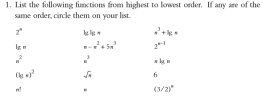 List the following functions from highest to lowest order. If any are of the same order, circle them on your list. 2^n lg n n^2 (lg n)^2 n! lg lg n n - n^2 + 5n^3 n squareroot n n n^3 + lg n 2^n - 1 n lg n 6 (3/2)^n
Order the following functions by asymptotic growth rate. 2n log n + 2n, 210, 2 log...
Order the following functions by asymptotic growth rate. 2n log n + 2n, 210, 2 log n, 3n + 100 log n, 4n, 2n, n2 + 10n, n3, n log n2
Hello, I would like to get help with the following question, thanks in advance. Order the...
Hello, I would like to get help with the following question, thanks in advance. Order the following functions according to their asymptotic growth rate. Justify the ordering. n2 --- n! --- (lg n)! --- (3/2)n --- ln ln n --- nlg(n) --- n2n ---- ln n --- en ---- n ---- sqrt(n) ---- 1 --- n(1/lg n) --- ln2(n) --- 2n --- lg(n!)
 16. Order the following functions from lowest to highest 0-class. fs= 4n /n+2n2 - fonlg (n')-lg (n'3) f2- 3n -lg (lg (n)) + n°.5 fs=3n3- 2n2 +4n - 5 f, 31459 + 1.5n lg (n) f=1.2" - 0.8" +2n2
16. Order the following functions from lowest to highest 0-class. fs= 4n /n+2n2 - fonlg (n')-lg (n'3) f2- 3n -lg (lg (n)) + n°.5 fs=3n3- 2n2 +4n - 5 f, 31459 + 1.5n lg (n) f=1.2" - 0.8" +2n2
16. Order the following functions from lowest to highest 0-class. fs= 4n /n+2n2 - fonlg (n')-lg (n'3) f2- 3n -lg (lg (n)) + n°.5 fs=3n3- 2n2 +4n - 5 f, 31459 + 1.5n lg (n) f=1.2" - 0.8" +2n2
 Need help with 1,2,3 thank you.
1. Order of growth (20 points) Order the following functions according to their order of growth from the lowest to the highest. If you think that two functions are of the same order (Le f(n) E Θ(g(n))), put then in the same group. log(n!), n., log log n, logn, n log(n), n2 V, (1)!, 2", n!, 3", 21 2. Asymptotic Notation (20 points) For each pair of functions in the table below, deternme whether...
Need help with 1,2,3 thank you.
1. Order of growth (20 points) Order the following functions according to their order of growth from the lowest to the highest. If you think that two functions are of the same order (Le f(n) E Θ(g(n))), put then in the same group. log(n!), n., log log n, logn, n log(n), n2 V, (1)!, 2", n!, 3", 21 2. Asymptotic Notation (20 points) For each pair of functions in the table below, deternme whether...
 Order the following functions by asymptotic growth rate: 4n, 2^log(n), 4nlog(n)+2n, 2^10, 3n+100log(n), 2^n, n^2+10n, n^3, nlog(n) You should state the asymptotic growth rate for each function in terms of Big-Oh and also explicitly order those functions that have the same asymptotic growth rate among themselves.
 1. Determine the appropriate big-o expression for each of the following functions, and put your answer in the table we have provided in section 2-1 of ps5_parti. We've included the answer for the first function. (Note: We're using the “ symbol to represent exponentiation.) a (n) = 5n + 1 b. b(n) = 5 - 10n - n^2 o c(n) = 4n + 2log (n) d. e. d(n) = 6nlog (n) + n^2 e(n) = 2n^2 + 3n^3 - 7n...
 They NAME sc 162- lec. 18 (Big quiz 1. Arrange the following functions in order of increasing rate of growth. Also, identify any functions with the SAME rate of growth by putting then below the others. a) sn, 44log n, 10n log n, 500, 2n, 28, 3n b) n', n +2 nlog2 n, n! ne log, n, n n n'. 4", n, na, 2 2. Use the Big-o notation to estimate the time complexity for the following segments/methods. (Assume all...
 List the following functions from highest to lowest order. If any are of the same order, circle them on your list. 2^n lg n n^2 (lg n)^2 n! lg lg n n - n^2 + 5n^3 n squareroot n n n^3 + lg n 2^n - 1 n lg n 6 (3/2)^n
Most questions answered within 3 hours.
-
Where is the error in this code sequence?
String s1 = "Hello";
String s2 = "ello";...
asked 10 months ago -
Financial data for Joel de Paris, Inc., for last year
follow:
Joel de Paris, Inc.
Balance...
asked 10 months ago -
Consider this reaction:
Al2(SO4)3 (aq)+ BaCl3
(aq) Al2Cl6 (aq)- +
3BaSO4(s) . What is the...
asked 10 months ago -
Suppose that Savneet is considering increasing her
recent random sample from 20 car rentals to 40...
asked 10 months ago -
Trucks arrive at an unloading terminal at an average rate of 120
per hour.
Trucks arrive...
asked 10 months ago -
Why are methanol and ethanol completely soluble in water while
octanol is not very little soluble....
asked 10 months ago -
A facilities manager at a university reads in a research report
that the mean amount of...
asked 10 months ago -
When the CuSO4 is rehydrated by adding water to the anhydrous
compound, is this an endothermic...
asked 10 months ago -
A ray of sunlight is passing from diamond into crown glass; the
angle of incidence is...
asked 10 months ago -
A block of mass 0.249 kg is placed on top of a light, vertical
spring of...
asked 10 months ago -
how do the kidneys compensate in the presences of acidosis
a) trigger hyperventilate
b) reserve acid...
asked 10 months ago -
Question 501 pts
The rental rate of capital to the firm increases. Which of the
following...
asked 10 months ago