
Homework Answers

Add Answer to:
Question 4 The plane truss is subjected to a load as shown in Figure 4. Take E = 200 GPa and cross sectional areas of m...
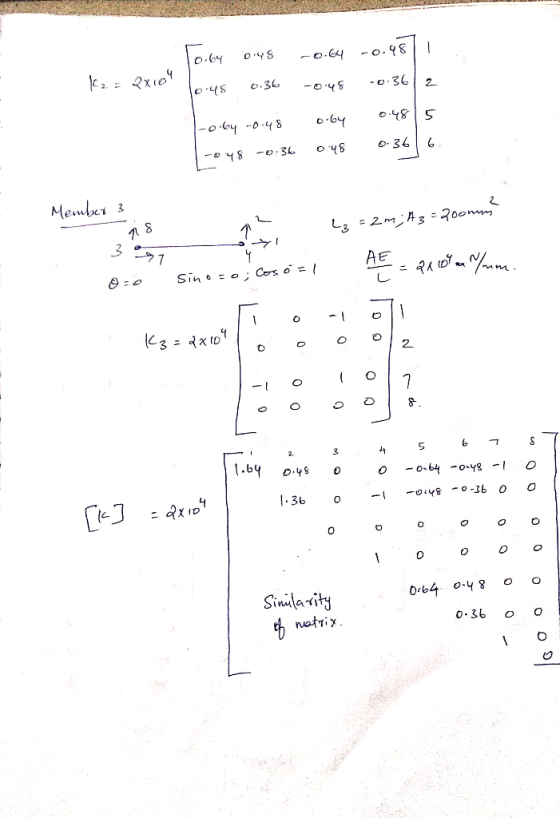
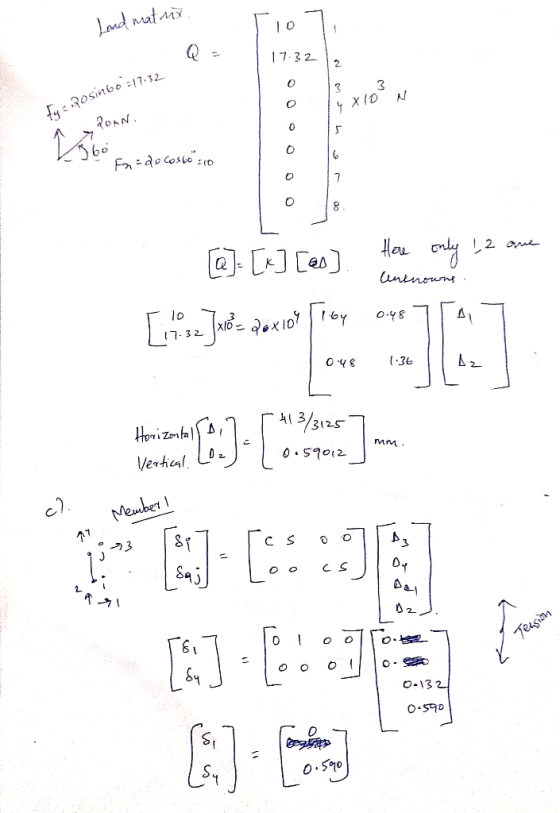
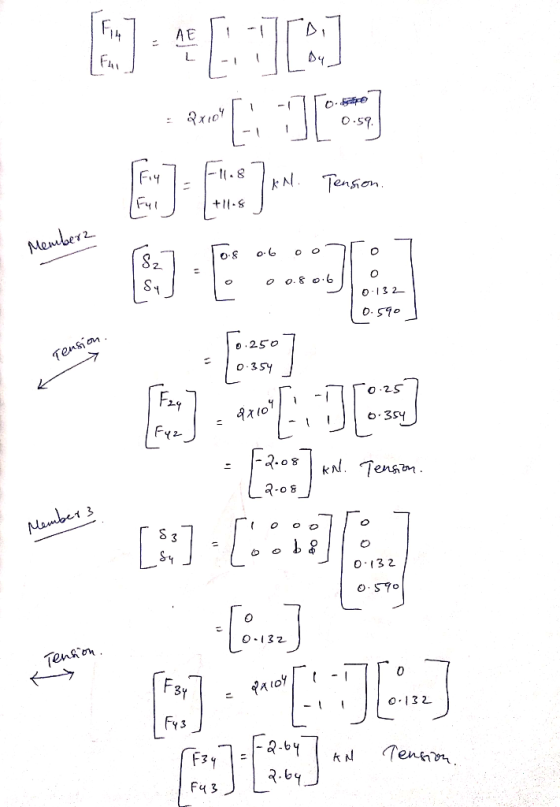
The plane truss is subjected to a load as shown in Figure 4. Take E = 200 GPa and cross sectional areas of members 1, 2...
 The plane truss is subjected to a load as shown in Figure 4. Take E = 200 GPa and cross sectional areas of members 1, 2 and 3 as 150, 250 and 200 mm2 respectively a) Assemble the upper triangular part of the global stiffness matrix for the truss b) Determine the horizontal and vertical displacements at node 4 c) Calculate the forces in each member of the truss. (25 marks) 20 kN 3 60° 4 1.5m 2 2 20m...
2. For the pin-jointed truss shown in Figure Q2.1 applied at node 4. The Young's modulus E(GPa) is the same for...
 2. For the pin-jointed truss shown in Figure Q2.1 applied at node 4. The Young's modulus E(GPa) is the same for the three truss vertical downward force P(kN) is a members. The cross sectional area of each of the truss members is indicated below and expressed in terms of a constant A. By using the stiffness method: (a) Compute the reduced stiffness matrix Kg [5 marks [10 marks (b) Calculate the global displacements of node 4 in terms of P,...
SAN4701 JAN/FE8 2017 QUESTION 1 1 is having a hinge support at 1 and a roller support at 2. (E - 200 GPa) for all the m...
 SAN4701 JAN/FE8 2017 QUESTION 1 1 is having a hinge support at 1 and a roller support at 2. (E - 200 GPa) for all the members and the members 1, d 3 have their cross sectional areas as 4000 mm2, 4000 mm2 and 6000 mm2 The truss shown in Figure Assuming that E is constant respectively, use the matrix stiffness method to determine the following Number of degrees of freedom. a. (15) b. Structure stiffness matrıx. (10) c Member...
The plane truss shown in Figure is composed of members having a square 15 mm ×...
 The plane truss shown in Figure is composed of members having a
square 15 mm × 15 mm cross section and modulus of elasticity
E = 69 GPa.
a. Assemble the global stiffness matrix.
b. Compute the nodal displacements in the global coordinate
system for theloads shown.
c. Compute the axial stress in each element
3 kN 3 5 kN 2 1.5 m 4. 1.5 m
The plane truss shown in Figure is composed of members having a
square 15 mm × 15 mm cross section and modulus of elasticity
E = 69 GPa.
a. Assemble the global stiffness matrix.
b. Compute the nodal displacements in the global coordinate
system for theloads shown.
c. Compute the axial stress in each element
3 kN 3 5 kN 2 1.5 m 4. 1.5 m
For truss shown below a vertical load of 25 KN and Horizontal Load of 30 KN...
 For truss shown below a vertical load of 25 KN and Horizontal
Load of 30 KN applied at Node 3 ( Use FEM Nodal displacement,
Direct stiffness method)
1). Calculate clearly the member length and distance between
members A = 5 x 10^-4 m^2 and E = 200 GPa
2). Determine the member and global stiffness matrix and show
the calculation fot Sinθ and Cosθ clearly
3). determine the displacement and
member forces
All Load and dimensions are in meter...
For truss shown below a vertical load of 25 KN and Horizontal
Load of 30 KN applied at Node 3 ( Use FEM Nodal displacement,
Direct stiffness method)
1). Calculate clearly the member length and distance between
members A = 5 x 10^-4 m^2 and E = 200 GPa
2). Determine the member and global stiffness matrix and show
the calculation fot Sinθ and Cosθ clearly
3). determine the displacement and
member forces
All Load and dimensions are in meter...
Figure Q5(a) shows a plane truss supported by a horizontal spring at the top node. The...
 Figure Q5(a) shows a plane truss supported by a horizontal spring at the top node. The truss members are of a solid circular cross section having a diameter of 20 mm and an elastic modulus (E) of 80 GPa (10° N/m2). The spring has a stiffness constant of k-2000 kN/m. A point load of 15 kN is applied at the top node. The direction of the load is indicated in the figure. The code numbers for elements, nodes, DOFS, and...
Please solve this question clearly and step by step. Thank you 2. A truss assembly shown...
 Please solve this question clearly and step by step.
Thank you
2. A truss assembly shown in Figure Q2 below is made of aluminum alloy that has a modulus of elasticity, E = 69 GPa. member is 225 mm2 The cross sectional area of each 4300 N (0, 40) m (40, 40) m 2 500 N 3 (0, 0) FIGURE Q2 Determine the global stiffness matrix for the truss assembly. a. [10 marks] Determine the displacement at node 3. b....
Please solve this question clearly and step by step.
Thank you
2. A truss assembly shown in Figure Q2 below is made of aluminum alloy that has a modulus of elasticity, E = 69 GPa. member is 225 mm2 The cross sectional area of each 4300 N (0, 40) m (40, 40) m 2 500 N 3 (0, 0) FIGURE Q2 Determine the global stiffness matrix for the truss assembly. a. [10 marks] Determine the displacement at node 3. b....
For the truss shown in the figure below, develop element stiffness matrices in the global co-ordinate system. AE 200 [M...
 For the truss shown in the figure below, develop element stiffness matrices in the global co-ordinate system. AE 200 [MN] is the same for all members. Use the direct stiffness matrix method to: i. Establish all element stiffness matrices in global coordinates ii.Find the displacements in node 3 ii. Calculate the member stresses 4m 3m 20kN 2 2 Use HELM resources on Moodle to find required determinant and inverse matrix. Answer 9.6x10³ [MPa] 0.24mmm u3-0.20mm 0.45mm 16x10-3 MPa σ2-3- 1...
Problem 2: The figure below shows a two-member plane truss supported by a linearly elastic spring....
 Problem 2: The figure below shows a two-member plane truss supported by a linearly elastic spring. The truss members are of a solid circular cross section having diameter, d = 20mm, and E = 80 GPa. The linear spring has a stiffness constant of 50 N/mm. A load of 15 kN is applied at 3 at an angle of 50 degrees with the horizontal. Find (a) The global displacements of the unconstrained node and (b) compute the reaction forces and...
Question 5 The members of the truss shown are made of steel and have the cross-sectional areas shown. Use the work e...
 Question 5 The members of the truss shown are made of steel and have the cross-sectional areas shown. Use the work energy method to determine the vertical deflection of joint C caused by the application of the 210 kN load. E = 200 GPa 15 m 1200 L5 m 210 kN 1800
Question 5 The members of the truss shown are made of steel and have the cross-sectional areas shown. Use the work energy method to determine the vertical deflection...
Question 5 The members of the truss shown are made of steel and have the cross-sectional areas shown. Use the work energy method to determine the vertical deflection of joint C caused by the application of the 210 kN load. E = 200 GPa 15 m 1200 L5 m 210 kN 1800
Question 5 The members of the truss shown are made of steel and have the cross-sectional areas shown. Use the work energy method to determine the vertical deflection...
 The plane truss is subjected to a load as shown in Figure 4. Take E = 200 GPa and cross sectional areas of members 1, 2 and 3 as 150, 250 and 200 mm2 respectively a) Assemble the upper triangular part of the global stiffness matrix for the truss b) Determine the horizontal and vertical displacements at node 4 c) Calculate the forces in each member of the truss. (25 marks) 20 kN 3 60° 4 1.5m 2 2 20m...
 2. For the pin-jointed truss shown in Figure Q2.1 applied at node 4. The Young's modulus E(GPa) is the same for the three truss vertical downward force P(kN) is a members. The cross sectional area of each of the truss members is indicated below and expressed in terms of a constant A. By using the stiffness method: (a) Compute the reduced stiffness matrix Kg [5 marks [10 marks (b) Calculate the global displacements of node 4 in terms of P,...
 SAN4701 JAN/FE8 2017 QUESTION 1 1 is having a hinge support at 1 and a roller support at 2. (E - 200 GPa) for all the members and the members 1, d 3 have their cross sectional areas as 4000 mm2, 4000 mm2 and 6000 mm2 The truss shown in Figure Assuming that E is constant respectively, use the matrix stiffness method to determine the following Number of degrees of freedom. a. (15) b. Structure stiffness matrıx. (10) c Member...
 The plane truss shown in Figure is composed of members having a
square 15 mm × 15 mm cross section and modulus of elasticity
E = 69 GPa.
a. Assemble the global stiffness matrix.
b. Compute the nodal displacements in the global coordinate
system for theloads shown.
c. Compute the axial stress in each element
3 kN 3 5 kN 2 1.5 m 4. 1.5 m
The plane truss shown in Figure is composed of members having a
square 15 mm × 15 mm cross section and modulus of elasticity
E = 69 GPa.
a. Assemble the global stiffness matrix.
b. Compute the nodal displacements in the global coordinate
system for theloads shown.
c. Compute the axial stress in each element
3 kN 3 5 kN 2 1.5 m 4. 1.5 m
 For truss shown below a vertical load of 25 KN and Horizontal
Load of 30 KN applied at Node 3 ( Use FEM Nodal displacement,
Direct stiffness method)
1). Calculate clearly the member length and distance between
members A = 5 x 10^-4 m^2 and E = 200 GPa
2). Determine the member and global stiffness matrix and show
the calculation fot Sinθ and Cosθ clearly
3). determine the displacement and
member forces
All Load and dimensions are in meter...
For truss shown below a vertical load of 25 KN and Horizontal
Load of 30 KN applied at Node 3 ( Use FEM Nodal displacement,
Direct stiffness method)
1). Calculate clearly the member length and distance between
members A = 5 x 10^-4 m^2 and E = 200 GPa
2). Determine the member and global stiffness matrix and show
the calculation fot Sinθ and Cosθ clearly
3). determine the displacement and
member forces
All Load and dimensions are in meter...
 Figure Q5(a) shows a plane truss supported by a horizontal spring at the top node. The truss members are of a solid circular cross section having a diameter of 20 mm and an elastic modulus (E) of 80 GPa (10° N/m2). The spring has a stiffness constant of k-2000 kN/m. A point load of 15 kN is applied at the top node. The direction of the load is indicated in the figure. The code numbers for elements, nodes, DOFS, and...
 Please solve this question clearly and step by step.
Thank you
2. A truss assembly shown in Figure Q2 below is made of aluminum alloy that has a modulus of elasticity, E = 69 GPa. member is 225 mm2 The cross sectional area of each 4300 N (0, 40) m (40, 40) m 2 500 N 3 (0, 0) FIGURE Q2 Determine the global stiffness matrix for the truss assembly. a. [10 marks] Determine the displacement at node 3. b....
Please solve this question clearly and step by step.
Thank you
2. A truss assembly shown in Figure Q2 below is made of aluminum alloy that has a modulus of elasticity, E = 69 GPa. member is 225 mm2 The cross sectional area of each 4300 N (0, 40) m (40, 40) m 2 500 N 3 (0, 0) FIGURE Q2 Determine the global stiffness matrix for the truss assembly. a. [10 marks] Determine the displacement at node 3. b....
 For the truss shown in the figure below, develop element stiffness matrices in the global co-ordinate system. AE 200 [MN] is the same for all members. Use the direct stiffness matrix method to: i. Establish all element stiffness matrices in global coordinates ii.Find the displacements in node 3 ii. Calculate the member stresses 4m 3m 20kN 2 2 Use HELM resources on Moodle to find required determinant and inverse matrix. Answer 9.6x10³ [MPa] 0.24mmm u3-0.20mm 0.45mm 16x10-3 MPa σ2-3- 1...
 Problem 2: The figure below shows a two-member plane truss supported by a linearly elastic spring. The truss members are of a solid circular cross section having diameter, d = 20mm, and E = 80 GPa. The linear spring has a stiffness constant of 50 N/mm. A load of 15 kN is applied at 3 at an angle of 50 degrees with the horizontal. Find (a) The global displacements of the unconstrained node and (b) compute the reaction forces and...
 Question 5 The members of the truss shown are made of steel and have the cross-sectional areas shown. Use the work energy method to determine the vertical deflection of joint C caused by the application of the 210 kN load. E = 200 GPa 15 m 1200 L5 m 210 kN 1800
Question 5 The members of the truss shown are made of steel and have the cross-sectional areas shown. Use the work energy method to determine the vertical deflection...
Question 5 The members of the truss shown are made of steel and have the cross-sectional areas shown. Use the work energy method to determine the vertical deflection of joint C caused by the application of the 210 kN load. E = 200 GPa 15 m 1200 L5 m 210 kN 1800
Question 5 The members of the truss shown are made of steel and have the cross-sectional areas shown. Use the work energy method to determine the vertical deflection...
Most questions answered within 3 hours.
-
Where is the error in this code sequence?
String s1 = "Hello";
String s2 = "ello";...
asked 10 months ago -
Financial data for Joel de Paris, Inc., for last year
follow:
Joel de Paris, Inc.
Balance...
asked 10 months ago -
Consider this reaction:
Al2(SO4)3 (aq)+ BaCl3
(aq) Al2Cl6 (aq)- +
3BaSO4(s) . What is the...
asked 10 months ago -
Suppose that Savneet is considering increasing her
recent random sample from 20 car rentals to 40...
asked 10 months ago -
Trucks arrive at an unloading terminal at an average rate of 120
per hour.
Trucks arrive...
asked 10 months ago -
Why are methanol and ethanol completely soluble in water while
octanol is not very little soluble....
asked 10 months ago -
A facilities manager at a university reads in a research report
that the mean amount of...
asked 10 months ago -
When the CuSO4 is rehydrated by adding water to the anhydrous
compound, is this an endothermic...
asked 10 months ago -
A ray of sunlight is passing from diamond into crown glass; the
angle of incidence is...
asked 10 months ago -
A block of mass 0.249 kg is placed on top of a light, vertical
spring of...
asked 10 months ago -
how do the kidneys compensate in the presences of acidosis
a) trigger hyperventilate
b) reserve acid...
asked 10 months ago -
Question 501 pts
The rental rate of capital to the firm increases. Which of the
following...
asked 10 months ago