
Homework Answers
Elaboration:
->All points on the string are at zero displacement at t=0 and have zero initial velocity at t=0
->There is a oscillation that is given to the leftmost part of the string from t=0 to t= 2 pi. It is a sinusoidal oscillation.
->c is the speed at which any disturbance travels along the string. (unit: m/s)
So, it is quite easy to picture that after a certain time say t seconds, all points on the string will still be at zero displacement except one cycle of a sine wave travelling along the string at a speed c m/s.
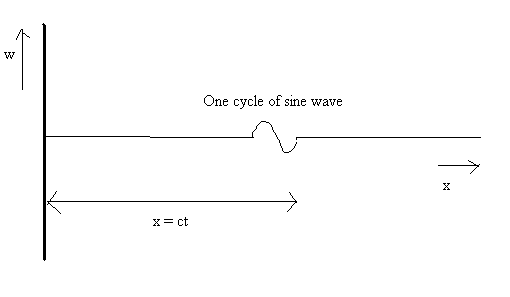
So the solution to the displacement of the string w(x,t) will be like, for all other points, other than the place where the single sine wave cycle is will be zero
so , partially, 
How to determine points that are in the sine wave cycle?
Well, the front of the sine wave cycle was the first to start traveling. So, at time t , it is at a distance x= ct . The backmost part of the sine wave is thus a wavelength behind.

the sine wave's general form is:

on comparing with the given sine wave, we get:

Thus

Thus, the back most part of the sine wave cycle is at

So, now we can complete the solution:

Add Answer to:
Find the displacement w(x.t) of an elastic string subject to the following conditions: 1) (sint, 0, 0 sts 2TT w(0,t) =...
u(x, t) represents the vertical displacement of a string of length L = 16 with wave...
 u(x, t) represents the vertical displacement of a string of length L = 16 with wave equation 25uxx = uft at position x along the string and at time t Find u(x, t) if a. the initial velocity of the string is 0 and the rightmost position b. the initial velocity is a constant 5 and the vertical displacement is 0. c. the initial velocity is a constant 5 and the rightmost position is held at a vertical displacement of...
Question 1: The separated solutions of the o fom u(x.t) -X(x)T(t), with the following solutions: ne-dimensional he...
 Question 1: The separated solutions of the o fom u(x.t) -X(x)T(t), with the following solutions: ne-dimensional heat equation dtt lu solutions of are - X(x)-Ax +B and T(t) E X(x) = A cos kx + B sin kx and T(t)=Ee-Det The boundary conditions for a metal rod insulated from both sides arex aum = 0 when x =0, and dx (e) Using the boundary conditions for u(x.t) wrie the boundary conditions for XCx), explain for full marks. (b) Find the...
r Extra Credit: Write a complete analysis of the wave equation with friction for a string of length L subject to initial conditions u(x, 0)-f(x) and (x,0) (t) r Extra Credit: Write a complete...
 r Extra Credit: Write a complete analysis of the wave equation with friction for a string of length L subject to initial conditions u(x, 0)-f(x) and (x,0) (t)
r Extra Credit: Write a complete analysis of the wave equation with friction for a string of length L subject to initial conditions u(x, 0)-f(x) and (x,0) (t)
r Extra Credit: Write a complete analysis of the wave equation with friction for a string of length L subject to initial conditions u(x, 0)-f(x) and (x,0) (t)
please show work i will rate you Extra Credit: Write a complete analysis of the wave equation with friction for a string of length L subject to initial conditions u(x,0) = f(x) and 쓿(x,0) = g(t)....
 please show work i will rate you
Extra Credit: Write a complete analysis of the wave equation with friction for a string of length L subject to initial conditions u(x,0) = f(x) and 쓿(x,0) = g(t).
Extra Credit: Write a complete analysis of the wave equation with friction for a string of length L subject to initial conditions u(x,0) = f(x) and 쓿(x,0) = g(t).
please show work i will rate you
Extra Credit: Write a complete analysis of the wave equation with friction for a string of length L subject to initial conditions u(x,0) = f(x) and 쓿(x,0) = g(t).
Extra Credit: Write a complete analysis of the wave equation with friction for a string of length L subject to initial conditions u(x,0) = f(x) and 쓿(x,0) = g(t).
(1 point) Solve the boundary value problem by using the Laplace transform: 4 ²w дх2 d²w...
 (1 point) Solve the boundary value problem by using the Laplace transform: 4 ²w дх2 d²w at2 ? x > 0, t> 0 w(0,t) = sin(8t), lim w(x, t) = 0, t> 0, X00 W(x,0) = 0, dw -(x,0) = 0, x > 0, дt First take the Laplace transform of the partial differential equation. Let W be the Laplace transform of w. Then W satisfies the ordinary differential equation W" = subject to W(0) = and limx→ W(x) =...
(a) Consider an elastic string of length 10 whose ends are held fixed. The string is...
 (a) Consider an elastic string of length 10 whose ends are held fixed. The string is set in motion with no initial velocity from an initial postion J2/4 0<x<8 u(x,0) = { 0 8 << 10 Assuming the string is elastic enough to assume this initial configuration, i. Find the Fourier sine series for f (extended as an odd periodic function of period 20). ii. Assuming the propagation speed a = 2 solve the wave equation to find the displacement...
show steps please! (1 point) u(x, t represents the vertical displacement of a string of length...
 show steps please!
(1 point) u(x, t represents the vertical displacement of a string of length L = 20 with wave equation 16. time t = Utt at position x along the string and at Find u(x, t) if a. the initial velocity of the string is 0 and the rightmost position is held at a vertical displacement of 1 and released b. the initial velocity is a constant -5 and the vertical displacement is 0 c. the initial velocity...
show steps please!
(1 point) u(x, t represents the vertical displacement of a string of length L = 20 with wave equation 16. time t = Utt at position x along the string and at Find u(x, t) if a. the initial velocity of the string is 0 and the rightmost position is held at a vertical displacement of 1 and released b. the initial velocity is a constant -5 and the vertical displacement is 0 c. the initial velocity...
3. Solve the wave equation subject to the conditions u(0,t)=0, u(z,t) = 0 at 2 2...
 3. Solve the wave equation subject to the conditions u(0,t)=0, u(z,t) = 0 at 2 2 u(x, 0) = 4 =0 at 2 =1
3. Solve the wave equation subject to the conditions u(0,t)=0, u(z,t) = 0 at 2 2 u(x, 0) = 4 =0 at 2 =1
3. Solve the wave equation subject to the conditions u(0,t)=0, u(z,t) = 0 at 2 2 u(x, 0) = 4 =0 at 2 =1
Problem 2 (10 points). Consider the wave equation for a vibrating string of infinite length with the initial conditions where the initial displacement f(x) is specified as 0, if 21 Determine the...
 Problem 2 (10 points). Consider the wave equation for a vibrating string of infinite length with the initial conditions where the initial displacement f(x) is specified as 0, if 21 Determine the expression of the function u(, 0.5) that represents the spatial profle of the string at timet 0.5. Provide the graph of this function
Problem 2 (10 points). Consider the wave equation for a vibrating string of infinite length with the initial conditions where the initial displacement f(x) is...
Problem 2 (10 points). Consider the wave equation for a vibrating string of infinite length with the initial conditions where the initial displacement f(x) is specified as 0, if 21 Determine the expression of the function u(, 0.5) that represents the spatial profle of the string at timet 0.5. Provide the graph of this function
Problem 2 (10 points). Consider the wave equation for a vibrating string of infinite length with the initial conditions where the initial displacement f(x) is...
(1 point) Solve the boundary value problem by using the Laplace transform az w &w 16-...
 (1 point) Solve the boundary value problem by using the Laplace transform az w &w 16- dx2 x > 0, t> 0 at2 w(0,t) = 0, lim w(x, t) = 0, t> 0, X+0 w(x,0) = 2xe-*, dw F(x,0) = 0, x > 0, дt First take the Laplace transform of the partial differential equation. Let W be the Laplace transform of w. Then W satisfies the ordinary differential equation W" = subject to W(0) = and limxW(x) = Solve...
 u(x, t) represents the vertical displacement of a string of length L = 16 with wave equation 25uxx = uft at position x along the string and at time t Find u(x, t) if a. the initial velocity of the string is 0 and the rightmost position b. the initial velocity is a constant 5 and the vertical displacement is 0. c. the initial velocity is a constant 5 and the rightmost position is held at a vertical displacement of...
 Question 1: The separated solutions of the o fom u(x.t) -X(x)T(t), with the following solutions: ne-dimensional heat equation dtt lu solutions of are - X(x)-Ax +B and T(t) E X(x) = A cos kx + B sin kx and T(t)=Ee-Det The boundary conditions for a metal rod insulated from both sides arex aum = 0 when x =0, and dx (e) Using the boundary conditions for u(x.t) wrie the boundary conditions for XCx), explain for full marks. (b) Find the...
 r Extra Credit: Write a complete analysis of the wave equation with friction for a string of length L subject to initial conditions u(x, 0)-f(x) and (x,0) (t)
r Extra Credit: Write a complete analysis of the wave equation with friction for a string of length L subject to initial conditions u(x, 0)-f(x) and (x,0) (t)
r Extra Credit: Write a complete analysis of the wave equation with friction for a string of length L subject to initial conditions u(x, 0)-f(x) and (x,0) (t)
 please show work i will rate you
Extra Credit: Write a complete analysis of the wave equation with friction for a string of length L subject to initial conditions u(x,0) = f(x) and 쓿(x,0) = g(t).
Extra Credit: Write a complete analysis of the wave equation with friction for a string of length L subject to initial conditions u(x,0) = f(x) and 쓿(x,0) = g(t).
please show work i will rate you
Extra Credit: Write a complete analysis of the wave equation with friction for a string of length L subject to initial conditions u(x,0) = f(x) and 쓿(x,0) = g(t).
Extra Credit: Write a complete analysis of the wave equation with friction for a string of length L subject to initial conditions u(x,0) = f(x) and 쓿(x,0) = g(t).
 (1 point) Solve the boundary value problem by using the Laplace transform: 4 ²w дх2 d²w at2 ? x > 0, t> 0 w(0,t) = sin(8t), lim w(x, t) = 0, t> 0, X00 W(x,0) = 0, dw -(x,0) = 0, x > 0, дt First take the Laplace transform of the partial differential equation. Let W be the Laplace transform of w. Then W satisfies the ordinary differential equation W" = subject to W(0) = and limx→ W(x) =...
 (a) Consider an elastic string of length 10 whose ends are held fixed. The string is set in motion with no initial velocity from an initial postion J2/4 0<x<8 u(x,0) = { 0 8 << 10 Assuming the string is elastic enough to assume this initial configuration, i. Find the Fourier sine series for f (extended as an odd periodic function of period 20). ii. Assuming the propagation speed a = 2 solve the wave equation to find the displacement...
 show steps please!
(1 point) u(x, t represents the vertical displacement of a string of length L = 20 with wave equation 16. time t = Utt at position x along the string and at Find u(x, t) if a. the initial velocity of the string is 0 and the rightmost position is held at a vertical displacement of 1 and released b. the initial velocity is a constant -5 and the vertical displacement is 0 c. the initial velocity...
show steps please!
(1 point) u(x, t represents the vertical displacement of a string of length L = 20 with wave equation 16. time t = Utt at position x along the string and at Find u(x, t) if a. the initial velocity of the string is 0 and the rightmost position is held at a vertical displacement of 1 and released b. the initial velocity is a constant -5 and the vertical displacement is 0 c. the initial velocity...
 3. Solve the wave equation subject to the conditions u(0,t)=0, u(z,t) = 0 at 2 2 u(x, 0) = 4 =0 at 2 =1
3. Solve the wave equation subject to the conditions u(0,t)=0, u(z,t) = 0 at 2 2 u(x, 0) = 4 =0 at 2 =1
3. Solve the wave equation subject to the conditions u(0,t)=0, u(z,t) = 0 at 2 2 u(x, 0) = 4 =0 at 2 =1
 Problem 2 (10 points). Consider the wave equation for a vibrating string of infinite length with the initial conditions where the initial displacement f(x) is specified as 0, if 21 Determine the expression of the function u(, 0.5) that represents the spatial profle of the string at timet 0.5. Provide the graph of this function
Problem 2 (10 points). Consider the wave equation for a vibrating string of infinite length with the initial conditions where the initial displacement f(x) is...
Problem 2 (10 points). Consider the wave equation for a vibrating string of infinite length with the initial conditions where the initial displacement f(x) is specified as 0, if 21 Determine the expression of the function u(, 0.5) that represents the spatial profle of the string at timet 0.5. Provide the graph of this function
Problem 2 (10 points). Consider the wave equation for a vibrating string of infinite length with the initial conditions where the initial displacement f(x) is...
 (1 point) Solve the boundary value problem by using the Laplace transform az w &w 16- dx2 x > 0, t> 0 at2 w(0,t) = 0, lim w(x, t) = 0, t> 0, X+0 w(x,0) = 2xe-*, dw F(x,0) = 0, x > 0, дt First take the Laplace transform of the partial differential equation. Let W be the Laplace transform of w. Then W satisfies the ordinary differential equation W" = subject to W(0) = and limxW(x) = Solve...
Most questions answered within 3 hours.
-
Where is the error in this code sequence?
String s1 = "Hello";
String s2 = "ello";...
asked 10 months ago -
Financial data for Joel de Paris, Inc., for last year
follow:
Joel de Paris, Inc.
Balance...
asked 10 months ago -
Consider this reaction:
Al2(SO4)3 (aq)+ BaCl3
(aq) Al2Cl6 (aq)- +
3BaSO4(s) . What is the...
asked 10 months ago -
Suppose that Savneet is considering increasing her
recent random sample from 20 car rentals to 40...
asked 10 months ago -
Trucks arrive at an unloading terminal at an average rate of 120
per hour.
Trucks arrive...
asked 10 months ago -
Why are methanol and ethanol completely soluble in water while
octanol is not very little soluble....
asked 10 months ago -
A facilities manager at a university reads in a research report
that the mean amount of...
asked 10 months ago -
When the CuSO4 is rehydrated by adding water to the anhydrous
compound, is this an endothermic...
asked 10 months ago -
A ray of sunlight is passing from diamond into crown glass; the
angle of incidence is...
asked 10 months ago -
A block of mass 0.249 kg is placed on top of a light, vertical
spring of...
asked 10 months ago -
how do the kidneys compensate in the presences of acidosis
a) trigger hyperventilate
b) reserve acid...
asked 10 months ago -
Question 501 pts
The rental rate of capital to the firm increases. Which of the
following...
asked 10 months ago