
Homework Answers
Add Answer to:
(20%) Problem 2 The circular tank shown in Figure 2 below has a steady state level of 50 m for a flow rate Q 2.5 m3/s....
5. The three tank liquid system is at a steady-state shown. The flow rates into the...
 5. The three tank liquid system is at a steady-state shown. The flow rates into the tank are suddenly changed to Q1 20.3 m/s, Q 15.5 m/s and Q m3/s, 2 m3/s (a) Determine the resistances in the pipes at steady-state. (b) Derive a mathematical linearized mathematical model for the system using the perturbations in liquid level as the outputs and the perturbations in flow rates as the inputs. 3 3 20 15 100 m 80 m 75 m 2...
The level ho of liquid in a vertical cylindrical tank as shown in Figure 4 is related to the infl...
 please answer all of part i really need them ASAP ...
The level ho of liquid in a vertical cylindrical tank as shown in Figure 4 is related to the inflow of liquid qi by the time domain equation d h dt where τ RLGL, the steady state gain of the system is G RL/pg and the tank capacitance, inlet ine ho outlet vave Tank Figure 4: Tank Level Process (a) You carry out some measurements on the tank and...
please answer all of part i really need them ASAP ...
The level ho of liquid in a vertical cylindrical tank as shown in Figure 4 is related to the inflow of liquid qi by the time domain equation d h dt where τ RLGL, the steady state gain of the system is G RL/pg and the tank capacitance, inlet ine ho outlet vave Tank Figure 4: Tank Level Process (a) You carry out some measurements on the tank and...
Consider the liquid level system shown in Figure 1. At steady state, the inflow rate and...
 Consider the liquid level system shown in Figure 1. At steady state, the inflow rate and outflow rate are both Ở and the flow rate between the tanks is zero. The heads at tank 1 and tank 2 are both H. At t = 0, the inflow rate is changed from 0 to + , where is the small change in the inflow rate. The resulting changes in the heads (h/ and h2) and flow rates are assumed to be...
(30pts) Consider the liquid level system shown in the figure. Assume the outflow rate Q (m3/s) th...
 (30pts) Consider the liquid level system shown in the figure. Assume the outflow rate Q (m3/s) through the outflow value is related to the liquid level H by Assume also that, when the inflow rate Qi and outflow rate QOare at Q = 0015m3/s, the liquid level stays at constant H. The capacitance C of the tank is 2m2 Find the steady state value of the liquid level system H. Develop the governing equations for the liquid level system and...
1. Consider a single tank for flow rate control and water level regulation. A single tank...
 1. Consider a single tank for flow rate control and water level regulation. A single tank subject to the pump dynamics can be modeled as follows Tank dynamics: h.-le,-4M h, -e-eyh.), Pump dynamics: Q,-1(av,-0) Pump dynamics: Q,--(av,-Q.) Tank dynamics: where the parameters are defined as follows: h :water level c: valve resistance r: time constant S,: water tank area Q,: supplied flow rate a: voltage scaling factor ,: applied control input voltage (all the coefficients are positive) (A). Please apply...
Question 2 a) The following diagram show a liquid-level storage tank with q, and qi is...
 Question 2 a) The following diagram show a liquid-level storage tank with q, and qi is the inlet and outlet volumetric flow rate of the tank. Ri is the resistance valve whereas Hi is the liquid level of the tank. Find the transfer function relating change in level, Qi', to the changes in flow rate into the tank, Q' (State your assumption) (10 marks) b) An electrically heated process is known to exhibit second order dynamics. The heater input change...
Problem #2 Water tank is supplied with water at a flow rate Q = 0.005 m/s....
 Problem #2 Water tank is supplied with water at a flow rate Q = 0.005 m/s. A 5 cm diameter, 15 m long pipe is attached to the tank at the bottom and discharges to the atmosphere as shown in the figure. The pipe has roughness e = 0.0015 mm and the water is at 18°C. Answer the following: a) If the depth of water in the tank is initially 7 m, does the amount of water in the tank...
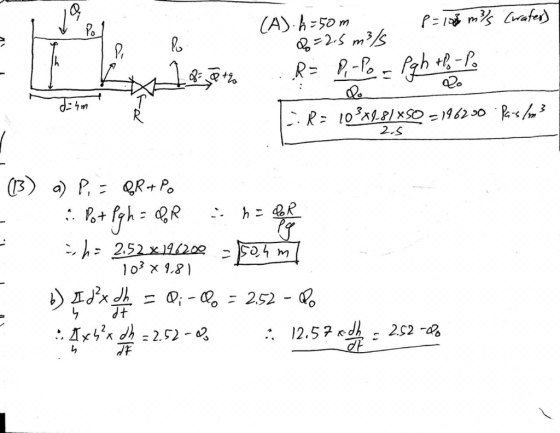
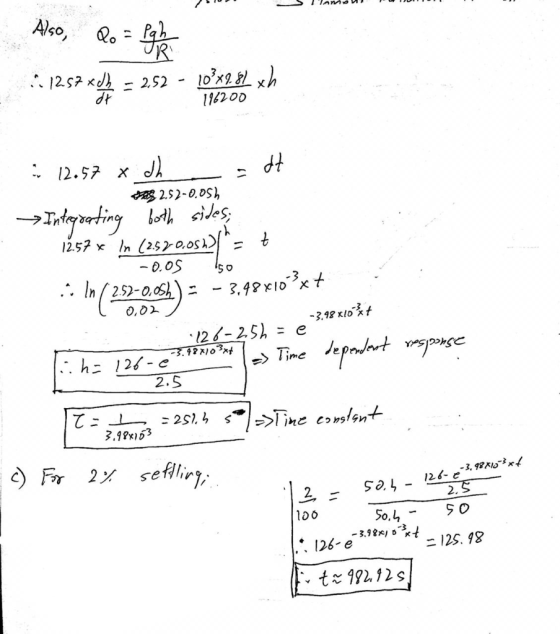
A tank has an inlet flow of 20 LPM and steady height inside the tank is...
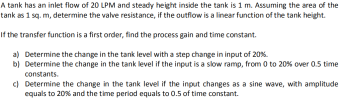 A tank has an inlet flow of 20 LPM and steady height inside the tank is 1 m. Assuming the area of the tank as 1 sq. m, determine the valve resistance, if the outflow is a linear function of the tank height. If the transfer function is a first order, find the process gain and time constant. a) Determine the change in the tank level with a step change in input of 20%. b) Determine the change in the...
5. (10 points) Consider the liquid-level system shown. At steady state, the inflow rate is Q:...
 5. (10 points) Consider the liquid-level system shown. At steady state, the inflow rate is Q: the outflow rates are Q1 and Q, respectively; the flow rate from tank 1 to tank 2 is Q12, and the heads of tanks 1 and 2 are H and H2, respectively. If the inflow rate is changed from Q to Q+q, determine the transfer function Hz(8)/Q(s). Assume the deviations 4,91,92,912, h, and hy are all small. 6th Jan Hathe +7 т/ н+А, JE>,+8....
Considering the following liquid-level qo where the liquid is laminar flow and .0-steady-state fl...
 Considering the following liquid-level qo where the liquid is laminar flow and .0-steady-state flow rate (m'/s) . H-steady-state head (m) rate from the steady-state value (m/s) qi-small deviation of inflow . qo-small deviation ofoutflow rate from the steady-state value (m/s) h - small deviation of head from its steady-state value (m) . R-the resistance of the laminar flow in the output flow pipe · C-the capacitance of the tank Derive the differential equation model of the liquid-level-system with input as...
 5. The three tank liquid system is at a steady-state shown. The flow rates into the tank are suddenly changed to Q1 20.3 m/s, Q 15.5 m/s and Q m3/s, 2 m3/s (a) Determine the resistances in the pipes at steady-state. (b) Derive a mathematical linearized mathematical model for the system using the perturbations in liquid level as the outputs and the perturbations in flow rates as the inputs. 3 3 20 15 100 m 80 m 75 m 2...
 please answer all of part i really need them ASAP ...
The level ho of liquid in a vertical cylindrical tank as shown in Figure 4 is related to the inflow of liquid qi by the time domain equation d h dt where τ RLGL, the steady state gain of the system is G RL/pg and the tank capacitance, inlet ine ho outlet vave Tank Figure 4: Tank Level Process (a) You carry out some measurements on the tank and...
please answer all of part i really need them ASAP ...
The level ho of liquid in a vertical cylindrical tank as shown in Figure 4 is related to the inflow of liquid qi by the time domain equation d h dt where τ RLGL, the steady state gain of the system is G RL/pg and the tank capacitance, inlet ine ho outlet vave Tank Figure 4: Tank Level Process (a) You carry out some measurements on the tank and...
 Consider the liquid level system shown in Figure 1. At steady state, the inflow rate and outflow rate are both Ở and the flow rate between the tanks is zero. The heads at tank 1 and tank 2 are both H. At t = 0, the inflow rate is changed from 0 to + , where is the small change in the inflow rate. The resulting changes in the heads (h/ and h2) and flow rates are assumed to be...
 (30pts) Consider the liquid level system shown in the figure. Assume the outflow rate Q (m3/s) through the outflow value is related to the liquid level H by Assume also that, when the inflow rate Qi and outflow rate QOare at Q = 0015m3/s, the liquid level stays at constant H. The capacitance C of the tank is 2m2 Find the steady state value of the liquid level system H. Develop the governing equations for the liquid level system and...
 1. Consider a single tank for flow rate control and water level regulation. A single tank subject to the pump dynamics can be modeled as follows Tank dynamics: h.-le,-4M h, -e-eyh.), Pump dynamics: Q,-1(av,-0) Pump dynamics: Q,--(av,-Q.) Tank dynamics: where the parameters are defined as follows: h :water level c: valve resistance r: time constant S,: water tank area Q,: supplied flow rate a: voltage scaling factor ,: applied control input voltage (all the coefficients are positive) (A). Please apply...
 Question 2 a) The following diagram show a liquid-level storage tank with q, and qi is the inlet and outlet volumetric flow rate of the tank. Ri is the resistance valve whereas Hi is the liquid level of the tank. Find the transfer function relating change in level, Qi', to the changes in flow rate into the tank, Q' (State your assumption) (10 marks) b) An electrically heated process is known to exhibit second order dynamics. The heater input change...
 Problem #2 Water tank is supplied with water at a flow rate Q = 0.005 m/s. A 5 cm diameter, 15 m long pipe is attached to the tank at the bottom and discharges to the atmosphere as shown in the figure. The pipe has roughness e = 0.0015 mm and the water is at 18°C. Answer the following: a) If the depth of water in the tank is initially 7 m, does the amount of water in the tank...
 A tank has an inlet flow of 20 LPM and steady height inside the tank is 1 m. Assuming the area of the tank as 1 sq. m, determine the valve resistance, if the outflow is a linear function of the tank height. If the transfer function is a first order, find the process gain and time constant. a) Determine the change in the tank level with a step change in input of 20%. b) Determine the change in the...
 5. (10 points) Consider the liquid-level system shown. At steady state, the inflow rate is Q: the outflow rates are Q1 and Q, respectively; the flow rate from tank 1 to tank 2 is Q12, and the heads of tanks 1 and 2 are H and H2, respectively. If the inflow rate is changed from Q to Q+q, determine the transfer function Hz(8)/Q(s). Assume the deviations 4,91,92,912, h, and hy are all small. 6th Jan Hathe +7 т/ н+А, JE>,+8....
 Considering the following liquid-level qo where the liquid is laminar flow and .0-steady-state flow rate (m'/s) . H-steady-state head (m) rate from the steady-state value (m/s) qi-small deviation of inflow . qo-small deviation ofoutflow rate from the steady-state value (m/s) h - small deviation of head from its steady-state value (m) . R-the resistance of the laminar flow in the output flow pipe · C-the capacitance of the tank Derive the differential equation model of the liquid-level-system with input as...
Most questions answered within 3 hours.
-
Where is the error in this code sequence?
String s1 = "Hello";
String s2 = "ello";...
asked 10 months ago -
Financial data for Joel de Paris, Inc., for last year
follow:
Joel de Paris, Inc.
Balance...
asked 10 months ago -
Consider this reaction:
Al2(SO4)3 (aq)+ BaCl3
(aq) Al2Cl6 (aq)- +
3BaSO4(s) . What is the...
asked 10 months ago -
Suppose that Savneet is considering increasing her
recent random sample from 20 car rentals to 40...
asked 10 months ago -
Trucks arrive at an unloading terminal at an average rate of 120
per hour.
Trucks arrive...
asked 10 months ago -
Why are methanol and ethanol completely soluble in water while
octanol is not very little soluble....
asked 10 months ago -
A facilities manager at a university reads in a research report
that the mean amount of...
asked 10 months ago -
When the CuSO4 is rehydrated by adding water to the anhydrous
compound, is this an endothermic...
asked 10 months ago -
A ray of sunlight is passing from diamond into crown glass; the
angle of incidence is...
asked 10 months ago -
A block of mass 0.249 kg is placed on top of a light, vertical
spring of...
asked 10 months ago -
how do the kidneys compensate in the presences of acidosis
a) trigger hyperventilate
b) reserve acid...
asked 10 months ago -
Question 501 pts
The rental rate of capital to the firm increases. Which of the
following...
asked 10 months ago