
Homework Answers
Add Answer to:
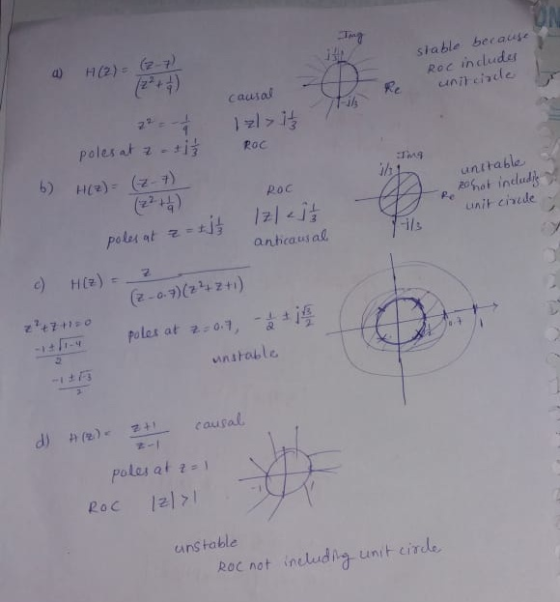
Question 1: (25marks) Determine whether each of the following represents a BIBO (Binary Input/Binary Output) stable...
8. Determine whether the following LTIC systems are BIBO stable and explain why or why not (a) hi...
 8. Determine whether the following LTIC systems are BIBO stable and explain why or why not (a) hi(t)8(t) etu(t), (b) h2(t) -26(t-3)-te5u(t) 9. Consider the following zero-state input-output relations for a variety of systems. In each case, determine whetheir the system is zero-state linear, time invariant, and casual t-2 r2 (b) (t) f(12)dr Page l of ï
8. Determine whether the following LTIC systems are BIBO stable and explain why or why not (a) hi(t)8(t) etu(t), (b) h2(t) -26(t-3)-te5u(t) 9....
8. Determine whether the following LTIC systems are BIBO stable and explain why or why not (a) hi(t)8(t) etu(t), (b) h2(t) -26(t-3)-te5u(t) 9. Consider the following zero-state input-output relations for a variety of systems. In each case, determine whetheir the system is zero-state linear, time invariant, and casual t-2 r2 (b) (t) f(12)dr Page l of ï
8. Determine whether the following LTIC systems are BIBO stable and explain why or why not (a) hi(t)8(t) etu(t), (b) h2(t) -26(t-3)-te5u(t) 9....
A system is BIBO (bounded-input, bounded-output) stable if every bounded input X(t) yields a bounded output...
 A system is BIBO (bounded-input, bounded-output) stable if every bounded input X(t) yields a bounded output y(t). A system is NOT BIBO stable if there exists any bounded input that results in an unbounded output. By "bounded", we mean that the magnitude of the signal is always less than some finite number. (The signal x(t)=sin(t) would be considered a bounded signal, but X(t)t would not be a bounded signal.) Signals that are infinite in time, but with a magnitude that...
2. Circle the causal BIBO stable ROC below. a) 1.1<\리<1.2 b) Izk1/201zP1/2 d) 0.5<Izl<0.9 e) none...
 2. Circle the causal BIBO stable ROC below. a) 1.1<\리<1.2 b) Izk1/201zP1/2 d) 0.5<Izl<0.9 e) none above 3. A linear time-invariant IIR system is always BIBO stable a) True b) False 4. If a fiter has z-transform H(z)05, then the fiter s ;z>0.5, then the filter is zz-0.5z a) Nonlinear b)FIR )R d) two-sided e) none above 5. The discrete-time frequency o in rad/ sample of the sinusoid hin] below is d) T2 e) none above hIn] -1
Please show detailed steps, thank you! 1. The transfer function of a BIBO stable discrete system...
 Please show detailed steps, thank you!
1. The transfer function of a BIBO stable discrete system is given as H(z) = In((1-1.2z-1)(1-0.9z-1)) (a) Find h(n). (b) Find the ROC for H(z). (c) Find the pole-zero location for the system W(z) = dH(z) 2an (d) If x(n)-2 cos(EN, } 3 r(n-6), goes through the H(z) system above, find y(n).
Please show detailed steps, thank you!
1. The transfer function of a BIBO stable discrete system is given as H(z) = In((1-1.2z-1)(1-0.9z-1)) (a) Find h(n). (b) Find the ROC for H(z). (c) Find the pole-zero location for the system W(z) = dH(z) 2an (d) If x(n)-2 cos(EN, } 3 r(n-6), goes through the H(z) system above, find y(n).
3) For each of the following systems with input xfin] and output y/nl, determine whether it...
 3) For each of the following systems with input xfin] and output y/nl, determine whether it is linear, time invariant, causal, and/or stable. lineax - time-varient
Solve these examples in detailed step wise EXAMPLE 3.4.5 Determine the partial-fraction expansion of the proper...
 Solve these examples in detailed step wise
EXAMPLE 3.4.5 Determine the partial-fraction expansion of the proper function X(2) = 1- 1.52-1 +0.52-2 EXAMPLE 3.4.7 Determine the partial-fraction expansion of (1+z-1)(1 - 2-1)2 EXAMPLE 3.4.8 Determine the inverse z-transform of X (2) = 1-1.52-1 +0.52-? (a) ROC: Iz/ > 1 (b) ROC: Iz1 <0.5 (e) ROC: 0,5 < Iz <1 EXAMPLE 3.4.10 Determine the causal signal x(n) having the z-transform X(z) = (1 + 2-1) (1 - 2-1)2 EXAMPLE 3.5.2 A...
Solve these examples in detailed step wise
EXAMPLE 3.4.5 Determine the partial-fraction expansion of the proper function X(2) = 1- 1.52-1 +0.52-2 EXAMPLE 3.4.7 Determine the partial-fraction expansion of (1+z-1)(1 - 2-1)2 EXAMPLE 3.4.8 Determine the inverse z-transform of X (2) = 1-1.52-1 +0.52-? (a) ROC: Iz/ > 1 (b) ROC: Iz1 <0.5 (e) ROC: 0,5 < Iz <1 EXAMPLE 3.4.10 Determine the causal signal x(n) having the z-transform X(z) = (1 + 2-1) (1 - 2-1)2 EXAMPLE 3.5.2 A...
determine whether 20 total pts] For each of the following systems described by their input-output behavior,...
 determine whether 20 total pts] For each of the following systems described by their input-output behavior, or not the system is (1) linear,(2) time-invariant, (3) causal. For each case, make sure that you explain why. a. (5 pts] y[n] Axn] +B where A and B are nonzero constants d. 5 pts] y[n] x[n cos(0.25n)
Assume amplitude a = 4 The input to an LTI system is shown in the graph...
 Assume amplitude a = 4
The input to an LTI system is shown in the graph below. Assume a = 4. X(t) 20 t @ by 0 Ingineering Given that the Laplace transform of the output is Y(s) = - (s + 3)(1 – e-45)2 s(s + 5)2 a) Find the transfer function of the system and the region of convergence for o = Re(s). H(s) = RoC: For regions of convergence, answer in interval notation e.g. (-INF, a),(a,b) or...
Assume amplitude a = 4
The input to an LTI system is shown in the graph below. Assume a = 4. X(t) 20 t @ by 0 Ingineering Given that the Laplace transform of the output is Y(s) = - (s + 3)(1 – e-45)2 s(s + 5)2 a) Find the transfer function of the system and the region of convergence for o = Re(s). H(s) = RoC: For regions of convergence, answer in interval notation e.g. (-INF, a),(a,b) or...
1. Consider a discrete-time system H with input x[n] and output y[n]Hn (a) Define the following...
 1. Consider a discrete-time system H with input x[n] and output y[n]Hn (a) Define the following general properties of system H () memoryless;(ii BIBO stable; (ii) time-invariant. (b) Consider the DT system given by the input-output relation Indicate whether or not the above properties are satisfied by this system and justify your answer.
signals and systems How to solve if coefficients are: A= -2 B = 1 C =...
 signals and systems
How to solve if coefficients are:
A= -2
B = 1
C = 2
zBzC (b) (24 points) For the additional information given in each case below, determine the output ya for all n. (i) The system is causal and ipatn Inl (ii) The system is stable and input z--1 ii) The system is causal and stable, while the (bilateral) a-transform of input n has ROC of al<1 In (c) (8 points) For the (non-causal) system implied...
signals and systems
How to solve if coefficients are:
A= -2
B = 1
C = 2
zBzC (b) (24 points) For the additional information given in each case below, determine the output ya for all n. (i) The system is causal and ipatn Inl (ii) The system is stable and input z--1 ii) The system is causal and stable, while the (bilateral) a-transform of input n has ROC of al<1 In (c) (8 points) For the (non-causal) system implied...
 8. Determine whether the following LTIC systems are BIBO stable and explain why or why not (a) hi(t)8(t) etu(t), (b) h2(t) -26(t-3)-te5u(t) 9. Consider the following zero-state input-output relations for a variety of systems. In each case, determine whetheir the system is zero-state linear, time invariant, and casual t-2 r2 (b) (t) f(12)dr Page l of ï
8. Determine whether the following LTIC systems are BIBO stable and explain why or why not (a) hi(t)8(t) etu(t), (b) h2(t) -26(t-3)-te5u(t) 9....
8. Determine whether the following LTIC systems are BIBO stable and explain why or why not (a) hi(t)8(t) etu(t), (b) h2(t) -26(t-3)-te5u(t) 9. Consider the following zero-state input-output relations for a variety of systems. In each case, determine whetheir the system is zero-state linear, time invariant, and casual t-2 r2 (b) (t) f(12)dr Page l of ï
8. Determine whether the following LTIC systems are BIBO stable and explain why or why not (a) hi(t)8(t) etu(t), (b) h2(t) -26(t-3)-te5u(t) 9....
 A system is BIBO (bounded-input, bounded-output) stable if every bounded input X(t) yields a bounded output y(t). A system is NOT BIBO stable if there exists any bounded input that results in an unbounded output. By "bounded", we mean that the magnitude of the signal is always less than some finite number. (The signal x(t)=sin(t) would be considered a bounded signal, but X(t)t would not be a bounded signal.) Signals that are infinite in time, but with a magnitude that...
 2. Circle the causal BIBO stable ROC below. a) 1.1<\리<1.2 b) Izk1/201zP1/2 d) 0.5<Izl<0.9 e) none above 3. A linear time-invariant IIR system is always BIBO stable a) True b) False 4. If a fiter has z-transform H(z)05, then the fiter s ;z>0.5, then the filter is zz-0.5z a) Nonlinear b)FIR )R d) two-sided e) none above 5. The discrete-time frequency o in rad/ sample of the sinusoid hin] below is d) T2 e) none above hIn] -1
 Please show detailed steps, thank you!
1. The transfer function of a BIBO stable discrete system is given as H(z) = In((1-1.2z-1)(1-0.9z-1)) (a) Find h(n). (b) Find the ROC for H(z). (c) Find the pole-zero location for the system W(z) = dH(z) 2an (d) If x(n)-2 cos(EN, } 3 r(n-6), goes through the H(z) system above, find y(n).
Please show detailed steps, thank you!
1. The transfer function of a BIBO stable discrete system is given as H(z) = In((1-1.2z-1)(1-0.9z-1)) (a) Find h(n). (b) Find the ROC for H(z). (c) Find the pole-zero location for the system W(z) = dH(z) 2an (d) If x(n)-2 cos(EN, } 3 r(n-6), goes through the H(z) system above, find y(n).
 3) For each of the following systems with input xfin] and output y/nl, determine whether it is linear, time invariant, causal, and/or stable. lineax - time-varient
 Solve these examples in detailed step wise
EXAMPLE 3.4.5 Determine the partial-fraction expansion of the proper function X(2) = 1- 1.52-1 +0.52-2 EXAMPLE 3.4.7 Determine the partial-fraction expansion of (1+z-1)(1 - 2-1)2 EXAMPLE 3.4.8 Determine the inverse z-transform of X (2) = 1-1.52-1 +0.52-? (a) ROC: Iz/ > 1 (b) ROC: Iz1 <0.5 (e) ROC: 0,5 < Iz <1 EXAMPLE 3.4.10 Determine the causal signal x(n) having the z-transform X(z) = (1 + 2-1) (1 - 2-1)2 EXAMPLE 3.5.2 A...
Solve these examples in detailed step wise
EXAMPLE 3.4.5 Determine the partial-fraction expansion of the proper function X(2) = 1- 1.52-1 +0.52-2 EXAMPLE 3.4.7 Determine the partial-fraction expansion of (1+z-1)(1 - 2-1)2 EXAMPLE 3.4.8 Determine the inverse z-transform of X (2) = 1-1.52-1 +0.52-? (a) ROC: Iz/ > 1 (b) ROC: Iz1 <0.5 (e) ROC: 0,5 < Iz <1 EXAMPLE 3.4.10 Determine the causal signal x(n) having the z-transform X(z) = (1 + 2-1) (1 - 2-1)2 EXAMPLE 3.5.2 A...
 determine whether 20 total pts] For each of the following systems described by their input-output behavior, or not the system is (1) linear,(2) time-invariant, (3) causal. For each case, make sure that you explain why. a. (5 pts] y[n] Axn] +B where A and B are nonzero constants d. 5 pts] y[n] x[n cos(0.25n)
 Assume amplitude a = 4
The input to an LTI system is shown in the graph below. Assume a = 4. X(t) 20 t @ by 0 Ingineering Given that the Laplace transform of the output is Y(s) = - (s + 3)(1 – e-45)2 s(s + 5)2 a) Find the transfer function of the system and the region of convergence for o = Re(s). H(s) = RoC: For regions of convergence, answer in interval notation e.g. (-INF, a),(a,b) or...
Assume amplitude a = 4
The input to an LTI system is shown in the graph below. Assume a = 4. X(t) 20 t @ by 0 Ingineering Given that the Laplace transform of the output is Y(s) = - (s + 3)(1 – e-45)2 s(s + 5)2 a) Find the transfer function of the system and the region of convergence for o = Re(s). H(s) = RoC: For regions of convergence, answer in interval notation e.g. (-INF, a),(a,b) or...
 1. Consider a discrete-time system H with input x[n] and output y[n]Hn (a) Define the following general properties of system H () memoryless;(ii BIBO stable; (ii) time-invariant. (b) Consider the DT system given by the input-output relation Indicate whether or not the above properties are satisfied by this system and justify your answer.
 signals and systems
How to solve if coefficients are:
A= -2
B = 1
C = 2
zBzC (b) (24 points) For the additional information given in each case below, determine the output ya for all n. (i) The system is causal and ipatn Inl (ii) The system is stable and input z--1 ii) The system is causal and stable, while the (bilateral) a-transform of input n has ROC of al<1 In (c) (8 points) For the (non-causal) system implied...
signals and systems
How to solve if coefficients are:
A= -2
B = 1
C = 2
zBzC (b) (24 points) For the additional information given in each case below, determine the output ya for all n. (i) The system is causal and ipatn Inl (ii) The system is stable and input z--1 ii) The system is causal and stable, while the (bilateral) a-transform of input n has ROC of al<1 In (c) (8 points) For the (non-causal) system implied...
Most questions answered within 3 hours.
-
Where is the error in this code sequence?
String s1 = "Hello";
String s2 = "ello";...
asked 10 months ago -
Financial data for Joel de Paris, Inc., for last year
follow:
Joel de Paris, Inc.
Balance...
asked 10 months ago -
Consider this reaction:
Al2(SO4)3 (aq)+ BaCl3
(aq) Al2Cl6 (aq)- +
3BaSO4(s) . What is the...
asked 10 months ago -
Suppose that Savneet is considering increasing her
recent random sample from 20 car rentals to 40...
asked 10 months ago -
Trucks arrive at an unloading terminal at an average rate of 120
per hour.
Trucks arrive...
asked 10 months ago -
Why are methanol and ethanol completely soluble in water while
octanol is not very little soluble....
asked 10 months ago -
A facilities manager at a university reads in a research report
that the mean amount of...
asked 10 months ago -
When the CuSO4 is rehydrated by adding water to the anhydrous
compound, is this an endothermic...
asked 10 months ago -
A ray of sunlight is passing from diamond into crown glass; the
angle of incidence is...
asked 10 months ago -
A block of mass 0.249 kg is placed on top of a light, vertical
spring of...
asked 10 months ago -
how do the kidneys compensate in the presences of acidosis
a) trigger hyperventilate
b) reserve acid...
asked 10 months ago -
Question 501 pts
The rental rate of capital to the firm increases. Which of the
following...
asked 10 months ago