Consider this reaction: Glucose + Pi ⇔ glucose 6-phosphate + H2O, ∆Go = +3 kcal/mol Under physiologic conditions, [gluco...
Consider this reaction:
Glucose + Pi ⇔ glucose 6-phosphate + H2O, ∆Go = +3 kcal/mol
Under physiologic conditions, [glucose] = 5 mM, [Glucose 6-phosphate] = 83 mM, and [Pi] = 1 mM. Under these conditions, will the reaction above go spontaneously from left to right? If not, what would the concentration of glucose need to be for the reaction to go from left to right, if the concentrations of the other reactants and products are as stated? Please show all work using the formula.
Homework Answers
Given question is answered on paper by hand written explanation,
Find the attached two images:-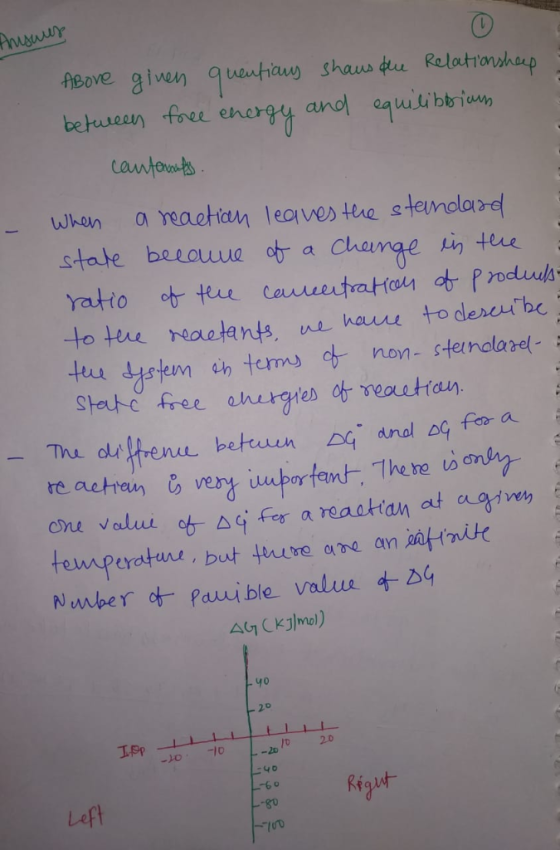

Add Answer to:
Consider this reaction: Glucose + Pi ⇔ glucose 6-phosphate + H2O, ∆Go = +3 kcal/mol Under physiologic conditions, [gluco...
In the reaction S ␣ P, if one mole of product (P) has the same free...
In the reaction S ␣ P, if one mole of product (P) has the same free energy as one mole of substrate (S) , what is the value for the K of this reaction? What is the value of the G ? If you started with a 1M solution of S, would it spontaneously react to give any P? What would the concentrations of S and P be when the reaction had reached equilibrium? .Consider the reaction: Glucose P ␣...
The enzyme hexokinase catalyzes the following reaction: Glucose + ATP ↔ Glucose 6-phosphate + ADP For...
The enzyme hexokinase catalyzes the following reaction: Glucose + ATP ↔ Glucose 6-phosphate + ADP For this reaction, ΔG° = +16.7 kJ/mol a. Calculate the equilibrium constant for this reaction at 25 °C. Is this reaction spontaneous under standard conditions at this temperature? Calculate the ΔG if the reaction temperature was 25 °C and the concentrations are: glucose, 55.0 mM,; ATP, 5.00 mM; ADP, 1.00 mM; and glucose 6-Phosphate, 0.100 mM. Would the reaction be spontaneous under the conditions of...
A highly regulated reaction in glycolysis involves the addition of a second phosphate to fructose-6-phosphate, which...
 A highly regulated reaction in glycolysis involves the addition
of a second phosphate to fructose-6-phosphate, which could be be
written as:
Fructose-6-phostphate + Pi à Fructose-1,6-bisphosphate + H2O
The ∆Go’ for this reaction is +16.8 kJ/mol
In a muscle cell at 37 oC, assume the concentration of
Fructose-6phosphate is 0.014 mM and the concentration of phosphate
is 1 mM.
a. What would be the equilibrium concentration of
fructose-1,6bisphosphate under these conditions?
b. What is Keq for this reaction?
Show...
A highly regulated reaction in glycolysis involves the addition
of a second phosphate to fructose-6-phosphate, which could be be
written as:
Fructose-6-phostphate + Pi à Fructose-1,6-bisphosphate + H2O
The ∆Go’ for this reaction is +16.8 kJ/mol
In a muscle cell at 37 oC, assume the concentration of
Fructose-6phosphate is 0.014 mM and the concentration of phosphate
is 1 mM.
a. What would be the equilibrium concentration of
fructose-1,6bisphosphate under these conditions?
b. What is Keq for this reaction?
Show...
The first reaction in glycolysis is the phosphorylation of glucose:
The first reaction in glycolysis is the phosphorylation of glucose:Pi+glucose⟶glucose−6−phosphate+H2OThis is a thermodynamically unfavorable process, with ΔG∘′=+13.8kJ/mol.Part AIn a liver cell at 37 ∘C the concentrations of both phosphate and glucose are normally maintained at about 5 mM each. =>theequilibrium concentration of glucose-6-phosphate = 1.2*10^-7 MPart BThis very low concentration of the desired product would be unfavorable for glycolysis. In fact, the reaction is coupled to ATP hydrolysis to give the overall reactionATP+glucose⟶glucose−6−phosphate+ADP+H+ΔG∘′ for the coupled reaction is -18.4 kJ/mol
Which one or more of the following reactions will NOT occur spontaneously under the standard conditions...
 Which one or more of the following reactions will NOT occur spontaneously under the standard conditions that specify AGº? (a) ADP + Pi — ATP AG° = +7.3 kcal/mole (b) glucose-1-phosphate glucose-6-phosphate AGº = -1.7 kcal/mole (c) glucose + fructose sucrose AG° = +5.5 kcal/mole (d) glucose + CO2 + H2O AGⓇ = -686 kcal/mole (a) and (d) O (c) only (b) and (c) (d) only (a) and (c) (a) only
5.The following reaction has a ΔG°'--61.9 kJ/mol at 25°C, Phosphoenolpyruvate (PEP) +H2O Pyruvate + Inorganic Phosphate...
 5.The following reaction has a ΔG°'--61.9 kJ/mol at 25°C, Phosphoenolpyruvate (PEP) +H2O Pyruvate + Inorganic Phosphate (Pi) (a) Is the reaction favorable under standard biochemical conditions? Explain your answer. (b) What is the equilibrium constant (K) of this reaction at 25°C? In cells the direct hydrolysis of PEP rarely occurs. Rather, the hydrolysis of PEP and the reverse hydrolysis of ATP are coupled (c) w rite out the coupled reaction and determine its ΔG at 25°C The hydrolysis of ATP...
Consider the given interconversion, which occurs in glycolysis. fructose 6-phosphate glucose 6-phosphate K1.97 What is AG...
 Consider the given interconversion, which occurs in glycolysis. fructose 6-phosphate glucose 6-phosphate K1.97 What is AG for the reaction (K measured at 25 °C)? AG -1680.9 kJ/mol If the concentration of fructose 6-phosphate is adjusted to 1.4 M and that of glucose 6-phosphate is adjusted to 0.75 M, what is AG? AG =-4402.59 kJ/mol Which statements are consistent with the conditions at which AG is measured? The temperature is 273 K. The initial concentrations of reactant and product are 1...
Please write and describe the following reaction: “Glucose + Pi ---> glucose 6-phosphate + H2O” Include...
Please write and describe the following reaction: “Glucose + Pi ---> glucose 6-phosphate + H2O” Include all assumed compounds involved which may not be explicitly written and include all intermediate molecular species. If enzymes are involved in promoting these reactions, please describe the associated chemistry (substrate – enzyme bond formatting and disassociation). Thank you :-)
Hexokinase catalyzes the following reaction in glycolysis: Glucose + ATP ← → glucose-6-phosphate + ADP The...
Hexokinase catalyzes the following reaction in glycolysis: Glucose + ATP ← → glucose-6-phosphate + ADP The standard free-energy change for this reaction in the direction written is -16.7 kJ/mol. The concentrations of the related reaction components in the hepatocyte of a mammalian cell are: Glucose: 6 mM Glucose-6-phosphate: 0.074 mM ATP: 1.00 mM ADP: 0.25 mM What is the actual free-energy change for the reaction at body temperature (37 C)?
During glycogen degradation glucose-1-phosphate is converted to glucose-6-phosphate and is an example of a coupled reaction....
During glycogen degradation glucose-1-phosphate is converted to glucose-6-phosphate and is an example of a coupled reaction. If the phosphoryl group transfer potential for glucose-1-phosphate is -20.9 kJ/mol and for glucose-6-phosphate is -13.8 kJ/mol, then what is the Keq (K) at 298 K? Is the conversion of glucose-1-phosphate to glucose-6-phosphate favorable or unfavorable under standard conditions? ΔG° = -RT ln K where R = 8.315 x 10⁻³ kJ/mol*K K = 0.057 and the reaction is unfavorable. K = 17.5 and the...
 A highly regulated reaction in glycolysis involves the addition
of a second phosphate to fructose-6-phosphate, which could be be
written as:
Fructose-6-phostphate + Pi à Fructose-1,6-bisphosphate + H2O
The ∆Go’ for this reaction is +16.8 kJ/mol
In a muscle cell at 37 oC, assume the concentration of
Fructose-6phosphate is 0.014 mM and the concentration of phosphate
is 1 mM.
a. What would be the equilibrium concentration of
fructose-1,6bisphosphate under these conditions?
b. What is Keq for this reaction?
Show...
A highly regulated reaction in glycolysis involves the addition
of a second phosphate to fructose-6-phosphate, which could be be
written as:
Fructose-6-phostphate + Pi à Fructose-1,6-bisphosphate + H2O
The ∆Go’ for this reaction is +16.8 kJ/mol
In a muscle cell at 37 oC, assume the concentration of
Fructose-6phosphate is 0.014 mM and the concentration of phosphate
is 1 mM.
a. What would be the equilibrium concentration of
fructose-1,6bisphosphate under these conditions?
b. What is Keq for this reaction?
Show...
 Which one or more of the following reactions will NOT occur spontaneously under the standard conditions that specify AGº? (a) ADP + Pi — ATP AG° = +7.3 kcal/mole (b) glucose-1-phosphate glucose-6-phosphate AGº = -1.7 kcal/mole (c) glucose + fructose sucrose AG° = +5.5 kcal/mole (d) glucose + CO2 + H2O AGⓇ = -686 kcal/mole (a) and (d) O (c) only (b) and (c) (d) only (a) and (c) (a) only
 5.The following reaction has a ΔG°'--61.9 kJ/mol at 25°C, Phosphoenolpyruvate (PEP) +H2O Pyruvate + Inorganic Phosphate (Pi) (a) Is the reaction favorable under standard biochemical conditions? Explain your answer. (b) What is the equilibrium constant (K) of this reaction at 25°C? In cells the direct hydrolysis of PEP rarely occurs. Rather, the hydrolysis of PEP and the reverse hydrolysis of ATP are coupled (c) w rite out the coupled reaction and determine its ΔG at 25°C The hydrolysis of ATP...
 Consider the given interconversion, which occurs in glycolysis. fructose 6-phosphate glucose 6-phosphate K1.97 What is AG for the reaction (K measured at 25 °C)? AG -1680.9 kJ/mol If the concentration of fructose 6-phosphate is adjusted to 1.4 M and that of glucose 6-phosphate is adjusted to 0.75 M, what is AG? AG =-4402.59 kJ/mol Which statements are consistent with the conditions at which AG is measured? The temperature is 273 K. The initial concentrations of reactant and product are 1...
Most questions answered within 3 hours.
-
Where is the error in this code sequence?
String s1 = "Hello";
String s2 = "ello";...
asked 10 months ago -
Financial data for Joel de Paris, Inc., for last year
follow:
Joel de Paris, Inc.
Balance...
asked 10 months ago -
Consider this reaction:
Al2(SO4)3 (aq)+ BaCl3
(aq) Al2Cl6 (aq)- +
3BaSO4(s) . What is the...
asked 10 months ago -
Suppose that Savneet is considering increasing her
recent random sample from 20 car rentals to 40...
asked 10 months ago -
Trucks arrive at an unloading terminal at an average rate of 120
per hour.
Trucks arrive...
asked 10 months ago -
Why are methanol and ethanol completely soluble in water while
octanol is not very little soluble....
asked 10 months ago -
A facilities manager at a university reads in a research report
that the mean amount of...
asked 10 months ago -
When the CuSO4 is rehydrated by adding water to the anhydrous
compound, is this an endothermic...
asked 10 months ago -
A ray of sunlight is passing from diamond into crown glass; the
angle of incidence is...
asked 10 months ago -
A block of mass 0.249 kg is placed on top of a light, vertical
spring of...
asked 10 months ago -
how do the kidneys compensate in the presences of acidosis
a) trigger hyperventilate
b) reserve acid...
asked 10 months ago -
Question 501 pts
The rental rate of capital to the firm increases. Which of the
following...
asked 10 months ago