
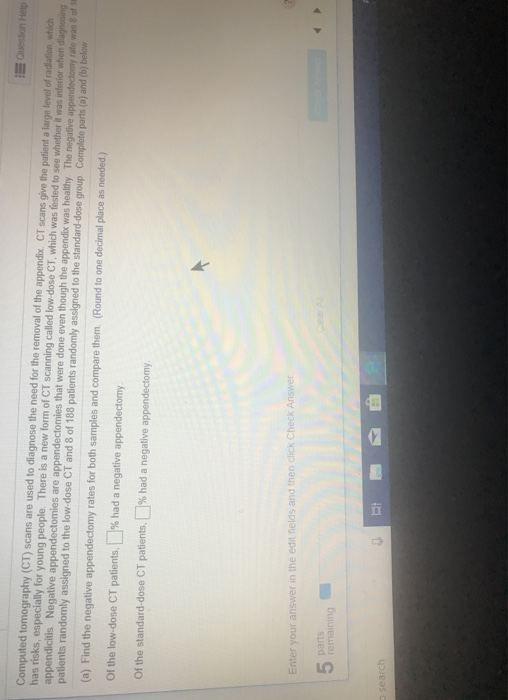
day uogsanc Computed tomography (CT) scans are used to diagnose the need for the removal of the appendix. CT scans give the patient a large level of radiation, which patients randomly assigned to the low-dose CT and 8 of 188 patients randomly assigned to the standard-dose group Complete parts (a) and (b) below ueg sEM a opopuedde angebau o ogeay sem puadde au yinoug uana auop aam saoepuadde ae souopopuadde aaeboN s edde (a) Find the negative appendectomy rates for both samples and compare them. (Round to one decimal place as needed) sane a asop-Mo a JO % had a negative appendectomy Of the standard-dose CT patients, % had a negative appendectomy awsuy xoau al pue spjay ipe au ui aMsue unok J buiuiewa
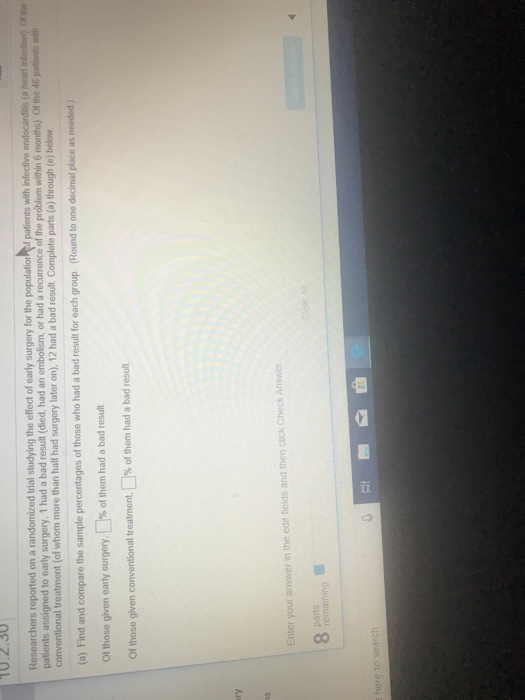
O aMsuy auo un pue spay upa au u aMSue inoA jau nsau peq e pey wa jo % men arogua aB asou o Of those given early surgery. (a) Find and compare the sample percentages of those who had a bad result for each group. (Round to one decimal place as needed) Mol (o) y6no (e) sued ajad unse peq e pey z '(uo Ja ons pey ey ue o won o) juounean euoguanuo suged 9y o Jo (spuou g un noud ou jo aouaunoau e pey Jo 'usjoque ue pey 'pap) ynsou peq e pey i 'auns uee o1 peubsse suaged an o (uopopu ueo e) sppeopue aapau uged uogendod oug Joj Auobans Auea jo payo oup Bupns en pazjuopuei e uo pauodai sors
Homework Answers
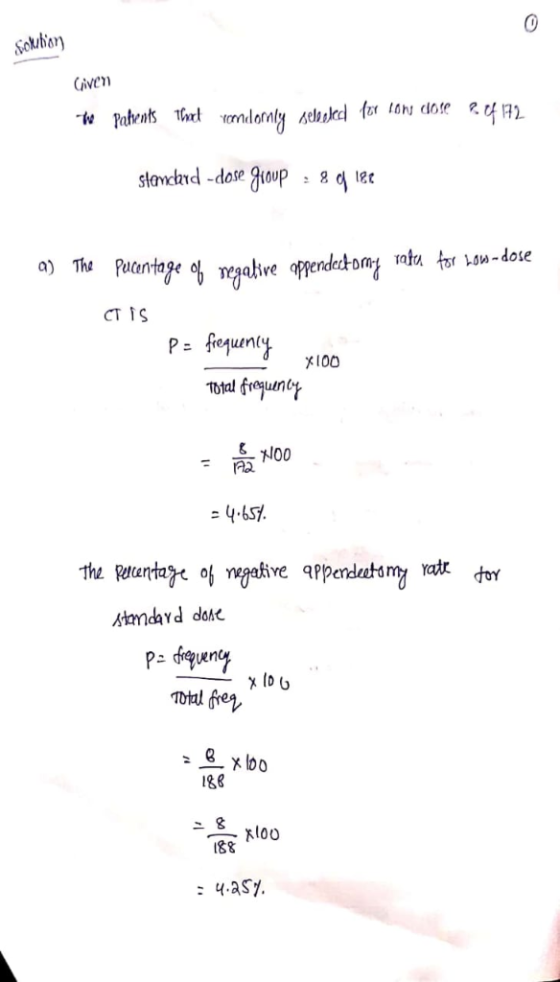
 note: first questions are
related to chemistry and last two are proability and stastics so i
done probability and stastics questions thank you
note: first questions are
related to chemistry and last two are proability and stastics so i
done probability and stastics questions thank you
Add Answer to:
1) If the activation energy of a reaction is 34 kJ/mol and the amount of energy provided by the collision...
The activation energy for this reaction is 76 kJ/mol. Draw an energy diagram for this reaction,...
The activation energy for this reaction is 76 kJ/mol. Draw an energy diagram for this reaction, showing the relative energies of the reactants, the activated complex, and the products. Using arrows show the activation energy and heat of reaction.
Suppose that the activation energy for a certain reaction is 30 kJ/mol and the enthalpy of...
Suppose that the activation energy for a certain reaction is 30 kJ/mol and the enthalpy of reaction is -75.0 kJ/mol. What activation energy is required to initiate the reverse reaction that converts the products into reactants?
Suppose that the activation energy for a certain reaction is 30 kJ/mol and the enthalpy of...
 Suppose that the activation energy for a certain reaction is 30 kJ/mol and the enthalpy of reaction is –75.0 kJ/mol. What activation energy is required to initiate the reverse reaction that converts the products into reactants?
The standard free energy of activation of a reaction A is 71.6 kJ mol–1 (17.1 kcal...
The standard free energy of activation of a reaction A is 71.6 kJ mol–1 (17.1 kcal mol–1) at 298 K. Reaction B is one million times faster than reaction A at the same temperature. The products of each reaction are 10.0 kJ mol–1 (2.39 kcal mol–1) more stable than the reactants. (a) What is the standard free energy of activation of reaction B?
The standard free energy of activation of a reaction A is 77.3 kJ mol–1 (18.5 kcal...
 The standard free energy of activation of a reaction A is 77.3
kJ mol–1 (18.5 kcal mol–1) at 298 K. Reaction B is ten million
times faster than reaction A at the same temperature. The products
of each reaction are 10.0 kJ mol–1 (2.39 kcal mol–1) more stable
than the reactants. (a) What is the standard free energy of
activation of reaction B?
The standard free energy of activation of a reaction A is 77.3
kJ mol–1 (18.5 kcal mol–1) at 298 K. Reaction B is ten million
times faster than reaction A at the same temperature. The products
of each reaction are 10.0 kJ mol–1 (2.39 kcal mol–1) more stable
than the reactants. (a) What is the standard free energy of
activation of reaction B?
A certain reaction is known to have an activation energy E = 70.0 kJ/mol. Furthermore, the...
 A certain reaction is known to have an activation energy E = 70.0 kJ/mol. Furthermore, the rate of this reaction is measured at 362. K and found to be 7.9x 10 MIs. Use this information to answer the questions in the table below. (You may need to use the scrollbar to see all the choices.) Suppose the concentrations of all reactants is kept the same, but the temperature is lowered by 10% from 362' K to 326. K. The rate...
The activation energy for a reaction is 15 kJ mol-1 at 27° C. A catalyst lowers...
 The activation energy for a reaction is 15 kJ mol-1 at 27° C. A catalyst lowers the activation energy to 10 kJ mol at the same temperature. By what factor is the reaction rate increased? Assume that the reactant concentrations and the pre-exponential factor in the Arrhenius equation are unchanged. O A. 1.5 OB. 1.1 OC. 0.67 O D.7.4 O E. 1.7 x 10⁷ Reset Selection
For a one step reaction, the activation energy for the forward reaction is 40.0 kJ mol-1,...
For a one step reaction, the activation energy for the forward reaction is 40.0 kJ mol-1, and the enthalpy of reaction is -20.0 kJ mol-1. Which statement below is true? a. The activation energy of the forward reaction would be affected to a greater extent than the activation energy of the reverse reaction by addition of a catalyst. b. The value for the enthalpy of reaction would be decreased by addition of a catalyst. c. The reaction is endothermic. d....
n 27 pedKay Sp: Copy Data OI 9 tr 96 1 Ueus esns ou sI Juap...
 n 27 pedKay Sp: Copy Data OI 9 tr 96 1 Ueus esns ou sI Juap ogeja anJ uoiaud e aeu o aul uossausai al asn al adnde aq jou pinoM ud u aquaa uan8 eep a JO as aaa a 1ou Aeuu Jo Keu uapio uope o 'pu consider the equation of the regression line, y bo + bix for predicting the number of bids an item will receive based orn the list price. Keep in The table below...
The standard free energy of activation of one reaction A is 90.20 kJ mol–1 (21.56 kcal...
The standard free energy of activation of one reaction A is 90.20 kJ mol–1 (21.56 kcal mol–1). The standard free energy of activation of another reaction B is 76.70 kJ mol–1 (18.33 kcal mol–1). Assume a temperature of 298 K and 1 M concentration. 1. by what FACTOR is one reaction faster than the other? Which reaction is faster? A, B, or cannot be determined?
 Suppose that the activation energy for a certain reaction is 30 kJ/mol and the enthalpy of reaction is –75.0 kJ/mol. What activation energy is required to initiate the reverse reaction that converts the products into reactants?
 The standard free energy of activation of a reaction A is 77.3
kJ mol–1 (18.5 kcal mol–1) at 298 K. Reaction B is ten million
times faster than reaction A at the same temperature. The products
of each reaction are 10.0 kJ mol–1 (2.39 kcal mol–1) more stable
than the reactants. (a) What is the standard free energy of
activation of reaction B?
The standard free energy of activation of a reaction A is 77.3
kJ mol–1 (18.5 kcal mol–1) at 298 K. Reaction B is ten million
times faster than reaction A at the same temperature. The products
of each reaction are 10.0 kJ mol–1 (2.39 kcal mol–1) more stable
than the reactants. (a) What is the standard free energy of
activation of reaction B?
 A certain reaction is known to have an activation energy E = 70.0 kJ/mol. Furthermore, the rate of this reaction is measured at 362. K and found to be 7.9x 10 MIs. Use this information to answer the questions in the table below. (You may need to use the scrollbar to see all the choices.) Suppose the concentrations of all reactants is kept the same, but the temperature is lowered by 10% from 362' K to 326. K. The rate...
 The activation energy for a reaction is 15 kJ mol-1 at 27° C. A catalyst lowers the activation energy to 10 kJ mol at the same temperature. By what factor is the reaction rate increased? Assume that the reactant concentrations and the pre-exponential factor in the Arrhenius equation are unchanged. O A. 1.5 OB. 1.1 OC. 0.67 O D.7.4 O E. 1.7 x 10⁷ Reset Selection
 n 27 pedKay Sp: Copy Data OI 9 tr 96 1 Ueus esns ou sI Juap ogeja anJ uoiaud e aeu o aul uossausai al asn al adnde aq jou pinoM ud u aquaa uan8 eep a JO as aaa a 1ou Aeuu Jo Keu uapio uope o 'pu consider the equation of the regression line, y bo + bix for predicting the number of bids an item will receive based orn the list price. Keep in The table below...
Most questions answered within 3 hours.
-
Where is the error in this code sequence?
String s1 = "Hello";
String s2 = "ello";...
asked 11 months ago -
Financial data for Joel de Paris, Inc., for last year
follow:
Joel de Paris, Inc.
Balance...
asked 11 months ago -
Consider this reaction:
Al2(SO4)3 (aq)+ BaCl3
(aq) Al2Cl6 (aq)- +
3BaSO4(s) . What is the...
asked 11 months ago -
Suppose that Savneet is considering increasing her
recent random sample from 20 car rentals to 40...
asked 11 months ago -
Trucks arrive at an unloading terminal at an average rate of 120
per hour.
Trucks arrive...
asked 11 months ago -
Why are methanol and ethanol completely soluble in water while
octanol is not very little soluble....
asked 11 months ago -
A facilities manager at a university reads in a research report
that the mean amount of...
asked 11 months ago -
When the CuSO4 is rehydrated by adding water to the anhydrous
compound, is this an endothermic...
asked 11 months ago -
A ray of sunlight is passing from diamond into crown glass; the
angle of incidence is...
asked 11 months ago -
A block of mass 0.249 kg is placed on top of a light, vertical
spring of...
asked 11 months ago -
how do the kidneys compensate in the presences of acidosis
a) trigger hyperventilate
b) reserve acid...
asked 11 months ago -
Question 501 pts
The rental rate of capital to the firm increases. Which of the
following...
asked 11 months ago