
Homework Answers
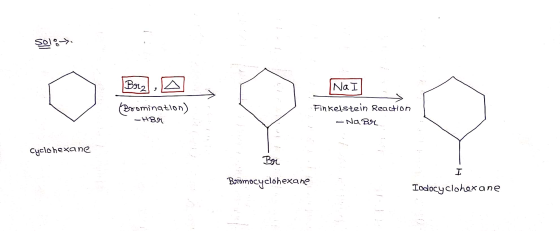
Ans :-
Reactants of first Steps are : Br2 , Δ
Reactants of Second Steps are : NaI
Add Answer to:
Identify the reactants needed for the following reactions by moving them from the choices to the correct box. Not a...
7. (3 pts each) Write the correct reactant, reagents, or major product of the following reactions...
 7. (3 pts each) Write the correct reactant, reagents, or major product of the following reactions он TSCI Nal pyridine DMSO HBr EtOK EtOH CH2l2, Zn/Cu Et20 Br2 hv ONa Ph3PBr2 он elimination product Name: Page 6 of
3. Identify which reactants are amphoteric species in the following reactions. For those species, determine if...
 3. Identify which reactants are amphoteric species in the following reactions. For those species, determine if the compound is also amphiprotic. Reaction Amphoteric Reactant Amphiprotic? (Y or N) HCO3 + HBr = H2CO3 + Br- 3 HCI + Al(OH)3 = AlCl3 + 3 H2O 2 HBr + ZnO = ZnBr2 + H2O
Using one of the reactions in this chapter, give the correct starting material (A-L) needed to...
 Using one of the reactions in this chapter, give the correct
starting material (A-L) needed to produce the following
structure.
- Write the letter corresponding to the correct starting
material in the space provided. If more than one of the starting
materials are used, write your answer as two letters. Example
"AB"
Name the type of reaction used by selecting the correct answer
from the choices provided. If the reaction is not an exact match
with any of the choices,...
Using one of the reactions in this chapter, give the correct
starting material (A-L) needed to produce the following
structure.
- Write the letter corresponding to the correct starting
material in the space provided. If more than one of the starting
materials are used, write your answer as two letters. Example
"AB"
Name the type of reaction used by selecting the correct answer
from the choices provided. If the reaction is not an exact match
with any of the choices,...
What is Wrong? Select the keyword or phrase that will best complete each sentence. Key terms: A radical...
 What is Wrong?
Select the keyword or phrase that will best complete each sentence. Key terms: A radical is a reactive intermediate with a single unpaired electron, formed by homoloysis of a covalent bond. paired unpaired Allylic radicals are stabilized by resonance, making them more stable than tertiary radicals increases inductive effects A compound that contains an especially weak bond that serves as a source of radicals is called a radical initiator ess homoloysis decreases more J Treatment of cyclohexene...
What is Wrong?
Select the keyword or phrase that will best complete each sentence. Key terms: A radical is a reactive intermediate with a single unpaired electron, formed by homoloysis of a covalent bond. paired unpaired Allylic radicals are stabilized by resonance, making them more stable than tertiary radicals increases inductive effects A compound that contains an especially weak bond that serves as a source of radicals is called a radical initiator ess homoloysis decreases more J Treatment of cyclohexene...
How are aromatic compounds different from alkenes? 5. Complete the following reactions by drawing the organic...
 How are aromatic compounds different from alkenes? 5. Complete the following reactions by drawing the organic product. If no reaction occurs, write "no reaction CH3-CH=CH2 + Br2→ (Hu ( CH3 +Br2 → H3C CH2 + Br2→ CH3-CH2-CH2-CH3 + Br2- +Br2 → CH4 + Br2-or- hv FeBr3 (Exp. 5, version 5) Page 11 of 12 aromatic
Select all of the correct statements about equilibrium from the choices below. At equilibrium the rates...
 Select all of the correct statements about equilibrium from the choices below. At equilibrium the rates of forward and reverse reactions are equal. As a reaction proceeds backwards toward equilibrium the reactant concentrations rise. As a reaction proceeds backwards toward equilibrium the reverse rate drops. As a reaction proceeds forward toward equilibrium the product concentrations rise. At equilibrium concentrations of reactants and products stay constant. At equilibrium there are always equal amounts of reactants and products.
5. From the following choices below, identify those that are the inputs and outputs of the...
 5. From the following choices below, identify those that are the inputs and outputs of the Photosystem I and II light reactions. (Recall that inputs to chemical reactions are modified over the course of the reaction as they are converted into products. In other words, if something is required for a reaction to occur, and it does not remain in its original form when the reaction is complete, it is an input.) Put each item below to the appropriate category...
Which of the following are correct for first-order reactions? Select all that apply. ? The reaction...
 Which of the following are correct for first-order reactions? Select all that apply. ? The reaction slows down as the reaction proceeds. ? A higher concentration of reactants will speed up the reaction. ? The concentration of the reactants changes nonlinearly. The half-life of the reaction stays constant as the reaction proceeds The units for the rate constant and the rate of reaction are the same.
Select all of the correct statements about equilibrium from the choices below. At equilibrium the rates of forward and r...
Select all of the correct statements about equilibrium from the choices below. At equilibrium the rates of forward and reverse reactions are equal. At equilibrium the rate of change of product concentration is zero. At equilibrium the forward rate constant equals zero. As a reaction proceeds backwards toward equilibrium the reverse rate drops. As a reaction proceeds forward toward equilibrium the reactant concentrations drop. At equilibrium no more reactants are transformed into products.
Be sure to answer all parts. Devise a synthesis of the following compound from benzene. You may use any other org...
 Be sure to answer all parts. Devise a synthesis of the following compound from benzene. You may use any other organic or inorganic reagents. Draw the intermediates and select the correct reagent for each step of the reaction sequence. HO Br Br2, FeBr3 PBr HBr NaBr draw structure NaNO, HCI; [2] HBF HNO3, H,SO ) NaNO, HCI; [2] H2O draw structure. NANO, HCI; [2] HBF HNO3, H,SO J NaNO;, HCI; [2] H,O NO; draw structure H.O HgSO2, H,0 I DIBAL-H;...
 7. (3 pts each) Write the correct reactant, reagents, or major product of the following reactions он TSCI Nal pyridine DMSO HBr EtOK EtOH CH2l2, Zn/Cu Et20 Br2 hv ONa Ph3PBr2 он elimination product Name: Page 6 of
 3. Identify which reactants are amphoteric species in the following reactions. For those species, determine if the compound is also amphiprotic. Reaction Amphoteric Reactant Amphiprotic? (Y or N) HCO3 + HBr = H2CO3 + Br- 3 HCI + Al(OH)3 = AlCl3 + 3 H2O 2 HBr + ZnO = ZnBr2 + H2O
 Using one of the reactions in this chapter, give the correct
starting material (A-L) needed to produce the following
structure.
- Write the letter corresponding to the correct starting
material in the space provided. If more than one of the starting
materials are used, write your answer as two letters. Example
"AB"
Name the type of reaction used by selecting the correct answer
from the choices provided. If the reaction is not an exact match
with any of the choices,...
Using one of the reactions in this chapter, give the correct
starting material (A-L) needed to produce the following
structure.
- Write the letter corresponding to the correct starting
material in the space provided. If more than one of the starting
materials are used, write your answer as two letters. Example
"AB"
Name the type of reaction used by selecting the correct answer
from the choices provided. If the reaction is not an exact match
with any of the choices,...
 What is Wrong?
Select the keyword or phrase that will best complete each sentence. Key terms: A radical is a reactive intermediate with a single unpaired electron, formed by homoloysis of a covalent bond. paired unpaired Allylic radicals are stabilized by resonance, making them more stable than tertiary radicals increases inductive effects A compound that contains an especially weak bond that serves as a source of radicals is called a radical initiator ess homoloysis decreases more J Treatment of cyclohexene...
What is Wrong?
Select the keyword or phrase that will best complete each sentence. Key terms: A radical is a reactive intermediate with a single unpaired electron, formed by homoloysis of a covalent bond. paired unpaired Allylic radicals are stabilized by resonance, making them more stable than tertiary radicals increases inductive effects A compound that contains an especially weak bond that serves as a source of radicals is called a radical initiator ess homoloysis decreases more J Treatment of cyclohexene...
 How are aromatic compounds different from alkenes? 5. Complete the following reactions by drawing the organic product. If no reaction occurs, write "no reaction CH3-CH=CH2 + Br2→ (Hu ( CH3 +Br2 → H3C CH2 + Br2→ CH3-CH2-CH2-CH3 + Br2- +Br2 → CH4 + Br2-or- hv FeBr3 (Exp. 5, version 5) Page 11 of 12 aromatic
 Select all of the correct statements about equilibrium from the choices below. At equilibrium the rates of forward and reverse reactions are equal. As a reaction proceeds backwards toward equilibrium the reactant concentrations rise. As a reaction proceeds backwards toward equilibrium the reverse rate drops. As a reaction proceeds forward toward equilibrium the product concentrations rise. At equilibrium concentrations of reactants and products stay constant. At equilibrium there are always equal amounts of reactants and products.
 5. From the following choices below, identify those that are the inputs and outputs of the Photosystem I and II light reactions. (Recall that inputs to chemical reactions are modified over the course of the reaction as they are converted into products. In other words, if something is required for a reaction to occur, and it does not remain in its original form when the reaction is complete, it is an input.) Put each item below to the appropriate category...
 Which of the following are correct for first-order reactions? Select all that apply. ? The reaction slows down as the reaction proceeds. ? A higher concentration of reactants will speed up the reaction. ? The concentration of the reactants changes nonlinearly. The half-life of the reaction stays constant as the reaction proceeds The units for the rate constant and the rate of reaction are the same.
 Be sure to answer all parts. Devise a synthesis of the following compound from benzene. You may use any other organic or inorganic reagents. Draw the intermediates and select the correct reagent for each step of the reaction sequence. HO Br Br2, FeBr3 PBr HBr NaBr draw structure NaNO, HCI; [2] HBF HNO3, H,SO ) NaNO, HCI; [2] H2O draw structure. NANO, HCI; [2] HBF HNO3, H,SO J NaNO;, HCI; [2] H,O NO; draw structure H.O HgSO2, H,0 I DIBAL-H;...
Most questions answered within 3 hours.
-
Where is the error in this code sequence?
String s1 = "Hello";
String s2 = "ello";...
asked 1 year ago -
Financial data for Joel de Paris, Inc., for last year
follow:
Joel de Paris, Inc.
Balance...
asked 1 year ago -
Consider this reaction:
Al2(SO4)3 (aq)+ BaCl3
(aq) Al2Cl6 (aq)- +
3BaSO4(s) . What is the...
asked 1 year ago -
Suppose that Savneet is considering increasing her
recent random sample from 20 car rentals to 40...
asked 1 year ago -
Trucks arrive at an unloading terminal at an average rate of 120
per hour.
Trucks arrive...
asked 1 year ago -
Why are methanol and ethanol completely soluble in water while
octanol is not very little soluble....
asked 1 year ago -
A facilities manager at a university reads in a research report
that the mean amount of...
asked 1 year ago -
When the CuSO4 is rehydrated by adding water to the anhydrous
compound, is this an endothermic...
asked 1 year ago -
A ray of sunlight is passing from diamond into crown glass; the
angle of incidence is...
asked 1 year ago -
A block of mass 0.249 kg is placed on top of a light, vertical
spring of...
asked 1 year ago -
how do the kidneys compensate in the presences of acidosis
a) trigger hyperventilate
b) reserve acid...
asked 1 year ago -
Question 501 pts
The rental rate of capital to the firm increases. Which of the
following...
asked 1 year ago