Please do only e and f and show work 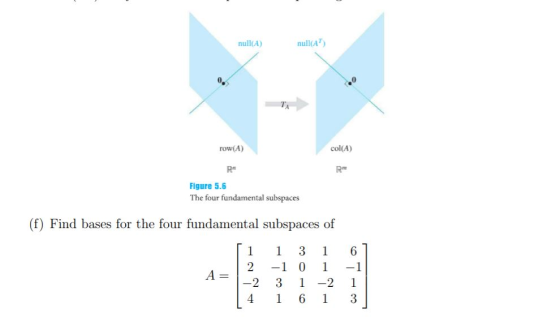

8. Given a subspace W of R", define the orthogonal complement of W to be W vE R u v 0 for every u E W (a) Let W span(e, e2) in R3. Show that e3 is orthogonal sense that W span(e3)? to ei and e2. Does it make (b) Let W be a subspace of R {v1, ... , Vn} in Rm. Let with basis B V1 V2 A = VI the matrix whose rows are the basis vectors of W. i. Verify that row (A) W i. Show that W = (row(A)) null(A) (c) Let A be any m x n matrix. Verify that (col(A)) - null(AT) (d) Use (b) to find W if W = span(v1, V2) where [0 3 and v2 1 2 V1 (e) Let A be an m x n matrix and TA : R"R be the linear transformation defined by A. Remind yourself that ker(TA) = null(A) and range(TA) below depicts the relationship between these objects. Examine this picture and make sure you understand what is going null(AT) the fundamental subspaces corresponding = col(A). The figure on. We call row (A), null(A), col (A), and to A. 1
Homework Answers


![Bat& do taw space:- Tho 4mon- zeto You in ThefCA) pace YOu aNte bag g D0.0,0,-5143,[0,1, 00,5. [ 0,01,0, 21], Cor0.0,1,4 -a a](http://img.homeworklib.com/images/7b66f0d4-0efd-4ae9-9f44-c80b2a1a8d7d.png?x-oss-process=image/resize,w_560)



Add Answer to:
Please do only e and f and show work null(AT) null(A) T col(A) row(A) Figure 5.6 The four fundamental subspaces (f) Fin...
e, none of these 7. Let {1,..., up} be an orthogonal basis for a subspace W...
 e, none of these 7. Let {1,..., up} be an orthogonal basis for a subspace W of R" and {...., } be an orthogonal basis for Wt. Determine which of the following is false. a. p+q=n b. {U1,..., Up, V1,...,0} is an orthogonal basis for R". c. the orthogonal projection of the u; onto W is 0. d. the orthogonal projection of the vi onto W is 0. e. none of these 8. Let {u},..., up} be an orthogonal basis...
All vectors and subspaces are in R”. Mark each statement True or False. Justify each answer....
 All vectors and subspaces are in R”. Mark each statement True or False. Justify each answer. Complete parts (a) through (e) below. a. If W is a subspace of R" and if y is in both W and wt, then y must be the zero vector. If v is in W, then projwv = Since the wt component of v is equal to v the w+ component of v must be A similar argument can be formed for the W...
Please solve both parts of this question! I've stared at it for a long time without knowing how to approach it. (1) A square matrix E є м,xn(R) is idempotent if E-E. It is symmetric if -t E. (a)...
 Please solve both parts of this question! I've stared at it for
a long time without knowing how to approach it.
(1) A square matrix E є м,xn(R) is idempotent if E-E. It is symmetric if -t E. (a) Let V C Rn be a subspace of R, and consider the orthogonal projection projy R" Rn onto V. Show that the representing matrix E = projy18 of proj v relative to the standard basis of IRn is both idempotent and...
Please solve both parts of this question! I've stared at it for
a long time without knowing how to approach it.
(1) A square matrix E є м,xn(R) is idempotent if E-E. It is symmetric if -t E. (a) Let V C Rn be a subspace of R, and consider the orthogonal projection projy R" Rn onto V. Show that the representing matrix E = projy18 of proj v relative to the standard basis of IRn is both idempotent and...
Problem 1: Let W = {p(t) € Pz : p'le) = 0}. We know from Problem...
 Problem 1: Let W = {p(t) € Pz : p'le) = 0}. We know from Problem 1, Section 4.3 and Problem 1, Section 4.6 that W is a subspace of P3. Let T:W+Pbe given by T(p(t)) = p' (t). It is easy to check that T is a linear transformation. (a) Find a basis for and the dimension of Range T. (b) Find Ker T, a basis for Ker T and dim KerT. (c) Is T one-to-one? Explain. (d) Is...
Hi, could you post solutions to the following questions. Thanks. 2. (a) Let V be a vector space on R. Give the definition of a subspace W of V 2% (b) For each of the following subsets of IR3 sta...
 Hi,
could you post solutions to the following questions. Thanks.
2. (a) Let V be a vector space on R. Give the definition of a subspace W of V 2% (b) For each of the following subsets of IR3 state whether they are subepaces of R3 or not by clearly explaining your answer. 2% 2% (c) Consider the map F : R2 → R3 defined by for any z = (zi,Z2) E R2. 3% 3% 3% 3% i. Show that...
Hi,
could you post solutions to the following questions. Thanks.
2. (a) Let V be a vector space on R. Give the definition of a subspace W of V 2% (b) For each of the following subsets of IR3 state whether they are subepaces of R3 or not by clearly explaining your answer. 2% 2% (c) Consider the map F : R2 → R3 defined by for any z = (zi,Z2) E R2. 3% 3% 3% 3% i. Show that...
Please show the detail, thank you! (1 point) (a) Let -4 -7 -2 -4 V1 =...
 Please show the detail, thank you!
(1 point) (a) Let -4 -7 -2 -4 V1 = and V2 = 1 6 0 2 and let W = span{V1, V2}. Apply the Gram-Schmidt procedure to vi and V2 to find an orthogonal basis {uj, u2 } for W. uj = U2 = -13 2 (b) Consider the vector v = - Find V' E W such that || V – v' || is as small as possible. 15 8 V =...
Please show the detail, thank you!
(1 point) (a) Let -4 -7 -2 -4 V1 = and V2 = 1 6 0 2 and let W = span{V1, V2}. Apply the Gram-Schmidt procedure to vi and V2 to find an orthogonal basis {uj, u2 } for W. uj = U2 = -13 2 (b) Consider the vector v = - Find V' E W such that || V – v' || is as small as possible. 15 8 V =...
2 5 Do the vectors u = and v= 3 7 span R3? -1 1 Explain! Hint: Use Let a, a2,ap be vectors in R", let A = [a1a2..ap...
 2 5 Do the vectors u = and v= 3 7 span R3? -1 1 Explain! Hint: Use Let a, a2,ap be vectors in R", let A = [a1a2..ap The following statements are equivalent. 1. ai,a2,..,a, span R" = # of rows of A. 2. A has a pivot position in every row, that is, rank(A) Select one: Oa. No since rank([uv]) < 2 3=# of rows of the matrix [uv b.Yes since rank([uv]) =2 = # of columns of...
please give the correct answer with explanations, thank you Let S {V1, V2, V3, V4, Vs}...
 please give the correct answer with explanations, thank you
Let S {V1, V2, V3, V4, Vs} be a set of five vectors in R] Let W-span) When these vectors are placed as columns into a matrix A as A-(V2 V3 r. ws). and Asrow-reduced to echelon form U. we have U - -1 1 013 001 1 state the dimension of W Number 2. State a boss B for W using the standard algorithm, using vectors with a small as...
please give the correct answer with explanations, thank you
Let S {V1, V2, V3, V4, Vs} be a set of five vectors in R] Let W-span) When these vectors are placed as columns into a matrix A as A-(V2 V3 r. ws). and Asrow-reduced to echelon form U. we have U - -1 1 013 001 1 state the dimension of W Number 2. State a boss B for W using the standard algorithm, using vectors with a small as...
only a-i T or F lit khd where it came from 4. You do not need to simplify results, unless otherwise stated. 1. (20pts.) Indicate whether each of the following questions is True or False by writin...
 only a-i T or F
lit khd where it came from 4. You do not need to simplify results, unless otherwise stated. 1. (20pts.) Indicate whether each of the following questions is True or False by writing the words "True" or "False" No explanation is needed. (a) If S is a set of linearly independent vectors in R" then the set S is an orthogonal set (b) If the vector x is orthogonal to every vector in a subspace W...
only a-i T or F
lit khd where it came from 4. You do not need to simplify results, unless otherwise stated. 1. (20pts.) Indicate whether each of the following questions is True or False by writing the words "True" or "False" No explanation is needed. (a) If S is a set of linearly independent vectors in R" then the set S is an orthogonal set (b) If the vector x is orthogonal to every vector in a subspace W...
Problem 4. Let V be the vector space of all infinitely differentiable functions f: [0, ]...
 Problem 4. Let V be the vector space of all infinitely differentiable functions f: [0, ] -» R, equipped with the inner product f(t)g(t)d (f,g) = (a) Let UC V be the subspace spanned by B = (sinr, cos x, 1) (you may assume without proof that B is linearly independent, and hence a basis for U). Find the B-matrix [D]93 of the "derivative linear transformation" D : U -> U given by D(f) = f'. (b) Let WC V...
 e, none of these 7. Let {1,..., up} be an orthogonal basis for a subspace W of R" and {...., } be an orthogonal basis for Wt. Determine which of the following is false. a. p+q=n b. {U1,..., Up, V1,...,0} is an orthogonal basis for R". c. the orthogonal projection of the u; onto W is 0. d. the orthogonal projection of the vi onto W is 0. e. none of these 8. Let {u},..., up} be an orthogonal basis...
 All vectors and subspaces are in R”. Mark each statement True or False. Justify each answer. Complete parts (a) through (e) below. a. If W is a subspace of R" and if y is in both W and wt, then y must be the zero vector. If v is in W, then projwv = Since the wt component of v is equal to v the w+ component of v must be A similar argument can be formed for the W...
 Please solve both parts of this question! I've stared at it for
a long time without knowing how to approach it.
(1) A square matrix E є м,xn(R) is idempotent if E-E. It is symmetric if -t E. (a) Let V C Rn be a subspace of R, and consider the orthogonal projection projy R" Rn onto V. Show that the representing matrix E = projy18 of proj v relative to the standard basis of IRn is both idempotent and...
Please solve both parts of this question! I've stared at it for
a long time without knowing how to approach it.
(1) A square matrix E є м,xn(R) is idempotent if E-E. It is symmetric if -t E. (a) Let V C Rn be a subspace of R, and consider the orthogonal projection projy R" Rn onto V. Show that the representing matrix E = projy18 of proj v relative to the standard basis of IRn is both idempotent and...
 Problem 1: Let W = {p(t) € Pz : p'le) = 0}. We know from Problem 1, Section 4.3 and Problem 1, Section 4.6 that W is a subspace of P3. Let T:W+Pbe given by T(p(t)) = p' (t). It is easy to check that T is a linear transformation. (a) Find a basis for and the dimension of Range T. (b) Find Ker T, a basis for Ker T and dim KerT. (c) Is T one-to-one? Explain. (d) Is...
 Hi,
could you post solutions to the following questions. Thanks.
2. (a) Let V be a vector space on R. Give the definition of a subspace W of V 2% (b) For each of the following subsets of IR3 state whether they are subepaces of R3 or not by clearly explaining your answer. 2% 2% (c) Consider the map F : R2 → R3 defined by for any z = (zi,Z2) E R2. 3% 3% 3% 3% i. Show that...
Hi,
could you post solutions to the following questions. Thanks.
2. (a) Let V be a vector space on R. Give the definition of a subspace W of V 2% (b) For each of the following subsets of IR3 state whether they are subepaces of R3 or not by clearly explaining your answer. 2% 2% (c) Consider the map F : R2 → R3 defined by for any z = (zi,Z2) E R2. 3% 3% 3% 3% i. Show that...
 Please show the detail, thank you!
(1 point) (a) Let -4 -7 -2 -4 V1 = and V2 = 1 6 0 2 and let W = span{V1, V2}. Apply the Gram-Schmidt procedure to vi and V2 to find an orthogonal basis {uj, u2 } for W. uj = U2 = -13 2 (b) Consider the vector v = - Find V' E W such that || V – v' || is as small as possible. 15 8 V =...
Please show the detail, thank you!
(1 point) (a) Let -4 -7 -2 -4 V1 = and V2 = 1 6 0 2 and let W = span{V1, V2}. Apply the Gram-Schmidt procedure to vi and V2 to find an orthogonal basis {uj, u2 } for W. uj = U2 = -13 2 (b) Consider the vector v = - Find V' E W such that || V – v' || is as small as possible. 15 8 V =...
 2 5 Do the vectors u = and v= 3 7 span R3? -1 1 Explain! Hint: Use Let a, a2,ap be vectors in R", let A = [a1a2..ap The following statements are equivalent. 1. ai,a2,..,a, span R" = # of rows of A. 2. A has a pivot position in every row, that is, rank(A) Select one: Oa. No since rank([uv]) < 2 3=# of rows of the matrix [uv b.Yes since rank([uv]) =2 = # of columns of...
 please give the correct answer with explanations, thank you
Let S {V1, V2, V3, V4, Vs} be a set of five vectors in R] Let W-span) When these vectors are placed as columns into a matrix A as A-(V2 V3 r. ws). and Asrow-reduced to echelon form U. we have U - -1 1 013 001 1 state the dimension of W Number 2. State a boss B for W using the standard algorithm, using vectors with a small as...
please give the correct answer with explanations, thank you
Let S {V1, V2, V3, V4, Vs} be a set of five vectors in R] Let W-span) When these vectors are placed as columns into a matrix A as A-(V2 V3 r. ws). and Asrow-reduced to echelon form U. we have U - -1 1 013 001 1 state the dimension of W Number 2. State a boss B for W using the standard algorithm, using vectors with a small as...
 only a-i T or F
lit khd where it came from 4. You do not need to simplify results, unless otherwise stated. 1. (20pts.) Indicate whether each of the following questions is True or False by writing the words "True" or "False" No explanation is needed. (a) If S is a set of linearly independent vectors in R" then the set S is an orthogonal set (b) If the vector x is orthogonal to every vector in a subspace W...
only a-i T or F
lit khd where it came from 4. You do not need to simplify results, unless otherwise stated. 1. (20pts.) Indicate whether each of the following questions is True or False by writing the words "True" or "False" No explanation is needed. (a) If S is a set of linearly independent vectors in R" then the set S is an orthogonal set (b) If the vector x is orthogonal to every vector in a subspace W...
 Problem 4. Let V be the vector space of all infinitely differentiable functions f: [0, ] -» R, equipped with the inner product f(t)g(t)d (f,g) = (a) Let UC V be the subspace spanned by B = (sinr, cos x, 1) (you may assume without proof that B is linearly independent, and hence a basis for U). Find the B-matrix [D]93 of the "derivative linear transformation" D : U -> U given by D(f) = f'. (b) Let WC V...
Most questions answered within 3 hours.
-
Where is the error in this code sequence?
String s1 = "Hello";
String s2 = "ello";...
asked 11 months ago -
Financial data for Joel de Paris, Inc., for last year
follow:
Joel de Paris, Inc.
Balance...
asked 11 months ago -
Consider this reaction:
Al2(SO4)3 (aq)+ BaCl3
(aq) Al2Cl6 (aq)- +
3BaSO4(s) . What is the...
asked 11 months ago -
Suppose that Savneet is considering increasing her
recent random sample from 20 car rentals to 40...
asked 11 months ago -
Trucks arrive at an unloading terminal at an average rate of 120
per hour.
Trucks arrive...
asked 11 months ago -
Why are methanol and ethanol completely soluble in water while
octanol is not very little soluble....
asked 11 months ago -
A facilities manager at a university reads in a research report
that the mean amount of...
asked 11 months ago -
When the CuSO4 is rehydrated by adding water to the anhydrous
compound, is this an endothermic...
asked 11 months ago -
A ray of sunlight is passing from diamond into crown glass; the
angle of incidence is...
asked 11 months ago -
A block of mass 0.249 kg is placed on top of a light, vertical
spring of...
asked 11 months ago -
how do the kidneys compensate in the presences of acidosis
a) trigger hyperventilate
b) reserve acid...
asked 11 months ago -
Question 501 pts
The rental rate of capital to the firm increases. Which of the
following...
asked 11 months ago