
Homework Answers
Add Answer to:
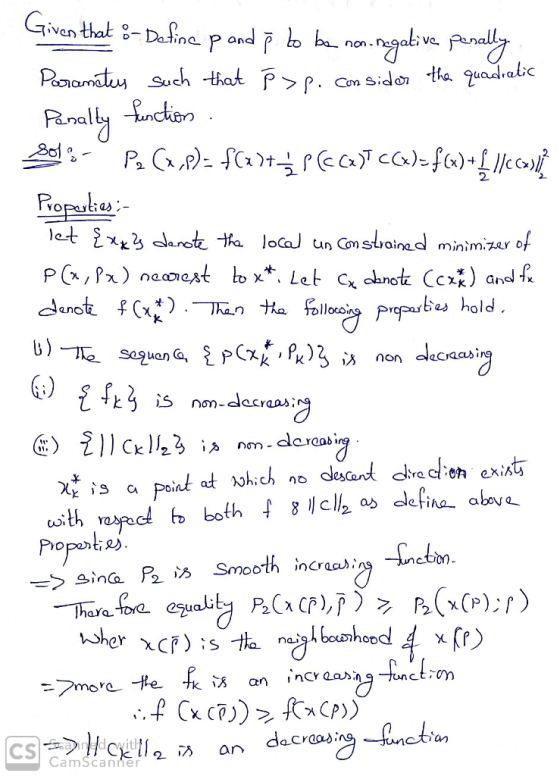
Exercise 8.4. Define p and p to be non-negative penalty parameters such that p > p. Consider the quadratic penalty f...
Let A be n × n with AT-A. (The matrix A is syrnmetric.) Let B be 1 × n and let c E R. Define f : Rn → R by f(x) = 2.7, A . x + B . x + c. Show that The function f is a quadratic function Let...
 Let A be n × n with AT-A. (The matrix A is syrnmetric.) Let B be 1 × n and let c E R. Define f : Rn → R by f(x) = 2.7, A . x + B . x + c. Show that The function f is a quadratic function
Let A be n × n with AT-A. (The matrix A is syrnmetric.) Let B be 1 × n and let c E R. Define f : Rn...
Let A be n × n with AT-A. (The matrix A is syrnmetric.) Let B be 1 × n and let c E R. Define f : Rn → R by f(x) = 2.7, A . x + B . x + c. Show that The function f is a quadratic function
Let A be n × n with AT-A. (The matrix A is syrnmetric.) Let B be 1 × n and let c E R. Define f : Rn...
E the vector space of polynomials over R of degree less than 3. Define a quadratic form on V by a...
 e the vector space of polynomials over R of degree less than 3. Define a quadratic form on V by a) Find the symmetric bilinear forma f such that q(p) = f(p, p). b) Consider the basis oy-(1,2-x U)o. c) Let R-(3,2-r, 4-2z +2.2} of V. Find the matrix {f}3: You may give your ,24 of V. Find the matrix answer as a product of matrices and/or their inverses.
e the vector space of polynomials over R of degree less...
e the vector space of polynomials over R of degree less than 3. Define a quadratic form on V by a) Find the symmetric bilinear forma f such that q(p) = f(p, p). b) Consider the basis oy-(1,2-x U)o. c) Let R-(3,2-r, 4-2z +2.2} of V. Find the matrix {f}3: You may give your ,24 of V. Find the matrix answer as a product of matrices and/or their inverses.
e the vector space of polynomials over R of degree less...
If E C F, then show that (a) Fe C Ee ss (b) P(Fe) P(Ee). Use...
 If E C F, then show that (a) Fe C Ee ss (b) P(Fe) P(Ee). Use the probability axioms and other identities in your proof. where the inequality holds by P(FE) 2 0
Exercise 2 We consider the functional F: X → R defined by Find the minimum and...
 Exercise 2 We consider the functional F: X → R defined by Find the minimum and al the minimizers of the functional F over the set X in the following cases X-(continuous functions y: 10,11 → R} b. X = {continuous functions y: 10, 1] → R such that y(0-1) Hint: use Exercise 1
Exercise 2.5. Consider finding a zero of function F : D as the sum of a linear and nonlinear part...
 hello can someone help me answer this please
Exercise 2.5. Consider finding a zero of function F : D as the sum of a linear and nonlinear part: Rn → Rn that can be written F(x) BG(x) where B is a nonsingular matrix and G DCRR" is a general nonlinear function. At a point ak consider a general linear model Mk(x)Ak(x -), where the quantities ak E R" and Ak E Rn*n are to be determined. Define the linear model...
hello can someone help me answer this please
Exercise 2.5. Consider finding a zero of function F : D as the sum of a linear and nonlinear part: Rn → Rn that can be written F(x) BG(x) where B is a nonsingular matrix and G DCRR" is a general nonlinear function. At a point ak consider a general linear model Mk(x)Ak(x -), where the quantities ak E R" and Ak E Rn*n are to be determined. Define the linear model...
Please all thank you Exercise 25: Let f 0,R be defined by f(x)-1/n, m, with m,nENand n is the minimal n such that m/n a) Show that L(f, P)0 for all partitions P of [0, 1] b) Let mE N. Show that t...
 Please all thank you
Exercise 25: Let f 0,R be defined by f(x)-1/n, m, with m,nENand n is the minimal n such that m/n a) Show that L(f, P)0 for all partitions P of [0, 1] b) Let mE N. Show that the cardinality of the set A bounded by m(m1)/2. e [0, 1]: f(x) > 1/m) is c) Given m E N construct a partition P such that U(f, Pm)2/m. d) Show that f is integrable and compute Jo...
Please all thank you
Exercise 25: Let f 0,R be defined by f(x)-1/n, m, with m,nENand n is the minimal n such that m/n a) Show that L(f, P)0 for all partitions P of [0, 1] b) Let mE N. Show that the cardinality of the set A bounded by m(m1)/2. e [0, 1]: f(x) > 1/m) is c) Given m E N construct a partition P such that U(f, Pm)2/m. d) Show that f is integrable and compute Jo...
Define f : R-R by f(x)-x, and consider the partition P = {-2, 0, 1,2) of...
 Define f : R-R by f(x)-x, and consider the partition P = {-2, 0, 1,2) of 1-2, 2] (i.e. xo =-2, x1 = 0, x2 = 1, and x3 2; note this partition is non-regular, i.e. not all the subintervals have the same length) Using the notation defined at the bottom of page 136, compute 1- (ie. what is the suprem um of {f(x) x є [-2.0])?) :
5. Let A = P(R). Define f : R → A by the formula f(x) =...
 5. Let A = P(R). Define f : R → A by the formula f(x) = {y E RIy2 < x). (a) Find f(2). (b) Is f injective, surjective, both (bijective), or neither? Z given by f(u)n+l, ifn is even n - 3, if n is odd 6. Consider the function f : Z → Z given by f(n) = (a) Is f injective? Prove your answer. (b) Is f surjective? Prove your answer
2008-2. Please provide clear justified step-by-step solutions (preferably handwritten) for the following question. The answers have...
 2008-2. Please provide clear justified step-by-step solutions
(preferably handwritten) for the following question. The answers
have been provided.
Questions:
Answers:
(a) Let X be the set of functions f : R → R in F such that the graph of y - f(x) passes through the point (0, 0). Show that X is a subspace of F (b) For any real number m, define pm E P1 by Pm(x)-mx +1. (c) Let Z P, P2, p3) C P2, where pi(x)...
2008-2. Please provide clear justified step-by-step solutions
(preferably handwritten) for the following question. The answers
have been provided.
Questions:
Answers:
(a) Let X be the set of functions f : R → R in F such that the graph of y - f(x) passes through the point (0, 0). Show that X is a subspace of F (b) For any real number m, define pm E P1 by Pm(x)-mx +1. (c) Let Z P, P2, p3) C P2, where pi(x)...
this is numerical analysis. please do a and b 2. Consider the non-standard interpolation problem: Given...
 this is numerical analysis. please do a and b
2. Consider the non-standard interpolation problem: Given three numbers A, B, C and a fixed node & € R, find a quadratic polynomial 9(x) = 40 +213 + azra so that 9(-1) = A, d'(E) - B, 9(1) = C. (1) (a) Show that if & = 0, the problem is not well-posed, that is, there are numbers A, B, C for which the interpolation problem (1) has no solution (b)...
this is numerical analysis. please do a and b
2. Consider the non-standard interpolation problem: Given three numbers A, B, C and a fixed node & € R, find a quadratic polynomial 9(x) = 40 +213 + azra so that 9(-1) = A, d'(E) - B, 9(1) = C. (1) (a) Show that if & = 0, the problem is not well-posed, that is, there are numbers A, B, C for which the interpolation problem (1) has no solution (b)...
 Let A be n × n with AT-A. (The matrix A is syrnmetric.) Let B be 1 × n and let c E R. Define f : Rn → R by f(x) = 2.7, A . x + B . x + c. Show that The function f is a quadratic function
Let A be n × n with AT-A. (The matrix A is syrnmetric.) Let B be 1 × n and let c E R. Define f : Rn...
Let A be n × n with AT-A. (The matrix A is syrnmetric.) Let B be 1 × n and let c E R. Define f : Rn → R by f(x) = 2.7, A . x + B . x + c. Show that The function f is a quadratic function
Let A be n × n with AT-A. (The matrix A is syrnmetric.) Let B be 1 × n and let c E R. Define f : Rn...
 e the vector space of polynomials over R of degree less than 3. Define a quadratic form on V by a) Find the symmetric bilinear forma f such that q(p) = f(p, p). b) Consider the basis oy-(1,2-x U)o. c) Let R-(3,2-r, 4-2z +2.2} of V. Find the matrix {f}3: You may give your ,24 of V. Find the matrix answer as a product of matrices and/or their inverses.
e the vector space of polynomials over R of degree less...
e the vector space of polynomials over R of degree less than 3. Define a quadratic form on V by a) Find the symmetric bilinear forma f such that q(p) = f(p, p). b) Consider the basis oy-(1,2-x U)o. c) Let R-(3,2-r, 4-2z +2.2} of V. Find the matrix {f}3: You may give your ,24 of V. Find the matrix answer as a product of matrices and/or their inverses.
e the vector space of polynomials over R of degree less...
 If E C F, then show that (a) Fe C Ee ss (b) P(Fe) P(Ee). Use the probability axioms and other identities in your proof. where the inequality holds by P(FE) 2 0
 Exercise 2 We consider the functional F: X → R defined by Find the minimum and al the minimizers of the functional F over the set X in the following cases X-(continuous functions y: 10,11 → R} b. X = {continuous functions y: 10, 1] → R such that y(0-1) Hint: use Exercise 1
 hello can someone help me answer this please
Exercise 2.5. Consider finding a zero of function F : D as the sum of a linear and nonlinear part: Rn → Rn that can be written F(x) BG(x) where B is a nonsingular matrix and G DCRR" is a general nonlinear function. At a point ak consider a general linear model Mk(x)Ak(x -), where the quantities ak E R" and Ak E Rn*n are to be determined. Define the linear model...
hello can someone help me answer this please
Exercise 2.5. Consider finding a zero of function F : D as the sum of a linear and nonlinear part: Rn → Rn that can be written F(x) BG(x) where B is a nonsingular matrix and G DCRR" is a general nonlinear function. At a point ak consider a general linear model Mk(x)Ak(x -), where the quantities ak E R" and Ak E Rn*n are to be determined. Define the linear model...
 Please all thank you
Exercise 25: Let f 0,R be defined by f(x)-1/n, m, with m,nENand n is the minimal n such that m/n a) Show that L(f, P)0 for all partitions P of [0, 1] b) Let mE N. Show that the cardinality of the set A bounded by m(m1)/2. e [0, 1]: f(x) > 1/m) is c) Given m E N construct a partition P such that U(f, Pm)2/m. d) Show that f is integrable and compute Jo...
Please all thank you
Exercise 25: Let f 0,R be defined by f(x)-1/n, m, with m,nENand n is the minimal n such that m/n a) Show that L(f, P)0 for all partitions P of [0, 1] b) Let mE N. Show that the cardinality of the set A bounded by m(m1)/2. e [0, 1]: f(x) > 1/m) is c) Given m E N construct a partition P such that U(f, Pm)2/m. d) Show that f is integrable and compute Jo...
 Define f : R-R by f(x)-x, and consider the partition P = {-2, 0, 1,2) of 1-2, 2] (i.e. xo =-2, x1 = 0, x2 = 1, and x3 2; note this partition is non-regular, i.e. not all the subintervals have the same length) Using the notation defined at the bottom of page 136, compute 1- (ie. what is the suprem um of {f(x) x є [-2.0])?) :
 5. Let A = P(R). Define f : R → A by the formula f(x) = {y E RIy2 < x). (a) Find f(2). (b) Is f injective, surjective, both (bijective), or neither? Z given by f(u)n+l, ifn is even n - 3, if n is odd 6. Consider the function f : Z → Z given by f(n) = (a) Is f injective? Prove your answer. (b) Is f surjective? Prove your answer
 2008-2. Please provide clear justified step-by-step solutions
(preferably handwritten) for the following question. The answers
have been provided.
Questions:
Answers:
(a) Let X be the set of functions f : R → R in F such that the graph of y - f(x) passes through the point (0, 0). Show that X is a subspace of F (b) For any real number m, define pm E P1 by Pm(x)-mx +1. (c) Let Z P, P2, p3) C P2, where pi(x)...
2008-2. Please provide clear justified step-by-step solutions
(preferably handwritten) for the following question. The answers
have been provided.
Questions:
Answers:
(a) Let X be the set of functions f : R → R in F such that the graph of y - f(x) passes through the point (0, 0). Show that X is a subspace of F (b) For any real number m, define pm E P1 by Pm(x)-mx +1. (c) Let Z P, P2, p3) C P2, where pi(x)...
 this is numerical analysis. please do a and b
2. Consider the non-standard interpolation problem: Given three numbers A, B, C and a fixed node & € R, find a quadratic polynomial 9(x) = 40 +213 + azra so that 9(-1) = A, d'(E) - B, 9(1) = C. (1) (a) Show that if & = 0, the problem is not well-posed, that is, there are numbers A, B, C for which the interpolation problem (1) has no solution (b)...
this is numerical analysis. please do a and b
2. Consider the non-standard interpolation problem: Given three numbers A, B, C and a fixed node & € R, find a quadratic polynomial 9(x) = 40 +213 + azra so that 9(-1) = A, d'(E) - B, 9(1) = C. (1) (a) Show that if & = 0, the problem is not well-posed, that is, there are numbers A, B, C for which the interpolation problem (1) has no solution (b)...
Most questions answered within 3 hours.
-
Where is the error in this code sequence?
String s1 = "Hello";
String s2 = "ello";...
asked 11 months ago -
Financial data for Joel de Paris, Inc., for last year
follow:
Joel de Paris, Inc.
Balance...
asked 11 months ago -
Consider this reaction:
Al2(SO4)3 (aq)+ BaCl3
(aq) Al2Cl6 (aq)- +
3BaSO4(s) . What is the...
asked 11 months ago -
Suppose that Savneet is considering increasing her
recent random sample from 20 car rentals to 40...
asked 11 months ago -
Trucks arrive at an unloading terminal at an average rate of 120
per hour.
Trucks arrive...
asked 11 months ago -
Why are methanol and ethanol completely soluble in water while
octanol is not very little soluble....
asked 11 months ago -
A facilities manager at a university reads in a research report
that the mean amount of...
asked 11 months ago -
When the CuSO4 is rehydrated by adding water to the anhydrous
compound, is this an endothermic...
asked 11 months ago -
A ray of sunlight is passing from diamond into crown glass; the
angle of incidence is...
asked 11 months ago -
A block of mass 0.249 kg is placed on top of a light, vertical
spring of...
asked 11 months ago -
how do the kidneys compensate in the presences of acidosis
a) trigger hyperventilate
b) reserve acid...
asked 11 months ago -
Question 501 pts
The rental rate of capital to the firm increases. Which of the
following...
asked 11 months ago