
Homework Answers
Ans a) According to figure,
0.60 Q = 0.20 Q + 40 + 30 + 50 + 40
=> Q = 400 L/s
Ans b) We know, accordin g to Hardy Cross Method,
HL = K Q2 , where, K = 8 f L / (g

K = 8(0.018)(1000) / (9.81 x 3.14 x 0.55)
= 47.64 for all pipes
Step 1 - Assume discharge in each pipe and asign a flow direction as shown below :
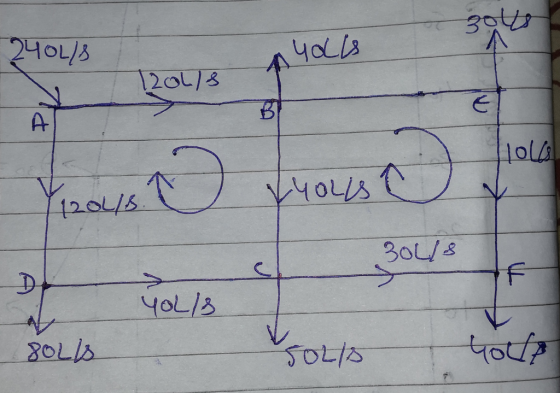
We know, Qcorrect = Q + 
where, 

Assume flow in clockwise direction as positive and vice versa ,
Loop ABCD,
| Pipe | Q (L/s) / m3/s | K | HL (m) | HL/Q ( m /m3/s) |
| AB | 120 / 0.12 | 47.64 | 0.68 | 5.667 |
| BC | 40 / 0.04 | 47.64 | 0.076 | 1.9 |
| DC | -40 / -0.04 | 47.64 | -0.076 | -1.9 |
| DA | -120 / -0.12 | 47.64 | -0.68 | -5.667 |
=> 

Here, 
=> 
=> Qcorrect for pipe ;
AB = 120 L/s
BC = 40 L/s
DC = 40 L/s
AD = 120 L/s
Loop BEFC
| Pipe | Q (L/s) / m3/s | K | HL (m) | HL/Q ( m /m3/s) |
| BE | 40 / 0.04 | 47.64 | 0.076 | 1.90 |
| EF | 10 / 0.01 | 47.64 | 0.0047 | 4.70 |
| CF | -30 / -0.03 | 47.64 | -0.0428 | 1.427 |
| BC | -40 / -0.04 | 47.64 | -0.076 | 1.90 |
=> 

= - 0.0042/ 2(9.927)
= - 0.00021 m3/s or 0.21 L/s
=> Qcorrect for pipe :
BE = 40 - 0.21 = 39.79 L/s
EF = 10 - 0.21 = 9.71 L/s
CF = - 30 - 0.21 = 30.21 L/s
BC = -40 - 0.21 = 40.21 L/s
Ans c) Following are the pressure head at each node
A -> 70 - 30 = 40 m
B = 31.26 m
C = 21.20 m
D = 28.56 m
E = 14.94 m
F = 38.54 m
Add Answer to:
A pipe network is given below (Figure 2). All pipes are 1 km long, and 500...
Question 1 The figure below shows a simple water pipe network. Relevant pipe properties are given...
 Question 1 The figure below shows a simple water pipe network. Relevant pipe properties are given in the figure and table below. The major losses of the pipes can be calculated by Darcy Weisbach equation. The friction factor () for all pipes is 0.015. Assuming that minor losses in the pipe network can be ignored and the pipe network is on a horizontal plane, determine the flow rates in all pipes using Hardy Cross method. Also, calculate the pressure head...
The water network in Figure 1 consists of two inflows at Node A and B. Assume...
 The water network in Figure 1 consists of two inflows at Node A and B. Assume that all pipes have a diameter of 350 mm and a length of 750 m and a Darcy friction factor, A, for all pipes of 0 012 Assume the initial flow through pipe AB and AD to be equal, and pipe CE to carry 80 L/'s. Use the Hardy-Cross method to determine flows in all pipes The elevation at node A is 87 m...
4. Figure 2 shows two reservoirs which are connected by three pipes of different diameters. The...
 4. Figure 2 shows two reservoirs which are connected by three pipes of different diameters. The length and diameter of each pipe are given in Table 1. The flow rate in the pipeline is 55 Ls. The entrance and exit from the pipes are sharp and the change between the pipelines in the cross sections is sudden. Assume the friction factor, /for the pipes as 0.01. (a) Analyse all the head losses which occur, giving an expression for each. (7...
Please assist with pipe analysis. Please clearly show your formulas. Thank you in advance Please neatly...
 Please assist with pipe analysis. Please clearly show
your formulas. Thank you in advance
Please neatly set your calculations/tables and show all necessary steps. Thanks in advance. Use the Hardy-Cross Method to analyse the system. Determine the flows in all pipes and residual heads at the various nodes for the node draw-offs given in Figure 1. Use the Hazen- Williams friction formula and assume a friction factor C of 110 for all pipes. The minimum pipe size is 100 mm...
Please assist with pipe analysis. Please clearly show
your formulas. Thank you in advance
Please neatly set your calculations/tables and show all necessary steps. Thanks in advance. Use the Hardy-Cross Method to analyse the system. Determine the flows in all pipes and residual heads at the various nodes for the node draw-offs given in Figure 1. Use the Hazen- Williams friction formula and assume a friction factor C of 110 for all pipes. The minimum pipe size is 100 mm...
[Problem 3] Two reservoirs are connected using the piping network shown in the figure. The pipes ...
 [Problem 3] Two reservoirs are connected using the piping network shown in the figure. The pipes are commercial steel. water is to be pumped using a pump (efficiency = 70%) that draws 8 kw of electric power from the mains. Ignore minor losses. Determine the flow rate through each pipe and the total flow between the reservoirs. Start with a friction factor of 0.02 for all pipes and use the Haaland equation to calculate updated friction factors. Ignore the length...
Using EPANET2.0 Software, determine the flow rate in each pipe for the simple network shown in...
 Using EPANET2.0 Software, determine the flow rate in each pipe
for the simple network shown in the Figure. Assume the fully
turbulent flow exists for all pipes. The pipe lengths, diameters
and the Darcy-Weisbachand Hazen-William roughness factor f for each
pipe are given in the Table.
60U/s 40L/ Question-1 Using EPANET 2.0 Software, determine the flow rate in each pipe for the simple network shown in the Figure. Assume the fully turbulent flow exists for all pipes. The pipe lengths,...
Using EPANET2.0 Software, determine the flow rate in each pipe
for the simple network shown in the Figure. Assume the fully
turbulent flow exists for all pipes. The pipe lengths, diameters
and the Darcy-Weisbachand Hazen-William roughness factor f for each
pipe are given in the Table.
60U/s 40L/ Question-1 Using EPANET 2.0 Software, determine the flow rate in each pipe for the simple network shown in the Figure. Assume the fully turbulent flow exists for all pipes. The pipe lengths,...
Two reservoirs are connected using the piping network shown in the figure. The pipes are commerci...
 Two reservoirs are connected using the piping network shown in
the figure. The pipes are commercial steel. Water is to be pumped
using a pump (efficiency = 70%) that draws 8 kW of electric power
from the mains. Ignore minor losses. Determine the flow rate
through each pipe and the total flow between the reservoirs. Start
with a friction factor of 0.02 for all pipes and use the Haaland
equation to calculate updated friction factors. Ignore the length
of the...
Two reservoirs are connected using the piping network shown in
the figure. The pipes are commercial steel. Water is to be pumped
using a pump (efficiency = 70%) that draws 8 kW of electric power
from the mains. Ignore minor losses. Determine the flow rate
through each pipe and the total flow between the reservoirs. Start
with a friction factor of 0.02 for all pipes and use the Haaland
equation to calculate updated friction factors. Ignore the length
of the...
A 600mm diameter horizontal pipe of length 2km branches into two pipes of 300mm and 450mm...
 A 600mm diameter horizontal pipe of length 2km branches into two pipes of 300mm and 450mm diameter, each 1.6km long (Fig. Q5). The 600mm pipe is at an elevation of 30m and connects reservoir A with water level 50m. The two branched pipes connects reservoir B with water level 100m. A pump is installed in the 600mm pipe and causes the flow from A to B. Calculate the required power of the pump to maintain a flow rate of Im®/s...
Question 1: Calculate the flow in each member of the pipe network shown in Figure 2.4 and also the presure difference i...
 Question 1: Calculate the flow in each member of the pipe network shown in Figure 2.4 and also the presure difference in N/m' between C and iE. Data for the individual pipes is given in the table below. 360 Ve 300 V E 600 V 460 Va 100 Vs Figure 2.4 UET Pipe Length (m) Diameter (mm)Friction coefficient (l) 530 0.020 460 BC700 530 0.020 CD 610 600 0.022 DE601 600 0.018 EA 150 450 0.018 Hint: Assume initially that...
Question 3 A pipe network with two loops is shown in the Figure below. Determine the...
 Question 3 A pipe network with two loops is shown in the Figure below. Determine the flow in each pipe for an: Inflow at the node A: 120 units; and Outflows at junctions B, C and D are of 25, 40 and 55 units respectively The resistance (R or K) for different pipes are: AB: 2; AC: 4; CD: 1; BC: 1; and BD: 5 A
 Question 1 The figure below shows a simple water pipe network. Relevant pipe properties are given in the figure and table below. The major losses of the pipes can be calculated by Darcy Weisbach equation. The friction factor () for all pipes is 0.015. Assuming that minor losses in the pipe network can be ignored and the pipe network is on a horizontal plane, determine the flow rates in all pipes using Hardy Cross method. Also, calculate the pressure head...
 The water network in Figure 1 consists of two inflows at Node A and B. Assume that all pipes have a diameter of 350 mm and a length of 750 m and a Darcy friction factor, A, for all pipes of 0 012 Assume the initial flow through pipe AB and AD to be equal, and pipe CE to carry 80 L/'s. Use the Hardy-Cross method to determine flows in all pipes The elevation at node A is 87 m...
 4. Figure 2 shows two reservoirs which are connected by three pipes of different diameters. The length and diameter of each pipe are given in Table 1. The flow rate in the pipeline is 55 Ls. The entrance and exit from the pipes are sharp and the change between the pipelines in the cross sections is sudden. Assume the friction factor, /for the pipes as 0.01. (a) Analyse all the head losses which occur, giving an expression for each. (7...
 Please assist with pipe analysis. Please clearly show
your formulas. Thank you in advance
Please neatly set your calculations/tables and show all necessary steps. Thanks in advance. Use the Hardy-Cross Method to analyse the system. Determine the flows in all pipes and residual heads at the various nodes for the node draw-offs given in Figure 1. Use the Hazen- Williams friction formula and assume a friction factor C of 110 for all pipes. The minimum pipe size is 100 mm...
Please assist with pipe analysis. Please clearly show
your formulas. Thank you in advance
Please neatly set your calculations/tables and show all necessary steps. Thanks in advance. Use the Hardy-Cross Method to analyse the system. Determine the flows in all pipes and residual heads at the various nodes for the node draw-offs given in Figure 1. Use the Hazen- Williams friction formula and assume a friction factor C of 110 for all pipes. The minimum pipe size is 100 mm...
 [Problem 3] Two reservoirs are connected using the piping network shown in the figure. The pipes are commercial steel. water is to be pumped using a pump (efficiency = 70%) that draws 8 kw of electric power from the mains. Ignore minor losses. Determine the flow rate through each pipe and the total flow between the reservoirs. Start with a friction factor of 0.02 for all pipes and use the Haaland equation to calculate updated friction factors. Ignore the length...
 Using EPANET2.0 Software, determine the flow rate in each pipe
for the simple network shown in the Figure. Assume the fully
turbulent flow exists for all pipes. The pipe lengths, diameters
and the Darcy-Weisbachand Hazen-William roughness factor f for each
pipe are given in the Table.
60U/s 40L/ Question-1 Using EPANET 2.0 Software, determine the flow rate in each pipe for the simple network shown in the Figure. Assume the fully turbulent flow exists for all pipes. The pipe lengths,...
Using EPANET2.0 Software, determine the flow rate in each pipe
for the simple network shown in the Figure. Assume the fully
turbulent flow exists for all pipes. The pipe lengths, diameters
and the Darcy-Weisbachand Hazen-William roughness factor f for each
pipe are given in the Table.
60U/s 40L/ Question-1 Using EPANET 2.0 Software, determine the flow rate in each pipe for the simple network shown in the Figure. Assume the fully turbulent flow exists for all pipes. The pipe lengths,...
 Two reservoirs are connected using the piping network shown in
the figure. The pipes are commercial steel. Water is to be pumped
using a pump (efficiency = 70%) that draws 8 kW of electric power
from the mains. Ignore minor losses. Determine the flow rate
through each pipe and the total flow between the reservoirs. Start
with a friction factor of 0.02 for all pipes and use the Haaland
equation to calculate updated friction factors. Ignore the length
of the...
Two reservoirs are connected using the piping network shown in
the figure. The pipes are commercial steel. Water is to be pumped
using a pump (efficiency = 70%) that draws 8 kW of electric power
from the mains. Ignore minor losses. Determine the flow rate
through each pipe and the total flow between the reservoirs. Start
with a friction factor of 0.02 for all pipes and use the Haaland
equation to calculate updated friction factors. Ignore the length
of the...
 A 600mm diameter horizontal pipe of length 2km branches into two pipes of 300mm and 450mm diameter, each 1.6km long (Fig. Q5). The 600mm pipe is at an elevation of 30m and connects reservoir A with water level 50m. The two branched pipes connects reservoir B with water level 100m. A pump is installed in the 600mm pipe and causes the flow from A to B. Calculate the required power of the pump to maintain a flow rate of Im®/s...
 Question 1: Calculate the flow in each member of the pipe network shown in Figure 2.4 and also the presure difference in N/m' between C and iE. Data for the individual pipes is given in the table below. 360 Ve 300 V E 600 V 460 Va 100 Vs Figure 2.4 UET Pipe Length (m) Diameter (mm)Friction coefficient (l) 530 0.020 460 BC700 530 0.020 CD 610 600 0.022 DE601 600 0.018 EA 150 450 0.018 Hint: Assume initially that...
 Question 3 A pipe network with two loops is shown in the Figure below. Determine the flow in each pipe for an: Inflow at the node A: 120 units; and Outflows at junctions B, C and D are of 25, 40 and 55 units respectively The resistance (R or K) for different pipes are: AB: 2; AC: 4; CD: 1; BC: 1; and BD: 5 A
Most questions answered within 3 hours.
-
Where is the error in this code sequence?
String s1 = "Hello";
String s2 = "ello";...
asked 10 months ago -
Financial data for Joel de Paris, Inc., for last year
follow:
Joel de Paris, Inc.
Balance...
asked 10 months ago -
Consider this reaction:
Al2(SO4)3 (aq)+ BaCl3
(aq) Al2Cl6 (aq)- +
3BaSO4(s) . What is the...
asked 10 months ago -
Suppose that Savneet is considering increasing her
recent random sample from 20 car rentals to 40...
asked 10 months ago -
Trucks arrive at an unloading terminal at an average rate of 120
per hour.
Trucks arrive...
asked 10 months ago -
Why are methanol and ethanol completely soluble in water while
octanol is not very little soluble....
asked 10 months ago -
A facilities manager at a university reads in a research report
that the mean amount of...
asked 10 months ago -
When the CuSO4 is rehydrated by adding water to the anhydrous
compound, is this an endothermic...
asked 10 months ago -
A ray of sunlight is passing from diamond into crown glass; the
angle of incidence is...
asked 10 months ago -
A block of mass 0.249 kg is placed on top of a light, vertical
spring of...
asked 10 months ago -
how do the kidneys compensate in the presences of acidosis
a) trigger hyperventilate
b) reserve acid...
asked 10 months ago -
Question 501 pts
The rental rate of capital to the firm increases. Which of the
following...
asked 10 months ago