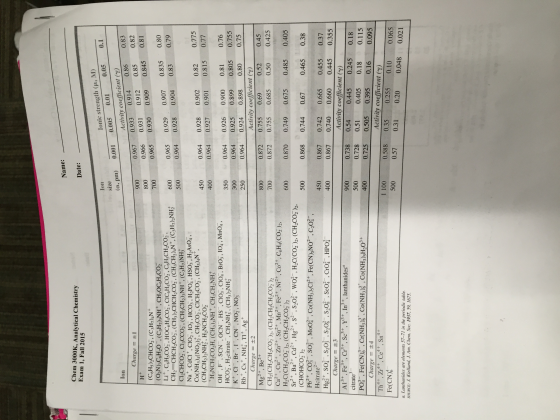
1- Calculate activity coefficient of Mg2+ in a 0.0100 M MgCl2 solution. a - By linear...
1- Calculate activity coefficient  of Mg2+ in a 0.0100 M MgCl2
solution.
of Mg2+ in a 0.0100 M MgCl2
solution.
a - By linear interpolation data in table 7-1
b - By using extended Debye-Huckel equation
Homework Answers
a) From the data given we find,
| Ionic strength(micro Molar) | Activity coeffcient | -log(activity coefficient) |
| 0.001 | 0.872 | 0.059483515 |
| 0.005 | 0.755 | 0.122053048 |
| 0.01 | 0.69 | 0.161150909 |
| 0.05 | 0.52 | 0.283996656 |
| 0.1 | 0.45 | 0.346787486 |
Plotting log(activity coefficient), log()
versus ionic strength, we get

Based on the curve fit we find,
log() = 0.063
* Ionic strength + 0.474
At Ionic strength = 0.01M,
log() =
0.063*ln(0.01) + 0.474
= 0.183874
Therefore,
for Mg2+
from interpolation = exp(-0.183874)
for Mg2+
from interpolation = 0.83204
b) From Debye-Huckel theory,
log() = -
A*z1*z2*I^0.5
where A = 0.509,
z1 is the charge on the ion 1
z1 is the charge of the ion 2
I is the ionic strength given by
I =0.5* Cizi^2
For MgCl2,
I = 0.5* (0.01*2^2+0.02*1^2)
= 0.03
log() = -
0.509*2*1*(0.03)^0.5
= - 0.176323
Therefore,
for Mg2+
from Debye Huckel theory = exp(-0.176323)
for Mg2+
from Debye Huckel theory = 0.838347
Add Answer to:
1- Calculate activity coefficient of Mg2+ in a 0.0100 M MgCl2 solution. a - By linear...
Activity Calculate the activity coefficient, y, of Fe2+ when the ionic strength of the solution, μ...
 Activity Calculate the activity coefficient, y, of Fe2+ when the ionic strength of the solution, μ , is 0.074 M lonic Strength Coefficient 2+ (a) by linear interpolation of the data in the table to the right; 0.001 0.005 0.01 0.05 0.1 0.870 0.749 0.675 0.485 0.405 Number Fe (b) by using the extended Debye-Huckel equation at 25°C, where the ion size is 600 pm Number Fe
Calculate the activity coefficient, ?, of Cu2 when the ionic strength of the solution, ? ,...
 Calculate the activity coefficient, ?, of Cu2 when the ionic
strength of the solution, ? , is 0.078 M:
(a) by linear interpolation of the data in the table to the
right;
yCu2+ = 0.440
(b) by using the extended Debye-Huckel equation at 25°C, where
the ion size is 600 pm.
yCu2+ =
answer to part a is correct.
ionic strength (,M)
activity coeffient
Cu2+
0.001
0.870
0.005
0.749
0.01
0.675
0.05
0.485
0.1
0.405
Calculate the activity coefficient, ?, of Cu2 when the ionic
strength of the solution, ? , is 0.078 M:
(a) by linear interpolation of the data in the table to the
right;
yCu2+ = 0.440
(b) by using the extended Debye-Huckel equation at 25°C, where
the ion size is 600 pm.
yCu2+ =
answer to part a is correct.
ionic strength (,M)
activity coeffient
Cu2+
0.001
0.870
0.005
0.749
0.01
0.675
0.05
0.485
0.1
0.405
Calculate the activity coefficient, y, of Snt when the ionic strength of the solution, , is...
 Calculate the activity coefficient, y, of Snt when the ionic strength of the solution, , is 0.062 M by linear interpolation of the data in the table. Ionic strength (H, M) 0.001 Activity coefficient (75m?) 0.870 0.005 0.43 0.749 YSa+= 0.01 0.05 10.1 0.675 0.485 0.405 Calculate the activity coefficient, y of Snt when the ionic strength of the solution, , is 0.062 M by using the extended Debye-Hückel equation at 25 °C, where the ion size is 600 pm....
Calculate the activity coefficient, γ, of Sn2+ when the ionic strength of the solution, μ, is...
Calculate the activity coefficient, γ, of Sn2+ when the ionic strength of the solution, μ, is 0.059 M by linear interpolation of the data in the table. Ionic strength (μ, M) Activity coefficient (γSn2+) 0.001 0.870 0.005 0.749 0.01 0.675 0.05 0.485 0.1 0.405 γSn2+= Calculate the activity coefficient, γ, of Sn2+ when the ionic strength of the solution, μ, is 0.059 M by using the extended Debye-Hückel equation at 25 °C, where the ion size is 600 pm. γSn2+=
Question 6 of 11 Calculate the activity coefficient, y, of Ca2 when the ionic Y. Ionic Activity strength of the sol...
 Question 6 of 11 Calculate the activity coefficient, y, of Ca2 when the ionic Y. Ionic Activity strength of the solution, , is 0.083 M by linear interpolation of the data in the table. strength (и, М) coefficient (YCa) 0.001 0.870 0.005 0.749 YCa+ 0.01 0.675 0.05 0.485 Calculate the activity coefficient, y, of Ca2+ when the ionic strength of the solution, u, is 0.083 M by using the extended Debye-Hückel equation at 25 °C, where the ion size is...
What is the activity [A] of Na+ in a .05M solution of NaCl at 25C? You...
What is the activity [A] of Na+ in a .05M solution of NaCl at 25C? You will need to use the extended Debye-Huckel equation to calculate the activity coefficient [Y] of Na+.
when u 7-6.Calculate the activity coefficient of Zn2 when p using (a) Equation 7-6; (b) linear...
 when u 7-6.Calculate the activity coefficient of Zn2 when p using (a) Equation 7-6; (b) linear interpolation in Table 7-1 0.083 M by 0.083 M by .3+..ban
Use the Debye-Huckel equation to calculate the activity coefficient of the following ions in an aqueous...
 Use the Debye-Huckel equation to calculate the activity coefficient of the following ions in an aqueous solution at 25 degree C. CrO_4^2- in a solution where mu = 0.0831 M Cr^3^+ in a solution where mu = 0.0350 M
The answers to these two questions must be calculated accurately to at least three decimal places....
The answers to these two questions must be calculated accurately to at least three decimal places. Use the Extended Debye-Hückel equation to calculate the activity coefficient of Fe2+ in a solution of ionic strength μ= 0.0056 M at 25 °C. γ = Now, determine a value for this same activity coefficient by linear interpolation from the values listed in Table 7-1, D.C. Harris, "Quantitative Chemical Analysis", 8th ed. γ =
Resources Use the Debye-Hückel equation to calculate the activity coefficient of each ion at the ...
 Resources Use the Debye-Hückel equation to calculate the activity coefficient of each ion at the given ionic strength in an aqueous solution at 25 °C Zn2+ in a solution where μ-0.0234 M Ion Ion size (a, nm) Pb20.450 Mg2+0.800 Zn+ 0.600 Cro0400 0.900 0400 1.100 Cr3+ Cr?+ in a solution where 0.0850 M 1.100 QCA9e_ch06 TB...docx QCA9e cho7 TB...docx
Resources Use the Debye-Hückel equation to calculate the activity coefficient of each ion at the given ionic strength in an aqueous...
Resources Use the Debye-Hückel equation to calculate the activity coefficient of each ion at the given ionic strength in an aqueous solution at 25 °C Zn2+ in a solution where μ-0.0234 M Ion Ion size (a, nm) Pb20.450 Mg2+0.800 Zn+ 0.600 Cro0400 0.900 0400 1.100 Cr3+ Cr?+ in a solution where 0.0850 M 1.100 QCA9e_ch06 TB...docx QCA9e cho7 TB...docx
Resources Use the Debye-Hückel equation to calculate the activity coefficient of each ion at the given ionic strength in an aqueous...
 Activity Calculate the activity coefficient, y, of Fe2+ when the ionic strength of the solution, μ , is 0.074 M lonic Strength Coefficient 2+ (a) by linear interpolation of the data in the table to the right; 0.001 0.005 0.01 0.05 0.1 0.870 0.749 0.675 0.485 0.405 Number Fe (b) by using the extended Debye-Huckel equation at 25°C, where the ion size is 600 pm Number Fe
 Calculate the activity coefficient, ?, of Cu2 when the ionic
strength of the solution, ? , is 0.078 M:
(a) by linear interpolation of the data in the table to the
right;
yCu2+ = 0.440
(b) by using the extended Debye-Huckel equation at 25°C, where
the ion size is 600 pm.
yCu2+ =
answer to part a is correct.
ionic strength (,M)
activity coeffient
Cu2+
0.001
0.870
0.005
0.749
0.01
0.675
0.05
0.485
0.1
0.405
Calculate the activity coefficient, ?, of Cu2 when the ionic
strength of the solution, ? , is 0.078 M:
(a) by linear interpolation of the data in the table to the
right;
yCu2+ = 0.440
(b) by using the extended Debye-Huckel equation at 25°C, where
the ion size is 600 pm.
yCu2+ =
answer to part a is correct.
ionic strength (,M)
activity coeffient
Cu2+
0.001
0.870
0.005
0.749
0.01
0.675
0.05
0.485
0.1
0.405
 Calculate the activity coefficient, y, of Snt when the ionic strength of the solution, , is 0.062 M by linear interpolation of the data in the table. Ionic strength (H, M) 0.001 Activity coefficient (75m?) 0.870 0.005 0.43 0.749 YSa+= 0.01 0.05 10.1 0.675 0.485 0.405 Calculate the activity coefficient, y of Snt when the ionic strength of the solution, , is 0.062 M by using the extended Debye-Hückel equation at 25 °C, where the ion size is 600 pm....
 Question 6 of 11 Calculate the activity coefficient, y, of Ca2 when the ionic Y. Ionic Activity strength of the solution, , is 0.083 M by linear interpolation of the data in the table. strength (и, М) coefficient (YCa) 0.001 0.870 0.005 0.749 YCa+ 0.01 0.675 0.05 0.485 Calculate the activity coefficient, y, of Ca2+ when the ionic strength of the solution, u, is 0.083 M by using the extended Debye-Hückel equation at 25 °C, where the ion size is...
 when u 7-6.Calculate the activity coefficient of Zn2 when p using (a) Equation 7-6; (b) linear interpolation in Table 7-1 0.083 M by 0.083 M by .3+..ban
 Use the Debye-Huckel equation to calculate the activity coefficient of the following ions in an aqueous solution at 25 degree C. CrO_4^2- in a solution where mu = 0.0831 M Cr^3^+ in a solution where mu = 0.0350 M
 Resources Use the Debye-Hückel equation to calculate the activity coefficient of each ion at the given ionic strength in an aqueous solution at 25 °C Zn2+ in a solution where μ-0.0234 M Ion Ion size (a, nm) Pb20.450 Mg2+0.800 Zn+ 0.600 Cro0400 0.900 0400 1.100 Cr3+ Cr?+ in a solution where 0.0850 M 1.100 QCA9e_ch06 TB...docx QCA9e cho7 TB...docx
Resources Use the Debye-Hückel equation to calculate the activity coefficient of each ion at the given ionic strength in an aqueous...
Resources Use the Debye-Hückel equation to calculate the activity coefficient of each ion at the given ionic strength in an aqueous solution at 25 °C Zn2+ in a solution where μ-0.0234 M Ion Ion size (a, nm) Pb20.450 Mg2+0.800 Zn+ 0.600 Cro0400 0.900 0400 1.100 Cr3+ Cr?+ in a solution where 0.0850 M 1.100 QCA9e_ch06 TB...docx QCA9e cho7 TB...docx
Resources Use the Debye-Hückel equation to calculate the activity coefficient of each ion at the given ionic strength in an aqueous...
Most questions answered within 3 hours.
-
Where is the error in this code sequence?
String s1 = "Hello";
String s2 = "ello";...
asked 10 months ago -
Financial data for Joel de Paris, Inc., for last year
follow:
Joel de Paris, Inc.
Balance...
asked 10 months ago -
Consider this reaction:
Al2(SO4)3 (aq)+ BaCl3
(aq) Al2Cl6 (aq)- +
3BaSO4(s) . What is the...
asked 10 months ago -
Suppose that Savneet is considering increasing her
recent random sample from 20 car rentals to 40...
asked 10 months ago -
Trucks arrive at an unloading terminal at an average rate of 120
per hour.
Trucks arrive...
asked 10 months ago -
Why are methanol and ethanol completely soluble in water while
octanol is not very little soluble....
asked 10 months ago -
A facilities manager at a university reads in a research report
that the mean amount of...
asked 10 months ago -
When the CuSO4 is rehydrated by adding water to the anhydrous
compound, is this an endothermic...
asked 10 months ago -
A ray of sunlight is passing from diamond into crown glass; the
angle of incidence is...
asked 10 months ago -
A block of mass 0.249 kg is placed on top of a light, vertical
spring of...
asked 10 months ago -
how do the kidneys compensate in the presences of acidosis
a) trigger hyperventilate
b) reserve acid...
asked 10 months ago -
Question 501 pts
The rental rate of capital to the firm increases. Which of the
following...
asked 10 months ago