
Homework Answers
Price of candy = $2
Price of banana = $1
Income = $8
1) Consumption bundle can be = (Candy, Banana) = (1,6), (2,4), (3,2) ,(4,0)
First bundle is not possible as maximum 5 units can be consumed.
Second bundle would give us the utility of 94 + 128 = 222
Third bundle would give us 132 + 76 = 208
Forth bundle is also not possible as atleast 1 units is consumed both goods.
Thus second bundle would give which consume 2 units of candy and 4 units of banana are consumed.
2) If 3 candy and 2 banana are consumed, I have already calculated the utility from this consumption bundle which is 208 and is less than the utility calculated in part above. Thus I will not consume this bundle as this gives less utility.
3) 
4) When price of candy rises, consumption of
candy falls to unit X.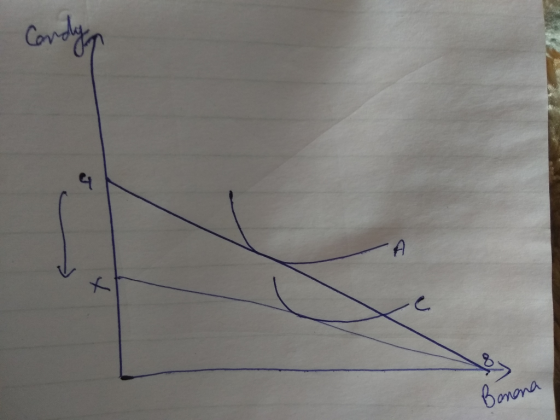
5) Initial consumption is at point A. When
price falls, consumption changes to point C as price of candy
rises, consumer consumes more banana and less candy. When we draw a
budget line parllel to initial line named as A'B' and consumer
shifts to point B. The distance from A to B is income effect and B
to C is substitution effect.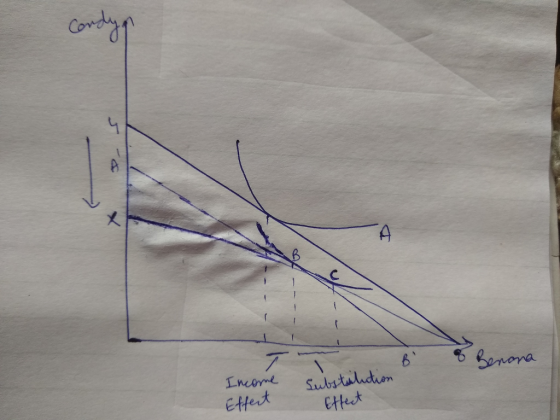
6) Candy is a normal good as when price of candy rises, consumption falls.
Add Answer to:
ZOOM Page 2 of 2 D. Consumer Decision Making Total Utility Candy Total Bananas Utility 1...
1. Suppose a consumer is maximizing utility consuming a bundle apples and bananas x and has...
 1. Suppose a consumer is maximizing utility consuming a bundle apples and bananas x and has standard preferences. Her budget constraint is given by the equation 1000-2a-2b0. Apples are normal goods and bananas are normal. a) plot the optimal bundle, showing the proper indifference curve and budget constraint. Call this bundle x1 b) show the effect of an increase of a single price increase for apples on the budget constraint. Use a hypothetical budget line to identify substitution effects for...
4. Charlie likes both apples and bananas. He consumes nothing else. Charlie consumes x bushels of apples per year...
 4. Charlie likes both apples and bananas. He consumes nothing else. Charlie consumes x bushels of apples per year and x bushels of bananas per year. Suppose that Charlie's preference is represented in the following utility function: u(x,,Xy)-x,Xy . Suppose that the price of apples is S1, the price of bananas is S2, and Charlie's income is $40. (14 points) a. Draw Charlie's budget line. Plot a few points on the indifference curve that gives Charlie a utility of 150...
4- Consumer utility Quantity Total Utility from A Total Utility from B 1 40 37 2...
4- Consumer utility Quantity Total Utility from A Total Utility from B 1 40 37 2 76 72 3 108 105 4 136 136 5 160 165 6 180 192 7 196 217 8 208 237 9 216 252 10 220 262 11 220 267 12 216 267 13 208 262 14 196 252 15 180 237 You are given the above total utilities for different consumption amounts of goods A and B. The consumer has a budget of 60,...
1. Charlie’s utility function for weekly consumption of bananas (B) and Apples (A) is given by...
1. Charlie’s utility function for weekly consumption of bananas (B) and Apples (A) is given by U = BA . a. Suppose Charlie consumes 20 bananas and 10 apples in a week. Sketch his indifference curve through that bundle on a diagram. (While it doesn’t really matter which good is on the horizontal axis, for consistency with our classwork, assume bananas are on the horizontal axis.) b. Use calculus (partial derivatives) to derive formulas for the marginal utilities (MU) of...
Charlie’s utility function is U(xA, xB) = xAxB. Suppose that the price of apples is 1,...
Charlie’s utility function is U(xA, xB) = xAxB. Suppose that the price of apples is 1, the price of bananas is 2, and Charlie’s income is 40. (a) On a graph, use blue ink to draw Charlie’s budget line. (Use a ruler and try to make this line accurate.) Plot a few points on the indifference curve that gives Charlie a utility of 150 and sketch this curve with red ink. Now plot a few points on the indifference curve...
Imagine a representative consumer, whose utility for apples (X) and all other goods (Y) can be...
Imagine a representative consumer, whose utility for apples (X) and all other goods (Y) can be represented in a Cobb-Douglas form. 1. Please graphically represent consumer indifference curves, given prices Px and Py and the budget constraint M. 2. What will happen to consumer utility and optimal bundle if consumer income (budget) increases and apples are a necessity good? Please show graphically and explain the intuition. 3. What will happen to consumer utility and optimal bundle if apple price decreases...
Question 2: Lorelai's choice behavior can be represented by the utility function u(x1, 2)0.9Inx)0.1x2 The prices...
 Question 2: Lorelai's choice behavior can be represented by the utility function u(x1, 2)0.9Inx)0.1x2 The prices of both x1 and x2 are $5 and she has an income of $40. 1. What preference does this utility function represent? (Hint: the utility is function is not linear, 2. Drawinwg indifference curves: you can copy down the graph on your paper using econgraphs. Set but at least linear in good x2) the preferences and parameters accordingly as given in the question. Click...
A consumer has the utility function U(X, Y) = (X + 2)(Y + 4). Her income is...
A consumer has the utility function U(X, Y) = (X + 2)(Y + 4). Her income is $100, the price of X is $4, and the price of Y is $5. In order to maximize utility subject to her budget constraint, how many units of X and Y will our consumer choose to purchase? Sketch a budget line – indifference curve diagram illustrating this optimum. Label this optimum A. Suppose the price of X increases to $8, while income and the price...
Lorelai's choice behavior can be represented by the utility function u(x1, 2) 0.9n(x)0.1x2. The prices of...
 Lorelai's choice behavior can be represented by the utility function u(x1, 2) 0.9n(x)0.1x2. The prices of both xi and x2 are $5 and she has an income of $40. 1. What preference does this utility function represent? (Hint: the utility is function is not linear, but at least linear in good x2) 2. Drawinwg indifference curves: you can copy down the graph on your paper using econgraphs. Set the preferences and parameters accordingly as given in the question. Click on...
Utility Max.docx Page 3 of 3 Yaomin is an aficionado of the true baseball experience. Every week during 2....
 Utility Max.docx Page 3 of 3 Yaomin is an aficionado of the true baseball experience. Every week during 2. baseball season, he budgets $128 for the game and hot dogs. Assume the price of a hot dog is $2.00 and the price of a baseball game is $60.00. Given the information below about Yaomin's preferences for hot dogs and baseball games, determine his optimal choice of games and hot dogs for each week of the baseball season. Show your work....
 1. Suppose a consumer is maximizing utility consuming a bundle apples and bananas x and has standard preferences. Her budget constraint is given by the equation 1000-2a-2b0. Apples are normal goods and bananas are normal. a) plot the optimal bundle, showing the proper indifference curve and budget constraint. Call this bundle x1 b) show the effect of an increase of a single price increase for apples on the budget constraint. Use a hypothetical budget line to identify substitution effects for...
 4. Charlie likes both apples and bananas. He consumes nothing else. Charlie consumes x bushels of apples per year and x bushels of bananas per year. Suppose that Charlie's preference is represented in the following utility function: u(x,,Xy)-x,Xy . Suppose that the price of apples is S1, the price of bananas is S2, and Charlie's income is $40. (14 points) a. Draw Charlie's budget line. Plot a few points on the indifference curve that gives Charlie a utility of 150...
 Question 2: Lorelai's choice behavior can be represented by the utility function u(x1, 2)0.9Inx)0.1x2 The prices of both x1 and x2 are $5 and she has an income of $40. 1. What preference does this utility function represent? (Hint: the utility is function is not linear, 2. Drawinwg indifference curves: you can copy down the graph on your paper using econgraphs. Set but at least linear in good x2) the preferences and parameters accordingly as given in the question. Click...
 Lorelai's choice behavior can be represented by the utility function u(x1, 2) 0.9n(x)0.1x2. The prices of both xi and x2 are $5 and she has an income of $40. 1. What preference does this utility function represent? (Hint: the utility is function is not linear, but at least linear in good x2) 2. Drawinwg indifference curves: you can copy down the graph on your paper using econgraphs. Set the preferences and parameters accordingly as given in the question. Click on...
 Utility Max.docx Page 3 of 3 Yaomin is an aficionado of the true baseball experience. Every week during 2. baseball season, he budgets $128 for the game and hot dogs. Assume the price of a hot dog is $2.00 and the price of a baseball game is $60.00. Given the information below about Yaomin's preferences for hot dogs and baseball games, determine his optimal choice of games and hot dogs for each week of the baseball season. Show your work....
Most questions answered within 3 hours.
-
Where is the error in this code sequence?
String s1 = "Hello";
String s2 = "ello";...
asked 10 months ago -
Financial data for Joel de Paris, Inc., for last year
follow:
Joel de Paris, Inc.
Balance...
asked 10 months ago -
Consider this reaction:
Al2(SO4)3 (aq)+ BaCl3
(aq) Al2Cl6 (aq)- +
3BaSO4(s) . What is the...
asked 10 months ago -
Suppose that Savneet is considering increasing her
recent random sample from 20 car rentals to 40...
asked 10 months ago -
Trucks arrive at an unloading terminal at an average rate of 120
per hour.
Trucks arrive...
asked 10 months ago -
Why are methanol and ethanol completely soluble in water while
octanol is not very little soluble....
asked 10 months ago -
A facilities manager at a university reads in a research report
that the mean amount of...
asked 10 months ago -
When the CuSO4 is rehydrated by adding water to the anhydrous
compound, is this an endothermic...
asked 10 months ago -
A ray of sunlight is passing from diamond into crown glass; the
angle of incidence is...
asked 10 months ago -
A block of mass 0.249 kg is placed on top of a light, vertical
spring of...
asked 10 months ago -
how do the kidneys compensate in the presences of acidosis
a) trigger hyperventilate
b) reserve acid...
asked 10 months ago -
Question 501 pts
The rental rate of capital to the firm increases. Which of the
following...
asked 10 months ago