
Homework Answers
1:-
If the undissolved KHT remains in the titration flask the Ksp reading will be higher because , as the NaOH will react with the dissolved KHT the undissolved form will get converted to dissolved form and it will also consume NaOH , hence the consumption of NaOH will be higher .
Which means , the more the solubilised KHT were present.
2:-The distilled watet is deionised water , hence it does no alter the affect chemiaclly but the only things matter is the dilution of the NaOH with the water droplets stick to the inner walls of the burette. Hence it effect the calculation by highering the Ksp with a little deviation, which can be considered as unaffected.
Add Answer to:
1. If the undissolved KHT is not filtered out before the titration with NaOH, will the...
3. Consider the analysis of the ammonia content in this experiment. If the buret used in...
 3. Consider the analysis of the ammonia content in this experiment. If the buret used in the titration was rinsed with distilled water, but not dried or conditioned before use, would the calculated number of moles of ammonia per gram of complex be too high, too low, or unaffected? Briefly Explain. If the titration flask was rinsed with distilled water but not dried before use, would the calculated number of moles of ammonia per gram of complex be too high,...
1. Consider the complex ion [Pt(NH3)4Cl2]*?. Note: Include charges for any ions. a. Identify the Lewis...
 1. Consider the complex ion [Pt(NH3)4Cl2]*?. Note: Include charges for any ions. a. Identify the Lewis acid(s). b. Identify the Lewis base(s). c. What is the coordination number? 2. Consider the analysis of the copper content in this experiment. If the cuvets used in the spectrophotometer were rinsed with distilled water, but not dried or conditioned (lined) before use, would the calculated number of moles of copper per gram of complex be too high, too low, or unaffected? Briefly explain....
If the titration flask is rinsed with distilled water and not dried, will the calculated value...
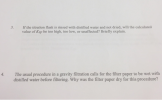 If the titration flask is rinsed with distilled water and not dried, will the calculated value of Ksp be too high, too low, or unaffected? Briefly explain. The usual procedure in a gravity filtration calls for the filter paper to be wet with distilled water before filtering. Why was the filter paper dry for this procedure?
Consider the analysis of the copper content in this experiment. 2. If the cuvets used in...
 Consider the analysis of the copper content in this experiment. 2. If the cuvets used in the spectrophotometer were rinsed with distilled water, but not dried or conditioned (lined) before use, would the calculated number of moles of copper per gram of complex be too high, too low, or unaffected? Briefly explain.
KHT in water KHT in KCI 1a. How did the molar solubility of KHT in pure...
 KHT in water
KHT in KCI
1a. How did the molar solubility of KHT in pure water compare to
its molar solubility of KHT in KCl solution? Why?
1b. How did the solubility product constant Ksp of
KHT in pure water compare to its solubility product constant
Ksp of KHT in KCl solution? Why?
1c. If all the undissolved KHT was not filtered out from the
solution prior to titrating, would the calculated molar solubility
of KHT be greater or...
KHT in water
KHT in KCI
1a. How did the molar solubility of KHT in pure water compare to
its molar solubility of KHT in KCl solution? Why?
1b. How did the solubility product constant Ksp of
KHT in pure water compare to its solubility product constant
Ksp of KHT in KCl solution? Why?
1c. If all the undissolved KHT was not filtered out from the
solution prior to titrating, would the calculated molar solubility
of KHT be greater or...
For vinegar titration in this experiment, would the following errors cause the % acetic acid in vinegar determined to be...
 For vinegar titration in this experiment, would the
following errors cause the % acetic acid in vinegar determined to
be (A) too large, (B) too small, (C) no effect, or (D) not enough
information to answer. Assume that the mistake given is the only
mistake made in the experiment. EXPLAIN.
1.) The burst is rinsed with distilled water, but not NaOH solution
before the vinegar sample is titrated.
2.) After standardization, the NaOH solution is not stoppered and
obsorbs CO2...
For vinegar titration in this experiment, would the
following errors cause the % acetic acid in vinegar determined to
be (A) too large, (B) too small, (C) no effect, or (D) not enough
information to answer. Assume that the mistake given is the only
mistake made in the experiment. EXPLAIN.
1.) The burst is rinsed with distilled water, but not NaOH solution
before the vinegar sample is titrated.
2.) After standardization, the NaOH solution is not stoppered and
obsorbs CO2...
ALL THE INFO YOU NEED IS BELOW average volume of NaOH: 15.7 mL or 0.0157 L...
 ALL THE INFO YOU NEED IS BELOW
average volume of NaOH: 15.7 mL or
0.0157 L
average number of moles of NaOH added:
6.28*10-4 moles
molar concentration of [HT] in saturated solution(HT–
acts as a monoprotic acid, reacting with NaOH in a 1:1 ratio
(Volume of KHT measured using 25.00 mL volumetric pipet.)):
0.2512 M
Analysis of KHT in water
1. Weigh out 0.8 grams of potassium hydrogen tartrate (KHT) on
weighing paper. Add the KHT to a clean dry...
ALL THE INFO YOU NEED IS BELOW
average volume of NaOH: 15.7 mL or
0.0157 L
average number of moles of NaOH added:
6.28*10-4 moles
molar concentration of [HT] in saturated solution(HT–
acts as a monoprotic acid, reacting with NaOH in a 1:1 ratio
(Volume of KHT measured using 25.00 mL volumetric pipet.)):
0.2512 M
Analysis of KHT in water
1. Weigh out 0.8 grams of potassium hydrogen tartrate (KHT) on
weighing paper. Add the KHT to a clean dry...
i need all answers Data Table 1: Titration of Vinegar with Sodium Hydroxide Vinegar Sample 1...
 i
need all answers
Data Table 1: Titration of Vinegar with Sodium Hydroxide Vinegar Sample 1 Vinegar Sample 2 Vinegar Sample 3 Mass of Vinegar (6) Volume of Vinegar (ml) Density - 1.005 g/ml Initial NaOH volume in syringe (ml) Final NaOH volume in syringe (ml) Volume of NaOH delivered (mL) Volume of NaOH delivered (L) Molarity of NaOH Moles of NaOH delivered Reaction of NaOH with Acetic Acid Moles of Acetic Acid in vinegar sample Molar mass of Acetic...
i
need all answers
Data Table 1: Titration of Vinegar with Sodium Hydroxide Vinegar Sample 1 Vinegar Sample 2 Vinegar Sample 3 Mass of Vinegar (6) Volume of Vinegar (ml) Density - 1.005 g/ml Initial NaOH volume in syringe (ml) Final NaOH volume in syringe (ml) Volume of NaOH delivered (mL) Volume of NaOH delivered (L) Molarity of NaOH Moles of NaOH delivered Reaction of NaOH with Acetic Acid Moles of Acetic Acid in vinegar sample Molar mass of Acetic...
2. A 0.500-gram sample of a weak, nonvolatile monoprotic acid, HA, was dissolved in sufficient water...
 2. A 0.500-gram sample of a weak, nonvolatile monoprotic acid, HA, was dissolved in sufficient water to make 50.0 milliliters of solution. The solution was then titrated with a standard NaOH solution. Predict how the calculated molar mass of HA would be affected (too high, too low, or not affected) by the following laboratory procedures. Explain each of your answers. A. (2 points.). After rinsing the buret with distilled water, the buret is filled with the standard NaOH solution; the...
ost-Lab Questions 1. A student determines that 37.2 mL of 0.1543 M NaOH is required to...
 ost-Lab Questions 1. A student determines that 37.2 mL of 0.1543 M NaOH is required to titrate 25.0 mL HCl. What is the concentration of the acid? 2. The student consistently titrates to a dark pink endpoint. Will the reported value for the concentration of the acid be too high, too low, or unaffected by the dark pink endpoint? 3. Another student performs the titration and does not notice the air bubbles trapped in the tip of the buret. How...
 3. Consider the analysis of the ammonia content in this experiment. If the buret used in the titration was rinsed with distilled water, but not dried or conditioned before use, would the calculated number of moles of ammonia per gram of complex be too high, too low, or unaffected? Briefly Explain. If the titration flask was rinsed with distilled water but not dried before use, would the calculated number of moles of ammonia per gram of complex be too high,...
 1. Consider the complex ion [Pt(NH3)4Cl2]*?. Note: Include charges for any ions. a. Identify the Lewis acid(s). b. Identify the Lewis base(s). c. What is the coordination number? 2. Consider the analysis of the copper content in this experiment. If the cuvets used in the spectrophotometer were rinsed with distilled water, but not dried or conditioned (lined) before use, would the calculated number of moles of copper per gram of complex be too high, too low, or unaffected? Briefly explain....
 If the titration flask is rinsed with distilled water and not dried, will the calculated value of Ksp be too high, too low, or unaffected? Briefly explain. The usual procedure in a gravity filtration calls for the filter paper to be wet with distilled water before filtering. Why was the filter paper dry for this procedure?
 Consider the analysis of the copper content in this experiment. 2. If the cuvets used in the spectrophotometer were rinsed with distilled water, but not dried or conditioned (lined) before use, would the calculated number of moles of copper per gram of complex be too high, too low, or unaffected? Briefly explain.
 KHT in water
KHT in KCI
1a. How did the molar solubility of KHT in pure water compare to
its molar solubility of KHT in KCl solution? Why?
1b. How did the solubility product constant Ksp of
KHT in pure water compare to its solubility product constant
Ksp of KHT in KCl solution? Why?
1c. If all the undissolved KHT was not filtered out from the
solution prior to titrating, would the calculated molar solubility
of KHT be greater or...
KHT in water
KHT in KCI
1a. How did the molar solubility of KHT in pure water compare to
its molar solubility of KHT in KCl solution? Why?
1b. How did the solubility product constant Ksp of
KHT in pure water compare to its solubility product constant
Ksp of KHT in KCl solution? Why?
1c. If all the undissolved KHT was not filtered out from the
solution prior to titrating, would the calculated molar solubility
of KHT be greater or...
 For vinegar titration in this experiment, would the
following errors cause the % acetic acid in vinegar determined to
be (A) too large, (B) too small, (C) no effect, or (D) not enough
information to answer. Assume that the mistake given is the only
mistake made in the experiment. EXPLAIN.
1.) The burst is rinsed with distilled water, but not NaOH solution
before the vinegar sample is titrated.
2.) After standardization, the NaOH solution is not stoppered and
obsorbs CO2...
For vinegar titration in this experiment, would the
following errors cause the % acetic acid in vinegar determined to
be (A) too large, (B) too small, (C) no effect, or (D) not enough
information to answer. Assume that the mistake given is the only
mistake made in the experiment. EXPLAIN.
1.) The burst is rinsed with distilled water, but not NaOH solution
before the vinegar sample is titrated.
2.) After standardization, the NaOH solution is not stoppered and
obsorbs CO2...
 ALL THE INFO YOU NEED IS BELOW
average volume of NaOH: 15.7 mL or
0.0157 L
average number of moles of NaOH added:
6.28*10-4 moles
molar concentration of [HT] in saturated solution(HT–
acts as a monoprotic acid, reacting with NaOH in a 1:1 ratio
(Volume of KHT measured using 25.00 mL volumetric pipet.)):
0.2512 M
Analysis of KHT in water
1. Weigh out 0.8 grams of potassium hydrogen tartrate (KHT) on
weighing paper. Add the KHT to a clean dry...
ALL THE INFO YOU NEED IS BELOW
average volume of NaOH: 15.7 mL or
0.0157 L
average number of moles of NaOH added:
6.28*10-4 moles
molar concentration of [HT] in saturated solution(HT–
acts as a monoprotic acid, reacting with NaOH in a 1:1 ratio
(Volume of KHT measured using 25.00 mL volumetric pipet.)):
0.2512 M
Analysis of KHT in water
1. Weigh out 0.8 grams of potassium hydrogen tartrate (KHT) on
weighing paper. Add the KHT to a clean dry...
 i
need all answers
Data Table 1: Titration of Vinegar with Sodium Hydroxide Vinegar Sample 1 Vinegar Sample 2 Vinegar Sample 3 Mass of Vinegar (6) Volume of Vinegar (ml) Density - 1.005 g/ml Initial NaOH volume in syringe (ml) Final NaOH volume in syringe (ml) Volume of NaOH delivered (mL) Volume of NaOH delivered (L) Molarity of NaOH Moles of NaOH delivered Reaction of NaOH with Acetic Acid Moles of Acetic Acid in vinegar sample Molar mass of Acetic...
i
need all answers
Data Table 1: Titration of Vinegar with Sodium Hydroxide Vinegar Sample 1 Vinegar Sample 2 Vinegar Sample 3 Mass of Vinegar (6) Volume of Vinegar (ml) Density - 1.005 g/ml Initial NaOH volume in syringe (ml) Final NaOH volume in syringe (ml) Volume of NaOH delivered (mL) Volume of NaOH delivered (L) Molarity of NaOH Moles of NaOH delivered Reaction of NaOH with Acetic Acid Moles of Acetic Acid in vinegar sample Molar mass of Acetic...
 2. A 0.500-gram sample of a weak, nonvolatile monoprotic acid, HA, was dissolved in sufficient water to make 50.0 milliliters of solution. The solution was then titrated with a standard NaOH solution. Predict how the calculated molar mass of HA would be affected (too high, too low, or not affected) by the following laboratory procedures. Explain each of your answers. A. (2 points.). After rinsing the buret with distilled water, the buret is filled with the standard NaOH solution; the...
 ost-Lab Questions 1. A student determines that 37.2 mL of 0.1543 M NaOH is required to titrate 25.0 mL HCl. What is the concentration of the acid? 2. The student consistently titrates to a dark pink endpoint. Will the reported value for the concentration of the acid be too high, too low, or unaffected by the dark pink endpoint? 3. Another student performs the titration and does not notice the air bubbles trapped in the tip of the buret. How...
Most questions answered within 3 hours.
-
Where is the error in this code sequence?
String s1 = "Hello";
String s2 = "ello";...
asked 10 months ago -
Financial data for Joel de Paris, Inc., for last year
follow:
Joel de Paris, Inc.
Balance...
asked 10 months ago -
Consider this reaction:
Al2(SO4)3 (aq)+ BaCl3
(aq) Al2Cl6 (aq)- +
3BaSO4(s) . What is the...
asked 10 months ago -
Suppose that Savneet is considering increasing her
recent random sample from 20 car rentals to 40...
asked 10 months ago -
Trucks arrive at an unloading terminal at an average rate of 120
per hour.
Trucks arrive...
asked 10 months ago -
Why are methanol and ethanol completely soluble in water while
octanol is not very little soluble....
asked 10 months ago -
A facilities manager at a university reads in a research report
that the mean amount of...
asked 10 months ago -
When the CuSO4 is rehydrated by adding water to the anhydrous
compound, is this an endothermic...
asked 10 months ago -
A ray of sunlight is passing from diamond into crown glass; the
angle of incidence is...
asked 10 months ago -
A block of mass 0.249 kg is placed on top of a light, vertical
spring of...
asked 10 months ago -
how do the kidneys compensate in the presences of acidosis
a) trigger hyperventilate
b) reserve acid...
asked 10 months ago -
Question 501 pts
The rental rate of capital to the firm increases. Which of the
following...
asked 10 months ago