
Homework Answers
If the cuvets used in the spectrophotmeter is washed with distilled water and then is not dried properly then the water present in the cuvet will dilute the solution that we are using and as absorbance is proportional to the concentration so we will observe a decreased absobance than normal. As the absorbtion is due to the presence of copper in the system so the calculated moles of copper per gram complex will be low.
Add Answer to:
Consider the analysis of the copper content in this experiment. 2. If the cuvets used in...
3. Consider the analysis of the ammonia content in this experiment. If the buret used in...
 3. Consider the analysis of the ammonia content in this experiment. If the buret used in the titration was rinsed with distilled water, but not dried or conditioned before use, would the calculated number of moles of ammonia per gram of complex be too high, too low, or unaffected? Briefly Explain. If the titration flask was rinsed with distilled water but not dried before use, would the calculated number of moles of ammonia per gram of complex be too high,...
1. Consider the complex ion [Pt(NH3)4Cl2]*?. Note: Include charges for any ions. a. Identify the Lewis...
 1. Consider the complex ion [Pt(NH3)4Cl2]*?. Note: Include charges for any ions. a. Identify the Lewis acid(s). b. Identify the Lewis base(s). c. What is the coordination number? 2. Consider the analysis of the copper content in this experiment. If the cuvets used in the spectrophotometer were rinsed with distilled water, but not dried or conditioned (lined) before use, would the calculated number of moles of copper per gram of complex be too high, too low, or unaffected? Briefly explain....
1. If the undissolved KHT is not filtered out before the titration with NaOH, will the...
 1. If the undissolved KHT is not filtered out before the titration with NaOH, will the calculated value of Ksp be too high, too low, or unaffected? Briefly explain. If the buret is rinsed with distilled water but not conditioned with NaOH, will the 2. calculated value of Ksp be too high, too low, or unaffected? Briefly explain.
If the titration flask is rinsed with distilled water and not dried, will the calculated value...
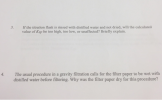 If the titration flask is rinsed with distilled water and not dried, will the calculated value of Ksp be too high, too low, or unaffected? Briefly explain. The usual procedure in a gravity filtration calls for the filter paper to be wet with distilled water before filtering. Why was the filter paper dry for this procedure?
Post Lab Questions 1. in a hurry to complete the experiment, the student failed to calibrate...
 Post Lab Questions 1. in a hurry to complete the experiment, the student failed to calibrate the Spectrophotometer. As a result, all absorbance values for the standard solutions that are measured and recorded are too high. How will this affect the following calculations in Part B? a. Will the calculated equilibrium concentrations of FeSCN** be too high, too low, or unaffected? Explain. b. Will the calculated equilibrium constants be too high, too low, or unaffected? Explain. 2. In Part A,...
111 Experiment 11 AN INSTRUMENTAL ANALYSIS OF POP FOR ITS PHOSPHORIC ACID CONTENT The Pre-Lab ....
 111 Experiment 11 AN INSTRUMENTAL ANALYSIS OF POP FOR ITS PHOSPHORIC ACID CONTENT The Pre-Lab . A student performs an experiment for the determination of phosphoric acid (H)PO present in a cola soft drink. A 0.5 milliliters sample of cola is diluted to 125 mL. The measured absorbance is 0.262. Using a graph of absorbance versus H,PO concentration, the student determines that the diluted cola solution has a concentra- tion of 15.5 x 10 moles liter: a) Calculate the total...
answer all parts: 2. You measured the volume of the CO2 by filling your flask with...
answer all parts: 2. You measured the volume of the CO2 by filling your flask with water and tightly inserting the stopper. a. Why was it necessary to tightly stop the water-filled flask and then remove the stopper before you emptied the water into a graduated cylinder for measurement? b. Would your calculated molar volume of CO2 (Vm) have been higher or lower if you had forgotten to stopper the flask before measuring the volume of the flask (V1)? Briefly...
Laboratory Questions Circle the questions that have been assigned. 1. Part A.1. The KIO, sample was...
 Laboratory Questions Circle the questions that have been assigned. 1. Part A.1. The KIO, sample was not sur klo, sample was not sufficiently dried. Will the reported molar concentration of the KIO, solution (Part B.3) be too high, too low, or unaffected? Explain. 2. Part A.1. The mass of KIO, used to prepare he mass of KIO, used to renare the solution was measured to be 0.585 g instead of the calculated 0.535 a. Will the molar concentration of th...
=4.31% 17:369 Laboratory Questions Circle the questions that have been assigned. 1. Part A.2. A 20-ml...
 =4.31% 17:369 Laboratory Questions Circle the questions that have been assigned. 1. Part A.2. A 20-ml volume of previously boiled, deionized water is added to the Erlenmeyer flask to prepare the sample for titration. Explain why this volume is not critical to the analysis. 2. Part A.2. Previously boiled, deionized water is unavailable. In a hurry to pursue the analysis, deionized water (not boiled) is added. How does this attempt to expedite the analysis affect the reported percent acetic acid...
The following questions are from a copper content in brass experiment in my Chem 1 lab...
The following questions are from a copper content in brass experiment in my Chem 1 lab class. These are the discussion questions, I would like a little bit of background knowledge on how I may get the answers so I could fully understand. Thank you! The equation for your line has a nonzero y intercept. Beer’s law does not have an analogous term. Explain the discrepancy between your experimental best fit equation and the theoretical Beer’s law equation. 2. Consider...
 3. Consider the analysis of the ammonia content in this experiment. If the buret used in the titration was rinsed with distilled water, but not dried or conditioned before use, would the calculated number of moles of ammonia per gram of complex be too high, too low, or unaffected? Briefly Explain. If the titration flask was rinsed with distilled water but not dried before use, would the calculated number of moles of ammonia per gram of complex be too high,...
 1. Consider the complex ion [Pt(NH3)4Cl2]*?. Note: Include charges for any ions. a. Identify the Lewis acid(s). b. Identify the Lewis base(s). c. What is the coordination number? 2. Consider the analysis of the copper content in this experiment. If the cuvets used in the spectrophotometer were rinsed with distilled water, but not dried or conditioned (lined) before use, would the calculated number of moles of copper per gram of complex be too high, too low, or unaffected? Briefly explain....
 1. If the undissolved KHT is not filtered out before the titration with NaOH, will the calculated value of Ksp be too high, too low, or unaffected? Briefly explain. If the buret is rinsed with distilled water but not conditioned with NaOH, will the 2. calculated value of Ksp be too high, too low, or unaffected? Briefly explain.
 If the titration flask is rinsed with distilled water and not dried, will the calculated value of Ksp be too high, too low, or unaffected? Briefly explain. The usual procedure in a gravity filtration calls for the filter paper to be wet with distilled water before filtering. Why was the filter paper dry for this procedure?
 Post Lab Questions 1. in a hurry to complete the experiment, the student failed to calibrate the Spectrophotometer. As a result, all absorbance values for the standard solutions that are measured and recorded are too high. How will this affect the following calculations in Part B? a. Will the calculated equilibrium concentrations of FeSCN** be too high, too low, or unaffected? Explain. b. Will the calculated equilibrium constants be too high, too low, or unaffected? Explain. 2. In Part A,...
 111 Experiment 11 AN INSTRUMENTAL ANALYSIS OF POP FOR ITS PHOSPHORIC ACID CONTENT The Pre-Lab . A student performs an experiment for the determination of phosphoric acid (H)PO present in a cola soft drink. A 0.5 milliliters sample of cola is diluted to 125 mL. The measured absorbance is 0.262. Using a graph of absorbance versus H,PO concentration, the student determines that the diluted cola solution has a concentra- tion of 15.5 x 10 moles liter: a) Calculate the total...
 Laboratory Questions Circle the questions that have been assigned. 1. Part A.1. The KIO, sample was not sur klo, sample was not sufficiently dried. Will the reported molar concentration of the KIO, solution (Part B.3) be too high, too low, or unaffected? Explain. 2. Part A.1. The mass of KIO, used to prepare he mass of KIO, used to renare the solution was measured to be 0.585 g instead of the calculated 0.535 a. Will the molar concentration of th...
 =4.31% 17:369 Laboratory Questions Circle the questions that have been assigned. 1. Part A.2. A 20-ml volume of previously boiled, deionized water is added to the Erlenmeyer flask to prepare the sample for titration. Explain why this volume is not critical to the analysis. 2. Part A.2. Previously boiled, deionized water is unavailable. In a hurry to pursue the analysis, deionized water (not boiled) is added. How does this attempt to expedite the analysis affect the reported percent acetic acid...
Most questions answered within 3 hours.
-
Where is the error in this code sequence?
String s1 = "Hello";
String s2 = "ello";...
asked 10 months ago -
Financial data for Joel de Paris, Inc., for last year
follow:
Joel de Paris, Inc.
Balance...
asked 10 months ago -
Consider this reaction:
Al2(SO4)3 (aq)+ BaCl3
(aq) Al2Cl6 (aq)- +
3BaSO4(s) . What is the...
asked 10 months ago -
Suppose that Savneet is considering increasing her
recent random sample from 20 car rentals to 40...
asked 10 months ago -
Trucks arrive at an unloading terminal at an average rate of 120
per hour.
Trucks arrive...
asked 10 months ago -
Why are methanol and ethanol completely soluble in water while
octanol is not very little soluble....
asked 10 months ago -
A facilities manager at a university reads in a research report
that the mean amount of...
asked 10 months ago -
When the CuSO4 is rehydrated by adding water to the anhydrous
compound, is this an endothermic...
asked 10 months ago -
A ray of sunlight is passing from diamond into crown glass; the
angle of incidence is...
asked 10 months ago -
A block of mass 0.249 kg is placed on top of a light, vertical
spring of...
asked 10 months ago -
how do the kidneys compensate in the presences of acidosis
a) trigger hyperventilate
b) reserve acid...
asked 10 months ago -
Question 501 pts
The rental rate of capital to the firm increases. Which of the
following...
asked 10 months ago