
Homework Answers

Add Answer to:
Question #4: Consider the signal x(t) cos(2π (a) Sketch the signal. Please make sure to label...
Signal: x(t) = 2cos(3πt) Sketch the signal. Please make sure to label all relevant features.
Signal: x(t) = 2cos(3πt) Sketch the signal. Please make sure to label all relevant features.
1.On the graph below, make a neat and labeled sketch of the signal s(t) = 2...
1.On the graph below, make a neat and labeled sketch of the signal s(t) = 2 + cos( t/4 + 1 ),Describe s(t) as odd, even, or neither. What is the energy in s(t)? What is the power in s(t)? 2.On the graph below, make a neat and labeled sketch of the signal s(t) = 3 rect( t - 2 ) cos( π t ),Describe s(t) as odd, even, or neither. What is the energy in s(t)? What is the...
Transformations of independent variable 1. A discrete time signal is shown below. Sketch and care...
 Please Answer the following questions ASAP. Thanks!
Transformations of independent variable 1. A discrete time signal is shown below. Sketch and carefully label x [2n 1 and xl-nlul-n1. 2. A continuous time signal x(t) is shown below. Sketch and carefully label x(t-1) and x(-t)-x(t)u(-t x(t) Even and Odd 3. Sketch x()Ev(sin(5mt)u(-t))for-1ts1 . Sketch the even and odd parts of signal x[n] in problem 1.
Transformations of independent variable 1. A discrete time signal is shown below. Sketch and carefully label...
Please Answer the following questions ASAP. Thanks!
Transformations of independent variable 1. A discrete time signal is shown below. Sketch and carefully label x [2n 1 and xl-nlul-n1. 2. A continuous time signal x(t) is shown below. Sketch and carefully label x(t-1) and x(-t)-x(t)u(-t x(t) Even and Odd 3. Sketch x()Ev(sin(5mt)u(-t))for-1ts1 . Sketch the even and odd parts of signal x[n] in problem 1.
Transformations of independent variable 1. A discrete time signal is shown below. Sketch and carefully label...
Q1) Given an analog signal X(t) = 3 cos (2π . 2000t) + 2 cos (2π...
Q1) Given an analog signal X(t) = 3 cos (2π . 2000t) + 2 cos (2π . 5500t) sampled at a rate of 10,000 Hz, a. Sketch the spectrum of the sampled signal up to 20 kHz; b. Sketch the recovered analog signal spectrum if an ideal lowpass filter with a cutoff frequency of 4 kHz is used to filter the sampled signal in order to recover the original signal ; c. Determine the frequency/frequencies of aliasing noise . Q2)...
Its related to MATLAB Generate a continuous-time signal z(t)-cos(2π 10t + 5) + cos(2π30t + 5). You may use the part of...
 Its related to MATLAB
Generate a continuous-time signal z(t)-cos(2π 10t + 5) + cos(2π30t + 5). You may use the part of the followings. a >>t0:0.001:1; >plot (t, x_t) b. Generate a discrete-time signal x[n] = (1/4)(u[n]-u[n-4). You may use the part of the followings >>a_n-ones (1, 4) s> b_nzeros (1, 7) >> stem(n, x n)
Generate a continuous-time signal z(t)-cos(2π 10t + 5) + cos(2π30t + 5). You may use the part of the followings. a >>t0:0.001:1; >plot (t,...
Its related to MATLAB
Generate a continuous-time signal z(t)-cos(2π 10t + 5) + cos(2π30t + 5). You may use the part of the followings. a >>t0:0.001:1; >plot (t, x_t) b. Generate a discrete-time signal x[n] = (1/4)(u[n]-u[n-4). You may use the part of the followings >>a_n-ones (1, 4) s> b_nzeros (1, 7) >> stem(n, x n)
Generate a continuous-time signal z(t)-cos(2π 10t + 5) + cos(2π30t + 5). You may use the part of the followings. a >>t0:0.001:1; >plot (t,...
Question #5: Consider the continuous-time signal shown below. x(t) -6 -4 -2 4 -2 (a) Sketch...
 Question #5: Consider the continuous-time signal shown below. x(t) -6 -4 -2 4 -2 (a) Sketch y(t) x1) (b) Sketch y(t) 2x[t- 2) (c) Sketch y(t) - 5x(t/3) (d) Sketch y(t) x(t) -x(-t)
3(20%) Assume a message signal is given by m(t) = 4 cos(2π//) + cos(4π.t). Let x (t)-5m(t) cos(2t f t) + 5m(t) sin(...
 3(20%) Assume a message signal is given by m(t) = 4 cos(2π//) + cos(4π.t). Let x (t)-5m(t) cos(2t f t) + 5m(t) sin( 2 fct), where m(t) İs the Hilbert Transform of m(t). (10%) (a) Derive x(t) (10%) (b) Prove, by sketching the spectra, that x(t) is a lower-sideband SSB signal of m(t).
3(20%) Assume a message signal is given by m(t) = 4 cos(2π//) + cos(4π.t). Let x (t)-5m(t) cos(2t f t) + 5m(t) sin( 2 fct), where m(t)...
3(20%) Assume a message signal is given by m(t) = 4 cos(2π//) + cos(4π.t). Let x (t)-5m(t) cos(2t f t) + 5m(t) sin( 2 fct), where m(t) İs the Hilbert Transform of m(t). (10%) (a) Derive x(t) (10%) (b) Prove, by sketching the spectra, that x(t) is a lower-sideband SSB signal of m(t).
3(20%) Assume a message signal is given by m(t) = 4 cos(2π//) + cos(4π.t). Let x (t)-5m(t) cos(2t f t) + 5m(t) sin( 2 fct), where m(t)...
3(20%) Assume a message signal is given by m(t) = 4 cos(2π//) + cos(4π.t). Let x...
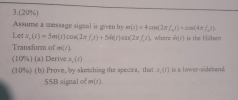 3(20%) Assume a message signal is given by m(t) = 4 cos(2π//) + cos(4π.t). Let x (t)-5m(t) cos(2t f t) + 5m(t) sin( 2 fct), where m(t) İs the Hilbert Transform of m(t). (10%) (a) Derive x(t) (10%) (b) Prove, by sketching the spectra, that x(t) is a lower-sideband SSB signal of m(t).
When the message signal m (t) =cos (2π fmt) and the carrier signal is c(t)=cos (2π fct) , fm<&...
 When the message signal m (t) =cos (2π fmt) and the
carrier signal is c(t)=cos (2π fct) ,
fm<< fc,
The modulated DSB-SC signal
SDSB-SC=m(t)cos(2πfct) is generated, and only
the upper sideband
To generate and transmit the SSB signal. As shown in the figure
below, the receiver is a local oscillator
cosine signal to the received signal and passes it through a
low-pass filter. Answer the following questions.
(a) Draw the waveform of DSB-SC modulated signal
SDSB-SC(t)
(b)Find the result...
When the message signal m (t) =cos (2π fmt) and the
carrier signal is c(t)=cos (2π fct) ,
fm<< fc,
The modulated DSB-SC signal
SDSB-SC=m(t)cos(2πfct) is generated, and only
the upper sideband
To generate and transmit the SSB signal. As shown in the figure
below, the receiver is a local oscillator
cosine signal to the received signal and passes it through a
low-pass filter. Answer the following questions.
(a) Draw the waveform of DSB-SC modulated signal
SDSB-SC(t)
(b)Find the result...
 Please Answer the following questions ASAP. Thanks!
Transformations of independent variable 1. A discrete time signal is shown below. Sketch and carefully label x [2n 1 and xl-nlul-n1. 2. A continuous time signal x(t) is shown below. Sketch and carefully label x(t-1) and x(-t)-x(t)u(-t x(t) Even and Odd 3. Sketch x()Ev(sin(5mt)u(-t))for-1ts1 . Sketch the even and odd parts of signal x[n] in problem 1.
Transformations of independent variable 1. A discrete time signal is shown below. Sketch and carefully label...
Please Answer the following questions ASAP. Thanks!
Transformations of independent variable 1. A discrete time signal is shown below. Sketch and carefully label x [2n 1 and xl-nlul-n1. 2. A continuous time signal x(t) is shown below. Sketch and carefully label x(t-1) and x(-t)-x(t)u(-t x(t) Even and Odd 3. Sketch x()Ev(sin(5mt)u(-t))for-1ts1 . Sketch the even and odd parts of signal x[n] in problem 1.
Transformations of independent variable 1. A discrete time signal is shown below. Sketch and carefully label...
 Its related to MATLAB
Generate a continuous-time signal z(t)-cos(2π 10t + 5) + cos(2π30t + 5). You may use the part of the followings. a >>t0:0.001:1; >plot (t, x_t) b. Generate a discrete-time signal x[n] = (1/4)(u[n]-u[n-4). You may use the part of the followings >>a_n-ones (1, 4) s> b_nzeros (1, 7) >> stem(n, x n)
Generate a continuous-time signal z(t)-cos(2π 10t + 5) + cos(2π30t + 5). You may use the part of the followings. a >>t0:0.001:1; >plot (t,...
Its related to MATLAB
Generate a continuous-time signal z(t)-cos(2π 10t + 5) + cos(2π30t + 5). You may use the part of the followings. a >>t0:0.001:1; >plot (t, x_t) b. Generate a discrete-time signal x[n] = (1/4)(u[n]-u[n-4). You may use the part of the followings >>a_n-ones (1, 4) s> b_nzeros (1, 7) >> stem(n, x n)
Generate a continuous-time signal z(t)-cos(2π 10t + 5) + cos(2π30t + 5). You may use the part of the followings. a >>t0:0.001:1; >plot (t,...
 Question #5: Consider the continuous-time signal shown below. x(t) -6 -4 -2 4 -2 (a) Sketch y(t) x1) (b) Sketch y(t) 2x[t- 2) (c) Sketch y(t) - 5x(t/3) (d) Sketch y(t) x(t) -x(-t)
 3(20%) Assume a message signal is given by m(t) = 4 cos(2π//) + cos(4π.t). Let x (t)-5m(t) cos(2t f t) + 5m(t) sin( 2 fct), where m(t) İs the Hilbert Transform of m(t). (10%) (a) Derive x(t) (10%) (b) Prove, by sketching the spectra, that x(t) is a lower-sideband SSB signal of m(t).
3(20%) Assume a message signal is given by m(t) = 4 cos(2π//) + cos(4π.t). Let x (t)-5m(t) cos(2t f t) + 5m(t) sin( 2 fct), where m(t)...
3(20%) Assume a message signal is given by m(t) = 4 cos(2π//) + cos(4π.t). Let x (t)-5m(t) cos(2t f t) + 5m(t) sin( 2 fct), where m(t) İs the Hilbert Transform of m(t). (10%) (a) Derive x(t) (10%) (b) Prove, by sketching the spectra, that x(t) is a lower-sideband SSB signal of m(t).
3(20%) Assume a message signal is given by m(t) = 4 cos(2π//) + cos(4π.t). Let x (t)-5m(t) cos(2t f t) + 5m(t) sin( 2 fct), where m(t)...
 3(20%) Assume a message signal is given by m(t) = 4 cos(2π//) + cos(4π.t). Let x (t)-5m(t) cos(2t f t) + 5m(t) sin( 2 fct), where m(t) İs the Hilbert Transform of m(t). (10%) (a) Derive x(t) (10%) (b) Prove, by sketching the spectra, that x(t) is a lower-sideband SSB signal of m(t).
 When the message signal m (t) =cos (2π fmt) and the
carrier signal is c(t)=cos (2π fct) ,
fm<< fc,
The modulated DSB-SC signal
SDSB-SC=m(t)cos(2πfct) is generated, and only
the upper sideband
To generate and transmit the SSB signal. As shown in the figure
below, the receiver is a local oscillator
cosine signal to the received signal and passes it through a
low-pass filter. Answer the following questions.
(a) Draw the waveform of DSB-SC modulated signal
SDSB-SC(t)
(b)Find the result...
When the message signal m (t) =cos (2π fmt) and the
carrier signal is c(t)=cos (2π fct) ,
fm<< fc,
The modulated DSB-SC signal
SDSB-SC=m(t)cos(2πfct) is generated, and only
the upper sideband
To generate and transmit the SSB signal. As shown in the figure
below, the receiver is a local oscillator
cosine signal to the received signal and passes it through a
low-pass filter. Answer the following questions.
(a) Draw the waveform of DSB-SC modulated signal
SDSB-SC(t)
(b)Find the result...
Most questions answered within 3 hours.
-
Where is the error in this code sequence?
String s1 = "Hello";
String s2 = "ello";...
asked 10 months ago -
Financial data for Joel de Paris, Inc., for last year
follow:
Joel de Paris, Inc.
Balance...
asked 10 months ago -
Consider this reaction:
Al2(SO4)3 (aq)+ BaCl3
(aq) Al2Cl6 (aq)- +
3BaSO4(s) . What is the...
asked 10 months ago -
Suppose that Savneet is considering increasing her
recent random sample from 20 car rentals to 40...
asked 10 months ago -
Trucks arrive at an unloading terminal at an average rate of 120
per hour.
Trucks arrive...
asked 10 months ago -
Why are methanol and ethanol completely soluble in water while
octanol is not very little soluble....
asked 10 months ago -
A facilities manager at a university reads in a research report
that the mean amount of...
asked 10 months ago -
When the CuSO4 is rehydrated by adding water to the anhydrous
compound, is this an endothermic...
asked 10 months ago -
A ray of sunlight is passing from diamond into crown glass; the
angle of incidence is...
asked 10 months ago -
A block of mass 0.249 kg is placed on top of a light, vertical
spring of...
asked 10 months ago -
how do the kidneys compensate in the presences of acidosis
a) trigger hyperventilate
b) reserve acid...
asked 10 months ago -
Question 501 pts
The rental rate of capital to the firm increases. Which of the
following...
asked 10 months ago