
Homework Answers
Mips instructions:
main:
push rbp
mov rbp, rsp
mov DWORD PTR [rbp-32], 300
mov DWORD PTR [rbp-28], 200
mov DWORD PTR [rbp-24], 100
mov DWORD PTR [rbp-20], 0
mov DWORD PTR [rbp-4], 3
mov edx, DWORD PTR [rbp-32]
mov eax, DWORD PTR [rbp-28]
add edx, eax
mov eax, DWORD PTR [rbp-24]
add edx, eax
mov eax, DWORD PTR [rbp-4]
cdqe
mov DWORD PTR [rbp-32+rax*4], edx
mov eax, 0
pop rbp
ret
Add Answer to:
directly 3- Consider the C++ code below. Translate the code into MIPS instructions as possible. Put...
2- Consider the C++ code below. Translate the code into MIPS instructions as directly as possible. Put them in a file c...
 2- Consider the C++ code below. Translate the code into MIPS instructions as directly as possible. Put them in a file called program1.s. int x 20; // use $t0 to keep track of x's value /use $t1 int y = x + 5; to keep track of y's value y = y| 2; X = X &4; /use $t2 to keep track of z's value Z ~X ^ y >> 2; Z Z Run your code to make sure it...
IN MIPS AND MUST RUN IN QTSPIM Translate the following C code to MIPS assembly code....
 IN MIPS AND MUST RUN IN QTSPIM
Translate the following C code to MIPS assembly code. Use a minimum number of instructions. Assume that the values of a, b, i and j are stored in registers Ss0, Ss1, St0 and Stl, respectively. Also assume that register Ss2 holds the base address of the array D. for (i=0; i<a; itt) for (i-0j<b:jt+)
IN MIPS AND MUST RUN IN QTSPIM
Translate the following C code to MIPS assembly code. Use a minimum number of instructions. Assume that the values of a, b, i and j are stored in registers Ss0, Ss1, St0 and Stl, respectively. Also assume that register Ss2 holds the base address of the array D. for (i=0; i<a; itt) for (i-0j<b:jt+)
7. Translate the following C code to MIPS assembly code. Use a minimum number of instructions....
 7. Translate the following C code to MIPS assembly code. Use a minimum number of instructions. Assume that the values of a,b, i and j are in registers Ss0, Ss1, St0, and St1, respectively. Also, assume that register SS2 holds the base address of the array D. for(i-0; i<a; i++) for(j=0 ; j<b; j++)
Translate the following C code to MIPS assembly code. Use a minimum number of instructions. Register...
Translate the following C code to MIPS assembly code. Use a minimum number of instructions. Register allocations - i $s0 - j $s1 - base of A[] $s2 - base of B[] $s3 2) A[3] = B[i] + B[j]; 3) i = 0; while (j != A[i]) { i++; }
B2. Convert the C code to MIPS assembly with only 2 efficient instructions: Register assignment: ...
 B2. Convert the C code to MIPS assembly with only 2 efficient instructions: Register assignment: timer-v0 int timer = 0x0AC8 0001; B3. Write MIPS assembly code segment for the following C code snippet for (i - 0, i < 100; i++) -array Register assignment: i-) $ao Base of array -> $s0 array [ i+1] [i] / 2;
B2. Convert the C code to MIPS assembly with only 2 efficient instructions: Register assignment: timer-v0 int timer = 0x0AC8 0001; B3. Write...
B2. Convert the C code to MIPS assembly with only 2 efficient instructions: Register assignment: timer-v0 int timer = 0x0AC8 0001; B3. Write MIPS assembly code segment for the following C code snippet for (i - 0, i < 100; i++) -array Register assignment: i-) $ao Base of array -> $s0 array [ i+1] [i] / 2;
B2. Convert the C code to MIPS assembly with only 2 efficient instructions: Register assignment: timer-v0 int timer = 0x0AC8 0001; B3. Write...
Using beq only, not bge! Translate the following C code to MIPS assembly code. Use a...
Using beq only, not bge! Translate the following C code to MIPS assembly code. Use a minimum number of instructions. Assume that the values of a, b, i, and j are in registers $s0, $s1, $t0, and $t1, respectively. Also, assume that register $s2 holds the base address of the integer array D. Comments are required. for(i=1; i<a; i++) for(j=1; j<b; j++) D[2*j] = i + j;
the first symbol reads '$t0' Consider to translate the to following MIPs instructions C code. AW...
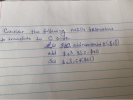 the first symbol reads '$t0'
Consider to translate the to following MIPs instructions C code. AW $10, addrconstant 8( $50) add $83, SS2, $40 sw $63,64CBET)
the first symbol reads '$t0'
Consider to translate the to following MIPs instructions C code. AW $10, addrconstant 8( $50) add $83, SS2, $40 sw $63,64CBET)
I need MIPS code for this program Translate the following C++ program to MIPS assembly program...
I need MIPS code for this program Translate the following C++ program to MIPS assembly program (Please explain each instruction of your code by a comment and submit a .asm file) // Example program #include <iostream> #include <string> using namespace std; int main() { const int ADULT_CHOICE= 1, CHILD_CHOICE= 2, SENIOR_CHOICE= 3, QUIT_CHOICE= 4, ADULT = 250, CHILD = 200, SENIOR = 350; int choice, months; int charges = 0; do { cout <<"\n\t\tHealth Club Membership Menu\n\n" <<"1. Standard Adult...
Translate the following C code to MIPS assembly. Assume that the values of a, b, i,...
 Translate the following C code to MIPS assembly. Assume that the values of a, b, i, and j are in registers $s0, $s1, $t0, and $t1, respectively. Also assume that $s2 holds the base address of the array D. for (i = 0: i < a: i++) for (j = 0: j < b: j++) D[2 * j] = i + j;
Translate each of the following pseudo-instructions into MIPS instructions. You should Produce a minimal sequence of...
Translate each of the following pseudo-instructions into MIPS instructions. You should Produce a minimal sequence of MIPS instructions to accomplish the required computation. (8 Points) 1) bgt $t1, 100, Label # bgt means branch if greater than 2) ble $s2, 10, Next # ble means branch if less than or equal 3) ror $s0, $s4, 7 # ror means rotate right $s4 by 7 bits and store the result in $s0 4) neg $s5, $s4 # $s5 will have the...
 2- Consider the C++ code below. Translate the code into MIPS instructions as directly as possible. Put them in a file called program1.s. int x 20; // use $t0 to keep track of x's value /use $t1 int y = x + 5; to keep track of y's value y = y| 2; X = X &4; /use $t2 to keep track of z's value Z ~X ^ y >> 2; Z Z Run your code to make sure it...
 IN MIPS AND MUST RUN IN QTSPIM
Translate the following C code to MIPS assembly code. Use a minimum number of instructions. Assume that the values of a, b, i and j are stored in registers Ss0, Ss1, St0 and Stl, respectively. Also assume that register Ss2 holds the base address of the array D. for (i=0; i<a; itt) for (i-0j<b:jt+)
IN MIPS AND MUST RUN IN QTSPIM
Translate the following C code to MIPS assembly code. Use a minimum number of instructions. Assume that the values of a, b, i and j are stored in registers Ss0, Ss1, St0 and Stl, respectively. Also assume that register Ss2 holds the base address of the array D. for (i=0; i<a; itt) for (i-0j<b:jt+)
 7. Translate the following C code to MIPS assembly code. Use a minimum number of instructions. Assume that the values of a,b, i and j are in registers Ss0, Ss1, St0, and St1, respectively. Also, assume that register SS2 holds the base address of the array D. for(i-0; i<a; i++) for(j=0 ; j<b; j++)
 B2. Convert the C code to MIPS assembly with only 2 efficient instructions: Register assignment: timer-v0 int timer = 0x0AC8 0001; B3. Write MIPS assembly code segment for the following C code snippet for (i - 0, i < 100; i++) -array Register assignment: i-) $ao Base of array -> $s0 array [ i+1] [i] / 2;
B2. Convert the C code to MIPS assembly with only 2 efficient instructions: Register assignment: timer-v0 int timer = 0x0AC8 0001; B3. Write...
B2. Convert the C code to MIPS assembly with only 2 efficient instructions: Register assignment: timer-v0 int timer = 0x0AC8 0001; B3. Write MIPS assembly code segment for the following C code snippet for (i - 0, i < 100; i++) -array Register assignment: i-) $ao Base of array -> $s0 array [ i+1] [i] / 2;
B2. Convert the C code to MIPS assembly with only 2 efficient instructions: Register assignment: timer-v0 int timer = 0x0AC8 0001; B3. Write...
 the first symbol reads '$t0'
Consider to translate the to following MIPs instructions C code. AW $10, addrconstant 8( $50) add $83, SS2, $40 sw $63,64CBET)
the first symbol reads '$t0'
Consider to translate the to following MIPs instructions C code. AW $10, addrconstant 8( $50) add $83, SS2, $40 sw $63,64CBET)
 Translate the following C code to MIPS assembly. Assume that the values of a, b, i, and j are in registers $s0, $s1, $t0, and $t1, respectively. Also assume that $s2 holds the base address of the array D. for (i = 0: i < a: i++) for (j = 0: j < b: j++) D[2 * j] = i + j;
Most questions answered within 3 hours.
-
Where is the error in this code sequence?
String s1 = "Hello";
String s2 = "ello";...
asked 11 months ago -
Financial data for Joel de Paris, Inc., for last year
follow:
Joel de Paris, Inc.
Balance...
asked 11 months ago -
Consider this reaction:
Al2(SO4)3 (aq)+ BaCl3
(aq) Al2Cl6 (aq)- +
3BaSO4(s) . What is the...
asked 11 months ago -
Suppose that Savneet is considering increasing her
recent random sample from 20 car rentals to 40...
asked 11 months ago -
Trucks arrive at an unloading terminal at an average rate of 120
per hour.
Trucks arrive...
asked 11 months ago -
Why are methanol and ethanol completely soluble in water while
octanol is not very little soluble....
asked 11 months ago -
A facilities manager at a university reads in a research report
that the mean amount of...
asked 11 months ago -
When the CuSO4 is rehydrated by adding water to the anhydrous
compound, is this an endothermic...
asked 11 months ago -
A ray of sunlight is passing from diamond into crown glass; the
angle of incidence is...
asked 11 months ago -
A block of mass 0.249 kg is placed on top of a light, vertical
spring of...
asked 11 months ago -
how do the kidneys compensate in the presences of acidosis
a) trigger hyperventilate
b) reserve acid...
asked 11 months ago -
Question 501 pts
The rental rate of capital to the firm increases. Which of the
following...
asked 11 months ago