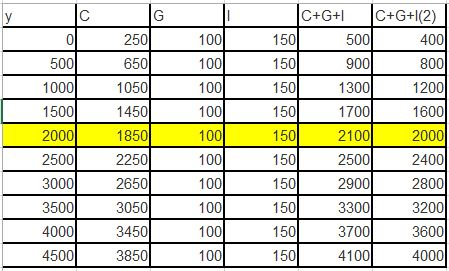
y C G I C+G+I C+G+I(2) 0 250 100 150 500 550 500 650 100 150...
| y | C | G | I | C+G+I | C+G+I(2) |
| 0 | 250 | 100 | 150 | 500 | 550 |
| 500 | 650 | 100 | 150 | 900 | 950 |
| 1000 | 1050 | 100 | 150 | 1300 | 1350 |
| 1500 | 1450 | 100 | 150 | 1700 | 1750 |
| 2000 | 1850 | 100 | 150 | 2100 | 2150 |
| 2500 | 2250 | 100 | 150 | 2500 | 2550 |
| 3000 | 2650 | 100 | 150 | 2900 | 2950 |
| 3500 | 3050 | 100 | 150 | 3300 | 3350 |
| 4000 | 3450 | 100 | 150 | 3700 | 3750 |
| 4500 | 3850 | 100 | 150 | 4100 | 4150 |
1. The consumption function is C=250+0.8y. How much are a (the intercept) and MPC (Marginal Propensity to Consume)?
2. What is the value of the spending multiplier?
3. How much is equilibrium y?
4. Reduce G to zero. Fill in the new C+G+I(2) (was already done in chart). By how much has equilibrium y changed after G decreased?
Homework Answers
- The consumption function is C=250+0.8y. How much are a (the intercept) and MPC (Marginal Propensity to Consume)= 0.8
Intercept is =$250
2.
MPC=0.8
MPS=1-MPC
=1-0.8
=0.2
Spending multiplier=1/MPS
=1/0.2
=5
3.
Since equilibrium determined by the following condition
Y=C+I+G
Hence equilibrium output (Y) will be $2,500
4.
If G reduces to zero, then New equilibrium will be determined by the following condition
Y=(C+I+G)2
Hence equilibrium (Y) will be 2,000.
New Table.
QUESTION 8 $500 450 E 400 350 250 2 200 쵸 E 150 C 100 U...
 QUESTION 8 $500 450 E 400 350 250 2 200 쵸 E 150 C 100 U 50 45° $50 100 150 200 250 300 350 400 450 500 550 Real Domestic Output ($B) Refer to the graph for a private closed economy. At the equilibrium level of GDP, saving will be O $100 billion. $50 billion. O $150 billion. an amount that cannot be determined from the information given
350 300 250 200 150 100 50 0 50 100 150 200 250 300 350 400...
 350 300 250 200 150 100 50 0 50 100 150 200 250 300 350 400 450 500 Actual Aggregate Expenditure (Y, billions of $) Instructions: Enter whole numbers into each box a. What is the Keynesian equilibrium output in this economy? billion b. At an output level of $200 billion, planned aggregate expenditure is equal to $ ( (Click to select) output in the upcoming year billion and the economy is likely to c. At an output level of...
PLAYER 2 8. StrategyD A 100/125 300/250 200/100 PLAYER1 250/0 500/500 750/400 c 0/-100 400/300100/350 a....
 PLAYER 2 8. StrategyD A 100/125 300/250 200/100 PLAYER1 250/0 500/500 750/400 c 0/-100 400/300100/350 a. Find the Nash Equilibrium.
Country Z has an economy that can be described as C= 200 + (0.8) y I= 150 G= 250 X= 115 M= 125 + (0.05) Y C= Consumption...
Country Z has an economy that can be described as C= 200 + (0.8) y I= 150 G= 250 X= 115 M= 125 + (0.05) Y C= Consumption Y= Income I= investment G= Goverment spending X= exports M=Imports What is the equilibrium level of income for this economy? 1. 2360 2. 3930 3. 4,960 4. 8,260
Consider an economy in long run equilibrium described by the following equations: Y = C + I + G +...
Consider an economy in long run equilibrium described by the following equations: Y = C + I + G + NX Y = 5000 G = 1000 T = 1000 C = 250 + 0.75*( Y - T ) I = 1000 - 50*r NCO = 500 - 50*r Where r is the real interest rate (in % terms). Suppose G rises to 1250 without any change in T. Solve again for the equilibrium real interest rate and the rest...
Y=C+I+G.Y=8,000.G=2,500.T=2,000.C=1,000+2/3 (Y-T).I=1,200-100 r. = C+I+G = 8,000. G = 2,500. T = 2,000. C = 1,000+2/3...
 Y=C+I+G.Y=8,000.G=2,500.T=2,000.C=1,000+2/3 (Y-T).I=1,200-100 r. = C+I+G = 8,000. G = 2,500. T = 2,000. C = 1,000+2/3 (Y – T'). I = 1,200 - 100 r. a. In this economy, compute private saving, public saving, and national saving. b. Find the equilibrium interest rate. C. Now suppose that G is reduced by 500. Compute private saving, public saving, and national saving. d. Find the new equilibrium interest rate.
c= 100+ 0.8 (y - t) i = 500 - 50r g= 400 t= 400 M...
 c= 100+ 0.8 (y - t) i = 500 - 50r g= 400 t= 400 M = P(0.2y + 500 – 25r) Price level is fixed at 1. The money supply is 520 (51 marks – 3 marks each) 1. Calculate equilibrium real GDP and the interest rate.
The following equations describe an economy. Y=C+I+G C=50+0.75*(Y-T) I=150-10r (M/P)d=Y-50r G=250 T=200 M=3,000 P=4 Identify each...
The following equations describe an economy. Y=C+I+G C=50+0.75*(Y-T) I=150-10r (M/P)d=Y-50r G=250 T=200 M=3,000 P=4 Identify each of the variables, and briefly explain their meaning. From the above list, use the relevant set of equations to derive the IS curve. Graph the IS curve on an appropriately labeled graph. From the above list, sue the relevant set of equations to derive the LM curve. Graph the LM curve on the same graph you used in part b). What are the equilibrium...
Suppose that i. C=60+.8Yd ii. I=150-10r iii. G=250 iv. T=200 v. Ms=100 vi. Md=40+.1Y-10r b. Write...
Suppose that i. C=60+.8Yd ii. I=150-10r iii. G=250 iv. T=200 v. Ms=100 vi. Md=40+.1Y-10r b. Write the equations for the IS and LM schedules c. Find the equilibrium values for income (Y0) and the interest rate r0 d. Suppose we change the model in the problem such that investment is assumed to be completely interest inelastic; investment does not depend on the rate of interest and we have I=150 i. Write the new equations for the IS and LM schedules....
Let Y = C+I+G C = 100+1/2(Y-T) T = t0+(t1 Y) I = 75 (a) Suppose...
Let Y = C+I+G C = 100+1/2(Y-T) T = t0+(t1 Y) I = 75 (a) Suppose that the initial values of the fiscal parameters are G = 100; t0 = 50 and t1 = 1/3 : Find the equilibrium levels of output, disposable income, consumption and the government budget deficit.
 QUESTION 8 $500 450 E 400 350 250 2 200 쵸 E 150 C 100 U 50 45° $50 100 150 200 250 300 350 400 450 500 550 Real Domestic Output ($B) Refer to the graph for a private closed economy. At the equilibrium level of GDP, saving will be O $100 billion. $50 billion. O $150 billion. an amount that cannot be determined from the information given
 350 300 250 200 150 100 50 0 50 100 150 200 250 300 350 400 450 500 Actual Aggregate Expenditure (Y, billions of $) Instructions: Enter whole numbers into each box a. What is the Keynesian equilibrium output in this economy? billion b. At an output level of $200 billion, planned aggregate expenditure is equal to $ ( (Click to select) output in the upcoming year billion and the economy is likely to c. At an output level of...
 PLAYER 2 8. StrategyD A 100/125 300/250 200/100 PLAYER1 250/0 500/500 750/400 c 0/-100 400/300100/350 a. Find the Nash Equilibrium.
 Y=C+I+G.Y=8,000.G=2,500.T=2,000.C=1,000+2/3 (Y-T).I=1,200-100 r. = C+I+G = 8,000. G = 2,500. T = 2,000. C = 1,000+2/3 (Y – T'). I = 1,200 - 100 r. a. In this economy, compute private saving, public saving, and national saving. b. Find the equilibrium interest rate. C. Now suppose that G is reduced by 500. Compute private saving, public saving, and national saving. d. Find the new equilibrium interest rate.
 c= 100+ 0.8 (y - t) i = 500 - 50r g= 400 t= 400 M = P(0.2y + 500 – 25r) Price level is fixed at 1. The money supply is 520 (51 marks – 3 marks each) 1. Calculate equilibrium real GDP and the interest rate.
Most questions answered within 3 hours.
-
Where is the error in this code sequence?
String s1 = "Hello";
String s2 = "ello";...
asked 10 months ago -
Financial data for Joel de Paris, Inc., for last year
follow:
Joel de Paris, Inc.
Balance...
asked 10 months ago -
Consider this reaction:
Al2(SO4)3 (aq)+ BaCl3
(aq) Al2Cl6 (aq)- +
3BaSO4(s) . What is the...
asked 10 months ago -
Suppose that Savneet is considering increasing her
recent random sample from 20 car rentals to 40...
asked 10 months ago -
Trucks arrive at an unloading terminal at an average rate of 120
per hour.
Trucks arrive...
asked 10 months ago -
Why are methanol and ethanol completely soluble in water while
octanol is not very little soluble....
asked 10 months ago -
A facilities manager at a university reads in a research report
that the mean amount of...
asked 10 months ago -
When the CuSO4 is rehydrated by adding water to the anhydrous
compound, is this an endothermic...
asked 10 months ago -
A ray of sunlight is passing from diamond into crown glass; the
angle of incidence is...
asked 10 months ago -
A block of mass 0.249 kg is placed on top of a light, vertical
spring of...
asked 10 months ago -
how do the kidneys compensate in the presences of acidosis
a) trigger hyperventilate
b) reserve acid...
asked 10 months ago -
Question 501 pts
The rental rate of capital to the firm increases. Which of the
following...
asked 10 months ago