
Homework Answers
CORRECT OPTION: TRANSAMINATION
EXPLANATION:
PHOSPHORYLATION:
It is the process of adding a phosphoryl group to a organic compound. Irrelevant here.
TRANSAMINATION:
A process in which amino groups are transferred into ketoacid to form newer amino acids.This happens if excess of protein is consumed.
UREA CYCLE:
A cycle of conversion of highly toxic ammonia into less toxic urea for excretion.
DEAMINATION:
Removal of amino groups from amino acids and converts them into ammonia.
The important process when a new amino acids are produced in the body:
- TRANSAMINATION
Add Answer to:
QUESTION 4 Which of the following processes is important when new amino acids are produced in...
2. Proteins degradation provides free amino acids, which may be further degraded by deamination and transamination...
2. Proteins degradation provides free amino acids, which may be further degraded by deamination and transamination in order to synthesis new compounds, produce energy, or eliminate waste. Provide a brief description for each of the possible fates of free amino acids with specific reference to biochemical reactions and state how the products of these reactions may are utilized. 3. Consider the amount the ATP yield from two different 6-carbon biomolecules: fructose and caproic acid. With specific reference to the catabolic...
6. Choose the correct answer: 1. In non-oxidative deamination, amino acid is converted into........ a hydrochloric...
 6. Choose the correct answer: 1. In non-oxidative deamination, amino acid is converted into........ a hydrochloric acid b. Pyruvate C. carboxylic acid 2. Process of breakdown of amino acids to a keto acids is called... a. Amination b. transamination c. deamination 3. Function of proteins is to ........ A. catalyze biochemical reactions. c. synthesis of nucleoproteins. b. regulates reactions d. all of above. 4.Transamination is catalyzed by.......... a. hydrogenases. b. glutamate transaminase. c.dehydrogenases. 5. the source of amino acid pool...
Amino acids can be categorized according to the body's ability to synthesize them. Both essential and...
 Amino acids can be categorized according to the body's ability to synthesize them. Both essential and nonessential amino acids are necessary for life, but the human body is unable to synthesize some amino acids. Different pathways enable synthesis of nonessential amino acids from five precursors: pyruvate, 3-phosphoglycerate, oxaloacetate, a-ketoglutarate, and phenylalanine. Many of these pathways include a process called transamination, which is a reaction between an amino acid and an alpha-keto acid. Some non essential amino acids are synthesized in...
1. 2. 3 The Cori cycle involves which of the following processes? (select all that apply)...
 1.
2.
3
The Cori cycle involves which of the following processes? (select all that apply) gluconeogenesis urea cycle citric acid cycle glycolysis (aerobic conditions) glycolysis (anaerobic conditions) transamination 0 beta-oxidation Which of the following is the electron carrier produced in the pentose phosphate pathway? FADH2 NADPH ubiquinone cytochrome C NADH Attaching coenzyme A to a fatty acid at the beginning of beta-oxidation requires: 2 ATP equivalents 1 ATP equivalent 3 ATP equivalents 4 ATP equivalents
1.
2.
3
The Cori cycle involves which of the following processes? (select all that apply) gluconeogenesis urea cycle citric acid cycle glycolysis (aerobic conditions) glycolysis (anaerobic conditions) transamination 0 beta-oxidation Which of the following is the electron carrier produced in the pentose phosphate pathway? FADH2 NADPH ubiquinone cytochrome C NADH Attaching coenzyme A to a fatty acid at the beginning of beta-oxidation requires: 2 ATP equivalents 1 ATP equivalent 3 ATP equivalents 4 ATP equivalents
Transamination is a step in the catabolism of amino acids. Label the following diagram to illustrate...
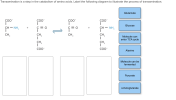 Transamination is a step in the catabolism of amino acids. Label the following diagram to illustrate the process of transamination. Glutamate COO çoo COO COO COO- Glucose CH-NH, C = O C= 0 CH - NHÀ 1 CH, CH, CH Molecule can enter TCA cycle CH CH COO COO Alanine Molecule can be fermented Pyruvate a-ketoglutarate
1. When amino acids are degraded the first step is to remove the amino group. To...
1. When amino acids are degraded the first step is to remove the amino group. To which of the following molecules is the amino group typically transferred? A. Pyruvate B. Oxaloacetate C. Fumarate D. Alpha-ketoglutarate 2. Most amino acid degradation takes place in the ... A. Adipose B. Muscle C. Liver D. Epithelium 3. Urea contains two nitrogen atoms. What is the source of these two nitrogen atoms? A. Both from NH4+ B. NH4+ and aspartate C. NH4+ and serine...
Question 5. Fill the blank: 1. Ketone bodies can substitute partially for energy as ........in the...
 Question 5. Fill the blank: 1. Ketone bodies can substitute partially for energy as ........in the blood. 2- Acetyl-Co A in the citric cycle is similar to..........in the urea cycle. 3- Write the name of the amino acid that is used to produce glucose? 4- ..............is the numbers of the nitrogen atoms in urea. 5- Pyruvate is reduced in anerobic conditions to produce.... ...., and its molecular formula is...... 6- ...........is the conjugate base of pyruvic acid., and its molecular...
Consider the following Lewis structure for Urea, a compound produced by the metabolism of amino a...
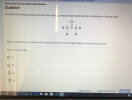 Consider the following Lewis structure for Urea, a compound produced by the metabolism of amino acids. Which atom(s) in the molecule will be at the center of a local trigonal planar molecular structure?
Additional energy can be provided and body fat can be made when amino acids are converted...
 Additional energy can be provided and body fat can be made when amino acids are converted to acetyl COA Some amino acids enter the TCA cycle directly and therefore, are allowed to continue in the metabolic cycle to generate energy and glucose The availability of nitrogen allows the body to use acetyl COA and glycerol to make some non-essential amino acids. Grade It Now Save & Continue with acer AUTO MENU
Which of the following amino acids transports and releases two equivalents of ammonia to the mitochondrial...
Which of the following amino acids transports and releases two equivalents of ammonia to the mitochondrial matrix by hydrolytic and oxidative deamination? A) Aspartate B) Alanine C) Glutamate D) Glutamine E) Both C and D
 6. Choose the correct answer: 1. In non-oxidative deamination, amino acid is converted into........ a hydrochloric acid b. Pyruvate C. carboxylic acid 2. Process of breakdown of amino acids to a keto acids is called... a. Amination b. transamination c. deamination 3. Function of proteins is to ........ A. catalyze biochemical reactions. c. synthesis of nucleoproteins. b. regulates reactions d. all of above. 4.Transamination is catalyzed by.......... a. hydrogenases. b. glutamate transaminase. c.dehydrogenases. 5. the source of amino acid pool...
 Amino acids can be categorized according to the body's ability to synthesize them. Both essential and nonessential amino acids are necessary for life, but the human body is unable to synthesize some amino acids. Different pathways enable synthesis of nonessential amino acids from five precursors: pyruvate, 3-phosphoglycerate, oxaloacetate, a-ketoglutarate, and phenylalanine. Many of these pathways include a process called transamination, which is a reaction between an amino acid and an alpha-keto acid. Some non essential amino acids are synthesized in...
 1.
2.
3
The Cori cycle involves which of the following processes? (select all that apply) gluconeogenesis urea cycle citric acid cycle glycolysis (aerobic conditions) glycolysis (anaerobic conditions) transamination 0 beta-oxidation Which of the following is the electron carrier produced in the pentose phosphate pathway? FADH2 NADPH ubiquinone cytochrome C NADH Attaching coenzyme A to a fatty acid at the beginning of beta-oxidation requires: 2 ATP equivalents 1 ATP equivalent 3 ATP equivalents 4 ATP equivalents
1.
2.
3
The Cori cycle involves which of the following processes? (select all that apply) gluconeogenesis urea cycle citric acid cycle glycolysis (aerobic conditions) glycolysis (anaerobic conditions) transamination 0 beta-oxidation Which of the following is the electron carrier produced in the pentose phosphate pathway? FADH2 NADPH ubiquinone cytochrome C NADH Attaching coenzyme A to a fatty acid at the beginning of beta-oxidation requires: 2 ATP equivalents 1 ATP equivalent 3 ATP equivalents 4 ATP equivalents
 Transamination is a step in the catabolism of amino acids. Label the following diagram to illustrate the process of transamination. Glutamate COO çoo COO COO COO- Glucose CH-NH, C = O C= 0 CH - NHÀ 1 CH, CH, CH Molecule can enter TCA cycle CH CH COO COO Alanine Molecule can be fermented Pyruvate a-ketoglutarate
 Question 5. Fill the blank: 1. Ketone bodies can substitute partially for energy as ........in the blood. 2- Acetyl-Co A in the citric cycle is similar to..........in the urea cycle. 3- Write the name of the amino acid that is used to produce glucose? 4- ..............is the numbers of the nitrogen atoms in urea. 5- Pyruvate is reduced in anerobic conditions to produce.... ...., and its molecular formula is...... 6- ...........is the conjugate base of pyruvic acid., and its molecular...
 Consider the following Lewis structure for Urea, a compound produced by the metabolism of amino acids. Which atom(s) in the molecule will be at the center of a local trigonal planar molecular structure?
 Additional energy can be provided and body fat can be made when amino acids are converted to acetyl COA Some amino acids enter the TCA cycle directly and therefore, are allowed to continue in the metabolic cycle to generate energy and glucose The availability of nitrogen allows the body to use acetyl COA and glycerol to make some non-essential amino acids. Grade It Now Save & Continue with acer AUTO MENU
Most questions answered within 3 hours.
-
Where is the error in this code sequence?
String s1 = "Hello";
String s2 = "ello";...
asked 11 months ago -
Financial data for Joel de Paris, Inc., for last year
follow:
Joel de Paris, Inc.
Balance...
asked 11 months ago -
Consider this reaction:
Al2(SO4)3 (aq)+ BaCl3
(aq) Al2Cl6 (aq)- +
3BaSO4(s) . What is the...
asked 11 months ago -
Suppose that Savneet is considering increasing her
recent random sample from 20 car rentals to 40...
asked 11 months ago -
Trucks arrive at an unloading terminal at an average rate of 120
per hour.
Trucks arrive...
asked 11 months ago -
Why are methanol and ethanol completely soluble in water while
octanol is not very little soluble....
asked 11 months ago -
A facilities manager at a university reads in a research report
that the mean amount of...
asked 11 months ago -
When the CuSO4 is rehydrated by adding water to the anhydrous
compound, is this an endothermic...
asked 11 months ago -
A ray of sunlight is passing from diamond into crown glass; the
angle of incidence is...
asked 11 months ago -
A block of mass 0.249 kg is placed on top of a light, vertical
spring of...
asked 11 months ago -
how do the kidneys compensate in the presences of acidosis
a) trigger hyperventilate
b) reserve acid...
asked 11 months ago -
Question 501 pts
The rental rate of capital to the firm increases. Which of the
following...
asked 11 months ago